
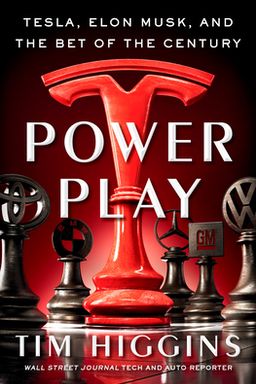
Power Play cover

Power Play

by Tim Higgins

Power Play chronicles Tesla''s ascent from a daring start-up to a global auto industry powerhouse. With Elon Musk at the helm, the book explores Tesla''s innovative breakthroughs, financial struggles, and the bold decisions that reshaped the future of electric vehicles.

Tesla’s Audacious Mission and Its Driving Force

At its core, Tesla’s story is a narrative of ambition colliding with reality. You follow how a small startup, born from the tzero prototype and AC Propulsion’s experiments, evolves into an industrial challenger reshaping global transportation. The book argues that this transformation rests on one variable above all: Elon Musk’s vision and control. Musk believes that belief itself creates momentum—convincing investors, employees, and customers that electric vehicles aren’t a niche experiment but the future of mobility.

Vision and volatility

You see Musk as both visionary and volatility generator. He bankrolls payroll with personal credit cards after the 2008 crisis, stages events like the Model 3 reveal to convert attention into cash, and sells belief as a financing tool. Musk’s public theater—lavish reveals, low price promises, and high deposits—turns crowds into financiers. But every accelerator comes with risk: the book makes clear that timelines slipping could flip Tesla from momentum to meltdown within weeks.

The founder’s paradox

Musk’s management style fuses Silicon Valley impatience with automotive physicality. He demands speed—fast, sometimes wrong, decisions—and fix-as-you-go execution. The upside is agility. The downside is attrition. Executives like Eberhard, Straubel, and Drori rotate through key roles because of Musk’s interventions. With him, Tesla gets both mythical commitment and chaos. You learn why that tension between founder control and institutional governance will later fuel controversies from SolarCity’s merger to his 2018 pay plan.

From prototype to global plan

Tesla’s broader narrative follows Musk’s evolving Master Plan: start with a luxury sports car (the Roadster) to prove electric performance, use profits to build a high-end sedan (Model S), then scale manufacturing for an affordable mass-electrified car (Model 3). It’s simple sequencing—but grounded in brutal executional lessons. Each phase demands new innovation: battery containment, manufacturing discipline, and direct sales under legal siege. When you read about Musk’s early gamble on the Roadster, it’s clear he’s not just building a car; he’s building belief infrastructure—convincing investors, suppliers, and drivers that batteries can power aspiration.

Why this matters

If you step back, Tesla’s journey frames bigger lessons about entrepreneurship and modern industry. The company defies conventional automotive consensus that scale and safety trump speed. Instead, Tesla scales on narrative—proving that cultural belief, not institutional patience, can underwrite industrial leaps. (Note: In classic founder biographies from Jobs or Edison to Musk, the tension between storytelling and manufacturing always defines success.) This book shows how Musk weaponizes attention and risk to create a new kind of industrial momentum in real time.

Central insight

Belief isn’t fluff. In Tesla’s case, belief acts as a funding source—messages create orders, orders create cash, and cash creates engineering capability. Understanding that feedback loop explains how Tesla defied recession, skeptics, and legacy automakers to scale an unfinished reality into a global carmaker.

Through these early arcs—Roadster to Model S and beyond—you realize that Tesla’s technical brilliance, operational drama, and political fights all orbit one gravitational center: a founder who uses narrative audacity to bend the physics of both technology and finance. That’s the story engine driving this book.


Batteries, Breakthroughs, and Fire Risk

Tesla’s rise rests on one technical leap: making lithium-ion cells viable for cars. JB Straubel and his engineering team inherit the tzero prototype’s radical idea—link thousands of small, commodity cells to power full-size vehicles. Commodity batteries lower costs but introduce safety nightmares. You watch Tesla confront one of physics’ scariest problems: thermal runaway.

Engineering containment, not perfection

Early tests show how lethal a defect can be. Heat one battery to 130°C and you trigger explosions exceeding 1400°F. Because Tesla packs thousands of cells, even a one-in-a-million defect can ignite whole modules. Straubel’s breakthrough isn’t purifying manufacturing—it’s designing barriers so one failure doesn’t propagate. Tesla weaves cooling channels and mineral fillers to bleed heat away and contain a meltdown. (Note: The approach mirrors aerospace logic—manage failure probability, not chase flawless components.)

Winning trust and suppliers

Those containment tests persuade hesitant partners. Panasonic and Sanyo only commit after Tesla demonstrates safety and durability in live fire trials. Straubel’s proof-of-concept transforms skepticism into partnership. Battery rigor and willingness to absorb testing costs become Tesla’s advantage; it convinces Daimler and Toyota to source packs for their EV projects. By converting technical credibility into contracts, Tesla turns physics into business leverage.

Why this shapes Tesla’s identity

The battery story explains Tesla’s DNA: it’s both engineering bravery and operational daring. The company learned early that small details—air gaps, cooling paths, filler materials—decide survival or recall. Containment isn’t just design, it’s philosophy. Straubel’s success lets Tesla prove lithium-ion is roadworthy, which anchors every later product line from Model S to Model 3, and ultimately justifies building Gigafactories to scale production.

Key insight

If you can’t eliminate defects, architect your systems to survive them. Tesla’s containment-first thinking converts a chemistry risk into an industrial advantage—and lays the groundwork for mass EV deployment.

Understanding this phase isn’t just about battery packs—it’s about mindset. Straubel and Musk prove that exponential risk can be engineered into reliability at scale. That’s the cornerstone under every Tesla that follows.


Scaling the Dream: The Factory Challenge

Having proven the technology, Tesla faces its hardest frontier: manufacturing. You watch the company evolve from niche prototype maker into volume producer. The Fremont plant acquisition—an abandoned GM-Toyota factory—becomes Tesla’s laboratory for ambition meeting physical constraint.

Retrofitting and reinvention

When Musk’s team enters Fremont, they inherit mostly empty floors. Stamping gear is missing, wiring incomplete. Rather than build from scratch, Tesla retools old machinery—saving capital but adding friction. They learn industrial choreography the hard way: ten-ton aluminum coils, welding robots, and millimeter-level tolerances. The challenge is making exotic materials (aluminum bodies) perform reliably at speed.

Production hell and learning culture

Tesla’s rush for delivery forces shortcuts. Misaligned panels, leaks, and endless rework bring forth Musk’s now-infamous phrase: “manufacturing hell.” You see teams running overnight fixes to avoid certification delays—an ethos defined by urgency more than process maturity. Yet those same crises embed resilience: tighter documentation, improvisational problem-solving, and hardened managers like Passin and Watkins forge processes in fire.

Automation overreach and retreat

The Model X reveals the perils of ambition. Complex falcon doors, giant windshields, and dense automation jam production. Robots crowd assembly lines until simple access fails. Musk later concedes “excessive automation was a mistake.” Tesla learns the manufacturing lesson every innovator faces: brilliance in vision must be coupled with boring discipline. Sometimes people, not machines, provide the flexibility needed to ramp.

Core takeaway

Tesla’s journey through production hell is industrial adolescence—the chaos of trying to scale genius. Every panel misalignment is a masterclass in how speed taxes precision, and how process eventually must mature to sustain innovation.

By living through this pain, Tesla learns what legacy automakers refined over decades: efficiency, worker safety, and stability can’t be hacked overnight. Yet Musk’s urgency, while punishing, is also catalytic—it forces breakthroughs faster than consensus allows.


Selling the Future: Tesla’s Direct Approach

Tesla revolutionizes not just cars but how they’re sold. The company rejects traditional dealership systems, choosing to own its retail experience. You watch Musk blend Apple-style stores, test-drive evangelism, and political battles into a new sales paradigm.

Experience over advertisement

Instead of billboards or TV spots, Tesla invests in test drives—letting torque and silence sell the product. Stores in Santana Row and Park Meadows function like technology galleries, staffed by enthusiasts who treat education as marketing. Events, not ads, become Tesla’s conversion funnel. (Note: It’s a parallel to Apple’s “store as storytelling” concept perfected by Ron Johnson.)

Legal battles and creativity

Refusing the dealer model sparks political warfare. Texas becomes a central case: lobbyists defend franchise laws, Musk counter-lobbies for reform, creating gallery workarounds where customers view but cannot buy. The retail fight teaches Tesla that law is part of distribution strategy. Abroad, the company adapts—franchising in China, working with regulators, tweaking retail presence. Flexibility becomes survival.

From education to velocity

As sales scale, Tesla evolves from educators to closer operators. Delivery centers, quarter-end “delivery waves,” and blitz appointments redefine internal logistics. Employee improvisation—text scheduling, overnight car drops—hits quarterly numbers but strains quality. Gradually, Tesla introduces home delivery and service improvements, learning that mass customers demand predictability, not just inspiration.

Key reflection

Tesla’s direct-sales fight is cultural more than commercial. It’s about owning the customer relationship in a century-old industry—and discovering that education, law, and logistics together define modern retail power.

In these chapters you learn that Tesla’s success isn’t just engineering—it’s experiential politics. Selling electric cars requires rewriting not only the product but the rules of how people buy them.


Partnerships, Governance, and Market Warfare

Tesla survives through alliances and confrontations. You trace how supplier relationships, board decisions, and PR storms collectively shape the company’s trajectory.

Alliances that scale

Panasonic’s support becomes Tesla’s backbone. Daimler and Toyota investments validate the brand and infuse discipline. These deals provide both funding and friction—each partner pushes for reliability standards alien to Tesla’s rapid pace. Meanwhile, the Gigafactory multiplies partnership complexity. Straubel and Musk choreograph earth-moving theatrics to secure Panasonic’s joint venture, proving that theater and industrial strategy remain intertwined.

Governance tests and SolarCity drama

When Musk pitches acquiring SolarCity, conflict-of-interest alarms sound. Board resistance, stock plunges, and shareholder fury expose Tesla’s governance fragility. Later, Musk’s 2018 pay structure—trillion-dollar valuation incentives—amplifies tension between founder dominance and investor caution. Governance lessons echo across his career: concentration of vision can be catalytic but must coexist with independent oversight to preserve legitimacy.

Media, short sellers, and self-inflicted crises

Musk’s Twitter persona turns communication into combat. Short sellers like Jim Chanos weaponize criticism; Musk fights back publicly. The infamous “funding secured” tweet triggers SEC lawsuits and leadership reshuffles—proof that in a digital age, a CEO’s words can move markets as fast as machines. PR crises, whistleblower suits, and online skirmishes show Tesla’s volatility isn’t only technical—it’s reputational.

Essential takeaway

Innovation attracts scrutiny. Tesla reveals how public narrative management, board governance, and external partnerships are not side battles—they’re survival fronts. In high-growth worlds, reputation is a business layer as critical as production itself.

If you study leadership, Tesla’s saga is a textbook: visionary control accelerates history but also multiplies risk. Balance becomes both a moral and financial necessity.


Global Footprint and Industrial Resilience

Tesla’s later chapters pivot from survival to global scale. The Gigafactory concept and Shanghai build-out mark Tesla’s evolution from startup to transnational industrial system. This phase proves that Musk’s global expansion isn’t just ambition—it’s resilience architecture.

Gigafactory as leverage

Straubel’s cost analysis reveals the bottleneck: battery expenses must drop below $100 per kWh. The Nevada Gigafactory pursues massive scale—ten million square feet—to attack cost through vertical integration. Negotiations with Panasonic become industrial theater; Musk stages mock construction scenes to pressure commitment. The gamble works—massive capacity transforms Tesla into a cost-competitive automaker.

Shanghai’s speed and the pandemic test

The Shanghai factory perfects Tesla’s process: faster build, local financing, leaner automation. When COVID hits, China’s swift restart offsets Fremont’s shutdown. Production continuity amid global chaos boosts Tesla’s valuation and confidence. (Note: Comparatively, few Western automakers regained momentum as fast—highlighting geopolitical agility as part of industrial competence.)

The lesson of repeatability

After years of improvisation, Tesla learns how to template factories. Replicable design, flexible automation, and cross-region supplier partnerships finally stabilize growth. The company transitions from episodic heroics to scalable systems—a turning point that positions it for sustained dominance.

Closing insight

Global expansion isn’t merely diversification—it’s operational insurance. Tesla’s footprint across Nevada and Shanghai proves resilience comes from geographic and political flexibility as much as from product brilliance.

By the end, you see Tesla not only as a car company but as a system builder—constructing supply, energy, and data infrastructure for the electric age. Its journey connects vision to execution, risk to resilience, and one founder’s audacity to planetary industry.

Dig Deeper

Get personalized prompts to apply these lessons to your life and deepen your understanding.

Go Deeper

Get the Full Experience

Download Insight Books for AI-powered reflections, quizzes, and more.