
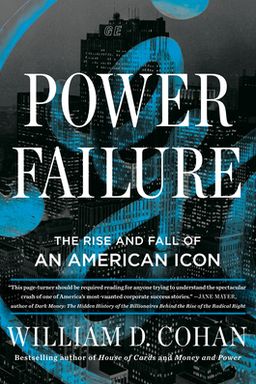
Power Failure cover

Power Failure

by William D Cohan

Power Failure delves into the dramatic rise and fall of General Electric, an American business icon. Through detailed narratives, the book uncovers the leadership triumphs and failures that shaped GE''s fate, offering timeless lessons in adaptability, decision-making, and ethics for current and future leaders.

The Finance-Industrial DNA of GE

How can a company become both an engineering marvel and a financial powerhouse—and survive for over a century? In this sweeping history, you learn how General Electric’s transformation from a 19th-century electrical start-up into a global conglomerate hinged less on invention and more on financial engineering, cultural evolution, and leadership adaptation. The core argument: GE’s success and eventual struggle mirror the tension between innovation and financialization inside modern capitalism.

From Coffin’s Playbook to Financial Engineering

Charles A. Coffin established GE’s financial DNA in the 1880s—aggressive acquisitions, vendor financing, and conservative balance-sheet management. He sold electrical equipment to local power companies and took their securities as payment, creating a pool of collateral he could monetize through subsidiaries like United Electric and later Electric Bond and Share. This mixture of invention and finance made GE uniquely resilient to panics in 1893 and 1907. Coffin’s lesson echoes through the firm’s history: technology creates opportunity, finance decides survival.

Coffin’s crisis playbook—raise liquidity before panics, convert illiquid receivables into collateral, maintain relationships with bankers like J.P. Morgan—became embedded cultural doctrine. It explains why decades later GE Capital felt like an extension of Coffin’s methods rather than a deviation from Edison’s spirit.

From Engineering to Mass Media and Global Influence

By the early 20th century, GE expanded into communications through radio and RCA. Owen D. Young, with Navy partnerships and government intervention, built RCA as both a technological and political venture—protecting national control over radio while seeding broadcasting empires like NBC. GE’s collaboration with the state set a precedent for combining private ambition with public purpose. Those alliances later shaped its involvement in defense contracts, nuclear energy, and space technology.

Management Revolutions and Cultural Paradoxes

The mid-century shift under R.J. Cordiner introduced decentralization—a network of autonomous divisions meant to unleash creativity. Yet autonomy bred cartels: managers colluded with competitors to hit profit targets. The pattern recurred in later leadership eras—Welch’s drive for relentless performance produced stunning financial efficiency but also pressure to manage perceptions, shaping both GE’s rise and its ethical hazards.

Jack Welch’s ascent from plastics marked the start of a high-performance era powered by discipline, charisma, and finance. He scaled GE Credit into GE Capital, turning cheap AAA funding into global lending. This created immense returns but blurred GE’s industrial identity. Welch’s mix of dealmaking (RCA, Kidder Peabody), cultural programs (Crotonville, Six Sigma), and earnings management built the myth of consistent excellence—what insiders later called "success theater."

From Immelt to Crisis: The Deconstruction of a Titan

Jeff Immelt inherited an empire whose financial infrastructure disguised fragility. After 9/11, he confronted liquidity stress, investor skepticism, and reputational fallout from Jack Welch’s divorce scandal. Immelt tried to pivot GE back to industrial roots—buying Amersham, water firms, and wind assets—while dismantling risky insurance and finance units. Yet legacy liabilities, overpayment for acquisitions like Alstom, and activist pressure (Trian Partners) eroded GE’s flexibility.

By the mid‑2010s, long‑tail insurance exposures (UFLIC, ERAC) and Power’s collapse exposed the hidden debt of decades of short‑termism. Immelt’s fall, Flannery’s short tenure, and Larry Culp’s eventual breakup of GE marked a generational conclusion: finance that once powered growth now demanded dismantling. The firm reverted to Coffin’s worldview—survival over prestige.

In essence

GE’s story is capitalism’s mirror. It shows you how innovation, finance, and leadership reinforce—and sometimes destroy—each other. From Coffin’s vendor financing to Welch’s GE Capital and Immelt’s unwinding, every era rediscovered the same truth: growth without transparency eventually trades magic for crisis.


Blueprints of Industrial Finance

GE’s origin was not about inventors tinkering—it was about financiers designing structures. Charles Coffin treated electricity as an investment system, not just lightbulbs and dynamos. His vendor‑financing model and subsidiary architecture formed the first blueprint for blending technology with balance‑sheet leverage.

How Coffin Engineered Scale

He sold dynamo plants on credit to local utilities and took securities as payment. These illiquid instruments became collateral for new financing entities—United Electric Securities and later EBASCO. This structure allowed GE to survive panics and expand uncontested. You can see echoes of this method in today’s conglomerates that use captive finance units to open new markets (like automotive leasing arms or industrial SaaS financing).

Crisis Playbook and Conservatism

The Panic of 1893 forced Coffin to convert customer securities into cash at steep discounts. After barely surviving, he adopted the principle: “use cost or market, whichever is lower.” He raised reserves, founded subsidiaries to securitize receivables, and built alliances with Morgan and Lee, Higginson. Those habits institutionalized financial conservatism without killing risk-taking—an equilibrium GE later forgot.

Acquisition as Innovation and Defense

Coffin solved patent wars and technological gaps via buyouts—Brush, Van Depoele, Fort Wayne Electric. Acquisitions defused litigation and expanded markets. This pragmatism—buy rivals rather than fight them—remained central to GE’s strategy from RCA to Amersham. It’s a reminder that invention often emerges from consolidation, not just creativity.

Key lesson

Industrial growth accelerates when finance and engineering co‑evolve. Coffin turned electricity into an asset class—setting a template that later became global corporate practice.


Welch’s Empire of Performance

Jack Welch transformed GE into the archetype of modern managerial capitalism: a ruthless meritocracy where numbers ruled and strategy turned on speed. His ascent from plastics taught him political skill, marketing flair, and technical precision—the foundation for how he later mastered scale and storytelling.

From Plastics to Power

Welch’s early wins—Lexan’s promotion and the Selkirk plant gamble—proved his ability to combine science with showmanship. At GE Plastics he blended innovation and aggression, pushing his teams and learning to survive corporate accidents and politics. His later decisions (reorganizing under Crotonville training, enforcing merit-based promotions) reflected that formative turbulence.

Financial Alchemy and GE Credit

Welch’s greatest strategic insight was financial: scaling GE Credit into GE Capital. By exploiting the spread between GE’s AAA borrowing cost and customer lending rates, he created huge arbitrage profits. Talent like Gary Wendt, Larry Bossidy, and Dennis Dammerman built divisions that financed everything—leasing, mortgages, LBOs. Welch turned an industrial company into a bank without deposits. The result: massive, steady profits that funded acquisitions and stock buybacks.

Deal-making and Narrative

Welch bought RCA to secure NBC and divested unfit units within weeks; he bought Kidder Peabody to chase LBO economics and suffered insider scandals and fraud. Each deal demonstrated his appetite and risk tolerance. He used PR mastery to shape perceptions, turning crises into reaffirmations of discipline.

Performance Ethics and Smoothing

Under Welch, hitting targets became religion. GE’s ability to beat estimates every quarter drew awe and suspicion. The line between operational discipline (Six Sigma) and accounting finesse blurred. Welch admitted to ‘a little smoothing,’ revealing how performance culture can systematize cosmetic earnings management.

Management insight

Performance obsession breeds innovation and opacity equally. Welch created a system that rewarded brilliance but punished truthfulness—a paradox still studied in leadership psychology.


Immelt’s Industrial Revival and Hidden Risks

Jeff Immelt inherited GE amid crises—9/11, liquidity strain, and public backlash against executive excess. Determined to pivot back to industrial roots, he launched a costly reinvention. But legacy financial structures and cultural inertia made recovery harder than rebranding.

Managing Crises and Reputational Shocks

After 9/11, Immelt led humanitarian and financial stabilization while defending GE Capital’s funding model. Simultaneously, Jack Welch’s divorce filings exposed lavish perks, drawing SEC inquiries and tarnishing GE’s image in a post‑Enron climate. Immelt’s tenure thus began under scrutiny from investors and moral watchdogs alike.

Industrial Pivot and Deal Risks

Immelt’s acquisitions—Amersham, Enron wind assets, BetzDearborn water—aimed to reclaim industrial prestige. While wind turned into a triumph, others suffered overpayment and integration issues. Immelt’s Genworth spin reduced insurance weight but retained catastrophic liabilities (UFLIC, ERAC) that later forced a $9.5B charge and $15B capital fix. Each deal demonstrated ambition colliding with technical diligence gaps.

Culture and Silence

Welch encouraged conflict; Immelt prized loyalty. The supplemental pension program (SUP) created handcuffed executives hesitant to challenge decisions. This silence hindered risk recognition, amplifying groupthink in key areas like Power and long‑term care insurance.

Marketing, Innovation, and Digital Gambles

Initiatives like Ecomagination and Predix symbolized Immelt’s vision to modernize GE’s image through sustainability and data. The campaigns drew talent but overpromised results—green marketing without long-term financial recovery. You see the tension between optimism and execution that later defined GE’s downfall.

Strategic reflection

Immelt’s intent was noble—restore industry pride—but his inheritance of GE Capital’s liabilities made that almost impossible. When history is financialized, even honest strategies become hostage to old equations.


Collapse of Power and Crisis of Leadership

GE Power became the breaking point of Immelt’s empire. After acquiring Alstom, GE misread turbine demand and created phantom profits through upgrade kits and factoring. The financial illusion burst, triggering goodwill write‑downs, credibility loss, and leadership collapse.

The Operational Unraveling

Steve Bolze’s Power division overbuilt inventory, betting on retrofit kits and Angola receivables that never converted to cash. Oxidation failures in HA turbines deepened reputational wounds. When earnings fell far below forecast, the corporate mythology of precision evaporated. GE booked a $22–23B impairment—one of the largest in industrial history.

Succession and Governance Breakdown

Leaks of board succession plans and the disastrous Longboat Key presentation exposed Immelt’s loss of board confidence. By June 2017, directors replaced him with John Flannery. Public promises (“$2 EPS by 2018”) became shackles rather than goals. Activist influence (Trian Partners) accelerated turnover and cost‑cutting euphorias unrelated to long‑term repair.

Hidden Liabilities and Financial Reckoning

Bornstein’s audit uncovered the shock—legacy insurance obligations requiring $15B regulatory capital. The revelation forced dividend cuts, halted buybacks, and closed GE Capital’s cash taps. This discovery linked operational failure to systemic financial rot: industrial weakness and actuarial exposure were two sides of the same hidden balance sheet.

Lesson

Quarterly optimism can destroy annual truth. GE’s leadership crisis proves that when culture rewards illusion, balance sheets stop warning and start collapsing.


Breakup, Activism, and the Aftermath

As Flannery and later Larry Culp inherited the ruins, GE entered its deconstruction era. Board activism, hidden liabilities, and public impatience combined to dismantle the century-old model.

Eisenhower Plan and Activist Momentum

Flannery proposed breaking GE into independent units—Aviation, Healthcare, Energy. He halved dividends, reduced guidance, and pursued transparency. Trian’s Ed Garden pushed for aggressive board refreshment, appointing Larry Culp, whose private-equity discipline promised accountability. Within months, the board replaced Flannery with Culp—an unprecedented corporate coup.

Buffett’s Lifeline and Structural Recovery

In crises like 2008, GE had already relied on Warren Buffett’s $3B preferred infusion to stay liquid—proof that historically, reputation was currency. The new era demanded cash transparency instead of charisma. Culp’s divestitures—Biopharma to Danaher, GECAS to AerCap—broke the conglomerate apart, fulfilling Coffin’s dictum: focus on liquidity before legacy.

Final Reckoning and Cultural Diagnosis

Directors and analysts converged on a triad of failure: poor capital allocation, weak governance, and cultural denial. Overpaying for Alstom and stock buybacks exhausted capital reserves; boards tolerated imperial CEOs; and optimism mutated into silence. GE’s decline wasn’t a single decision—it was accumulated blindness.

Concluding insight

GE’s breakup closes the loop begun by Coffin: companies that master both invention and finance eventually rediscover humility. When transparency returns, survival follows.

Dig Deeper

Get personalized prompts to apply these lessons to your life and deepen your understanding.

Go Deeper

Get the Full Experience

Download Insight Books for AI-powered reflections, quizzes, and more.