
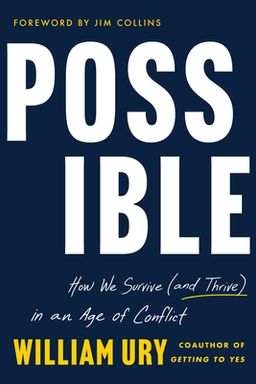
Possible cover

Possible

by William Ury

Possible by William Ury offers a revolutionary approach to conflict resolution, turning adversarial interactions into opportunities for cooperation and innovation. Through practical strategies like the ''three victories,'' readers learn to engage constructively with conflict, paving the way for personal, professional, and global progress.

The Path to Possible

What if conflict—personal, political, or global—could be changed not by force or luck but by design? In his decades of negotiation work from Kentucky coal mines to nuclear treaties, William Ury argues that conflict is human-made, and therefore human-changeable. His central idea is that we can transform destructive confrontation into creative collaboration through what he calls the Possibilist Path: learning to step back, see clearly, build bridges, and engage the community around us.

Ury’s approach is both philosophical and practical. He is not an optimist or pessimist but a possibilist—someone who starts from what could be done. Possibilism accepts fear, greed, and anger as realities, yet asserts that because conflict is made by us, it can be remade by us. This outlook is the seed of his life’s work: transforming wars, political crises, and family disputes through deliberate human skill.

The Three Victories

Ury’s roadmap is built around three victories—a set of sequential but interlocking steps: Go to the Balcony (master yourself), Build a Golden Bridge (connect with others), and Engage the Third Side (activate the community). Each victory represents a shift of perspective: from reaction to choice, from antagonism to dignity, and from isolation to collective action.

The balcony is your inner vantage point. When arguments swirl, you rise above the emotional storm, pause, and regain clarity before responding. This pause is not avoidance—it’s power. From there, you look inward to clarify needs (zoom in) and outward to see the wider terrain (zoom out). Building a golden bridge comes next: instead of pushing others to agree, you design a path they want to take. You listen, invent options, and make saying yes easy. Finally, engaging the third side brings in the wider network—the family, colleagues, institutions, or citizens whose collective power sustains peace. These are the I-You-Us steps that translate possibility into practice.

From Mindset to Method

The possibilist mindset unfolds through learnable habits: curiosity, creativity, and collaborative courage. Ury’s stories, from the Semai elder in Malaysia who said “War is made by us” to the miners of Kentucky, show how these virtues can turn fear into agency. Curiosity asks “What do they really want?” Creativity seeks both-and solutions through victory speeches or flipped perspectives. Collaborative courage means inviting third parties—the “wizards,” mediators, or communities—to help when direct talks falter.

The mindset also means reframing negotiation itself. Instead of coercion or compromise, Ury sees negotiation as joint invention: the task is not to defeat the other but to create new reality together. Whether writing imaginary victory speeches for Trump and Kim Jong Un or convening citizens in Caracas, he always begins from one question: “What small breakthrough could change the dynamic?” The focus on the smallest actionable step—what he calls the “baby kiss” in Venezuela’s trust menu—makes massive conflict tractable.

Human Examples of Possibility

Throughout the book, real examples illustrate the path. Mandela uses meditation and empathy in prison to master the balcony. Carter builds a golden bridge at Camp David where sovereignty and security meet. The Semai elders gather the whole village to talk until peace returns—the third side in its purest form. Even small gestures, like Carter’s signed photos for Begin’s grandchildren or a Syrian rebel’s unexpected poetry, show how listening and dignity melt barriers.

The overarching theme is courage with humility. Audacity sets transformational goals; humility accepts iteration and patience. You paddle into the rapids together instead of resisting them—as Ury’s Grand Canyon analogy shows—and the momentum becomes collective.

From Individual Skill to Global Practice

The path to possible scales from everyday life to geopolitics. You can use it with a colleague, a spouse, or a rival state. The principles—pause, listen, reframe, attract, mobilize—apply across domains. Ury’s multi-level lens echoes thinkers like Roger Fisher (Getting to Yes) and Peter Senge (The Fifth Discipline): systems change begins with inner change.

At its heart, Ury’s message is a moral one: because conflict is human, peace must be too. Your responsibility is not to eliminate disagreement but to turn it into creative possibility. Every time you choose curiosity over rage or design a bridge instead of a wall, you contribute to that human-made peace. That is the essence of possibilism—the conviction that what seems impossible today can become possible tomorrow if enough people learn and act together.


Go to the Balcony

The first victory—Go to the Balcony—is about regaining agency in the heat of conflict. Ury borrowed the metaphor from theater: imagine stepping up to the balcony where you can see the whole stage. From there you can pause, zoom in, and zoom out—three mental superpowers that break reactive cycles and reveal options invisible from the floor.

Pause Before You React

Pausing interrupts the fight-flight-freeze reflex. Vasili Arkhipov’s “no” aboard the Soviet submarine during the Cuban Missile Crisis perhaps saved the world because he paused to think. Ury himself used a physical pinch of his palm while Chávez berated him in Caracas to remind himself to stay calm. That moment enabled Chávez to propose a Christmas truce—a pivot born of composure. (Note: Neuroscientist Jill Bolte Taylor discovered that stress chemicals dissipate in about ninety seconds if you refrain from ruminating.)

Zoom In to Clarify What You Need

Once you pause, you zoom in. The task is to sort out what you really want—the underlying interest or need beneath your position. A parent arguing over curfews may realize the real need is safety; a CEO fighting for a deal may realize the underlying need is dignity or freedom. Ury recounts how Brazilian businessman Abilio Diniz uncovered his bedrock need—"liberdade"—which became both his compass and his negotiation leverage.

Zoom Out to See the Landscape

Then widen the lens. Who else matters? What’s the bigger story? Zooming out helped Ury see that Venezuelans were exhausted and ready for a symbolic truce; it helped him design a proposal aligned with timing and sentiment. When you zoom out, you shift from tactical reaction to strategic design. You can map multiple tables: internal factions, external stakeholders, and the public itself.

Balcony Insight

The balcony gives you one freedom: the power to choose your next move consciously. That small pause can redirect the whole story.

Going to the balcony is not withdrawal—it’s mastery. Whether you meditate like Mandela, take a reflective walk, or schedule deliberate silence like MIT negotiators, you are building your internal resilience. The balcony is where possibility starts.


Build a Golden Bridge

Once you steady yourself, you turn outward. The second victory—Build a Golden Bridge—means designing a path the other side can walk with dignity. It reverses the usual power logic: rather than pushing for concessions, you attract the other side by understanding their needs and making agreement feel like victory.

Listen With Empathy

At Camp David, Carter’s team began by listening—not to demands but to fears. Egyptians wanted sovereignty; Israelis needed security. Only by acknowledging both could mediators design options. Similarly, Ury’s meeting with Chávez was more listening session than lecture: noticing paintings of Bolívar and the story of Chávez’s imprisonment helped reveal his emotional landscape and create connection.

Create Options and Choreography

Golden bridges are built piece by piece. Carter’s demilitarized Sinai proposal is the model: Egypt regains land, Israel gains safety, and both keep honor. Ury formalizes this creative sequence into tools—“victory speech” exercises, draft menus, and political choreography scripts. You imagine what each leader could say to their people; that vision shows what bridge to build.

Attract, Don’t Push

Like Aesop’s Sun, you make saying yes easier. Instead of pressuring Kentucky miners who distrusted management, Ury joined them underground, listened to grievances, and helped management solve small issues. Trust accumulated and conversation replaced walkouts. Attraction works through credibility and goodwill—the currency of persuasion.

Golden Bridge Principle

Make the other side’s victory possible too. That paradox turns opponents into partners and disagreement into shared success.

When you redesign the interaction so both sides keep dignity and gain value, the “yes” arrives naturally. Golden bridges are architectures of empathy and imagination—crafted so people can cross from fear to cooperation.


Create and Collaborate

At the center of every breakthrough lies creative collaboration. Ury shows this through labs and stories—Harvard’s Devising Seminar, the Colombian poolside talks, and informal wizard circles from Geneva to South Africa. The principle: invention happens when trusted, curious people brainstorm without political risk.

Invent Together

The Devising Seminar separated brainstorming from evaluation, allowing wild ideas first and judgment later. That openness yielded solutions later used at Camp David and other major accords. Likewise, the Colombian negotiators imagined guerrillas delivering mock victory speeches; the visualization led to a concrete five-point peace framework. (It’s the same logic that drives modern design thinking: prototype first, refine later.)

Use Wizards and Back‑Channels

Ury highlights “wizards”—small trusted teams who meet offstage to test ideas. In Geneva arms talks, mid‑level experts devised counting methods that solved technical deadlocks. In South Africa, Cyril Ramaphosa and Roelf Meyer’s fishing‑trip friendship became the invisible engine behind apartheid’s end. These informal tracks thrive because they combine expertise with deniability: people can ask “what if?” without fear.

Design Visible Trust

After creativity comes choreography. Trust menus and iconic stories translate ideas into action. In Venezuela, both sides agreed to small reciprocal gestures—a list of besitos—that built confidence. Visual storytelling also matters: photoshopped images of Trump, Kim, and Moon standing together helped officials imagine peace before it existed. Visible imagination makes cooperation credible.

Creative Collaboration Rule

If you want different results, create different possibilities—and do it together before judgment enters the room.

Collective creativity is pragmatic, not utopian. It harnesses imagination, technical skill, and trust to produce both symbolic and structural breakthroughs. From peace accords to business deals, the act of co‑inventing transforms opponents into co‑authors.


Mobilize the Third Side

The third victory—the Third Side—expands the frame of negotiation to society itself. Ury’s insight is that lasting peace depends not only on leaders but on the surrounding community. The third side acts as a social immune system, discouraging violence and sustaining cooperation.

Host: Create Inclusion

Hosting is the first move. At Caracas’s Teatro Ateneo, when indigenous leader María Elena Martínez presented a blessed necklace and the crowd united under “Basta!”, fear turned to collective resolve. Hosting means creating spaces of belonging, listening, and sharing symbols that unite rather than divide.

Help: Ask Questions That Unlock

Helping is gentle facilitation. In Havana, an impasse over the term “institutional actors” melted when Ury reframed it as “state actors,” a subtle edit that preserved dignity and reopened talks. Helping is not advising from authority but asking the right question from curiosity.

Swarm: Assemble a Critical Mass

When tension escalates, communities can swarm—mobilize people with ACT: access, credibility, trust. A Boulder experiment brought together diverse teams to brainstorm North Korea de‑escalation strategies, later connecting with envoys who could act. Swarming integrates creativity with influence to interrupt destructive momentum.

Third Side Principle

Conflict is not just between two sides—it belongs to the community. When the community speaks, violence loses legitimacy.

The third side transforms polarization into cooperation. Whether through local hosts, global networks, or quick-response swarms, you can activate collective power to make peace sustainable. It’s the final stage of possibilism: turning private disputes into shared stewardship for the common good.


Living Possibilism

The final synthesis of Ury’s teaching is a way of life—Living Possibilism. It means choosing courage and imagination in every sphere: family, business, civic life, and geopolitics. You start from what’s possible and build step by step toward peace others believe impossible.

Practice Everyday Skills

Possibilism isn’t reserved for diplomats. You can practice it daily: take a breath before replying in anger, ask why until you uncover your need, write the other’s victory speech to imagine empathy, or convene a small trust menu of gestures with colleagues. Every act is a rehearsal for larger peace work.

Combine Audacity and Humility

Ury’s grandfather’s motto—“Wanted: a Hard Job”—symbolizes that balance. You aim for transformation but accept slow, imperfect progress. Audacity gives vision; humility gives endurance. The mix turns idealism into action.

From Personal to Planetary

When individuals adopt possibilism, they widen what their societies can achieve. Mandela meditated his anger into clarity; Rodgers and Carlin reframed North Korea diplomacy through imagination; Venezuelans gathered thousands under a common identity. Possibilism, multiplied across people, is a practical engine of global change.

Possibilist Creed

“War is made by us. Therefore it can be stopped by us.” That sentence, learned from a Semai elder, is the moral foundation of all negotiation and peacebuilding.

Living possibilism means seeing every conflict as a workshop for human creativity. You look for openings, invent ways to cross them, and persist even when progress feels slow. That posture—audacious, humble, collaborative—is Ury’s enduring legacy and your invitation to make the possible real.

Dig Deeper

Get personalized prompts to apply these lessons to your life and deepen your understanding.

Go Deeper

Get the Full Experience

Download Insight Books for AI-powered reflections, quizzes, and more.