
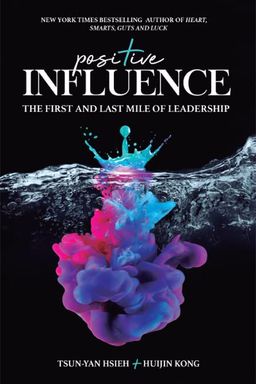
Idea 1
+Influence: Creating Constructive Impact
How can you move people and systems without coercion, manipulation, or power plays? In +Influence, Tsun-yan Hsieh and Marie Cheong argue that the highest form of influence is not persuasion or authority—it’s the intentional ability to mobilize yourself and others toward outcomes that serve all stakeholders. They call this +influence: the skill of shaping interactions, tasks, and relationships for mutual benefit.
You practice +influence when you create shared productivity, satisfaction, and growth—three enduring outcomes that lift both people and performance. The book teaches you how to influence deliberately through awareness, process, and presence. It integrates psychology, emotional intelligence, and leadership craft into a coherent method for shaping results without domination. Throughout, stories of leaders—from CEOs to project managers—reveal how +influence works in moments of uncertainty, cultural tension, and personal risk.
Defining +Influence
+Influence is defined as mobilizing yourself and others to positively affect an interaction, task, or group without using coercion or manipulation. Unlike persuasion, it’s anchored in mutual orientation: asking, “How will everyone be better off?” rather than “How do I win?” You read context, understand pressures, and act from curiosity—not assertion. Motive is central: people can sense whether you act from genuine care or self-interest.
Case examples like Bill, Vik, and Sue-Ann’s service launch illustrate the point. Bill could simply insist on his pricing ideas, but if he considers Vik’s need to appear competent and Sue-Ann’s family distractions, he can shape a conversation that benefits all—project success and personal growth. That’s +influence in practice: empathy fused with effectiveness.
The Core Outcomes: Productivity, Satisfaction, Growth
Every act of +influence aims at three outcomes: better performance (productivity), stronger relationships (satisfaction), and expansion for all (growth). Neglecting any one destabilizes the others. Tsun-yan’s story of managing cost-cutting without morale loss shows the balance: he saved costs while creating training for displaced employees, sustaining both performance and dignity. Marie Cheong’s career choice—to trade salary for purpose—underscores how growth and satisfaction interplay.
This triad of outcomes reframes influence as stewardship, not advantage seeking. You start by treating people as subjects, not objects—asking “How good is John?” rather than just “How many apples did John pick?”
The Deliberate Process of +Influencing
Instead of winging it, you plan, do, and adjust in rapid cycles (PDA). The eight principles—being deliberate, reading context, setting task and relationship objectives, surfacing inquiry, timing, pacing, seizing moments, and engaging your being—serve as a toolkit. Case work and roleplay transform theory into repeatable habits. You learn to define what you want others to think, feel, and do, and then to adapt until those outcomes appear.
Context analysis and judgment become your compass. Organizational pressure points often hide in emotion or identity—family stress, ambition, pride. You uncover these through inquiry (“What might I be missing?”) and empathy, calibrating tactics accordingly.
Timing, Pace, and Presence
Influence doesn’t happen at random—it happens in moments. Recognizing when minds are open and calibrating pace transforms outcomes. Quick moves work under urgency and trust; slower tempo builds ownership. Roberto’s failed presentation was redeemed not by new slides but by pivoting midstream—asking a story-driven question at the silent moment of disengagement. Such micro-adjustments define mastery.
Aligning Your Being
You are the instrument of influence. Authentic impact demands coherence between thoughts, emotions, body, and intention. Cultivate seven qualities—care, courage, curiosity, humility, compassion, persistence, and drive. They ground you when stakes are high. Before hard meetings, Tsun-yan centers himself through breath and visualizes one person’s strength to practice unconditional positive regard—a spiritual discipline that shifts energy and opens dialogue.
Emotion and Mentalizing
Emotional intelligence is not softness—it’s strategic. Emotions reveal bottlenecks in identity and motivation. “Mentalizing” means analyzing feelings as data: why does someone feel anxious, proud, or angry? Huijin channels emotions productively by noticing physical cues and naming the feeling to diffuse tension. Addressing identity wounds and acknowledging fear often precede any rational agreement.
Crafting Durable Influence
Influence becomes durable when grounded in conduct (visible habits), character (moral compass), and craft (personal mastery integrating both). Over time, you grow through High Challenge, High Support environments (HCHS)—stretching and being backed simultaneously—and through mentors who combine risk-taking with care. This process shapes your +craft: a way of influencing that’s distinctively yours, as Ron Oberlander’s balance of truth-seeking and empathy demonstrates.
Against All Odds: The Power of Courage and Truth
Extraordinary influence appears under pressure. Zelensky and Churchill showed that matching words with personal risk amplifies credibility. Ron Oberlander and Tsun-yan revealed how truth-seeking and compassion rebuild reputations (“carpet stain” case) and trust in boardrooms. You learn that persistence, courage, and ethical clarity turn influence from tactic into legacy.
The Journey of Mastery
Mastery grows through habits: care, stretching, presence, feedback, reflection. Consistent practice transforms conscious effort into unconscious skill. You train yourself to sense, perceive, judge lightly, and act at the right moment. Over years, conduct blossoms into character and your +craft emerges—a signature style of influencing that is authentic, ethical, and generative.
Why It Matters
In the end, +influence isn’t about clever talk or perfect meetings. It’s a disciplined way of being that makes others freer, more productive, and more whole. You lead not by authority but by orientation—choosing the intersection where doing well meets doing good. That shift, once made, will transform not only how you lead others but how you live your life.