
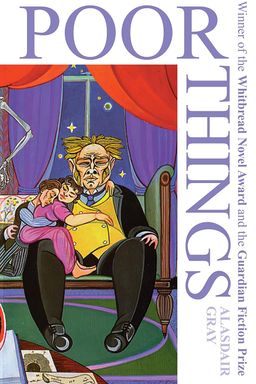
Poor Things cover

Poor Things

by Alasdair Gray

Poor Things is a captivating postmodern novel by Alasdair Gray that merges gothic drama with social satire. Set in late-Victorian Glasgow, it follows Bella Baxter, a woman defying male-constructed narratives, offering a fresh feminist perspective on history and identity.

Resurrecting the Body and Mind: Science, Love, and Identity in 'Poor Things'

Can science bring back what the soul has lost? Can love recreate the person we once were? In Poor Things, Alasdair Gray combines gothic invention, political satire, and social philosophy to explore these haunting questions. Centered around a brilliant but monstrous Scottish surgeon, Godwin Baxter, and his creation—the reanimated woman Bella Baxter—the novel asks whether identity is ever truly fixed, whether the body can be remade without reshaping the mind, and whether society can rise from its own moral corpse just as Bella rises from hers.

Gray frames his narrative as a metafictional puzzle: a supposedly true account by Dr. Archibald McCandless, edited and expanded by Gray himself, with an appendix—a letter from Bella/Victoria McCandless—that fiercely contradicts the story you’ve just read. The book is self-aware, playfully Victorian in style, and deeply Glaswegian in spirit. Beneath its grotesque tale of resurrection, Poor Things challenges you to think critically about science, sexuality, politics, and the lies we tell about progress.

A Modern Frankenstein in Glasgow

At its core, Poor Things reimagines Mary Shelley’s Frankenstein—not as a tale of horror in a laboratory, but as a meditation on creation and compassion in late-Victorian Scotland. Godwin Baxter takes the corpse of a drowned pregnant woman and inserts the brain of her unborn child, creating Bella—a grown woman with the mind of a child. The Gothic frame gives way to social commentary: how do innocence and knowledge coexist in a society built on deception, imperialism, and greed? Through Bella’s evolution—from an infantile, curious creature to a politically aware, sexually liberated doctor—Gray dissects the tensions between science and morality, men and women, body and mind.

A War Between Versions of Truth

The novel’s structure mirrors its philosophical conflict. First comes Archibald McCandless’s account, sentimental and self-serving—a love story mourning the brilliance of Bella and the death of his mentor. Then comes Bella’s own letter, correcting his delusions. Her version overturns his romanticized narrative: she was not a resurrected baby-brained woman but a real adult, a traumatized wife fleeing abuse. By juxtaposing fiction and rebuttal, Gray attacks patriarchal storytelling itself. Which version do you believe—the melancholic male myth, or the self-assertive female counter-history? The question is both literary and political, reminding readers that history has often been told by those with power, not those with truth.

Victorian Morality and Modern Politics

Gray’s Glasgow—an industrial labyrinth of poverty, invention, and hypocrisy—stands in for the modern world, where moral certainties crumble under the pressures of progress. Through Baxter’s experiments, he mocks scientific pretensions to godhood; through Bella’s adventures—her sexual freedom, socialist awakening, and work in public health—he paints a feminist alternative to Victorian repression. The novel is not merely historical pastiche; it’s a mirror for contemporary capitalism and gender politics. By blurring fact and fiction, Gray suggests that every age resurrects its corpses—its ideals, its heroes, its myths—and mistakes them for living truth.

Why It Matters Today

The brilliance of Poor Things lies in its ability to make biography, myth, and science collide. Gray speaks to anyone who has struggled with reinvention—who wonders whether change means betrayal or rebirth. Bella’s journey, from laboratory creation to self-made doctor and activist, embodies the possibility of moral resurrection in an age obsessed with progress. Her story invites us to question who gets to define sanity, civilization, and truth. As Gray mixes satire, tenderness, and scientific fantasy, he leaves you with a haunting realization: perhaps the real experiment is society itself—and we, like Bella, are still learning how to be fully alive.


Godwin Baxter: The Scientist as Creator

Godwin Baxter, the eccentric surgeon at the heart of Poor Things, represents both the promise and peril of scientific ambition. Gray portrays him as a modern Prometheus: brilliant, ugly, compassionate, and godlike. His grotesque appearance mirrors his moral complexity—a reminder that beauty, whether in science or ethics, is often only skin deep. Baxter’s laboratory at Park Circus becomes a microcosm of Victorian innovation, filled with dissected brains, galvanic currents, and strange hybrids of life and death.

Baxter’s Experiments and Ethics

Early in the story, Baxter shows McCandless rabbits spliced together—a shocking scene that demonstrates both his genius and his disregard for moral convention. His claim to have restored life to a drowned woman by implanting her infant’s brain is horrifying but oddly tender. Baxter acts not out of cruelty but curiosity: he wants to heal through understanding creation itself. Yet his creation, Bella, awakens questions of consent, soul, and individuality. In many ways, Baxter’s laboratory becomes a symbol of modern science—how far can we go before our pursuit of knowledge becomes tyranny?

Medicine and Morality

Gray roots Baxter’s character in real scientific history. The shadow of Edward Jenner’s vaccinations, Florence Nightingale’s reforms, and Charles Darwin’s evolution looms over him. He represents a generation of men who imagined science could perfect humanity, often ignoring its emotional cost. His conversation with McCandless on hygiene and society becomes prophetic: surgery may mend the body, but true healing requires justice, equality, and compassion. (Compare this with George Bernard Shaw’s critique of medicine’s moral blindness in Doctor’s Dilemma.)

Love, Fear, and the Limits of Creation

Baxter’s greatest flaw is his loneliness. He dreams of being adored by his creation but fears intimacy. His grotesque hands, his trembling speech—these make him tragic rather than monstrous. When he names Bella “Beautiful Victory,” he hopes love will redeem science. But his death shows that genius without empathy devours itself. Baxter embodies the novel’s warning: progress cannot save humanity unless compassion accompanies power. You might see him as the eternal scientist in all of us—the part that asks questions yet fears the answers.


Bella Baxter: From Creation to Selfhood

Bella Baxter is both creature and creator, patient and doctor, victim and liberator. When she awakens on Baxter’s operating table, she is childlike—curious, linguistically playful, unafraid to question anything. Her learning process mirrors human evolution itself: every word she utters is discovery, every emotion an experiment. Through her peculiar innocence, Gray explores how knowledge and morality develop together. Bella becomes the vessel for his greatest idea—that true humanity is learned, not given.

Learning to Think and Desire

In her first conversations, Bella visualizes the world as sound and rhythm, mispronouncing words in endearing ways (“Hell low God win”). Her speech reveals both mental infancy and creative intelligence. She learns to reason through sensation instead of prejudice. This radical curiosity horrifies Baxter’s students but enchants McCandless. Her growing intellect parallels a child’s development, yet her beauty and adult body destabilize every moral boundary. She becomes Gray’s allegory for the birth of free thought—a mind liberated from shame.

Sex, Experience, and Independence

What begins as a scientific experiment becomes a feminist awakening. Bella’s affair with Duncan Wedderburn, her adventures across Europe, and her work as a nurse and doctor mark her transformation from object to subject. She learns that freedom costs experience—that innocence without choice is another form of captivity. When she returns to Glasgow, she refuses both Baxter’s guardianship and Wedderburn’s domination. She studies medicine, becomes Victoria McCandless, and dedicates her life to helping other women reclaim autonomy. (Her journey mirrors Mary Shelley’s argument that women’s minds are distorted by patriarchal education.)

A Feminist Rebirth

In reclaiming her body and mind, Bella becomes the true resurrector—not of flesh, but of conscience. She embodies Gray’s belief that feminism, socialism, and science can coexist to improve human life. Her metamorphosis from experiment to emancipator invites you to consider how your own growth depends on education and empathy, not inheritance. As Victoria McCandless, the doctor and reformer, she replaces Baxter’s surgical genius with moral intelligence. Her rebirth stands for all social revolutions—the moment when knowledge liberates the soul from history’s experiment.


Archibald McCandless: The Narrator’s Illusion

Dr. Archibald McCandless tells most of Poor Things, and he tells it badly—too romantically, too conveniently. His memoir, framed as Episodes from the Early Life of a Scottish Public Health Officer, turns scientific tragedy into sentimental legend. Gray deliberately makes him unreliable: his love for Bella blinds him; his admiration for Baxter masks self-pity. Through McCandless, Gray examines how men narrate women’s lives while claiming objectivity. His prose imitates Victorian self-justification—a blend of modesty and moral superiority that exposes its own hypocrisy.

The Making of a Narrator

McCandless rises from poverty to medical success, embracing professionalism as a refuge from class shame. His scientific learning gives him social status, but also moral blindness. When Baxter introduces him to Bella, McCandless idealizes her as “a radiant child-woman”—a fantasy that lets him feel protective and powerful. His narration transforms her into his muse, erasing her agency. As readers, you come to distrust him, recognizing how deeply his Victorian sentimentality distorts reality.

Truth, Desire, and Control

Gray uses McCandless to parody the earnest tone of nineteenth-century memoirists like Samuel Smiles or Thomas Carlyle. His diarist’s pride in “self-improvement” becomes a psychological prison. When he learns Bella loves others, his devotion curdles into moral panic. His attempts to frame her story as one of purity and redemption reveal his fear of female autonomy. In contrast, Bella’s later letter exposes McCandless’s narrative as fantasy—a scientific romance written to soothe his envy and longing.

Why Gray Undermines His Narrator

Gray’s choice of McCandless as narrator allows a radical inversion: history as men write it versus history as women live it. By letting Bella contradict him at the end, Gray forces readers to reexamine the act of storytelling itself. What if every “truth” is just another experiment—an attempt to resurrect dead ideas in living form? McCandless’s illusions remind you that objectivity often masks emotion, that language can conceal the very humanity it seeks to record.


Science, Society, and Scottish Progress

Beyond its Gothic romance, Poor Things is an epic of Scottish progress—a vision of how science can either liberate or enslave. Gray juxtaposes industrial Glasgow’s filth and brilliance: surgeons dissecting corpses while factories poison workers, scholars preaching hygiene as children starve. He mocks Britain’s industrial pride through the cruel logic of social Darwinism: survival of the richest, not the fittest. In this setting, Baxter’s experiments become metaphors for social engineering. His resurrection of Bella echoes the city’s attempt to resurrect itself through technology and empire.

The Industrial Moral Laboratory

Gray’s Glasgow is both laboratory and graveyard. Streets filled with steam replace moral clarity with mechanical rhythm. The city’s obsession with progress hides moral rot beneath civic architecture. McCandless’s later work as a public health officer shows reform’s limits—how even the best intentions can serve bureaucracy rather than humanity. The story of Bella’s clinic, fighting disease with compassion, contrasts the cold efficiency of medicine practiced for profit. As historian Patrick Geddes argued, true progress must unite science and sympathy—a theme Gray repeats through Bella’s career.

Politics of Healing

Bella’s later activism bridges medicine and socialism. Her Fabian pamphlets, clinic for mothers, and fight against “horizontalism”—patients made passive under patriarchal care—all advance Gray’s belief in community healing. Science should democratize power, not reinforce it. Her work anticipates twentieth-century welfare reforms and feminist health movements. (Note: Gray’s heroine resembles the pioneering physician Sophia Jex-Blake, who fought for women’s medical education in Edinburgh.)

Vision of Human Progress

By grounding invention in empathy, Gray rejects the Victorian myth of divine hierarchy. Glasgow’s factories and Baxter’s lab are the same experiment—the creation of life without care. The cure, Gray suggests, lies not in machines or miracles but in love informed by science. Through Bella, he argues that true progress is not technological but moral: the resurrection of conscience, the healing of inequality. Science alone cannot save the world; only science that remembers its heart can.


The Feminist and Socialist Vision of Humanity

At its most philosophical, Poor Things becomes a manifesto for feminist socialism. Bella’s evolution from laboratory subject to social reformer mirrors Gray’s vision of human progress through equality. The book dismantles Victorian hierarchies—of men over women, masters over servants, doctors over patients—and replaces them with a society bound by empathy and education. In doing so, Gray fuses the spiritual with the political: the resurrection of Bella’s body parallels the resurrection of collective morality.

From Private Desire to Public Duty

Bella’s journey transforms personal liberation into social purpose. Her marriage to McCandless—steady but intellectual—anchors her activism. She uses her education to improve maternal health, fight poverty, and promote birth control as a form of freedom. Her clinic becomes a microcosm of Gray’s ideal society—a place where science serves love rather than dominance. This continuation of her arc shows that the novel was never just a feminist parable; it’s a social one, envisioning a world healed by compassion.

The Politics of Gender and Knowledge

Gray aligns Bella with early humanist thinkers who demanded education for women—Wollstonecraft’s rational mother, Jex-Blake’s scientific pioneer. By letting her outthink Baxter and outgrow McCandless, he turns the Gothic damsel into the new doctor-saint. Her writings on public health echo socialist visions from William Morris and George Bernard Shaw: medicine must become moral engineering, not monetary enterprise. Her feminist socialism insists that care, not competition, is humanity’s most advanced invention.

A New Definition of the Divine

In the end, Gray’s politics hinge on spiritual insight. Baxter seeks to imitate God by creating life; Bella becomes godlike by preserving it. Her compassion replaces his ambition. In a world resurrecting corpses through technology, Gray reminds you that kindness is the only miracle that lasts. The novel closes not with horror but with hope—the belief that science and socialism can create a moral resurrection, a society reborn as beautifully as Bella herself.

Dig Deeper

Get personalized prompts to apply these lessons to your life and deepen your understanding.

Go Deeper

Get the Full Experience

Download Insight Books for AI-powered reflections, quizzes, and more.