
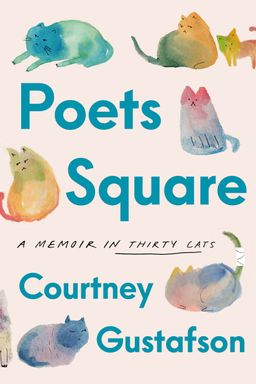
Poets Square cover

Poets Square

by Courtney Gustafson

The creator of the Poets Square Cats social media accounts recalls the time when she moved into a rental house during a pandemic and cared for 30 feral cats.

Turning Ferality into a Practice of Care

When a crisis shows up on your doorstep, what kind of person do you become? In Poets Square, Courtney Gustafson argues that care—sustained, imperfect, daily care—is both a survival strategy and a radical reorientation to a world that routinely abandons people and animals. She contends that tending to a sprawling colony of feral cats outside her Tucson rental forces her to confront the limits of individual goodness, the failures of public systems, and the hard math of scarcity, while also revealing unexpected reservoirs of community, creativity, and hope.

Across this memoir, you see how the line between wild and feral isn’t just biological—it’s moral and political. Wild animals evolved away from us; feral animals are the ones our systems created and then cast off. In that gap, Gustafson finds a mirror: to care for feral cats is to stare down abandonment as a design feature of modern life. The book follows her from the first sleepless nights listening to paws on the roof to a years-long immersion in rescue work, neighbor relations, social media virality, and the economics that determine whether living beings get to eat, heal, and stay warm.

What the book argues

Gustafson argues that choosing care inside broken systems changes you at a cellular level. It softens you where you’ve been guarded (her attachment to a sickly orange cat named Goldie), toughens you where you’d rather not look (euthanizing cats hit by cars), and links your fate to others—human and animal—whether you wanted that or not. She suggests that the difference between “I don’t want them to suffer” and “I don’t want to see them suffer” becomes a moral pivot; once the suffering moves to your front step, you either reorganize your life around response or you look away.

How the story unfolds

Early chapters map the clumsy beginnings: naming cats as a way to notice (BeeBee, Reverse Monkey, Mr. Business), rationing Walmart paté, and learning what TNR (trap-neuter-return) really means when thirty cats are multiplying in real time. From there, the book braids four threads: a personal reckoning with scarcity and grief; a ground-level education in community organizing through colonies like the “Trash Pals” at Desert Palms; a gendered critique of who does rescue work and how they’re treated; and the uneasy windfall of social media virality that unexpectedly pays the bills (and saves her house).

Why it matters

If you’ve ever wondered why some people seem to have endless capacity for care, Poets Square shows the hidden machinery: repetition, ritual, and an honest accounting of loss. It matters because the cats keep standing in for something bigger—precisely where safety nets fail. Gustafson’s day job at a regional food bank becomes a prism: the same scarcity math that makes people guard granola bars (“resource guarding,” as her therapist notes) is what makes Monkey the calico hiss and swipe over a bowl. Stability changes behavior—of humans and cats alike (a theme echoed in behavioral economics; see Mullainathan & Shafir’s Scarcity).

What you’ll learn in this summary

You’ll meet unforgettable animals—Goldie, the flat-as-a-pancake napper who hates eating; Monkey, the bully starved into meanness who becomes goofy once fed; and Sad Boy & Lola, a bonded rooftop pair who model a kind of protective love Gustafson didn’t know was possible. You’ll see how gender and class play out in alleys and parking lots (“men call cats sluts”), why empathy is a more durable organizing tactic than punishment (Richard, the Trash Pals caretaker; Francisco, the Hotdog Man), and how viral videos can both save a life and complicate your ethics.

We’ll also sit with grief that doesn’t tidy itself into meaning (the death of Dr. Big Butt), the body-image fallout of stepping off the stage of the male gaze (“letting myself go” in order to crawl under cars), and the radical ordinariness of making a home where animals and humans can rest. Along the way, we’ll compare Gustafson’s ideas to conversations in feminist care ethics (Eva Feder Kittay), grassroots mutual aid (adrienne maree brown), attachment science (Amir Levine’s Attached), and the creator economy (Kevin Kelly’s “1,000 True Fans”).

Key idea

Care doesn’t fix broken systems—but it does create a counter-system you can live inside: a carport turned sanctuary, a spreadsheet turned lifeline, a driveway turned commons. That work can change your outcomes (it literally buys her house), but more importantly, it changes your reflex: from looking away to staying with.

By the end, you don’t just understand how one woman managed thirty feral cats; you see a blueprint for how you might meet the next feral thing that crosses your threshold—inside your family, on your block, or in yourself—and choose to keep showing up.


From Wild to Feral: What We Owe

Gustafson opens with a crucial distinction: wild animals evolved away from us; feral animals are our own castoffs. You feel this difference in your body when the first evidence of life at Poets Square is a field of pawprints, a chorus of roof-thumps, and a dozen pairs of eyes blinking from the dark. The cats aren’t a quirk of the neighborhood; they’re a ledger of human choices. Once you see that, the Book of What We Owe flips open—and it doesn’t close again.

Naming as noticing

Before any plan, Gustafson names: BeeBee (Belinda), Reverse Monkey (the calico inverse of Monkey), Mr. Business, Sad Mouth Sam, François (cross-eyed), and more. You might be tempted to dismiss silly names, but names are an ethical technology: they create trackable beings. Naming lets her notice when someone goes missing, when someone’s eye is suddenly weeping, when a cat like Reverse Monkey is, in fact, giving birth alone on cold concrete.

This is the first moral shift—from “there are cats out there” to “Georgie didn’t show up this morning.” The shift looks small; it’s not. (Compare to Atul Gawande’s argument in The Checklist Manifesto: naming and listing turn intention into reliable action.)

The trap-neuter-return (TNR) apprenticeship

The book demystifies TNR without romanticizing it. Mini, the frantic gray-and-white, is always in heat—until she’s not. A few days after spaying, she sleeps belly-up for the first time. Lola returns from surgery to a partner, Sad Boy, so bereft he’s stopped grooming; reunited, he’s suddenly pristine white again. You understand TNR not as a technical fix but as a restoration of rest. For females, it’s literally freedom from an involuntary reproductive treadmill; for males, an end to the hormone-fueled brawls that leave faces shredded.

Crucially, she learns ear-tips—the tiny missing triangle that signals a cat has been fixed—are public communication. Ear-tips say, “someone is caring here,” which doubles as harm reduction against well-meaning roundups that can kill ferals in overcrowded shelters.

The ethics of seeing

One of the book’s most piercing lines is Gustafson’s self-correction: it’s different to say “I don’t want them to suffer” than “I don’t want to see them suffer.” You probably know that dodge: if we look away long enough, someone else will fix it. The cats break that spell. With Reverse Monkey, whose dead kittens fit in a small box lined respectfully with a blanket, you grasp how proximity turns aversion into responsibility.

Care that scales (and doesn’t)

Gustafson is honest about the arithmetic. One skinny cat on your stoop? Most of us know what to do. Multiply by thirty and you hit a boundary: lease clauses, wages, food costs, vet access. Her workaround starts embarrassingly small—blankets in the carport, a contraband bowl of water—and grows to a homegrown sanctuary that can only exist because neighbors pitch in and, later, because strangers on the internet do. But she refuses to launder this into bootstrap mythology; systems still fail. Without the clinic’s low-cost surgeries, without fosters, without a public that learns to look for ear-tips, the colony’s stability would collapse.

Key idea

Feral isn’t fate; it’s a relationship to us. When you accept that, “what we owe” shifts from charity to maintenance: food bowls refilled, traps set and reset, vet runs made, records kept. Not heroic—just daily.

If you’ve ever stalled because the problem felt too big, this chapter of the story gives you a working model: name, notice, take the next smallest action, and keep going. That rhythm isn’t glamorous, but it’s how a roof full of cats becomes a community that can sleep.


Hunger Rewrites Behavior

What looks like meanness is often messaging. Gustafson learns this from Monkey, the tiny calico who bullies every bowl. Monkey hisses, swats, swallows whole. It’s easy to call her a jerk—until you learn the rule of scarcity: if you’re never sure you’ll eat again, you guard the bowl with your life. At the same time, Gustafson is working at a regional food bank during the pandemic. In the car line, drivers flip her off, refuse white bread, beg for oatmeal brands their kids will actually eat. The parallel is blunt and bracing: hunger is behavioral.

Resource guarding, from dogs to people

In therapy, her counselor names Gustafson’s nighttime bingeing “resource guarding.” That low growl in Monkey’s throat—please don’t take this from me—isn’t far from the panic of a staff pizza in a nonprofit break room. Maybe you’ve felt that, too: scanning who took how much, hoarding snacks in a desk drawer. The behavior isn’t a moral failing; it’s an adaptation (see Mullainathan & Shafir’s Scarcity, which shows how scarcity taxes bandwidth and narrows focus).

Six months of enough

Monkey’s transformation is slow, then sudden. After half a year of reliably full bowls, her coat shines. Her eyes brighten. Then the shocker: she leaves dinner to roll blissfully in the dirt, white belly up, blissed out. The aggression evaporates, not because she learned manners but because her nervous system recalibrated to enough. Gustafson starts stashing cans around the house—twelve here, twelve there—talismanic insurance policies so the bowls never run dry. It’s not just logistics; it’s nervous-system work.

Dignity at the line

The food bank scenes resist the tidy donor newsletter. People refuse items they can’t eat (no teeth; diabetic; gluten intolerant) and get shamed for it. Volunteers freeze when there’s no protocol. One mother cries over a brand change. A man arrives at the end of a three-hour line and gets a single bag of salad. He says what you might be thinking: “Honestly, fuck this.” The book dares you not to judge him. It also dares you to notice how programs designed for throughput erase individual needs and then call the result ingratitude.

What changes behavior

Gustafson draws the conclusion you can use: stable access changes the nervous system. That’s true for Monkey; it’s true for the woman who stops hoarding cookies once the break room always has cookies. It suggests a program design cue for humans as well as cats: build redundancy, not one-off events. Replace punitive expectations (“say thank you”) with metrics that actually matter: did hunger drop? did stress signals soften?

Key idea

You don’t get kinder by shaming people into gratitude. You get kinder by feeding the body predictably enough that it can stand down. The rest follows.

If you run a team, a classroom, a household—or a feeding station—this is as practical as it gets. Make the bowls boringly reliable. Expect weirdness under scarcity and softness when it abates. The behavior you want is on the other side of enough.


Gendered Labor and Slut‑Shamed Cats

Who gets called the “cat lady,” and who gets called a hero? In Gustafson’s world, nearly everyone trapping, fostering, and bottle-feeding is a woman. Nearly everyone rolling up to the fence with commentary is a man. The misogyny is familiar—catcalls, innuendo, boundary-testing—but Poets Square adds a surreal twist: men also slut‑shame the cats. Females in heat get called “whores,” “strippers,” and “slutty little girls,” as if their biology were a character flaw.

The work behind the work

Consider the invisible load: late-night trapping in alleys, driving cats to dawn clinics, fielding DMs for help, laundering parasite-contaminated towels, mixing formula at 3 a.m. This is classic reproductive labor—care work that sustains life and rarely accrues status (see Silvia Federici on unwaged women’s work). Meanwhile, Gustafson gets peppered with one question from strangers: “What does your boyfriend think?” Her partner, Tim, is supportive yet cautious about boundaries, but the question reveals the assumption: her labor is negotiable against his comfort.

Slut‑shaming as control

When men call cats sluts, it’s not a joke. It’s a diagnostic: sex and reproduction are read as spectacle to be managed, not biology to be addressed via spay surgeries. Gustafson arrives with traps and vet slots; the men respond with moralizing. You watch her reframe: don’t argue biology—change the incentives. Once Mini and Lola are spayed, the drama recedes. The howls stop. The “whore” disappears because the heat cycle does.

Boundary work in the field

Gustafson wears a fake wedding band to signal “not available,” but the inquiries keep coming, from junkyard landlords to men who text hotel room invitations mid‑trap (“I can keep a secret ;)”). She learns to tolerate the boredom of safety: stick to daylight where you can, bring a friend at night, accept that a cheerful demeanor can be PPE. It’s not fair; it’s effective. (Rebecca Solnit’s Men Explain Things to Me echoes here.)

Reclaiming legitimacy

With repetition, the “cat lady” caricature flips. Ear‑tipped colonies are quiet and stable; the neighborhood sleeps. Spay cards stack up. A map of clinics and fosters starts to look like infrastructure. Gustafson embraces the title on her terms: a technician of care, a translator between systems (public shelter, neighbors, rescues), and a strategist who understands that empathy outperforms shaming in the field.

Key idea

Calling the labor “crazy cat lady” erases skill. Spay schedules, trap placement, wound triage, neighbor diplomacy—this is project management under pressure. Name it, and its value becomes obvious.

If you’ve ever been dismissed while doing the most important, least visible work, this chapter will sound like your life. The fix isn’t waiting for respect; it’s building outcomes so undeniable that the label loses power.


Sad Boy & Lola: A New Love Script

What if a pair of feral cats could show you what care feels like in your body? Sad Boy, an enormous, weathered white tom, and Lola, his brown‑tabby counterpart, live as a single organism: eating from side‑by‑side bowls, synchronized grooming, holding paws in sleep. When Lola disappears once, Sad Boy stops grooming; he wanders the roof like a ghost. Reunited, he gleams again, spotless as if blow‑dried. Their bond becomes a rooftop parable about mutual protection and rest.

Unlearning danger

Gustafson sets their tenderness against the backdrop of an earlier relationship with Robby, a charismatic older man whose love ran on jealousy, control, and tests she could never pass. She remembers the thrill of the runway lights at the airport, then the unease of surveillance (“You wore the shorts. I saw you.”). If you’ve ever conflated intensity with intimacy, Sad Boy and Lola’s gentle domesticity is startling: no tests, no edge, just daily presence and protection.

Attachment in the carport

Watching Sad Boy wait while Lola eats first, or Lola shield Sad Boy from a camera with her own body, you get a picture of secure attachment in miniature (compare to Amir Levine’s Attached). Their choreography challenges Gustafson’s old scripts: maybe love isn’t drama managed by apology but softness managed by routine. With Tim, her current partner, this lands as a practice—quiet dinners, early bike rides, roof‑perch sunsets—boring only if you’ve never had safety.

Don’t romanticize the feral

Importantly, Sad Boy and Lola still hiss at human approach. Ferality and love coexist. Gustafson respects their distance, leaves a heating pad on a timer, and checks it in the cold night barefoot because her body won’t rest until she knows it’s warm. Love here is logistics, not access; service, not ownership.

A public love story

Online, their story goes viral: couples dress as them for Halloween, a bride references them in vows. It’s twee on the surface, but you can see why it spreads: in a culture hooked on conflict, this pair models protective dailiness. “Let your girl eat first. Protect her with your life,” a commenter writes. Internet kitsch as attachment education.

Key idea

Gentleness isn’t the absence of risk; it’s the presence of rituals that make risk livable. Sad Boy and Lola don’t abolish danger. They abolish isolation.

If you’re rewriting your own love script, borrow from the rooftop: synchronized routines, no tests, shared vigil when the other is missing. Care first; drama never.


Viral Cat Videos and the Price of Hope

One miniature Cornish hen changed Gustafson’s life. On a whim, she plates a miniature Thanksgiving for the ferals on porcelain saucers edged in gold, garnishes with a single green bean, and posts the video. It explodes on Reddit and TikTok. Overnight, she’s invited into the platform’s creator fund. Within months, cat videos bring in more than her master’s‑degree nonprofit job. The money buys vet care, food—and eventually, a mortgage payment that saves her house. It’s the American Dream by algorithm, and it’s as exhilarating as it is disorienting.

From captions to cashflow

Gustafson always loved writing; her long captions read like prose poems about François’s clumsy tail or Sad Boy’s moonlit paws. Virality turns that writing into revenue. She joins the creator fund, sells T‑shirts with cartoon cats, opens an Amazon wishlist. Packages of Fancy Feast and scratchers arrive at her door. She films six videos a day, mixes cat rescue with storytelling, and pays off medical debt. It’s head‑spinning—and ethically complicated.

The wealth gap, now in kibble

Driving food to twenty‑three addresses monthly, she maps where cats thrive and where they die. The pins cluster in poorer neighborhoods: south side, mobile‑home parks, east of the Air Force base. In the foothills’ million‑dollar homes, there are no colonies. The algorithm money feels both miraculous and arbitrary: if not for timing, lighting, and François’s face, she’d still be one paycheck from crisis. The question “Do I deserve this?” follows her to bed. (Compare to Kevin Kelly’s “1,000 True Fans” and the precariousness of creator livelihoods.)

Content vs. care

Her job becomes two jobs: do rescue and turn rescue into narrative. Some days, the camera feels like a betrayal. When Goldie returns with a broken jaw, she doesn’t post. When cats die, she wrestles with whether grief is content. Yet without the audience, she can’t fund the care. She splits the difference: tell the truth without spectacle; let the work lead.

The house that cats built

When her landlord decides to sell, the numbers don’t pencil out. She posts a fundraiser, embarrassed and desperate. In four hours, followers send $50,000. She and Tim buy the Poets Square house. There’s no bootstrap myth here—just collective action by strangers who care about cats and the person who’s been caring for them. Hope, as audience participation.

Key idea

Social media didn’t fix the system; it created a pocket system large enough for one colony and one mortgage. It’s a win. It’s also a reminder that luck and labor come braided—and luck gets a say.

If you’re working in the creator economy or relying on mutual aid, Gustafson’s rule of thumb helps: be transparent about money, center outcomes (cats fed, surgeries done), and accept that you’ll feel both grateful and unsettled. That tension is honest.


From Isolation to Mutual Aid

Before Poets Square, Gustafson had a single companion—Bubbles, a giant semi‑feral black cat who sometimes bit hard and loved harder. In grad school, Bubbles stood in for a community she didn’t have. After he dies—on the day she moves into Poets Square—cats again become the bridge. This time, though, they carry her outward, away from self‑reliance and into a mesh of neighbors, rescuers, and strangers who show up with traps, soup, and spare keys.

How a driveway becomes a commons

It starts with a DM: “I live in your neighborhood if you ever need help.” That’s Katy, who feeds the cats when Gustafson is sick and later drops dinner on her porch. Gerald adopts a kitten rescued from a hamster cage and years later rescues Gustafson from the side of the road when her car breaks down. Annie becomes a spare‑key neighbor. A web unfurls. What looked niche—sitting in a carport at dusk—turns out to be a portal into a city‑wide team (“Team Eartip”).

The Trash Pals at Desert Palms

The breakthrough case study is the Trash Colony: fifty cats living amid syringes and rotting mattresses at an apartment complex without running water. Richard, whose burned‑out house across the street is condemned, threatens to kill Gustafson if she traps “his” cats. Weeks later, he calls from the hospital: he’s getting his foot amputated; no one is feeding the cats. She breaks in gently (with a neighbor’s help), feeds daily, leaves his yard cleaner than she found it, and—after he returns—asks again: may we fix a few? He says yes.

This is slow trust, not compliance by force. Instead of calling animal control, she builds a picnic line: pizza for neighbors on trapping nights, blankets and water for people living in tents, dog food for Cliff’s pup, and surgeries for Dumptruck, Crusty, Feral Gerald. The alley becomes a block party. It works because empathy scales better than punishment (adrienne maree brown’s Emergent Strategy vibes throughout).

The Hotdog Man (Francisco)

Next door to another colony, a man in a gold Mustang leaves hotdogs every night and drives off. At first, Gustafson bristles—cats need real food!—and leaves notes in Spanish explaining TNR. He avoids her until he spots the plush beds lined up along the wall, each one overflowing with sleeping cats. He knocks to say thanks. She realizes he eats one hotdog for dinner and tosses the rest like confetti for his former pets. Care is messy, sometimes inefficient, and fully human.

Key idea

Mutual aid is not “we help them.” It’s “we keep each other alive.” The cats get surgeries; the neighbors get pizza and blankets; Gustafson gets a city full of people to call at 2 a.m.

If you’ve longed for community but didn’t know where to start, start where you already stand—your driveway, your block. Feed something. Leave a note. Ask permission again. You’re closer than you think.


Grief Without Redemption

Some losses don’t mature into meaning; they stay jagged. For Gustafson, Dr. Big Butt—a massive orange cat with eraser‑pink nose and a sun‑warmed sherpa mat—dies of a sudden clot that paralyzes his back half. The ER vet salutes his name (“a fellow doctor”) and throws every tool at it. Twenty‑four hours later, she holds him as he goes. She comes home and can’t get out of bed. For weeks, every orange blur is him. You may want a clean arc here; she withholds it on purpose.

Against tidy narratives

We love to say that loss makes us better. Gustafson refuses. “My cat died and it didn’t make me a better person” is the bumper sticker she imagines. She lets you see the aftermath honestly: nausea as a grief language; self‑protection that looks like dissociation (“read me a list of all the dead cats, and it feels like someone else’s life”); the tiny random comforts (a single whisker saved, a nose print).

Executioner feelings

Rescue sometimes means luring a suffering animal toward a good death. You can call it mercy; it can still feel like complicity. Gustafson owns the double exposure: Instagram cheers “you saved him from suffering” while her gut whispers “I delivered him to the end.” Holding both truths keeps her human. (Joan Didion’s The Year of Magical Thinking offers a human‑loss analog.)

The pattern you can trust

Tim names her cycle: after every brutal case (the motor‑oil‑soaked feral who disappears, the alley body you can’t unsee), she says she’ll never get up again. Then she does. Not because the loss got redeemed, but because a ritual—a bowl to fill, a trap to check—pulls her forward. Smallness is the feeling she trusts now: small steps, small bodies, small wins.

Key idea

You don’t have to convert every grief into growth. You can let it stay meaningless—and still keep feeding what’s alive.

If you’ve ever waited for sorrow to teach you a lesson before allowing yourself to continue, this chapter gives permission for a different practice: keep the rituals; ditch the moral of the story.


Letting Yourself Go (On Purpose)

Care work wrecks your manicure—and maybe that’s the point. Mid‑rescue at a hospital garage, Gustafson shimmies beneath a Mercedes to free a soot‑coated kitten wedged on the rear axle. An hour later, covered in grease, hair stiff with oil, she realizes: this is the first time since childhood she did something urgent without tracking how she looked to an imaginary audience. The kitten—later named Benz—is safe. Her self‑image has slipped its leash.

Leaving the male gaze

As a teen and twenty‑something, she optimized for admiration: Side‑swept bangs just so, Crest Whitestrips, spandex shorts regulated by a jealous boyfriend. She learned that achievement didn’t count unless a man was watching. Cat rescue creates a counter‑audience. The cats do not care about your pores or your angles. The work is so sweaty and specific—under fences, inside dumpsters—that beauty performance becomes friction.

Coexisting versions of you

Gustafson experiments: stained jeans in public, shirts that say CAT MILF in airport security lines, evenings without eyeliner. Some days she returns to blow‑dry and brows. Crucially, she permits multiple versions of herself to exist: the person who delights in a crisp winged liner and the one who’s fine with ringworm‑ruined tees. It’s not a conversion away from care for appearance; it’s a diversification of value.

Resisting self‑care capitalism

TikTok’s FYP floods her with dewy serums, wrinkle tapes, and lash growth hacks masquerading as “self‑care.” She sees the trap: anxieties that keep women pliant and purchasing. She chooses a different baseline: function. Can she crawl under a car? Can she set ten traps by dusk? Can she make it to the clinic by 7 a.m.? This is not anti‑beauty; it’s pro‑priority. (See also Phoebe Waller‑Bridge’s critique of “having it all” as a performance loop.)

Identity as service

Oddly, the more she serves, the more anchored she feels. The trench‑coat joke—“I’m not a person; I’m a pile of cats in a trench coat”—turns out to be a liberation. It’s not erasure; it’s belonging to something bigger. The shirts with dancing cats aren’t tacky; they’re team colors for a life that finally makes sense.

Key idea

“Letting yourself go” can be a survival strategy: releasing the imaginary audience so you can rescue what’s actually in front of you.

If you feel policed by an internal camera, take your next action for the being in front of you—kid, elder, cat—and not the one in your head. Notice what drops away. Keep what helps you move.


Home as Sanctuary, Systems in Ruin

Two houses define the book’s stakes. The first is Poets Square, a modest rental where care alchemizes a carport into a sanctuary. When the landlord sells, a GoFundMe buys the deed in four hours. The second is the Pigeon House, a once‑grand property now condemned, its yard ankle‑deep in feathers and rot, its cats starving among corpses of pigeons. One house becomes a commons by design; the other becomes a cautionary tale about what happens when supports fail and grief metastasizes into squalor.

A house that holds

Owning Poets Square lets Gustafson act like a caretaker, not a guest. She waters bougainvillea at dawn while the cats eat. She checks the patio heating pad timer in the cold night, barefoot. She learns the pawprints by heart. bell hooks called homeplace “a site of resistance” where the battered can heal; Poets Square makes that literal for animals and their people.

A house that breaks

At the Pigeon House, Sharon, the owner, cycles through grief scripts: she’s been caring for her disabled mother; she’s been abandoned by family; she doesn’t know how it got this bad. All may be true. Inside, rescuers wear respirators, set traps on cleared patches between trash drifts, and extract forty‑two cats from insulation, roach nests, and wet kitchen floors. The team refuses to sensationalize and still tells you the truth: some nights are horror movies with birds slamming into glass.

Punishment vs. prevention

The book is cleareyed about enforcement theater. Police sweep Desert Palms to “clean up the area,” evicting people living in cars and tents while leaving a map of structural failure untouched—no water, predatory management, no clinics. Animal control, used bluntly, tends to punish both humans and animals. By contrast, prevention looks like ear‑tips, monthly food deliveries, blankets, and neighbors who know who to call when they hear a kitten crying under a hood.

A practical blueprint

If your own “house”—organization, classroom, block—feels fragile, Poets Square offers a build list:

  • Make care visible: ear‑tips, whiteboards, public bowls.
  • Give agency back: partner with caretakers (Richard; Francisco) instead of displacing them.
  • Build redundancy: stashed cans, backup fosters, shared keys.
  • Ritualize response: morning rounds, trap nights, clinic runs.

Key idea

Home can be a social technology: a place designed to absorb sorrow and convert it into rest. That’s not sentimental—it’s architectural.

Hold those two houses in mind the next time you decide where to spend your energy. You can’t fix every structure in ruin. You can choose one site—porch, classroom, Slack channel—and make it a place where living things exhale.

Dig Deeper

Get personalized prompts to apply these lessons to your life and deepen your understanding.

Go Deeper

Get the Full Experience

Download Insight Books for AI-powered reflections, quizzes, and more.