
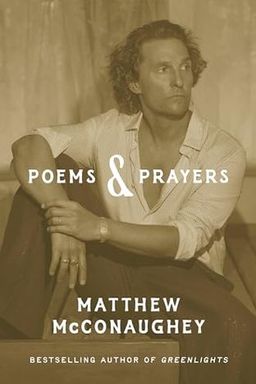
Poems & Prayers cover

Poems & Prayers

by Matthew Mcconaughey

The actor and author of “Greenlights” explores elements of belief and reason that make up our lives.

Rhyme Your Way to Reason

What do you reach for when logic stops making sense—another hot take, or a quiet breath you can stand on? In Poems & Prayers, Matthew McConaughey argues that when data, spin, and deepfakes scramble our senses, the way back to reality is oddly old-fashioned: sing more than you explain and pray more than you prove. He contends that you don’t out-logic a chaotic age; you retune your perception through poetry’s wonder and prayer’s attention until your desires, understanding, and actions can work in sync again.

McConaughey’s core claim is simple and subversive: art emulates life best when you let life be artful. Poetry and prayer aren’t escapes; they’re calibration tools. Poems are the Saturday in the middle of your week—brief bridges to enchantment—while prayer is a practical reset that anchors spirit without pinning it down. When you weave them together, you build what he calls a livin’ approach—catching more “greenlights” (yeses) by aligning pace, purpose, and perspective rather than forcing outcomes.

Why this matters now

McConaughey opens with a diagnosis that feels uncomfortably current: our perception is off, therefore our desires are off, therefore our understanding and actions are off. Facts alone aren’t fixing it. So he flips the script: put proof on the shelf for a season; let wonder, faith, and disciplined attention tune the instrument of your life. You’re not asked to abandon reason. You’re asked to rhyme your way back to it.

This reframing grounds a book that’s part psalter, part field manual. It’s organized into themes—Time, Man Up, Regulation Gauges, Love Stories, Faith & Doubt—each blending lyrics with lived commentary. You’ll see ditties about roadside burritos in an abandoned bank, a ZZ Top–metered meditation on “Changing Lanes,” and prayers that start by rolling a mental “Rolodex” of loved ones until you can see them—and then yourself—at your most true. The tone is country chapel meets campfire philosophy, a little Rumi, a little Robert Frost, a lot of Texas porch light.

What you’ll learn in this summary

First, you’ll see how McConaughey uses prayer as practical navigation—gratitude first, service second, then the hard work of seeing yourself as loved—and why he thinks “prayer is paying attention.” Second, you’ll hear how time becomes livable when you choose a daily rhythm over a daily race, making ordinary hours sing. Third, you’ll unpack courage and consequences: why being a good man isn’t the same as being a nice guy, why the universe is designed to test you, and how to expect “six to eight problems you couldn’t have imagined” every day.

You’ll also learn to tune your personal equalizer—health, family, marriage, career, God—so no one gauge runs in the red for long. In love, you’ll get small, homely practices (ditch the king-sized bed) and big, humbling ones (admit “there’s more than one way to be right”). You’ll confront daymares—the monsters in daylight we refuse to name—and see how he handles temptation (look for the albino armadillo irrigating the lawn) and remorse (“The Mess I Made”). Finally, you’ll enter his stance on faith: doubt is logical; faith isn’t, but it carries you through doubt. Grace lives between self-reliance and surrender. And America? It’s “Yet”—a promise you pursue but never finish (a line that nods to Langston Hughes).

Signal lines

“Let inspiration interrupt our appointments. Dream our way to reality. Serve some soul food to our hungry heads.”

“Prayer is paying attention.”

“We either persist, pivot, or concede. The art is knowing when.”

How this fits with other thinkers

If Greenlights was his road diary of decisions, Poems & Prayers is the chapel beside the highway. It shares DNA with Anne Lamott’s Help, Thanks, Wow (prayer as honest conversation), Oliver Burkeman’s Four Thousand Weeks (stop racing time; befriend finitude), and the Stoics (expect difficulty; own your choices), while keeping a bluesy twang all its own. Where many self-help books sell tactics, McConaughey sells frequency—get your signal right and more of life harmonizes.

What you can do with it

Use prayer to align your appetites with your aims. Score your day like a song so friction becomes part of the groove. Trade the comfort of the couch for courage that bleeds just enough to mean it. Recalibrate your gauges before something breaks. Love with smaller beds and bigger ears. Name your daymares in daylight. Carry your doubt, don’t cancel it. And stay in the chase—of your hero, your purpose, and the country you want to help build—“now and forever, yet.”


Prayer as Practical Navigation

McConaughey treats prayer less like porcelain and more like a multi-tool. He writes, paints, parents, and even laughs as forms of prayer because each resets the signal and returns him to what he values most. You’re invited to use prayer not to get out of life but to get deeper into it—anchored, not anchored down.

Start with gratitude, then service

His ritual starts with thanks. He smiles upon his blessings, then reminds himself that “in God’s economy, service serves me.” Practically, he prays for guidance to be the husband and father his family needs—mentally, physically, spiritually. That subtle order matters: gratitude protects against grasping; service turns love into calendar entries.

Roll the mental “Rolodex”

Next, he scrolls through loved ones until he sees each person “most themselves”—not just happiest or proudest, but authentically at ease. He locks that image in and prays for that state “in perpetuity.” Then comes the hard part: seeing himself the same way. Only when he can picture and receive his true likeness does he say amen. Try it: it’s both gut-check and grace-practice, worth five quiet minutes before email.

Prayer is paying attention

McConaughey widens prayer beyond pews. A walk that clears your mind, stargazing until you feel small, making love, or laughing hard—these can all be prayer because they revive your heart and quiet the frantic mind. The point is devotional attention: raise your heart above your head long enough to hear the wiser voice inside.

A working definition

“Prayer anchors me but doesn’t hold me down, giving me a more stable floor from which to fly.”

Align ambition with Divinity’s law

The aim of prayer, he says, is to align your earthly ambitions with the higher order—so you do what you’re here to do. In theological terms, that’s purpose. It’s less mandate than love affair. You don’t conjure worthiness; you consent to being guided. The daily practice slowly shifts wants into needs and narrows the gap between who you are and who you can be.

Make room for all the prayers

Some prayers bleed. He includes laments (“Dear God, seems my sight’s getting in the way of Your sound…”), confessions (“Forgive me Father for I know what I do”), and simple petitions (“Please remind me to give thanks in all circumstances not for all circumstances”). The honesty is the offering. If you’ve read Anne Lamott’s Help, Thanks, Wow, you’ll recognize the cadence—he just adds a Texas drawl and a drummer’s count-in.

Try this tomorrow morning

  • Two breaths of gratitude: name three gifts you didn’t earn.
  • Service check: one concrete way to care for your nearest people today.
  • Rolodex frame: picture someone “most themselves” and pray that state back to them; repeat with yourself.
  • Amen as intention: carry the snapshot into your calendar decisions.

(Context: In Greenlights, he framed life as catching yeses. Here, prayer becomes how you tune your signal so you can see the yes when it arrives—and be the kind of person who can receive it.)


Time, Rhythm, and Everyday Ditties

McConaughey treats time like a drum kit, not a stopwatch. When your day has a beat, he says, even struggles start to sound like snuggles. The practical move isn’t to add more hours but to choose a meter you can keep—and let your life answer back in kind.

Choose a daily meter

Some mornings he wakes with a rhythm in his head and tries to live the day to its tempo. He calls the resulting snapshots “ditties,” written beat-poems of real moments that rhyme his hours into meaning. In “Shades for the Eclipse,” he hunts for glasses in a dusty town (“they say she’s got shades for the e-clipse”) and buys a no-tax $2 burrito from a stove set up in an abandoned bank. It’s not just a story; it’s how attention turns errands into lyrics.

Trade racing for pacing

He admits he loves being on time—and when he is, he doesn’t need a watch. Preparation lets him saunter instead of sprint. The big question isn’t how to live longer; it’s how to live better. Would you rather have 60 satisfying years or 90 anxious ones? Oliver Burkeman makes a similar case in Four Thousand Weeks: time “management” is really about choosing what to neglect.

Sing the commute: “Changing Lanes”

Set to the rhythm of ZZ Top’s “Just Got Paid,” this ditty is a road-prayer for agency. Lines like “be best at what you’re good at not better at what you’re not” and “keep your windshield clean so your vision won’t get blurry” turn mundane drives into proverbs. The refrain—“no need to use your blinker when I’m changing lanes”—isn’t about rudeness; it’s about moving decisively once you’ve done the inner due diligence.

Let small wins set the tone

“Deuces,” a comic ode to being the first morning butt in a clean porta-potty, is low-brow wisdom with high-yield dividend: momentum loves cleanliness. “More Time” rejoices when the band plays an unexpected encore or when you mistakenly date your checks a year behind—“God I love it when I’m early instead.” The point: delight in surplus time trains you to stop worshiping scarcity.

Remember is a verb

In “Memory,” he personifies memory as a patient poet—never judging, always ready—if you’ll only “take the time.” He counters obsession with perfect recall (“Barbiturate Logic”) by halving mental noise to double meaning: fewer fragments, fuller story. Time and truth, he says, are two constraints you can rely on; one always shows up, the other never leaves.

Time-friendly moves you can try

  • Score your day: pick a song or tempo in the morning and let it steer your pacing decisions.
  • Honor small surplus: celebrate unplanned extra minutes as gifts to savor, not new slots to fill.
  • Write a ditty: one paragraph that rhymes your commute or errands into a narrative you can enjoy later.

(Context: Where business books sell productivity hacks, McConaughey sells cadence. The output matters, but the soundtrack you live to matters more. When the day grooves, you can keep time with less effort and more joy.)


Courage, Consequences, and Being a Good Man

Courage threads the book: fly a little longer before you pull the parachute; expect problems; keep your word when it hurts. McConaughey distinguishes “nice” from “good”—and pushes you to pick the one that costs more and pays longer.

Nice guy vs. good man

“Nice” goes along; “good” stands up. In the late ’90s, he wrote “Good Man” just as he decided to stop taking romantic comedies. People kept telling him, “You seem like such a nice guy.” He didn’t want to be cute; he wanted to be handsome—in character. That career pivot (famously chronicled in Greenlights) wasn’t branding; it was backbone.

Count both sides of consequence

We treat “consequence” like it only means punishment. He flips that: every decision brings a debit and a credit—something you want and something you won’t. Acknowledging both makes you braver and fairer. You’ll risk with eyes open, not chase wins that quietly bankrupt something you value.

Expect six to eight surprises a day

He quotes coach Bill Parcells: if you want to lead, get ready to face “six to eight big problems you could never have thought were coming every day.” Normalize difficulty. When trouble’s not a scandal but the standard, you respond instead of react. (This echoes the Stoics—from Epictetus to Ryan Holiday—who insist that obstacle is the way.)

Propaganda you tell yourself

In a litany-poem titled “Propaganda,” he pits instant comforts (“the encore,” “the quick fix,” “fifteen minutes of fame”) against character: the great concert, the dance you do, the truth that makes you immortal. Translation: if you want a legend, trade novelty for craft and appetite for devotion.

Rebel toward the good

“Good Rebel” prays for the courage to do more than perform goodness—he wants to demonstrate it. He reframes prevention: courage isn’t revenge; it’s suffering well to succeed. When you request what you don’t yet possess, the answer is no—until it becomes yes. So keep at it.

Courage moves to practice

  • Name the cost you’re willing to pay—before the audition, pitch, or apology.
  • Count the positive consequences, not just the risks; let the upside pull you through the fear.
  • Adopt a Parcells mindset: write “x8” at the top of your day to normalize incoming fires.

(Context: Where some self-help promises control, McConaughey offers consent—to difficulty, to consequence, to the longer game of character. The reward is sturdiness.)


Regulation Gauges: Tuning Life’s Equalizer

Think of your life like an old Alpine car stereo: lots of sliders, never all peaking green. McConaughey’s gauges are health, family, marriage, career, and God. If one rides high too long, another bleeds into the red. The work is constant recalibration—honest inventory, small adjustments—so you don’t blow a speaker.

Own your personal operations

He writes a self-regulation poem—“Listen to yourself, hear yourself, learn yourself…”—that reads like a one-man operating manual. It’s not narcissism; it’s stewardship. “It’s good when your success goes to your head,” he quips, “as long as it goes to your heart as well.”

Heartline over headline

In “Heartline,” he confesses to skating on the surface—transactions as fake transformations. Things were good on paper but thin in his chest. The remedy wasn’t a grand gesture; it was a self-imposed jackknife into new water—risk something, bloody your own nose, feel alive again. If you’ve ever plateaued after a win, you know this ache.

Live on the outskirts

“On the Outskirts of Town” is part map, part manifesto: a little closer to grace, a little further from revenge; fewer motors on the lake because the fish still bite; down the road from America, closer to the dream. He likes new places enough to want to move to Main Street—until he remembers he prefers the neighborhood one bend away. Outskirts keep you in touch with common sense and conversation.

Beware freebies and fluffers

“Tips Included” skewers over-convenience: when extra credit is automatic, service suffers; when participation trophies abound, you play to tie. The moral muscle atrophies. Likewise “Candy Crush” becomes a parable about barter, patience, and saying no to the first offer. Convenience is fine; dependency isn’t.

Project only as far as you remember

In “Projection,” he argues you can only see as far into the future as you can remember into the past. Writing Greenlights forced him to look back; only then could he aim forward with more accuracy. “Your Friend Been” adds a mental hygiene tip: speak past pain in past tense, or you invite it to prophesy.

Equalizer practices

  • Weekly check: rate Health, Family, Marriage, Career, God from -2 to +2; nudge only one or two sliders up each week.
  • Outskirts audit: identify one “Main Street” you should leave (news cycle? social platform?) and shift one bend away.
  • Fluffer fast: remove one easy credit (auto-“tips,” default perks) to reawaken merit.

(Note: This resembles David Brooks’s “resume vs. eulogy virtues” and James Clear’s systems-first approach—calibrate structure so behavior follows.)


Love Stories: Practicing Intimacy and Humility

McConaughey writes about love with the same mix of grit and peach-fuzz tenderness he brings to prayer. The theme: less posturing, more presence. Let truth move in and never leave. Make room for two rights. And shrink the bed.

Revel in the post

“Revel in the Post” is a sensuous ode to the afterglow that softens edges—eyes, lips, shoulders—and slows time. The lesson is not just carnal; it’s about savor. When you linger after beauty, your sips get smaller so your drinking lasts longer, and quiet moments “aren’t so loud.” You can practice this with steak and with conversation.

Meet at the boundary

In “Meet You in the Middle,” he proposes a rendezvous at the property line—each seeing the other’s past with enough boundary to lean on. The image admits difference and makes it usable. You don’t merge identities; you exchange honors at the fence.

Become a “Truth Slave”

If Truth knocks and you only want a fling, she’ll be gone by first light. If you put “forever on her pillow,” she’ll stay. The metaphor disciplines intimacy: lasting love is more than chemistry; it’s devotion to what is, especially when it complicates ego.

Make space for being wrong—and right

“Certainly” confesses a familiar marital sin: confusing selfishness for certainty. He admits he’s “seldom wrong,” then adds, “there’s more than one way to be right.” That single line, if you live it, dissolves a decade of stalemates.

Stumble forward, together

“We push, we pull… we tell the truth, we lie… until we stumble upon a song.” The couple’s music isn’t found by avoiding dissonance; it’s found by living through it until a melody emerges. His most concrete hack might be the smallest: “get rid of that king-size mattress, and sleep in a queen-size bed.” Physical closeness makes repair more likely.

Bring the childlike reset

“Daughter’s Bed” is a weary father’s nap in sheets that “never cheat.” It’s a metaphor for innocence resets: when you’re crusted over by duty or self-reproach, lie down where the air is lighter. Then get up better.

Practices to try

  • Fence-line talks: discuss hard topics literally at the edge of a room or on a walk—shared horizon, gentle boundary.
  • Truth vow: agree that if truth visits, she gets a seat at the table, even when it ruins the bit.
  • Smaller bed, slower sips: make proximity and pacing structural, not optional.

(Context: This sits comfortably beside John Gottman’s research—repair attempts predict success—and Esther Perel’s reminder that closeness requires both intimacy and healthy distance.)


Daymares, Temptation, and the Discipline of Repair

McConaughey doesn’t airbrush failure. He shares daymares—the monsters you feed in daylight by denial—and the messes you make when you “kiss the fire and walk away whistlin’” one too many times. The point isn’t guilt-mongering. It’s growth via honest inventory and repair.

Name daytime monsters

“Daymares” catalogs addictions, blames, and counterfeit incarcerations. These aren’t midnight ghosts; they’re noon-day lies you live by. He prays, “Seems my sight’s getting in the way of Your sound,” admitting how over-interpretation (he jokes about weed turning into “paralysis puff of fucking analysis”) can make you miss a birthday party because you’re stuck replaying one song in the car. The remedy: widen back out—hear the forest again, not just the grain in the rafter.

Shut up when you should

He confesses to chasing superiority by criticizing others, then asks for the “courage to shut the fuck up instead.” That prayer alone could detox a thousand group chats. It’s also a nod to AA wisdom: restraint of tongue and pen often is the miracle.

Heed the armadillo

In a vivid turning point, he’s on the edge of indulging old vices when he sees “an albino armadillo irrigating my lawn.” It’s bizarre, on-brand, and effective: a grace interruption that sends him to tend the garden instead. You can build your own armadillo—pre-decide a pattern interrupt (cold shower, call a friend, step outside) for the moments you know you wobble.

Own “The Mess I Made”

He writes a flood of consequences—buzzards circling, sharks scenting blood—as metaphors for compounding omissions, unpaid tabs, and broken glasses. It reads like a country psalm of accountability. No excuses, no self-flagellation—just sober cause and effect.

Mortality as mirror

Turning fifty triggered “What’re You Gonna Do?”—a litany of moments when your backstage pass is a line, the music stops, and the broom rides where the lover lay. It’s Thursday on life’s calendar. What now? The implied answer: do the next right thing, again and again. Repair is a practice, not an event.

Repair regimen

  • Name your daymares in a note app at lunch; one sentence each. Sunlight shrinks them.
  • Preload your armadillo—three pattern interrupts you will do when tempted.
  • Pay a small tab today: one apology, one bill, one promise kept.

(Context: This pairs with Dan Harris’s 10% Happier ethic—less drama, more reps—and with the Serenity Prayer: accept, change, discern.)


Faith, Doubt, and Grace in Motion

For McConaughey, doubt is logical; faith isn’t. But faith can carry you through doubt, and grace lives in the charged space between self-reliance and surrender. The result is a muscular, cheerful spirituality: work hard, expect tests, forgive freely, and let rain slow you down to listen.

Admit pride, befriend doubt

He names pride—of knowledge, approval, self-reliance—as what keeps him from full surrender. He doesn’t cancel pride; he situates it. In “Sometimes,” prayer is a rotating conversation: guidance, confession, unloading, and courage to move on. Skeptics are needed, he says; cynics aren’t. That’s the posture: discerning, not dead-eyed.

Heaven or not—move anyway

In a striking passage, he admits religion helps the suffering hang on—sometimes with reward deferred to the next life. “And what if there is nothing there?” he asks. He doesn’t know. But having no hope guarantees you stay stuck. So pick something small to look forward to and chase it, heaven or not. (Viktor Frankl would nod.)

Practice raining grace

Forgiveness is a health plan. Refusing to forgive—others or yourself—makes you physically, mentally, spiritually ill. He separates act from identity: condemn the lying, cheating, stealing; don’t brand the person. Then he prays, “Give me another sip of forgiveness before I am drunk with resentment.” It’s a vivid dosage note—sip saves, binge poisons.

Grace is not passive

“Until Now” insists grace keeps a vow with urgency. It knows the past was part of the plan and presses on. “To My Friend the Rain” thanks weather for dampening ambition enough to hear the soul’s whispers. Slow is not stuck; it’s sacramental.

America, Yet

Zooming out, he applies his theology to civics. Borrowing Langston Hughes’s idea that America is a “land that has never been yet,” he argues national purpose is pursuit, not arrival. He’s skeptical of party “pep rallies,” preferring principle over posture and peacemaking that brokers real values without outsourcing truth to ideology. God isn’t politics; God is progress—toward justice we’ll never fully reach, but must keep chasing.

Faith-in-motion habits

  • Schedule a “rain hour” weekly—dim lights, no agenda, just listen and write what you hear.
  • Forgiveness sip: one small grace you can offer today (a withheld jab, a returned text, a debt named).
  • Civic courage: pick one issue; state your principle without pep rally jargon; take one neighborly action.

(Context: This blends Reinhold Niebuhr’s realism (grace amid imperfect structures) with Thomas Merton’s contemplative listening—done on a back porch with boots on.)

Dig Deeper

Get personalized prompts to apply these lessons to your life and deepen your understanding.

Go Deeper

Get the Full Experience

Download Insight Books for AI-powered reflections, quizzes, and more.