
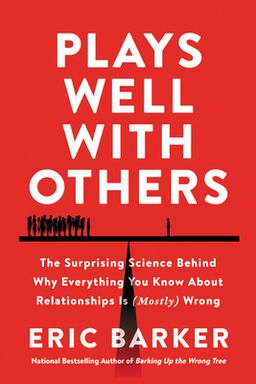
Plays Well with Others cover

Plays Well with Others

by Eric Barker

In ''Plays Well with Others,'' Eric Barker dismantles relationship myths and provides science-based strategies for developing lasting bonds. Discover how true connections enhance happiness, resolve conflicts, and fulfill the human need for belonging and purpose.

The Art and Science of Understanding Others

Why do we so often misunderstand each other? This book argues that our failures to read minds, connect sincerely, and sustain love share a single root cause: we mistake intuition for insight. We want to believe we're good judges of character, but research reveals persistent illusions in how we interpret people—and even ourselves. The book blends psychology, neuroscience, and vivid stories to uncover why our social instincts mislead us, and what we can do to become more accurate, compassionate observers.

The Hidden Errors of Mindreading

Our brains crave coherence. When you're trying to read someone else, you're also reading a projection crafted by your expectations and biases. Studies on trained FBI profilers show they often perform no better than amateurs. The Barnum effect—our tendency to see vague statements as personally accurate—shows how easily stories stick when they feel specific. Even 'Clever Hans,' a horse once thought to do math, was simply responding to subtle cues from humans. The lesson: we are not detached observers. We are participants shaping the very behavior we claim to detect.

(Note: this distortion explains why techniques like cold reading or personality quizzes feel astonishingly accurate—they exploit our brain’s craving for meaning.)

The Paradox of First Impressions

We make lightning-fast judgments that can be surprisingly predictive—Alex Todorov’s research shows faces alone can forecast election success—but those early impressions are also sticky. Once a first narrative forms, confirmation bias cements it. You notice evidence that supports your story and ignore what doesn't. Neuroscience confirms that as confidence grows, openness shrinks.

The book calls this the 'First Impressions Paradox': the brain values being consistently wrong over constantly uncertain. But refinement is possible through accountability, emotional distance, and deliberate perspective-shifting (strategies proven by Kruglanski and Trope). The message: human intuition is necessary—but it needs disciplined auditing.

Truth, Lies, and the Friendly Journalist

Lie detection often fails because most cues are unreliable. Eye contact, fidgeting, even polygraphs mislead. Instead, the book reframes detection as conversation design. Acting as a 'friendly journalist'—rapport-seeking, informed, curious—elicits contradictions and truth without confrontation. Increasing cognitive load through unanticipated questions or strategic evidence exposure makes lying harder. When airport screeners tried this, accuracy jumped from near chance to over 60%. The insight: truth emerges through cognitive friction, not suspicion.

The Broader Pattern: Meaning Before Mystery

Across domains, we mistakenly romanticize mystery—thinking intuition will reveal hidden depths—when in fact careful observation demystifies more effectively. The Parkes Telescope 'peryton' saga illustrates this beautifully: what seemed alien radio signals were caused by microwaves in a nearby break room. Scientist Emily Petroff’s discovery captures the theme: before reaching for the extraordinary, rule out the obvious. Clarity often hides in plain human habits.

From Mindreading to Connection

Once you grasp that perception is flawed, you can pivot from judgment to empathy. Later sections deepen the focus from reading others to relating to them: friendships as extensions of self, love as neurochemical commitment, and belonging as biological safety. In each realm, accuracy gives way to care as the real social technology. The early message—'you can’t really read minds'—sets up the later argument: 'but you can connect minds.'

Core idea

Understanding others begins with humility: assume misperception, slow down your stories, and deliberately design situations that invite honesty and connection.

At its heart, the book argues that insight into others—and yourself—requires intentional structure: context-shaping, truth-friendly conversation, and emotional accountability. When applied beyond individuals, these principles explain the mechanics of friendship, love, and community. Truth, trust, and belonging stem not from intuition alone, but from consciously built environments where honesty can breathe.


Seeing Clearly, Without Illusion

One of the hardest truths about human interaction is that your mind loves shortcuts. From reading faces to spotting lies, intuition feels accurate even when it’s not. Psychological experiments—from Bertram Forer's Barnum test to Nicholas Epley’s mindreading studies—reveal just how unreliable your 'gut sense' of people can be. Most of what you interpret as insight is pattern-making under uncertainty.

The Barnum Trap and the Clever Hans Lesson

You’re prone to believing generic statements if they fit your narrative. That’s why astrology and sketchy profiling work: you do the interpretive labor for them. Wilhelm von Osten’s horse Hans didn’t count—it read unconscious human cues. Likewise, when you try to read someone, your expectations can leak into behavior, shaping what you see. The brain’s feedback loop rewards vague success and hides errors.

To break this illusion, treat interpretation as experiment, not revelation. Ask questions. Change contexts. Listen for speech cues—hesitation, tone, speed—rather than imagined 'tells.'

Motivation and Readability

People-reading accuracy hovers around 20–35%, even in close relationships. Nicholas Epley’s findings show two key levers: motivation and readability. Motivation increases awareness—men, for instance, get better at empathy tests when offered romantic incentives. Readability, however, matters more than skill: expressive people are simply easier to read. The best strategy, then, is to modify the situation so others reveal themselves naturally.

  • Elicit emotion: deep talk beats small talk.
  • Add social dynamics: watching someone with friends shows truer patterns.
  • Focus on voice; it carries more reliable data than posture.

Truth Detection Through Curiosity

Instead of scrutinizing micro-expressions, act like a friendly journalist. Build rapport, ask open 'how' and 'what' questions, and keep people talking. The goal isn’t confrontation but cognitive load. Deceptive answers collapse under detail; honest ones maintain coherence. Studies show this rapport-based, question-driven style dramatically outperforms standard interrogation or lie detection myths.

Insight

You become more accurate not by becoming Sherlock Holmes, but by creating conditions that make truth easier to tell.

If you want to read others more wisely, stop assuming clarity is natural. Treat mindreading as co-created: both sides shape the signal. Question your internal narrator before you interpret anyone else’s. Accuracy begins with self-doubt and structured curiosity.


The Power and Peril of First Impressions

The first few seconds define much of your social reality. You form rapid judgments about competence, kindness, or trustworthiness—and they often stick, even when wrong. This is the 'First Impressions Paradox': split-second accuracy mixed with stubborn resistance to change. The paradox explains both why bias persists and how relationships start on rails you barely notice.

How Fast Judgments Shape Life

Alex Todorov’s research found facial features alone could predict election results around 70% of the time. Silent 30-second classroom clips let observers predict teacher effectiveness assessments. Such 'thin slices' do convey real information, but they’re averages, not destinies. Still, your brain locks onto them as reliable templates.

Why They Stick

Once a story forms, it becomes self-confirming. You remember confirming data and downplay contradictions. Neuroscientific findings show confidence and openness are inversely linked: the more certain your judgment, the less you revise it. The mind prefers certainty over accuracy.

Undoing the Lock-In

Three tested strategies weaken this bias. First, accountability: knowing you’ll have to justify a judgment makes you more objective. Second, psychological distance: imagine you’re an outsider evaluating the same person in five years. Third, consider the opposite: actively list evidence that could prove you wrong. These steps, from Kruglanski and Trope’s work, create an internal opponent for your bias.

  • Write down your first impression, then revisit it later.
  • Ask open questions rather than silently inferring motives.
  • Give second chances; people change across contexts.

Main takeaway

Your first instincts might be fast but not final. Treat them as drafts, not verdicts.

Mastering first impressions doesn’t mean suppressing intuition; it means refining it. Like perception in science, your judgments improve when tested against disconfirming evidence. The trick is humility: seeing early impressions as hypotheses to explore, not beliefs to defend.


Friendship and the Biology of Connection

Friendship is not casual—it’s biological. Aristotle called a friend 'another self,' and modern neuroscience backs him up. When you think of a close friend, your brain’s self-processing circuits activate as though you’re thinking of yourself. Friendship literally expands the boundaries of identity.

From Evolution to Emotion

Darwin’s puzzle—why would altruism survive natural selection?—found an eerie human illustration in George Price. He quantified self-interest mathematically before abandoning everything to serve the homeless. His story underscores that altruism is both irrational and deeply human. Friendship, viewed through this lens, is evolution’s social experiment in merging selves.

Measuring “Another Self”

Social psychologists capture friend closeness through the Inclusion-of-Other-in-Self (IOS) scale. High-IOS pairs share emotional and cognitive resources—losing a friend often feels like losing a limb. Functional MRI studies echo this finding: friends occupy neural 'self space.'

True friendship operates beyond reciprocity; its currency is shared identity. You help your friend not in exchange but because helping them stabilizes you too.

Practical Commitments

  • Invest time deliberately—Jeff Hall estimates 60 hours for light friendship, 200 for deep.
  • Practice vulnerability; it tests trust faster than small talk.
  • Maintain rituals; without institutional safeguards, friendship withers without consistency.

Lesson

Because friends become part of you, neglecting them is a form of self-neglect.

Seeing friends as extensions of self reframes loyalty: it’s not sacrifice but preservation. To live well, you must curate who becomes part of you.


Building Deep, Trustworthy Bonds

How do you actually form the kind of friendships that reshape identity? Science points to two costly signals: time and vulnerability. These are expensive in energy and risk, so they serve as credible commitments. The more you invest both, the richer and more durable the bond.

The Biology of Openness

Williams syndrome, caused by gene deletions affecting oxytocin pathways, produces intense friendliness and near absence of prejudice. It illustrates how social warmth is biologically mediated. You can’t copy the genes—but you can emulate the behavioral lesson: openness attracts connection when tempered by boundaries.

Vulnerability as a Trust Engine

Arthur Aron’s 45-minute self-disclosure study turned paired strangers into rapid friends. Eric Barker’s 'Scary Rule' (“If it scares you, say it”) captures the principle: appropriate vulnerability accelerates authenticity. Start with minor disclosures, gauge response, then deepen. Vulnerability signals trust precisely because it could be misused.

How to Maintain Bonds

  • Contact every two weeks to prevent 'relational decay.'
  • Share rituals—calls, dinners, games—that make closeness habitual.
  • Reward openness with attention; nothing kills trust faster than indifference.

Insight

Deep friendship combines biological readiness with deliberate practice. You can’t automate it, but you can schedule it.

Connection thrives when you give it both structure and depth. Time and emotional exposure aren’t optional extras—they’re the medium human friendship grows in.


Navigating Frenemies and Narcissists

Not every relationship nourishes you. Some are ambivalent or toxic, and they can be more harmful than overt hostility. Research by Julianne Holt-Lunstad shows that frenemy dynamics—where affection mixes with unpredictability—trigger higher stress and cortisol levels than pure conflict. The uncertainty itself is corrosive.

Dealing with Narcissists

True narcissistic personality disorder is notoriously resistant to therapy, but subclinical narcissists can respond to social framing. Experiments suggest three empathy prompts can soften their defenses: emphasize similarity, stress vulnerability ('That hurt my feelings, was that your intent?'), and appeal to community identity or public image. These techniques work because narcissists are hyper-attuned to self and status cues.

When to Walk Away

If empathy prompts fail, boundaries are vital. Limit contact, clarify exchanges, and require reciprocity. Appealing to social reputation ('What will people think?') may redirect behavior without confrontation. But self-protection comes first; chronic ambivalence is a slow toxin.

Rule of thumb

If you must brace yourself before contact, it’s not friendship—it’s management.

Learning to recognize frenemy and narcissistic patterns matters not only for peace of mind but for health. Energy conserved from toxic ties becomes the raw material of genuine connection elsewhere.


Love as a Designed Addiction

Romantic love looks like madness because, in neurochemical terms, it is. Dopamine, serotonin, and reward circuits mirror addiction patterns. Psychiatrist Donatella Marazziti found serotonin drops in new lovers akin to obsessive-compulsive disorder levels. Yet evolution harnessed this instability to ensure commitment: obsession becomes pair-bond insurance.

Idealization and Commitment

Idealizing your partner—seeing them through a positive bias—predicts longevity. You’re programmed to 'derogate alternatives'—discount potential rivals—to stabilize the pair bond. Over time, passion shifts toward companionate love, but deliberate idealization can preserve satisfaction. Gottman’s research intersects here: couples who highlight partner virtues buffer against the Four Horsemen of relationship doom (criticism, defensiveness, stonewalling, contempt).

The All-or-Nothing Marriage

Eli Finkel’s studies show marriage has become aspirational: spouses must fulfill not just survival but self-actualization. This raises the stakes—happy marriages are happier, unhappy ones worse. Success now demands active psychological maintenance, not default roles.

Key takeaway

Love’s early insanity isn’t a flaw; it’s the scaffolding that builds lifelong attachment—if you keep reinforcing it with skill and empathy.

Recognizing love as an evolved addiction frees you to treat it like fitness: monitor inputs, maintain rituals, and manage recovery. Passion can fade, but connection remains if you train it deliberately.


The Four Rs: Rekindle, Remind, Renew, Rewrite

When the honeymoon glow fades, maintenance becomes the art of love. The book distills this into four actionable verbs—Rekindle, Remind, Renew, Rewrite—each targeting a psychological mechanism that sustains intimacy. They convert fleeting emotion into repeatable behavior.

Rekindle: Use Novelty to Reignite Emotion

Self-expansion theory shows new, stimulating experiences boost attraction by associating excitement with your partner. Couples who try novel activities report higher satisfaction than those who just 'relax together.' Even safe challenges—learning a dance, trying rock climbing—rekindle awe without chaos. Novelty plus safety beats routine plus comfort.

Remind: Deepen Love Maps and Rituals

Gottman’s 'love maps' involve storing detailed knowledge about your partner’s world—fears, joys, small preferences. Ritualizing this knowledge (morning check-ins, evening gratitude) builds emotional predictability. Couples who celebrate small wins fare better than those who only manage crises.

Renew: Sculpt the Ideal Self

The 'Michelangelo effect' means helping your partner move toward their aspirational self. Support autonomy, encourage incremental progress, and affirm potential rather than criticize flaws. Partners who aid each other’s growth see measurable gains in life satisfaction.

Rewrite: Shared Stories That Heal

Healthy couples craft narratives that glorify their shared struggles—turning conflict into co-authored resilience. Ian and Michelle Philpots’ story illustrates this: every day he retells their marriage to his amnesiac wife, renewing emotional memory even when factual memory’s gone. Love, it turns out, is partly storytelling.

Central message

Romance is a verb. By practicing the Four Rs, you manufacture affection on purpose instead of waiting for spontaneous sparks.

Together, these four practices convert emotional decay into rejuvenation. The science is comforting: love weakens passively, but it strengthens predictably when treated like a craft.


Loneliness, Solitude, and Belonging

The final chapters zoom out from individual bonds to the collective craving beneath them: belonging. Loneliness isn’t physical isolation—it’s the perception of disconnection. John Cacioppo’s research shows loneliness triggers stress responses equivalent to physical pain and increases mortality risks. Historically, it’s a modern disorder born of individualism and technology.

The Modern Paradox

Freedom and autonomy surged, but community eroded. In 1920, 1% of Americans lived alone; now it’s over 14%. Virtual links fill gaps poorly—parasocial relationships mimic intimacy without reciprocity. The result: connection abundance, meaning scarcity.

The Healing Power of Care

Ted Kaptchuk’s placebo research reframes care itself as biological medicine. The ritual of attention activates the brain’s own opioids and reduces alarm states—even when you know it’s a placebo. In social terms, this means to belong is to biologically relax. You literally heal faster when cared for.

Meaning Through Mutual Protection

Stories of collective compassion—Giovanni Borromeo’s invented 'Syndrome K' to save Jews in wartime Italy, or the Molokai leper community’s shared caretaking—show that belonging can be built through narrative as much as proximity. Shared myths of care, even partially fictional, can sustain survival.

Final insight

Belonging is the master motive. Whether in friendship, love, or society, you thrive when someone’s care signals that you matter.

Loneliness is not an unavoidable side effect of modern life; it’s a treatable symptom of neglected rituals of care. The cure is not more people—it’s better signals of significance. Connection, practiced intentionally, anchors both mental health and meaning itself.

Dig Deeper

Get personalized prompts to apply these lessons to your life and deepen your understanding.

Go Deeper

Get the Full Experience

Download Insight Books for AI-powered reflections, quizzes, and more.