
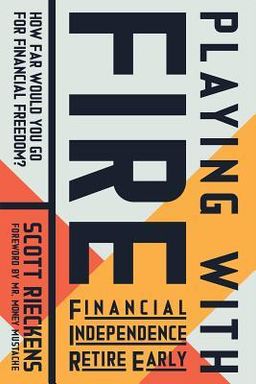
Playing with FIRE (Financial Independence Retire Early) cover

Playing with FIRE (Financial Independence Retire Early)

by Scott Rieckens

Playing with FIRE illuminates the path to financial independence and early retirement through the author''s personal journey and diverse examples. By changing spending and investing habits, readers can pursue their passions and lead more fulfilling lives. The book demonstrates that financial freedom is achievable for anyone committed to living intentionally.

Playing with FIRE: Escaping the Consumer Trap to Reclaim Freedom

Have you ever wondered why, despite making good money, you still feel trapped by work or constantly anxious about bills? In Playing with FIRE (Financial Independence Retire Early), filmmaker and author Scott Rieckens shares his candid, life-changing journey from burnout and overspending to financial independence and authentic happiness. His argument is simple but radical: the modern pursuit of success—bigger houses, newer cars, dream vacations—has locked many into a cycle of consumption that kills creativity, connection, and joy. The antidote, he contends, lies in the FIRE movement—Financial Independence, Retire Early—a global community focused on saving aggressively, spending intentionally, and buying back your most precious resource: time.

The Core Idea: Financial Freedom as Life Freedom

For Rieckens, FIRE isn’t really about early retirement; it’s about liberation from dependence on a paycheck. Once your investments generate enough income to cover living expenses, you’re free to focus on what matters—whether that’s family, creativity, or rest. Drawing on the pioneering work of Pete Adeney (known as “Mr. Money Mustache”) and other FIRE icons like JL Collins, Brandon Ganch (Mad Fientist), and Vicki Robin, Rieckens explores how intentional living, not endless accumulation, leads to fulfillment. As Robin observed in Your Money or Your Life, the problem isn’t that we don’t earn enough—it’s that we confuse consumption with happiness.

FIRE’s Simple Math: From Earnings to Independence

Rieckens lays out the shockingly simple math of FIRE: save and invest 25 times your annual expenses, and you can live off 4 percent of your portfolio indefinitely—the famous “4 percent rule” from the Trinity Study. In his case, he realized his family spent about $120,000 a year; by that logic, they’d need to save roughly $3 million to stop working. The moment he calculated this, something clicked. Early retirement wasn’t reserved for millionaires—it was just a matter of discipline and design. This insight transformed his obsession with finding a “million-dollar idea” into something more practical: financial independence is achievable through conscious choices, not luck or lottery wins.

From Consumerism to Conscious Living

Rieckens and his wife Taylor began this journey consumed by normal American dreams: nice cars, their Coronado beach life, and frequent dining out. Yet beneath the façade, they felt hollow. When Taylor’s distress at leaving their newborn, Jovie, for work collided with rising costs, they realized their definition of “doing life right” was actually a trap. Hearing Mr. Money Mustache’s story of living beautifully on $27,000 a year jolted Rieckens into questioning everything. His revelation echoes the Stoic and minimalist traditions (and modern research highlighted in The Nature of Happiness): accumulating things doesn’t yield meaning—agency and relationships do.

From Film to Philosophy: A Movement Spreads

Rieckens chronicled his transformation in both this book and the Playing with FIRE documentary, capturing the successes and stumbles along the way. The process involved quitting his job, selling possessions, leaving expensive California, and traveling with his family to discover what truly matters. They encountered FIRE’s biggest voices—Pete Adeney in Colorado, Vicki Robin in Washington, and JL Collins in Ecuador—and found a vibrant community of people redefining life on their own terms. This movement, once niche, has grown into a global phenomenon because it answers a universal desire: to reclaim autonomy and align money with meaning.

Why It Matters for You

Rieckens’ story functions both as confession and invitation. He doesn’t moralize about spending; instead, he shows how every financial decision reflects what we value most. Do we buy a BMW—or buy back years of freedom? By reframing wealth as time rather than stuff, he demonstrates that even small lifestyle shifts (cooking at home, using public transit, downsizing housing) can compound into long-term independence. Modern consumer culture sells comfort but trades away freedom. Playing with FIRE proposes that by embracing intentional living and rejecting “normal,” anyone can break the cycle and create a life rich in purpose and presence.

Across its chapters, the book charts Taylor and Scott’s evolution from indulgence to intention. You’ll encounter formulas, personal tensions, travel adventures, and emotional reckonings. But at its heart, this is a manifesto for modern self-mastery: a reminder that happiness isn’t something we buy—it’s something we build through clarity, courage, and conscious living.


The Consumer Trap: Redefining Success and Happiness

Rieckens begins with a startling observation: despite unprecedented wealth and prosperity, many Americans live anxious, debt-heavy, time-poor lives. We’ve mistaken “luxury” for fulfillment. In his foreword, Pete Adeney (Mr. Money Mustache) calls it the “consumerism trap”—a brilliantly marketed system where we trade freedom for gadgets and validation. The book’s early chapters unravel how the author and his wife Taylor, like countless families, fell prey to this illusion. Their story could be anyone’s: stable jobs, good salaries, and the nagging feeling there must be more.

From Comfort to Constraint

Scott and Taylor lived what looked like the American Dream. They rented a house in idyllic Coronado, California, owned two leased cars, ate out frequently, and took lavish vacations. They weren’t reckless per se—they avoided debt and contributed 10 percent to their 401(k)s. But their “if there’s money in the bank, go for it” mindset ensured they were perpetually broke despite high incomes. Taylor’s maternity leave exposed the fragility of it all: childcare costs exceeded reason, and the idea of returning to full-time work felt unbearable. This emotional crisis—more than financial strain—became the spark for transformation.

The False Promises of Attainment

Through reflection, Rieckens discovers what many modern thinkers (from Thoreau to Cal Newport) have echoed: each time we buy more to feel secure or important, we forfeit independence. The culture of perpetual comparison—what Adeney dubs “reality”—normalizes overwork so profoundly that we forget it’s optional. Even success metrics like promotions or homeownership are revealed as traps when they serve ego over utility. The problem isn’t wanting a good life; it’s not knowing when enough is enough.

Escaping Normal

When Rieckens heard Pete Adeney’s interview about living on $25,000 a year while “not feeling deprived,” something inside him cracked. He realized that the true breakthrough of FIRE isn’t frugality—it’s awareness. By interrogating every purchase, you ask: is this making me happier or simply poorer? For Scott and Taylor, it meant abandoning the illusion of San Diego paradise, selling their luxuries, and confronting their identity as consumers. In doing so, they rediscovered what Aldous Huxley called “the charm of limitation”—freedom found in less, not more.


The Math of Independence: The 4% Rule and Beyond

The cornerstone of financial independence is strikingly simple: spend less, save more, invest wisely. Rieckens demystifies the math through the lens of his awakening moment—learning about Mr. Money Mustache’s formula for early retirement. The essential principle is the 4 percent rule, derived from the Trinity University study: if you withdraw 4% of your total investments annually, your money can last indefinitely, assuming average returns of around 5% after inflation. To find your FIRE number, multiply your annual spending by 25. That’s your target portfolio.

Personal Realization: Living on $120,000 Costs $3 Million

When Scott calculated that his family was spending $10,000 a month—$120,000 yearly—he realized their magic number was $3 million. It wasn’t impossible, but it was absurdly far off given their paycheck-to-paycheck habits. The lesson was intuitive but transformative: independence is not about income, but the ratio between what you earn and what you keep. If they could cut expenses in half, their target—and retirement timeline—would be halved too. In practical terms, every expense reduction buys months or years of freedom.

Demystifying Fear: What If Markets Crash?

Taylor voiced the question everyone secretly worries about: what if the market collapses? Rieckens uses insights from FIRE experts like Michael Kitces and the Mad Fientist to explain why the math still holds. Historical data show that a diversified, low-fee index portfolio adjusted by modest withdrawals can weather recessions. Some opt for extra caution by saving 35x expenses or withdrawing only 3.25%. Flexibility—working part-time, reducing consumption, or delaying withdrawals—adds further resilience. The goal is never perfection but robust freedom.

Transformation Through Numbers

Numbers became motivation, not restriction. Using a retirement calculator, Scott illustrated to Taylor that halving expenses to $60,000 could shrink their work obligation from 34 years to just 11. Visualizing the trade-off—a decade of freedom—turned skepticism into action. The math became their moral compass, guiding decisions big and small.


Align Spending with Happiness: The Ten Things Exercise

One of the book’s most relatable exercises—borrowed from Vicki Robin’s teachings—is the Ten Things Exercise, a deceptively simple tool that exposes how far our spending drifts from our values. Scott asked Taylor to list the ten things that made her happy each week. Her answers—like hearing their baby laugh, sipping coffee together, and walking outdoors—cost almost nothing. None of the luxuries they worked so hard for appeared. This realization dissolved her resistance to FIRE more effectively than any podcast or spreadsheet could.

Values Over Validation

Rieckens highlights that financial independence isn’t about deprivation—it’s about alignment. By comparing the “Ten Things” list to their top expenses, the couple saw most of their money funded things that added little real joy. This gap between values and spending patterns is where financial anxiety thrives. Philosophically, the exercise recalls Stoic practices of premeditated simplicity: happiness arises when desire and reality match.

Conversation, Not Conversion

For couples, Rieckens notes, money can feel like a minefield. Many partners hear “budget” as criticism. Exercises like this reframe FIRE as a shared aspiration rather than a personal crusade. Once Taylor saw the emotional why behind the math—more time with Jovie, less stress—she didn’t just consent; she joined enthusiastically. The broader lesson: before cutting costs, connect them to what you genuinely care about.


Cut Ruthlessly, Live Richly: Learning Frugality

After embracing FIRE, Scott and Taylor faced the practical challenge of slashing spending. Their average monthly expenses exceeded $10,000, typical for professionals in an expensive city. The key was tackling both small habits and major lifestyle decisions—known in FIRE circles as “The Big Three”: housing, transportation, and food.

Redefining Needs vs. Wants

They began by confronting food costs. Home-cooked meals replaced daily Starbucks runs and restaurant dinners. Using tools like the “Latte Factor Calculator,” Scott quantified that his daily $6 coffee habit equated to over $130,000 lost to compounding over 30 years. They found joy in cooking and conversation, transforming what felt like austerity into connection. Even friends began noticing and adopting similar habits.

Facing the BMW and Boat Club

Large indulgences required tough love. The infamous “BMW saga” tested the couple’s resolve: a $400 monthly lease represented eighteen extra months of work. Taylor eventually agreed to give up the car after realizing each payment equaled lost time with her child. Similarly, Scott cancelled his cherished $6,000 boat club membership, learning the core economic principle of the sunk cost fallacy—past spending shouldn’t dictate future choices. These decisions were emotional milestones toward authentic freedom.

Intentional Community and Choices

Frugality spilled into social life. Dinners out became potlucks; indulgent vacations shifted to low-cost family road trips. FIRE, they discovered, isn’t about isolation—it’s about intentional joy. As their expenses halved, their savings rate soared past 50 percent, buying them flexibility and peace of mind unknown before.


Changing Environments, Changing Mindsets: Leaving Coronado

Ultimately, freedom required not just new spending habits but a new environment. California’s relentless cost of living made genuine financial progress impossible. Their decision to leave Coronado—an oceanfront paradise they once considered forever home—symbolized a psychological break from “normal.” By selling possessions, moving in temporarily with family, and hitting the road to explore affordable towns, they turned theory into practice.

The Power of Geo-Arbitrage

Through geographic arbitrage—relocating to lower-cost areas—they discovered homes in the Midwest and Pacific Northwest cost a fraction of California’s, without sacrificing quality of life. Living rent-free with parents and house-sitting dramatically boosted their savings. Critics saw freeloading; Scott saw resourcefulness. Along the way, they documented their experience in a FIRE documentary, attracting a supportive community that reinforced their resolve.

Facing Fear and Letting Go

Leaving was emotional, especially for Taylor, who struggled to abandon friends and familiarity. Yet each step—selling furniture, watching their BMW drive away, packing their lives into a car—was also liberation. By redefining success as flexibility instead of stability, they discovered that mobility itself is a form of wealth. Living lighter, they gained freedom to experiment without the weight of “stuff.”


Learning to Invest: The Simple Path to Wealth

Like many professionals, the Rieckenses once found investing intimidating. Their awakening came through conversations with JL Collins, author of The Simple Path to Wealth, and the FIRE community’s unanimous preference for low-cost index funds. Collins’ philosophy—that the market, over time, rises and complexity only costs returns—became their blueprint.

Index Funds and Simplicity

An index fund simply tracks the entire stock market, avoiding the high fees and low performance of most managed funds. Instead of chasing stock tips or hiring costly advisors, FIRE adherents invest steadily in funds like Vanguard’s VTSAX. Collins and even Warren Buffett argue that this approach outperforms 85% of professional managers. The Rieckenses realized their old fear of markets had cost them years of compounding growth.

Compound Interest: The Real Magic

They learned that every dollar invested early earns not just return, but return on return—what Einstein supposedly called the “eighth wonder of the world.” This changed how they viewed money: as employees working 24/7 on their behalf. Investing wasn’t gambling; it was cultivating a silent business partner for life.

Packaging Purpose with Profit

Different mentors in the book showcase varied paths: Collins champions index funds, Chad Carson uses real estate as community wealth-building, and Vicki Robin funds local microloans. The unifying idea: let your money serve your values. Whether in equities or rentals, the purpose isn’t to hoard wealth but to reclaim time and meaning.


Finding Community and the Psychology of FIRE

No major life shift succeeds in isolation. After scaling down, Scott and Taylor sought belonging among others who “got it.” FIRE gatherings like Chautauqua in Ecuador and Camp Mustache in Washington revealed an unexpected truth: this wasn’t just a financial movement—it was a philosophical and emotional one. They met Paula Pant (Afford Anything), the Mad Fientist, and Mr. Money Mustache himself, each teaching that purpose, not penny-pinching, sustains freedom.

Money, Mindset, and Meaning

At FinCon and Chautauqua, veteran FIRE advocates discussed privilege, psychology, and the true aim of independence. Liz Thames (Frugalwoods) reminded them systemic barriers exist but intentional habits can still yield power. Pant’s mantra—“You can afford anything but not everything”—distilled FIRE’s ethos. These encounters shifted Scott’s view from math to mindset: wealth is the ability to choose deliberately.

Avoiding the Frugality Trap

In Iowa, after months of extreme saving, the couple hit emotional fatigue—questioning if life without restaurants or Christmas gifts was worth it. Through mentors like Brandon Ganch, they learned the goal isn’t to suffer; it’s to balance joy with intention. “Happiness is the only logical pursuit,” Pete Adeney wrote. They adopted flexibility: spend on what enriches life, cut what doesn’t. FIRE’s real victory lies in psychological peace, not rigid deprivation.


From Dream House to Dream Life

The final chapters chronicle the couple’s settlement in Bend, Oregon—a practical paradise aligning beauty, affordability, and simplicity. Yet even here, temptation returned. A “dream house” priced $100,000 beyond budget seduced them into rationalizing overspending again. Recognizing this relapse, they withdrew the offer, reaffirming a hard truth: financial independence demands constant vigilance against lifestyle inflation.

Getting the Big Things Right

Referencing financial planner Michael Kitces, Rieckens concludes that success hinges on mastering the big expenses—housing, transport, health—not obsessing over lattes. Once those are under control, “you can buy the coffee.” Their $420,000 modest home allowed comfort without compromise: a FIRE home that served life, not the other way around.

Freedom Redefined

A year after leaving San Diego, they reached a 70% savings rate, a net worth of $300,000, and a ten-year path to full independence. Bend became the symbol of FIRE achieved—not through excess, but equilibrium. Independence is not escape from work but the ability to choose work that matters. As Rieckens writes in closing, once you’ve tasted freedom, you can’t untaste it—once you’ve seen “the trap,” you can’t unsee it.

Dig Deeper

Get personalized prompts to apply these lessons to your life and deepen your understanding.

Go Deeper

Get the Full Experience

Download Insight Books for AI-powered reflections, quizzes, and more.