
Idea 1
Building, Transforming, and Reinventing Dell
Building, Transforming, and Reinventing Dell
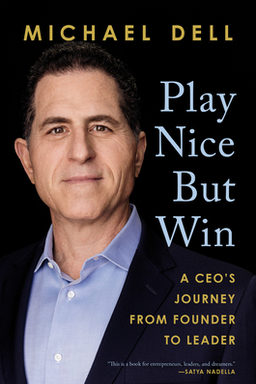
What makes a founder capable of steering a company from dorm-room hustle to multibillion-dollar transformation decades later? In Play Nice But Win, Michael Dell explains this through his own journey: how curiosity, operational precision, governance mastery, and bold strategic reinvention turned Dell from a PC assembler into a global technology and infrastructure powerhouse. The narrative traces not only the external growth—from PCs to servers to cloud—but also the internal evolution—culture, governance, leadership, and resilience.
From idea to enterprise
The book begins with Dell’s teenage ventures that fused curiosity and sales hustle. Upgrading PCs for local customers, selling newspaper subscriptions through data-driven targeting, and turning technical tinkering into a business taught him to combine engineering with entrepreneurship. That DNA—the ability to integrate customer insight, technology, and process—never left. By building directly for customers and avoiding retail markups, Michael pioneered the direct model, allowing Dell to deliver configured systems faster and cheaper than rivals.
That direct model became the first major innovation in Dell’s journey, anchoring its early moat: low inventory, rapid cash cycles, and strong supplier relationships. Yet success created complexity. As Dell scaled, growth exposed weaknesses in cash control, compliance, and product quality. Each crisis—whether the FCC’s manufacturing halt or a flaming computer incident—forced the company to institutionalize what had been instinctive: process discipline, bar-coded quality systems, and professional financing.
Scaling and surviving
Scaling beyond early hustle meant attracting experienced leaders and fixing broken systems. CFO Tom Meredith shifted focus from pure growth to liquidity and profitability. Mort Topfer and Kevin Rollins introduced operational discipline, while engineers repaired notebook failures and product recalls with rigorous testing. These stories show the maturity curve: you move from making things work to making them repeatable under pressure. Dell learned to balance speed with structure—a tension every growing company faces.
Problems became lessons in adaptability. The IBM patent conflict in 1988 taught Dell that innovation without legal strategy is perilous. Signing a license while hiring IBM veteran Glenn Henry gave Dell the know-how and legitimacy to compete. Each episode reinforced the principle that growth isn’t only technical; it’s also legal, cultural, and organizational.
Transformation at scale
By the mid-2000s, Dell faced declining PC margins and shifting customer priorities toward storage, virtualization, and services. Michael’s vision shifted: he wanted Dell to be an end-to-end IT solutions firm. Through acquisitions like EqualLogic, Compellent, Perot Systems, and SecureWorks, Dell gradually built enterprise capabilities. However, investors focused only on short-term profit dips and commodity PC metrics, undervaluing long-term bets. Going private in 2013 became the mechanism to remove that constraint.
The go-private process itself became a masterclass in governance and persistence: creating independent special committees, handling activist resistance from Carl Icahn, negotiating with Silver Lake, and surviving litigation. When Dell and Silver Lake finally closed the deal at $13.75 a share, it wasn’t just financial engineering—it was about recovering strategic freedom. Michael described the result as transforming Dell into “the world’s largest start-up,” capable of investing for decades rather than quarters.
Reinvention through EMC and VMware
The next reinvention arrived with Project Emerald—the 2015 acquisition of EMC and its majority stake in VMware for over $60 billion. It united Dell’s hardware expertise with EMC’s storage mastery and VMware’s virtualization leadership. Creative financing, including the VMware tracking stock, made the impossible deal feasible. The merger created Dell Technologies, a hybrid infrastructure giant positioned for the cloud era. Dell’s strategic posture shifted from product to platform, combining hardware, software, and services around data center modernization.
Purpose, culture, and continuity
Beyond balance sheets, Dell emphasizes culture and ethics. Initiatives like the “Soul of Dell,” launched after 9/11 and the dot-com bust, restored internal purpose through shared values—customer focus, respect, and learning. Later, philanthropy through the Michael & Susan Dell Foundation extended those values globally, tackling education and health for underserved children, while Dell Technologies pursued sustainability and circular innovation goals.
Throughout, leadership consistency anchors the narrative. Dell advocates curiosity, resilience, and facts over ego. Whether surviving activist campaigns, product failures, or global crises like COVID-19, his reflection is constant: lead with humility and build for the long term. Every shift—from PC components to cloud ecosystems, or from profit obsession to purposeful innovation—demonstrates how reinvention is not a one-time act but a continuous state of learning and adaptation.
Core insight
Michael Dell’s story reveals that durability in enterprise comes from seeing every stage—startup, scale, transformation, privatization—as an opportunity to unlearn and rebuild. The lesson is simple: the best way to stay relevant is to keep redesigning your company as if you were starting it all over again.