
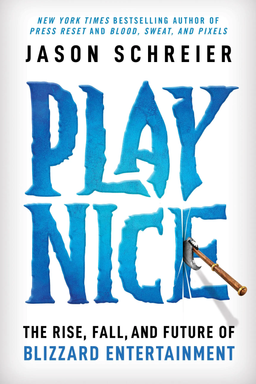
Play Nice cover

Play Nice

by Jason Schreier

The Blizzard Paradox

How do you keep the magic of a small, renegade studio as it grows into a global entertainment company? This book argues that Blizzard’s story is a paradox: the chaotic, gameplay-first culture that created The Lost Vikings, Warcraft, Diablo, and StarCraft also sowed the seeds of later problems—corporate friction, cultural blind spots, and product stumbles. You watch a studio built by Allen Adham, Mike Morhaime, and Frank Pearce evolve from a handful of friends in Irvine into a corporate pillar inside Activision Blizzard, with the shift changing how decisions get made, how games are operated, and how success is measured.

At its core, the book contends that Blizzard thrived when it protected two ideas: “management by chaos” (structured informality that privileges hands-on play and rapid iteration) and “gameplay first” (polish, accessibility, and depth guided by the “donut theory”). But as the company scaled, those values collided with the demands of live operations (World of Warcraft), corporate financialization (post–Vivendi buyback under Bobby Kotick), and a longstanding boys’ club culture that eventually triggered public scandal. The narrative takes you from garage-like teams to a machine tuned for predictability, and shows how both postures can be right—and wrong—depending on context.

Origins: Chaos that ships

You start with Silicon & Synapse/Chaos Studios: Adham’s “Velvet Hammer” calls, Morhaime’s pragmatism, and a crew that playtested obsessively. Decisions formed in marathon debates where deep gamer literacy (Dune II, Street Fighter) mattered more than titles. That approach led to rapid pivots—Warcraft began as a Dune II riff—and embedded multiplayer instincts that later defined Battle.net. It worked because the team could iterate quickly without corporate drag.

Philosophy: Gameplay first and the donut

Allen Adham’s “donut theory” targeted the hardcore center as evangelists and the mainstream ring as the market. The mantra “easy to learn, difficult to master” guided Warcraft II’s approachability, Diablo’s real-time pivot (from Condor’s turn-based pitch), and Mike O’Brien’s decision to make Battle.net free at a time when networks charged per hour. The result was a flywheel: low friction grew communities that evangelized Blizzard’s polish (compare to Nintendo’s clarity-first design; both put player experience ahead of short-term monetization).

Scale: From products to platforms

World of Warcraft transformed Blizzard from ship-and-move-on into operate-and-expand. Subscriptions demanded server capacity, 24/7 support, analytics, and monthly/annual content. WoW’s success created gravity that pulled talent and attention, delaying other franchises. It also professionalized parts of the studio—game masters, live ops cadences, BlizzCon—without fully replacing the informal norms that had served small teams.

Ownership: Corporate pressure arrives

Multiple sales—Davidson & Associates (stability and resentment over equity), CUC/Cendant (accounting fraud that vaporized stock-based wealth), Vivendi (hands-off but distant), and finally Activision (franchise predictability)—reshaped incentives. After 2013’s Vivendi buyback, Kotick and Brian Kelly had outsized influence. Finance, led by Armin Zerza, embedded KPIs, long-range planning, and monetization cadence inside teams. The language of “craft” shared the table with “LTV” and “ASP,” often uncomfortably.

Culture: Strengths and blind spots

The same late-night, all-in camaraderie that bonded teams also excluded many. A boys’ club ethos—strip-club trips, porn in shared spaces, men-only bathrooms—normalized behavior that harmed women and quieter colleagues. Over time, permissive norms and opaque HR responses eroded trust. The 2021 California lawsuit and “A Better ABK” walkouts catalyzed a reckoning that reshaped leadership and public perception (similar to industry-wide shifts after #MeToo).

Crest and trough: Failures, pivots, and reinvention

Blizzard’s resilience shows in Diablo III’s painful launch (Error 37, real-money auction house backlash) and methodical redemption (auction house removal, Reaper of Souls). It shows in Hearthstone’s skunkworks rise under Team 5. And it shows in Overwatch, born from Titan’s ashes after scope bloat, clashing visions (Rob Pardo vs. Chris Metzen), and “seagull management” killed a seven-year, ~$80M MMO. Yet success also attracted overreach: the Overwatch League tried to graft a traditional sports model onto an evolving FPS and later collapsed.

Key idea

Blizzard wins when small, empowered teams chase player joy; it stumbles when financial cadence, cultural complacency, or runaway scope outruns clarity of vision.

Across these chapters, you learn how to protect creative conditions, scale operations without crushing soul, and integrate finance without letting it dictate fantasy. You also see why culture is product: who you hire, how you behave, and what you reward all show up in the games you make (Mary Kenney’s point about representation and authenticity echoes throughout). If you lead teams, Blizzard’s paradox is your case study: keep the chaos where it helps, build systems where it hurts, and never forget that gameplay—not spreadsheets—creates the durable moat.


Management by Chaos

Blizzard’s origin myth is a tiny Irvine office where arguments double as design workshops and everyone ships code. Allen Adham and Mike Morhaime pooled about $20,000, hired Frank Pearce, and survived on ports before creating original games like The Lost Vikings. Their process—what Adham later called “management by chaos”—is structured informality: long debates, playtesting as truth, and a founder who decides when consensus breaks.

You see how this works in practice. Meetings morph into design labs. People reference a shared canon (Dune II’s base-building, Street Fighter’s input tightness) and can’t hide ignorance. Heated exchanges—even fistfights—end in decisions that move the game forward. In a small, expert team, chaos accelerates iteration because communication is fast and feedback is visceral. The Lost Vikings’ three-character puzzle loop and Pat Wyatt’s mouse shortcuts come from exactly this pressure cooker.

Why chaos works—until it doesn’t

Chaos privileges domain masters and rewards rapid prototyping. You don’t waste time on slide decks; you ship something you can feel. That’s how Warcraft pivots from a Dune II experiment to a multiplayer-first RTS that feels modern. But chaos scales poorly. Ad-hoc hiring means cliques form; mentorship is inconsistent; less assertive voices get trampled. The “Velvet Hammer” (Adham) could quickly unblock decisions, but centralized judgment also meant uneven treatment (Andy Weir’s firing is a cautionary tale about a culture that valorizes aggression over structure).

Playtesting over market research

Blizzard internalized an axiom: you learn more from a dozen engaged playtests than a hundred survey forms. The Lost Vikings’ in-store demo that killed players in seconds taught them to fix onboarding before polish. That instinct echoes later: Warcraft II simplifies inputs without sacrificing strategic depth, and StarCraft’s asymmetry gets tuned through brutal internal ladders (a foreshadow of Battle.net eloquent matchmaking). (Note: This mirrors Valve’s “playtest is design” mantra and Supercell’s small-team testing culture.)

Costs you carry forward

The boys’ club tone—late nights, brawls, and off-color humor—built camaraderie and velocity. It also institutionalized exclusion. Early success masked missing systems: HR lacked teeth, conflict resolution relied on personal relationships, and power flowed to charismatic leads. These debts come due as teams grow and acquisitions stack (Davidson, CUC/Cendant, Vivendi). The very chaos that shipped early hits later clashes with the need for transparent processes and inclusive norms.

If you apply it today

You can harness chaos by bounding it. Keep small strike teams (6–15 people) with clear decision owners. Use “playable every week” cadences to force concrete learning. Pair craft leaders with operations partners who build humane schedules, HR safety nets, and equitable promotion paths. The lesson isn’t to abandon chaos; it’s to institutionalize the parts that create insight and retire the parts that create harm.

Key idea

“Management by chaos” is a creative engine, not a company. Build scaffolding—mentorship, HR, and inclusive rituals—so the engine doesn’t burn people as fuel.

If you’re leading a startup-like team inside a larger org, adopt Blizzard’s early superpowers—deep gamer literacy, fast iteration, strong product taste—while explicitly countering the weaknesses: set norms that protect quiet thinkers; rotate facilitation so debates don’t reward volume; and commit to decisions with time-boxed experiments (“Allen decisions” become “owner calls” with review gates). That way, your chaos ships—and your people stay.


Gameplay, Donut, Battle.net

Blizzard’s product spine is “gameplay first,” operationalized through Allen Adham’s “donut theory.” Picture a donut: the hole is hardcore players—the evangelists who master depth and teach others. The ring is the broader audience—the sales you need. Your job is to design for both at once: approachable onramp, durable mastery. This simple diagram explains why Blizzard delayed games, simplified inputs, and invested in infrastructure that grew communities before it grew revenue.

Design for hole and ring

You start with empathy for the first 5 minutes. The Lost Vikings’ instant-death demo taught Blizzard to remove cheap shots from intros. Warcraft II embraced clarity—bigger silhouettes, cleaner UI—so anyone could command armies quickly. Yet underneath, mastery abounded: macro vs. micro trade-offs, fog-of-war reads, and faction personalities that kept experts theorycrafting. Diablo’s pivotal shift—from Condor’s turn-based prototype to real-time—made every click a dopamine hit, while loot tables delivered long-tail depth. (Note: “Easy to learn, hard to master” echoes Sid Meier’s and Miyamoto’s philosophies.)

Battle.net as a product choice

Technical investment can be design. Mike O’Brien’s Battle.net removed friction: free accounts, quick matchmaking, global chat, later rankings. At a time when services charged hourly, Blizzard bet on player goodwill compounding through community. Diablo and StarCraft flourished because online play felt effortless and social. Giving it away looked naive to some publishers; in hindsight, it was strategic: free network effects made the box more valuable and the brand sticky.

“Ready when it’s ready”—and its bill

Blizzard’s mantra wasn’t arrogance; it was a guardrail. When a feature didn’t serve both donut segments, it slipped. That stance missed holiday windows (Diablo slipped past Christmas), angered shareholders, and stressed teams—but it built trust with players. You can see the compounding return: fans showed up for BlizzCon; they bought expansions; they followed Blizzard into new genres (Hearthstone) and platforms because they learned to expect polish.

Trade-offs and tensions

This philosophy becomes harder under live-service demands and quarterly expectations. StarCraft’s iterative balance and Diablo III’s systemic fixes take time; Activision wants predictability. Finance teams ask for pack bundles, loot boxes, and more frequent beats; designers defend frictionless fun and fair ecosystems. Heroes of the Storm exemplifies the knife-edge: it removed “sharp edges” to be inclusive, but some players missed the skill expression of rivals (Riot/Valve). Navigating this line requires ruthless clarity on what you’re optimizing for—reach, retention, or reputation.

How you can use it

Apply the donut test to every major choice: does your onramp remove confusion without flattening depth? Do your systems reward mastery without punishing newcomers? Invest in “invisible” infrastructure—matchmaking, anti-cheat, social tools—that makes your game feel like a place. Price monetization after you earn trust. And when you must delay, communicate like Jeff Kaplan did for Overwatch: open, human, specific. Trust is Blizzard’s most valuable currency; gameplay-first is how they minted it.

Key idea

Design the donut: protect approachability and mastery equally—and build the rails (like Battle.net) that let both groups find each other.

The pattern repeats from Warcraft II to StarCraft, from Diablo to Hearthstone. Where Blizzard honors the donut, it wins adoption and longevity. Where it compromises—by adding friction for revenue or removing depth for broadness—it risks eroding the trust that made the brand special.


Two Cultures, One Company

Blizzard’s success came from two creative engines that didn’t always mesh: Irvine’s polish-first, QA-heavy craft and Blizzard North’s improvisational, loot-driven experimentation. When Irvine acquired Condor (renamed Blizzard North), you got Diablo’s dark, replayable dungeons and addictive identification mechanics under David Brevik—and you also got cultural friction that eventually closed the studio. If you’ve ever integrated an acquisition, this is your cautionary tale.

North: Embrace the mess

Blizzard North prioritized fast iteration and emergent fun. Randomized dungeons, rare loot, and post-launch patching defined Diablo’s magic. The team tolerated bugs if the core loop sang. Designers argued with code in hand. The studio’s cultural texture—edgy, scrappy, sometimes chaotic—produced risk-taking that felt different from Irvine’s curated aesthetic.

Irvine: Curate and polish

Irvine pursued clarity, balance, and QA rigor. Battle.net’s reliability, Warcraft’s readable art, and StarCraft’s famously tuned asymmetry reflected a belief that problems should be fixed before ship. This mindset created trust with players and predictable quality—but it also clashed with North’s tolerance for post-launch fixes and grim palette choices.

Flashpoints and fallout

Fights erupted over art direction (Diablo’s darkness vs. lighter stylization), engine decisions (one or two 3D pipelines?), and shipping philosophy (patch later vs. polish now). Communication broke down. In 2003, heavyweights—Brevik, Max and Erich Schaefer, Bill Roper—resigned, and by 2005 Blizzard North collapsed. Corporate leadership prioritized consistency and control, preserving Irvine’s approach but losing North’s experimental energy and institutional memory.

Integration lessons for you

Two successful cultures can be incompatible if governance is vague and respect is thin. To integrate creative orgs, you need explicit charters: who decides art direction, who owns tools, how you resolve ship-criteria conflicts. Preserve local strengths by ring-fencing autonomy where it creates value (e.g., let a loot team own drop cadence) and standardize where friction hurts players (e.g., anti-cheat, network). Create cross-site rituals that build shared context—rotations, dual-site playtests—so disagreements ride on trust rather than power.

The broader pattern

You see this tension again with Heroes of the Storm vs. League/Dota, with Overwatch’s tight team resisting the sprawl of a franchised league, and later with Classic Games (Warcraft III: Reforged) struggling under under-resourcing. When leadership can’t reconcile process differences, departures follow—and with them, the tacit knowledge that often matters more than any asset. (Note: Pixar and Marvel both show the opposite—clear creative leadership paired with mechanisms that channel disagreement into integration rather than exits.)

Key idea

Integration fails when you try to make one studio behave exactly like another. Build bridges, not clones.

If you’re merging teams, set governance and kill criteria early, protect the weirdness that creates hits, and invest in communication scaffolds. Blizzard kept shipping blockbusters—but it paid a price in talent churn and lost optionality after North’s departure.


From Product to Platform

World of Warcraft didn’t just launch a massive MMO; it rewired Blizzard into a platform operator. A guided, quest-based design (“all cake all the time”) welcomed mainstream players into Azeroth and unleashed growth—1.5 million subscribers fast, then many more. But the choice to run a subscription world turned shipping into operating: servers, customer service, analytics, content cadences, and community events became core competencies.

Design that scales socially

WoW traded sandbox obscurity for clear quest hubs, approachable classes, and lore-fueled accessibility. You didn’t need a spreadsheet to enjoy it. That intentional clarity (inherited from the donut theory) produced not just players, but communities: guilds, raids, and PC bangs in Korea transformed the game into a social ritual. Viral moments like Leeroy Jenkins and a South Park cameo showed how WoW penetrated mainstream culture.

Operate, don’t just ship

Running WoW forced Blizzard to industrialize. It hired game masters, built server farms, and stood up analytics teams to track churn and engagement. Monthly patches and expansion cycles turned “content treadmill” from a metaphor into a planning artifact. BlizzCon emerged as both fan service and marketing engine, cementing a two-way conversation with players that few studios had mastered at the time. (Note: This shift resembles Netflix’s move from licensing to original content—ops muscle becomes strategic.)

Gravity and trade-offs

Live service gravity pulls. Resources and veterans gravitated to WoW and its expansions, sometimes starving other projects (StarCraft II delays, Diablo III trade-offs). Operating a global service also increased exposure to regional politics (e.g., StarCraft II’s struggle with KeSPA in Korea). Blizzard became excellent at sustaining a world—but the cost was attention, optionality, and occasionally, the novelty that defined earlier eras.

What you can learn

If you shift from product to platform, redesign your org. Split builders from operators but rotate talent to cross-pollinate. Build analytics that inform design without dictating it. Pace expansions so cadence serves craft, not just revenue. Invest in trust-building rituals (events, transparent patch notes) and service reliabilities (anti-cheat, server stability). Live services magnify both your strengths and your debt—culturally and technically.

Key idea

Platforms demand new muscles: customer support, analytics, and community stewardship. If you don’t build them, success will break you.

WoW proved Blizzard could operate at industrial scale and monetize predictably. It also made the company a different creature—one that would later wrestle with annualization pressures and the complexities of esports and franchising.


Titan’s Fall, Overwatch’s Rise

Titan is Blizzard’s cautionary epic: a seven-year, ~$80M odyssey undone by clashing fantasies, runaway scope, and diffuse leadership. From its ashes, a small team led by Jeff Kaplan distilled a crisp, character-first hero shooter—Overwatch—that reasserted the power of focused constraints. If you’ve watched big bets stall and small bets soar, this arc will feel familiar.

When vision fragments

Titan couldn’t decide what it wanted to be. Rob Pardo saw secret-agent intrigue; Chris Metzen leaned superhero epic. Writers cycled drafts; the “core fantasy… constantly changing,” as Jason Repp recalled. Meanwhile, the project tried to be two games: a civilian life sim (“Titan Town” with fishing, gardening, business ownership) and a deep MMO with complex PvE/PvP classes. Artists poured out thousands of assets—“enough for five games”—without integration. Seagull management (leaders swoop in with critique, then leave) sapped momentum. Eventually, Pardo departed in 2014 after internal pressure and a conversation with Morhaime. The collateral damage? Talent diverted for years, opportunity costs across the portfolio, and morale drag.

Small, playable, lovable

From Titan’s wreckage, Team 4 grabbed one strong shard—the hero classes—and reframed it as a first-person, Team Fortress 2–inspired shooter. Kaplan’s crew focused on two things: expressive characters (Tracer, Mercy, Winston) and feel-first maps and modes. Chris Metzen’s Pixar-like shorts gave you an emotional doorway. At a pivotal meeting, Bobby Kotick stared at the cast portrait and said, “These are the most unique characters I’ve ever seen,” flipping exec sentiment. Art—and clarity—won budget.

Community-first launch

Overwatch’s beta drew nearly 10 million players. Kaplan’s candid developer videos built trust. Weekly beats, polished cinematics, and careful timing (May 2016) created a cultural event. The game quickly cleared a billion dollars and won Game of the Year. The formula was simple, not easy: narrow scope, characters with soul, and transparency that invited players along for the ride. (Note: This echoes Respawn’s Apex Legends surprise launch but with a heavier pre-launch community handshake.)

Success attracts obligations

Winning made Overwatch a target for scale. Activision pitched the Overwatch League: city-based franchises, big fees, a broadcast product. Team 4 resisted bloat; Kaplan favored tight onboarding and creative control. The tension between a handcrafted game and a sports-entertainment machine would define the next chapter—showing how a beautiful product can be pulled into a business model that strains its design DNA.

Key idea

Ship a lovable vertical slice with a strong fantasy and protect it from scope creep. When you win, prepare governance for the new stakeholders success invites.

Titan teaches you to kill projects earlier, appoint accountable directors, and set integration milestones. Overwatch reminds you that constraints and characters can do what tech bloat can’t: make people care. Together, they’re a blueprint for recovering from a moonshot gone wrong.


Finance, KPIs, Esports Misfit

After the 2013 Vivendi buyback, Bobby Kotick and Brian Kelly gained control and demanded predictability. That corporate pivot filtered down through Armin Zerza’s finance reorg—MBAs from McKinsey, commercial leads embedded in teams, and a new vocabulary: LTV, ASP, cadence, long-range planning. Blizzard’s craft-first instincts now shared the table with quarterly guidance, and the tension reshaped products and priorities.

From craft to cadence

Finance asked teams to map 3–5 year roadmaps and justify features with revenue projections. Hearthstone’s Team 5 fielded pressure around pack bundles and sales beats. Heroes of the Storm adopted virtual currencies and loot boxes. The goal wasn’t evil; it was predictability. But the effect was cultural drift: developers felt judged by spreadsheets, not play. The old “ready when it’s ready” rhythm collided with “what can we book this quarter?” (Compare to EA’s shift toward live services; both reorient design around monetization cadence.)

Annualization pressure

Kotick’s history with Call of Duty, Tony Hawk, and Guitar Hero informed a push for repeatable outputs—WoW expansions on schedule, sequel timetables, and more live beats. Blizzard leaders like Morhaime pushed back to protect polish. But long-range planning stuck, changing how ideas earned greenlights and how teams staffed to hit predictable beats. Creativity narrowed as risk tolerance shrank.

Esports goes big—and breaks

The Overwatch League embodied corporate ambition: $20M franchise fees, city-based teams (Robert Kraft, Stan Kroenke), and a broadcast-grade product. Nate Nanzer and colleagues envisioned mainstream sports analogs. But structural mismatches surfaced. Overwatch is a frenetic FPS—hard to watch compared to traditional sports. Team 4 resisted deep commercialization (team skins, owners’ separate sponsorships), frustrating franchisees. Viewership spiked, then slid; players preferred playing to passive watching. By late 2023, owners voted the league down. The NFL-of-games dream met the reality of evolving, patchable products and fragmented digital audiences.

What this means for you

Financial discipline can help focus, but when finance “speaks last,” it changes products. Use KPIs as instruments, not ideology: measure retention to inform design, not dictate it. For esports, fit the business model to the game: is it watchable, stable, and narrative-friendly? If not, support community-driven circuits first, keep costs light, and monetize through in-game cosmetics aligned with teams and players. Don’t drag a grassroots medium into a franchise model before product-market fit for spectators exists.

Key idea

When you financialize creativity, you must rebalance your governance—otherwise cadence crowds out craft, and models outrun mediums.

The post-buyback years show a company negotiating with Wall Street logic while trying to keep a player-first soul. Sometimes it worked (predictable expansions); sometimes it cracked (Overwatch League). The lesson isn’t “finance bad”; it’s “finance must be yoked to fun.”


Reckoning, Erosion, Renewal

Blizzard’s cultural reckoning and quality stumbles reveal how internal norms and resourcing choices surface in products. The early frat-house vibe—drinking, hazing, porn in shared spaces, men-only bathrooms—bonded teams but excluded and harmed women. Over time, opaque HR practices and power entanglements (executives dating subordinates) compounded grievances. When public pressure arrived, the gap between the company’s myth and its reality snapped.

The breaking point

In July 2021, California’s DFEH sued Activision Blizzard over systemic discrimination and harassment. Employees organized walkouts and formed “A Better ABK,” pushing leadership for accountability. Investigations and leadership churn followed (J. Allen Brack out; Jen Oneal and Mike Ybarra in; Oneal soon departed). A Wall Street Journal report alleged Bobby Kotick knew of certain misconduct and didn’t fully inform the board, intensifying scrutiny. The Blitzchung controversy (punishing a Hearthstone player who supported Hong Kong protests) and the “Cosby suite” article further damaged trust.

Product signals: cracks and comebacks

Warcraft III: Reforged became a case study in misaligned scope and underinvestment. Classic Games, led by Rob Bridenbecker, aimed high—new art, cinematics, script edits—but headcount cuts, layoffs, and tight timelines doomed delivery. Features vanished; the original Warcraft III was pulled from Battle.net; community outrage spiked; Metacritic cratered. By contrast, World of Warcraft Classic succeeded because it honored a narrow promise: authenticity. Brian Birmingham’s team reconstructed an old state and shipped the nostalgia fans asked for—manual group-finding, rough edges, social friction that creates bonds.

Redemption patterns

Diablo III’s turnaround is Blizzard at its best under pressure. After Error 37 and auction-house backlash (Jay Wilson took public heat and even threats), the team listened, removed the auction house, retuned loot, and shipped Reaper of Souls—winning players back. Hearthstone’s origin—Team 5’s small, protected unit—shows how sheltering skunkworks can birth fresh successes even as larger systems strain. StarCraft II’s South Korea struggles remind you that external institutions (KeSPA broadcasts) can bound a product’s cultural impact regardless of polish.

Rebuild playbooks for you

To repair culture, decouple complaint handling from line management, publish transparent compensation bands, and measure managers on inclusion and retention, not just delivery. To repair product trust, right-size scopes (especially for remasters), co-design with communities on legacy titles, and prioritize fidelity before revisionism. Protect small teams that can move without the drag of the machine—and give them clear, humane gates to scale.

Key idea

Culture is product. If your rituals exclude or your incentives erode craft, players will feel it—first at the edges, then at the core.

Blizzard’s later years—scandal, Microsoft’s acquisition context, leadership shifts—close the loop from a chaotic, brilliant startup to a chastened giant relearning first principles. The playbook is there: protect small teams, honor the donut, kill scope that muddies fantasy, and put players back in the room where decisions happen.

Dig Deeper

Get personalized prompts to apply these lessons to your life and deepen your understanding.

Go Deeper

Get the Full Experience

Download Insight Books for AI-powered reflections, quizzes, and more.