
Idea 1
Plain Talk and the Power of Simplicity in Leadership
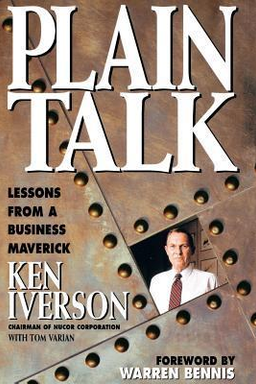
When you look around your workplace, do you ever wonder why so many organizations feel suffocated by bureaucracy, politics, and complicated hierarchies? In Plain Talk: Lessons from a Business Maverick, Ken Iverson, the longtime CEO of Nucor Corporation, argues that business doesn't need to be so complex—or so self-serving. His core claim is deceptively simple: success in business comes from trusting people, rewarding performance, destroying hierarchy, and keeping operations small, flexible, and humane.
Iverson contends that most of the conventional wisdom on corporate management—command-and-control leadership, excessive specialization, and hierarchy—kills motivation and innovation. Over his decades leading Nucor, he proved that ordinary people could accomplish extraordinary results when freed from the shackles of bureaucratic nonsense. His philosophy became a living case study: a steel company that never laid off employees, maintained industry-leading productivity, and did it all while paying workers top dollar.
This book invites you to rethink how you define leadership. It's not about charisma or flashy vision statements but about cultivating trust, autonomy, and fairness. Iverson’s way of managing embodies Warren Bennis’s definition of leadership as social architecture—the design of an environment where people can thrive creatively and ethically.
From Chaos to Culture: Nucor’s Reinvention
When Iverson joined Nuclear Corporation of America in 1962, it was a tangle of failed experiments and lost direction. Bankruptcy looked inevitable. He revived it not with grand strategy but with moral clarity and common sense—selling off unprofitable businesses, focusing on Vulcraft’s steel operations, and moving headquarters to Charlotte, North Carolina. Nucor emerged from this crucible leaner and more focused, operating on the principle that every worker should earn according to their productivity and be treated with respect.
Iverson demonstrates how simplicity leads to resilience. Nucor had just twenty-two people at headquarters overseeing thousands of employees—an example of radical decentralization that other CEOs would call reckless. Yet, as the company grew from regional obscurity to one of America’s steel giants, Nucor thrived with minimal management layers. The result: extraordinary morale, efficiency, and innovation.
The Human Side of Steel
Iverson’s vision isn’t just operational—it’s profoundly humanistic. The book opens with molten metal and workers rallying around a “shared purpose.” This image mirrors Nucor’s ethos: a team forging something powerful together. During the steel recession of 1982, Iverson practiced what he called “pain-sharing”—executives took drastic pay cuts so hourly workers could keep their jobs. He was proud to be listed as the lowest-paid Fortune 500 CEO that year. That act of solidarity became a defining feature of Nucor’s identity, proving that motivation and loyalty hinge on fairness, not fear.
Iverson presents leadership as stewardship—a moral duty to ensure the company’s survival for future generations. His long-term perspective contrasts sharply with the short-term profit obsession of Wall Street. “We’re not dogs on a leash,” he’d tell analysts. “We’re eagles. We soar.” This long-term mentality guided Nucor through downturns, technological leaps like thin-slab casting, and decades of profitability.
A Blueprint for Modern Leadership
Throughout Plain Talk, Iverson offers more than anecdotes; he provides a new framework for leadership grounded in equality and autonomy. He dismantles status symbols—executive parking, gold hard hats, lavish offices—and urges leaders to “destroy hierarchy.” He advocates decentralization (“trust your instincts”), smallness as strength, experimentation over perfection, and ethics over politics. Each idea reinforces his belief that motivated people—not policies or procedures—are the true engines of progress.
Iverson’s Core Philosophy
“Good managers make bad decisions,” Iverson once joked, meaning that leaders must be willing to fail in service of progress. He saw missteps not as corruption of strategy but as the price of innovation. His organization’s success stemmed from decentralization—letting each division manage itself, make mistakes, and learn fast.
Ultimately, Plain Talk reveals a rare kind of corporate wisdom: success isn’t built by superstars at the top but by respect and responsibility shared among all. Iverson reminds you that every great company is, at heart, a community. If you cultivate honesty, equality, and courage—not just profit—you’ll discover the power of simplicity that built one of America’s most extraordinary businesses.