
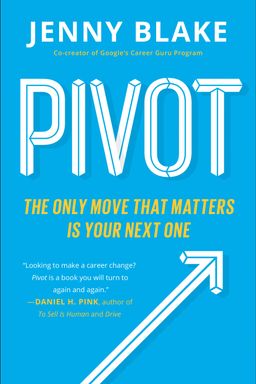
Pivot cover

Pivot

by Jenny Blake

In ''Pivot'', Jenny Blake presents a four-step approach to navigating career transitions, helping individuals and managers alike to adapt and thrive in changing professional landscapes. Through real-life examples and practical advice, discover how to plant, scan, pilot, and launch your next career move with confidence and clarity.

Pivoting as the New Plan A: Reinventing Work and Growth

What do you do when what used to work no longer does—when your career feels stalled even though you’ve done everything “right”? In Pivot: The Only Move That Matters Is Your Next One, Jenny Blake argues that the answer is not to start from scratch, but to pivot intentionally. She contends that in an age of constant disruption—where people change jobs every few years, technology reshapes industries overnight, and traditional career ladders have collapsed—learning how to pivot is no longer Plan B. It’s Plan A.

Blake defines a pivot as “doubling down on what is working to make a purposeful shift in a new, related direction.” Drawing inspiration from Eric Ries’s startup model in The Lean Startup and from her own journey leaving Google to become an entrepreneur, she presents a method for navigating transitions without succumbing to fear or burnout. Rather than quitting everything in a blaze of glory, Blake teaches you how to build from where you are—using your existing strengths as your launchpad for what comes next.

A World Built on Change

Blake opens by diagnosing a simple truth: stability is gone. Most people face multiple job and career changes, often by necessity rather than choice. Modern work has become project-based, fluid, and fast-moving. The illusion of lifelong corporate loyalty has vanished, but for many, this realization leads to frustration and paralysis rather than opportunity. Blake flips this anxiety on its head, offering practical optimism: if you learn how to pivot well, you can thrive amid uncertainty instead of being crushed by it.

She compares traditional careers to old-school desktops—fixed, predictable, and slow-moving—while modern careers resemble smartphones: modular, flexible, and customizable. Each skill or experience functions like an app. You can install new ones as needed and update your operating system (your mindset) whenever life demands it. The key is to master the process of upgrading so you can adapt to change smoothly rather than chaotically.

The Pivot Method: Four Stages of Intelligent Movement

At the heart of Blake’s system is the Pivot Method, inspired by basketball players who pivot on one planted foot while exploring passing options. You keep one foot grounded—anchored in your values and strengths—while exploring new directions with the other. This structure breaks down into four stages:

  • Plant: Establish your foundation—your values, vision, and strengths—so you know what matters and what’s already working.
  • Scan: Explore new opportunities, build skills, and connect with people to discover possibilities aligned with your core strengths.
  • Pilot: Run small, smart experiments to test your ideas before making major changes. These low-risk trials give you real-world data.
  • Launch: Commit to a decisive move once you've gathered insight, reducing risk and maximizing reward.

Blake also adds a fifth stage—Lead—for managers and organizations to apply the same method as a coaching framework, creating workplaces where employees can pivot internally rather than leaving altogether. This stage turns pivoting into a shared language for leadership and growth.

The Mindset Behind the Method

Beneath the process lies an essential psychological shift: embrace uncertainty. Blake challenges you to stop seeing career confusion as failure and start seeing it as data—information that helps refine your next move. Drawing from Carol Dweck’s concept of the growth mindset, she positions change not as something to fear but as the natural consequence of ambition. Impact-driven professionals, whom she calls impacters, thrive when they lean into growth and contribution rather than clinging to security.

Core Insight

Pivoting is not abandoning the past—it’s using it as fuel. You don’t leap blindly into the unknown; you build bridges using the materials you already have.

Throughout the book, Blake reframes fear and uncertainty as creative allies. She emphasizes that clarity emerges through action, not endless analysis. When you pilot intelligently, you move from theory to learning, gathering feedback in small increments until you’re ready to launch with conviction. And when you do launch, failure becomes feedback, not catastrophe.

Why Pivoting Matters

Ultimately, Pivot argues that agility is the defining skill of the twenty-first century. The people who flourish—not just survive—are those who know how to update, test, and evolve continuously. Whether you’re leaving a corporate role, starting a business, or redefining your position within an organization, mastering the Pivot Method turns chaotic change into a deliberate, empowering process.

This isn’t a call to reckless risk-taking or impulsive career hopping. It’s a practical guide to sustained evolution—a map for anyone ready to stop spinning in uncertainty and start moving forward with intention. By the end, Blake promises that you’ll not only be prepared to answer “What’s next?”—you’ll learn how to love asking the question.


Plant: Build on What’s Already Working

When life feels chaotic, Jenny Blake insists you shouldn't start over—you should start where you're strong. The first stage of her Pivot Method, Plant, is about grounding yourself in what’s already working. This stage helps you identify your core values, vision, and strengths so you can make changes from stability rather than anxiety. As Blake puts it, “Ignoring what’s working will leave you spinning your wheels in the mud.”

Clarify Your Compass: Values and Vision

Blake describes values as your internal GPS—the decision filters that define what matters most. Without clear values, every career crossroad feels confusing. Through exercises like “values mining,” she invites you to free-write about times you’ve felt fulfilled, proud, or energized, then look for patterns. A strong value set becomes the lens for evaluating your next step: does it align with your principles or violate them?

From there, your vision gives direction to those values. Rather than asking “Where do you see yourself in five years?”—a question Blake calls outdated—she recommends focusing on a tangible one-year vision. People can rarely predict future industries, but they can imagine short-term outcomes. For instance, Julien Pham, a physician-entrepreneur in the book, crafted a vivid one-year scene: leading a healthcare startup, speaking at TED, mentoring other clinicians. Within months of writing it, his vision materialized almost exactly as planned.

The Tyranny of the Hows

One major obstacle early on is what Blake calls “the tyranny of the hows”—the tendency to spiral prematurely into logistics. People ask, “How will I make money? How will I quit? What if it doesn’t work?” These questions invite panic before purpose. In the Plant stage, you deliberately delay the “how.” The focus is instead on the what: what success looks like next year, what impact excites you, what actions express who you want to become. You’ll handle the mechanics later, during Pilot and Launch, when you have data rather than just fear.

Define Success with Give–Receive–Achieve

To shape an inspiring one-year vision, Blake offers the Give–Receive–Achieve framework:

  • Give: What impact do you want to have on others—your family, team, or society?
  • Receive: What rewards or experiences will come back to you in the process?
  • Achieve: What milestones or tangible results will show that you’re succeeding?

This pragmatic blend connects purpose with measurement—something Blake learned at Google, where culture emphasized both inspiration and metrics. She encourages imagining your future in the present tense, saying “I am…” instead of “I will be,” because writing like it’s already true trains the mind to act accordingly.

Knowns and Unknowns

Finally, Blake suggests listing your knowns and unknowns—what you’re certain about versus what’s still unclear. For example, she knew New York was her home (a known), but her business model was undetermined (an unknown). Clarifying both helps contain ambiguity. You realize where you can make decisions right now and where experimentation is still required. This practice anchors your pivot while acknowledging reality.

Planting doesn’t mean standing still—it means grounding yourself so you can move with purpose. As Ralph Waldo Emerson wrote and Blake echoes: “Trust thyself; every heart vibrates to that iron string.”

By the end of this stage, you have a foundation of clarity—a sense of inner stability that lets you explore outward confidently. Money concerns, fear, or self-doubt still exist, but you’ve replaced vague anxiety with actionable direction. You know what you’re building toward, and that’s enough to begin scanning the horizon for what’s next.


Scan: Explore Options and Build Momentum

Once your Plant foot is grounded, Blake moves to the second stage—Scan—the phase of structured exploration. Now you gather information, connect with people, and identify promising opportunities. Scanning transforms curiosity into momentum by expanding your knowledge, skills, and network without commitment yet.

Networking Without the Sleaze

Blake dismantles the popular dread around “networking.” She cites studies showing that even the word itself makes people feel dirty. Instead, she reframes it as building authentic connections. The most successful pivoters use their existing relationships and reputations, not cold emails, to open new doors. For example, Shawn Henry, a former FBI executive who pivoted thirteen times within the bureau, expanded his “sphere of influence” by mastering each role and nurturing connections incrementally. When change arrived, opportunities found him because he had already earned trust through contribution.

Bolster Your Bench

Blake encourages assembling your “bench”—a mix of one-off mentors, friendtors, mastermind groups, and advisory boards. A friendtor is a peer who inspires you and offers reciprocal support, while a mastermind group provides accountability through regular check-ins. For instance, Lora Koenig joined one of Blake’s ten-week courses where participants met weekly to share progress. Within six months, she pivoted from product management to agricultural development in Ethiopia through the Peace Corps. This collective accountability, Blake notes, “turns isolation into courage.”

Investigative Listening

Scanning also means listening deeply before you act. Drawing inspiration from Brené Brown’s concept of grounded theory, Blake advises observing real experiences first, then drawing conclusions. Ask open-ended questions: What are people struggling with? What opportunities catch your attention? Marques Anderson, a former NFL player, used investigative listening to launch the World Education Foundation. Instead of imposing Western solutions, he immersed himself in local communities across 51 countries, listening before leading. His pivot succeeded because it was rooted in empathy, not ego.

Bridge the Gaps: Learn How to Learn

In scanning, you also identify skill gaps. But Blake warns against perfectionism—waiting until you feel “ready.” She references Josh Kaufman’s The First 20 Hours to emphasize that rapid skill acquisition often comes from focused practice, not long credentials. By improving your ability to learn itself, you stay agile in a changing economy. Blake reminds us that technology can make any skill obsolete quickly; therefore, learning how to learn is the ultimate superpower.

Make Yourself Discoverable

Another part of scanning is visibility—being “discoverable” like a Bluetooth device. You don’t need fame, but you need a visible platform so opportunities can find you. Whether it’s blogs, social media, or speaking engagements, sharing your expertise builds momentum. Blake’s own website, JennyBlake.me, became her discovery engine after leaving Google. Similarly, photographer Daniel Kelleghan gained clients overnight when his Instagram account was featured, proving that visibility compounds success.

Scanning is not aimless searching—it’s strategic curiosity. You look inward to your strengths and outward to opportunities, merging both into momentum.

By the end of the Scan stage, you’re informed, connected, and energized. You’ve turned uncertainty into potential directions. Now it’s time to stop researching endlessly and start testing those ideas—with action.


Pilot: Experiment with Purpose

After scanning the horizon, Blake moves to Pilot, the experimentation stage. Here you run low-risk tests—small bets that help you gather feedback before committing fully. Drawing from Eric Ries’s Lean Startup, she introduces the concept of a minimum viable pilot (MVP): the simplest way to test whether an idea works.

Start Small and Scrappy

Blake argues that waiting for perfect conditions is the enemy of progress. Pilots can be simple: taking on a short freelance project, testing a service with one client, or taking a class tied to a new interest. Pamela Slim’s experiment running a community-building workshop tour across 23 cities began as a small test; it evolved into a core part of her business. “Launch and iterate,” Blake says—get something out, then improve it based on feedback.

Three Criteria for a Strong Pilot

According to Blake, smart experiments share three qualities:

  • They connect to your strengths and vision.
  • They start small and lean in cost and energy.
  • They tip the risk scales in your favor—offering high potential upside, low downside.

This principle mirrors Nassim Taleb’s idea of optionality in Antifragile: take asymmetric risks where you have more to gain than lose.

Examples in Action

Blake highlights Ryan White (alias Bob Gower), a consultant who tested a niche idea—a beginner’s bondage guide—before investing heavily. Rather than launching a full brand, he created a free PDF and monitored interest. The data revealed limited appeal, saving him months of overcommitment. Likewise, Christian Roberts and Bill Connolly piloted a comedy show called Angry Landlord, using each low-attendance flop as feedback. By revising their format and marketing, they sold out future shows and launched careers aligned with their passions.

Incremental and Organizational Pilots

Pilots work inside companies too. Seth Marbin, frustrated with his Google role, proposed a volunteer initiative called GoogleServe. His small pilot became a global program with 14,000 participants, later landing him a full-time philanthropy role. Blake calls this “a fourfold win”: the employee grows, the company benefits, the community thrives, and momentum builds sustainably.

The Fauxspiration Trap

A common pitfall is mistaking research for progress. Reading endlessly or planning perfectly can masquerade as movement. Blake calls this fauxspiration—getting inspired without taking action. She urges turning curiosity into creation: even one experiment holds more value than a dozen brainstorms that never leave the page.

Every pilot, Blake reminds us, “removes the pressure of finding the perfect next move.” Small actions bring clarity faster than big dreams ever will.

By the end of the Pilot stage, you’ve replaced abstract ideas with real-world data. Failures become refinements, and each test sharpens your understanding of what “hot” really feels like. You’re ready to scale up—to launch.


Launch: Build Courage Through Action

Eventually, you reach the moment every pivoter anticipates—and fears—the Launch. This is when you commit to your next direction. Blake emphasizes that courage doesn’t precede the leap; it follows it. Her mantra: “Build first, courage second.”

Timing: How to Know You’re Ready

Blake outlines four categories of decision criteria: financial benchmarks (enough savings or side income), date-based timing (fixed decision deadlines), progress milestones (tangible indicators like clients or prototypes), and gut instinct (you simply know it’s time). When all align—or when your intuition outweighs fear—it’s time to launch.

She shares stories like Tom Meitner’s: tired of long shifts and separation from his spouse, Tom committed to replacing his income within a month through freelance writing. By sending hundreds of emails, he secured clients and crossed the $3,000 mark within three weeks. Action replaced anxiety.

The Pivot Hexagon

Blake presents a useful mental model called the Pivot Hexagon, based on the project management triangle. It maps six reciprocal values: security vs. freedom, money vs. time flexibility, and structure vs. adventure. Sometimes you must sacrifice one to gain the other. Recognizing which values matter most helps you make trade-offs consciously rather than reactively.

Dealing with Risk and Regret

In the launch phase, fear of failure often spikes. Blake responds with practical psychology: regret is worse than failure. Jeff Bezos’s “regret minimization framework” guides this thinking—project yourself to age 80 and ask what you’d regret more, trying and failing or never trying at all. Most realize the second option is unbearable.

For those hesitant to leave roles too soon, Blake discusses unrealized gains (potential rewards worth waiting for) versus diminishing returns (continued effort with little benefit). Melissa Anzman, for instance, stayed two years too long at a side gig that drained her joy. Once she quit, her business flourished. The lesson: don’t wait for safety when stagnation robs growth.

Listen to Your Gut

Blake expands the metaphor literally: the gut has a brain. She cites neurological research showing the gut contains 500 million neurons and communicates with the head-brain through the vagus nerve. Your gut, she says, acts as “the guardian of your boundaries and core identity.” Learn to distinguish intuition (inner wisdom) from anxiety (fear of the unknown). When your body says it’s time to move, listen.

Courage is not the absence of fear—it’s taking one smart step despite it. Each launch exposes your resilience, creativity, and resourcefulness. That proof becomes fuel for the next pivot.

By separating decision-making from fear, and by respecting trade-offs realistically, you turn a high-stakes leap into a measured stride. Once launched, uncertainty remains—but now, it feels exhilarating rather than paralyzing.


Lead: Turning Pivot Into a Shared Culture

After mastering personal pivots, Blake extends her method to leaders. The Lead stage teaches how managers can apply the Pivot framework to career coaching and organizational development. The goal is to turn individual agility into a collective advantage.

The Lost Art of Career Conversations

Blake recalls her own regrets: she wished she had spoken with her first CEO about growth before quitting. Many managers avoid career conversations due to fear—of losing talent or making promises they can’t keep. Yet data shows these talks directly increase engagement and retention (Gallup reports that regular meetings triple worker satisfaction). Managers who listen and guide rather than dictate become magnets for top performers.

Using the Pivot Method as a Coaching Tool

Managers can use the Pivot Method’s four stages in coaching sessions. They help employees identify what’s working (Plant), explore next steps (Scan), design experiments (Pilot), and discuss timing (Launch). This transparency turns change from threat to collaboration. Companies like Google and Chanel, where Blake’s peers work, demonstrate this model by allowing employees to shift teams or invest “10 percent time” in new projects.

Creating a Pivot-Friendly Culture

A culture of pivots thrives when leaders encourage autonomy and adaptability. Blake outlines simple programs organizations can pilot: lunch-and-learn workshops, internal-mobility initiatives, reverse mentoring, volunteer weeks, and “fund-a-goal” incentives (as at Lululemon). These programs keep employees learning and contributing, instead of stagnating. “People leave managers, not companies,” she reminds us—so teach managers to coach with curiosity.

Adaptability as Survival Skill

Blake closes by quoting Dr. Tom Guarriello: “There is no org anymore. The org is an emergent entity that reconfigures itself around opportunities.” In this world, coaching conversations and shared agility aren’t luxuries—they’re survival tools. The same skills that serve your personal pivot also sustain innovation within teams.

Leading with a Pivot mindset means helping others find momentum, not dictating their path. It builds organizations that evolve as fast as their people.

In the end, Blake’s message to leaders mirrors her message to individuals: don’t wait for perfect clarity. Create conditions for experimentation and trust. That—more than any static plan—keeps teams resilient in a world that pivots daily.


Flip Failure and Celebrate Complexity

The final theme of Pivot reframes what most people dread: failure. Blake argues that fear and doubt are not problems but proof that you’re in your stretch zone. Her chapter “Flip Failure” explores how to transform setbacks into lessons, concluding with a call to “celebrate complexity.”

Redefining Failure

Rather than pretending failure doesn’t exist, Blake defines it personally—dishonesty, self-betrayal, or giving a half-hearted effort. Financial loss or rejection only counts as failure if you stop learning. Shawn Henry’s story illustrates this: after four rejected FBI promotions, he pivoted to cybersecurity, eventually leading the agency’s Cyber Division. Rejection wasn’t a dead end—it was course correction.

Mining Strengths from the Wreckage

When something fails, Blake advises returning to the Plant stage to identify what still works. Dave Ursillo’s first book flopped, but his true joy—writing—revealed a hidden direction. He launched a writers’ community that became profitable. “Failure,” Blake writes, “is feedback on skills, not on self-worth.”

People-Pleasing and Courage

Another form of failure is people-pleasing. Many avoid pivots to keep others happy. Blake, echoing Brené Brown’s vulnerability research, suggests naming your five Most Important People (MIPs)—those whose opinions truly matter. Everyone else’s judgment can’t dictate your decisions. When you act authentically, you trade approval for peace.

The Continuous Pivot and the Courageous Life

Ultimately, there’s no final destination. Every launch leads to another pivot. Blake’s conclusion—“Pivot is the new Plan A”—urges ongoing experimentation across life stages. She ends with the metaphor of knots: complex tangles aren’t frustrations but intricate designs waiting to be untied. Her client Brian, once stuck at a career plateau, realized his PhD in knot theory was the perfect metaphor; complexity was his craft.

“Life does not give us what we want; it gives us what we need,” Blake concludes. Pivots are those needs in motion—each knot teaching resilience, resourcefulness, and grace.

By choosing courage repeatedly, you stop fearing the unknown and start decoding it. Complexity becomes a feature, not a flaw—a sign that your life is fully alive, constantly evolving, and brilliantly unfinished.

Dig Deeper

Get personalized prompts to apply these lessons to your life and deepen your understanding.

Go Deeper

Get the Full Experience

Download Insight Books for AI-powered reflections, quizzes, and more.