
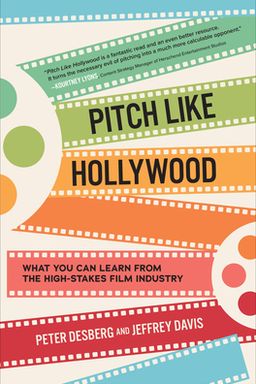
Pitch Like Hollywood cover

Pitch Like Hollywood

by Peter Desberg and Jeffrey Davis

Pitch Like Hollywood demystifies the art of pitching, revealing how Hollywood''s storytelling and persuasion techniques can be universally applied. Whether selling a script or a business idea, learn to captivate any audience and boost your pitching success.

The Hollywood Secret: Turning Pitches into Powerful Stories

Have you ever tried to convince someone of an idea and wondered why logic alone didn’t work? In Pitch Like Hollywood: What You Can Learn from the High-Stakes Film Industry, Peter Desberg and Jeffrey Davis argue that persuasive power doesn’t come from data—it comes from emotion, story, and performance. Drawing on decades of experience teaching screenwriting and psychology, they reveal how the film industry’s most persuasive insiders—from producers to writers—have turned the anxiety-ridden act of pitching into an art that can be applied anywhere: from boardrooms to classrooms to everyday negotiations.

Pitching Is Not Selling

Desberg and Davis dismantle the common misconception that pitching is about hard selling. Instead, they treat it as a form of storytelling and problem-solving. Hollywood pitch meetings aren’t won by presenting endless spreadsheets or technical details; they’re won when you make your audience lean forward, emotionally invested in what happens next. The authors show that a great pitch blends intellect and emotion—it uses narrative tension, conflict, and character in the same way film scripts do. Like Neil Simon’s The Odd Couple, every pitch needs a protagonist (your idea) and an antagonist (the problem or risk standing in its way).

Why Hollywood Is the Ultimate Laboratory

Hollywood is the authors’ testing ground because, as they note, it’s one of the toughest and most scrutinized pitching environments in existence. The stakes are astronomical—a single yes can launch careers, while a no can end them. By studying how writers and producers persuade executives to commit millions to uncertain ventures, Desberg and Davis demonstrate principles transferable to any industry. Whether you’re pitching an app, a campaign, or a new product, you face the same psychological barriers: fear of rejection, confirmation bias, and audience skepticism. Hollywood offers the perfect case study in handling those pressures with creativity and grace.

Three Foundations of a High-Impact Pitch

The authors identify three pillars that make the Hollywood pitch uniquely powerful: persuasion, stage fright management, and emotional storytelling. First, persuasion isn’t manipulation—it’s guiding the decision-maker toward feeling that your idea matches their goals. Second, stage fright (what they call Pitch Panic) is universal, but can be transformed through psychological tools and preparation. Third, emotional storytelling—constructed through hooks, conflict, and structure—is how you make ideas unforgettable. Just as Daniel Kahneman’s Thinking, Fast and Slow explains how emotional “fast thinking” drives decisions, Desberg and Davis show that successful pitches connect with that instinctive, intuitive system, not just rational thought.

The Science Behind Persuasion

You’re surrounded by persuasion daily—marketing, media, politics, even social conversations. The authors remind us that modern persuasion research, from Dale Carnegie to Kahneman, demonstrates that people rarely change their minds through logic alone. Instead, they’re influenced through emotional cues, story resonance, and likability. When you craft a pitch, your audience’s brains instinctively mirror yours if your story works, creating what neuroscientists call “speaker-listener coupling.” That’s why storytelling outperforms fact sheets.

Why This Matters Beyond Hollywood

Whether you’re an entrepreneur, teacher, or creative professional, Desberg and Davis show that pitching is no longer industry-specific—it’s a universal skill. Kickstarter campaigns, Shark Tank episodes, and even political speeches echo the same principles. By combining research on persuasion, psychology, and creativity with unforgettable Hollywood anecdotes—like Will Smith selling The Fresh Prince of Bel-Air at Quincy Jones’s birthday party—the book teaches you how to move from selling data to telling a captivating, memorable story.

Core Message

Pitching is storytelling in miniature—an emotional conversation that invites collaboration rather than confrontation. By combining persuasion psychology, narrative structure, and emotional intelligence, you can get anyone to not just hear your idea, but remember it and desire to be part of it.

In short, Pitch Like Hollywood is both a practical manual and a psychological journey. It teaches you to craft stories that tap into human emotion, conquer performance fear, and convert skeptical audiences into allies—all lessons born from the most pressurized creative marketplace in the world.


The Hollywood Pitch Formula

Desberg and Davis reveal that Hollywood’s pitching success boils down to one key technique: using story structure to make complex ideas vivid and persuasive. Just like films, compelling pitches follow the three-act format—setup, conflict, and resolution. Regardless of whether you’re presenting a tech startup or a film concept, structuring your pitch this way turns it from an information dump into a cinematic experience.

Act I: The Hook and Logline

Your opening must catch attention, or your pitch dies. The hook is a short, sharp statement that makes people curious (“Saving your friend from suicide could kill you”). The logline then sets up the story’s conflict—a brief sentence showing what drives the narrative (“Two guys, one neat, one messy, move in together and relive their worst marital habits”). You can apply the same principle to startups: capture interest with a paradox (“Luxury is a lie”) and explain the problem your idea solves (“Audi redefines luxury as choice, not status”).

Act II: Escalating Conflict

The second act is where tension rises. Desberg and Davis emphasize that pitches must illustrate obstacles—not just solutions—because conflict drives curiosity. For example, in the story-driven app pitch Nutritious N Delicious, the conflict is between taste and health. Explaining failed past attempts heightens suspense before revealing the solution. In business, this means showing the pain points your idea resolves and letting the audience feel them firsthand.

Act III: Resolution and Call to Action

Finally, you resolve the problem and demonstrate why your solution matters emotionally and practically. It should end with a clear “what’s next” moment—a call to action, partnership, or investment. The resolution should evoke satisfaction, not just understanding. When Lynne Grigg’s agency pitched Audi, her team performed theatrically, integrating multi-platform visuals and live energy so the executives felt part of the vision. That emotional connection turned into a six-year contract.

The Drama of Rejection

Hollywood also teaches humility: rejection isn’t failure—it’s feedback. Brahms’s publisher rejected his Hungarian Dances; a rival published them, making a fortune. In pitching, rejection often signals poor story alignment, not poor ideas. Desberg and Davis urge you to view objections as opportunities to clarify your narrative and invite collaboration.

Takeaway

Every effective pitch mirrors great storytelling: a compelling hook, emotional tension, and resolution that invites action. If your audience isn’t leaning forward wondering what happens next, you haven’t truly pitched—you’ve just described.


Persuasion as Psychology, Not Performance

Salesmanship is outdated, argue Desberg and Davis. What drives decisions isn’t performance—it’s psychology. Chapter by chapter, they translate decades of persuasion research into practical advice, explaining how human cognition and emotion intersect inside every pitch. This isn’t manipulation; it’s understanding how people make choices under uncertainty.

Central vs. Peripheral Route

Borrowing from psychologist Richard Petty’s Elaboration Likelihood Model, they show that persuasion travels two routes: the central route, which uses logic and evidence, and the peripheral route, which relies on emotional and aesthetic cues. When stakes are high—like pitching Boeing or a film studio—listeners engage their central route. But when attention or energy is low, peripheral cues (your confidence, tone, and visuals) dominate. They even cite a study proving people rate heavier clipboards as containing better resumes—proof we judge weight as “importance” unconsciously.

Cognitive Ease vs. Strain

Daniel Kahneman’s distinction between Cognitive Ease and Cognitive Strain appears throughout the book. When information feels easy to process, people feel safe and rationalize agreement; when it feels complex, skepticism rises. Your job is to design your pitch for ease—clear slides, bold colors, simple language—to keep your listeners in an emotional “flow” state rather than doubt. Yet when you want deep engagement, occasional “strain” wakes up intellect, prompting thoughtful evaluation.

Mood and Persuasion

Mood affects our openness. In one cited study, students in good moods solved creative problems twice as fast as unhappy ones. Hollywood’s secret is using emotion to build that mood early—humor, surprise, empathy—so audiences process ideas intuitively before logic intervenes. Comedians warm up live shows for this very reason, priming the room before the pitch begins.

Bottom Line

In persuasion, ease equals trust. Simplicity, clarity, and emotional flow aren’t niceties—they’re cognitive levers. If listeners must work hard to understand you, they won’t believe you. Make your pitch easy to process, and their intuition will do the rest.


Defeating Pitch Panic: Conquering Stage Fright

What good is a great idea if anxiety ruins your delivery? Desberg—himself a clinical psychologist—dedicates nearly a third of the book to understanding and managing stage fright, or what he brilliantly names Pitch Panic. Through humor, neuroscience, and behavioral exercises, he dissects how fear hijacks both your body and your mind—and how practice, reframing, and physiological regulation can bring calm back.

Understanding Anxiety’s Manual

Anxiety isn’t malfunction—it’s misdirection. Our brains evolved to fight or flee from danger, not present ideas under fluorescent lights. When fear triggers the amygdala, it diverts blood from the brain to limbs, leaving you dizzy, sweaty, and tongue-tied. Realizing it’s just outdated biology helps depersonalize the fear. As Desberg quips, “You haven’t read the manual.”

Prediction and Panic

Fear begins with negative predictions: you imagine failure, embarrassment, rejection. The authors classify this as Stage One of the Pitch Panic Cycle. Each thought fuels physiological evidence (“my heart’s racing, therefore it must be bad”), creating a feedback loop of fear. Breaking that cycle requires consciously reframing those predictions—turning “they’ll hate this” into “they’ll challenge this.”

The Role of Practice

Preparation rewires fear. Overlearning your opening moments creates automaticity—the brain’s ability to act without conscious thought. Like concert pianists who mark breathing points on their sheet music, you should rehearse until muscle memory overrides anxiety. The authors recommend “distraction training”: practicing with interruptions, alarms, or phone calls so your focus survives real-world chaos.

Reframing the Rush

Desberg invokes cognitive therapy and humor. Professionals call their adrenaline “excitement,” amateurs call it “fear.” The physiological symptoms are identical; only the label differs. Calling it excitement transforms panic into energy. The authors even cite research showing students who were told their anxiety would improve test performance scored higher. Reframing changes outcomes.

Practical Moral

Fear is fuel—manage it don’t mute it. When you label panic as excitement and practice until reflexes replace thoughts, your anxiety becomes the very energy that propels your best performance.


Preparation is Persuasion

By the time you enter a pitch meeting, success is already decided—by your preparation. Desberg and Davis elevate preparation to a psychological discipline: knowing your audience, researching their values, anticipating objections, and adapting to demographics. It’s less about rehearsing lines and more about investigating minds.

Know the Catcher

Every pitch has a “catcher”—the decision-maker. Study them as deeply as method actors study roles. Jasmine Bina, a brand strategist cited by the authors, researches journalists’ tweets and readings to locate emotional hooks for her pitches. Her insight: when you challenge rather than flatter someone’s beliefs, you create genuine conversation instead of sterile selling.

Social Proof and Timing

Researching agreement matters. People prefer conformity; citing others who support your direction reduces psychological risk. Reference credible peers, trending data, or examples of success to invoke social proof (a concept backed by psychologist Robert Cialdini). Time also matters: pitch early in the day, when decision fatigue is low, and glucose levels are stable.

Cultural and Age Awareness

In Japan, building relationships precedes agreement; in the U.S., results drive relationships. Age matters too—older executives expect competence, younger ones value enthusiasm and digital fluency. Jim Press, former Toyota COO, observes that calm logic earns respect in Asia, while charisma helps in America. Adapting your emotional tempo to context is strategic empathy, not pandering.

Key Lesson

Preparation isn’t about memorizing—it’s reconnaissance. When you know who you’re pitching to, their culture, their fatigue level, and their biases, you can plant your story exactly where their intuition wants to believe it.


Practicing for the Real Room

Practice, as Desberg and Davis write, is not repetition—it’s simulation. To perform under pressure, you must rehearse in the same conditions where you’ll pitch. They call this state-dependent learning: your brain recalls best when environment and emotion match training.

Distraction and Sequence

Expect interruptions—a phone buzzing, an executive yawning. Practice recovering mid-pitch without restarting. This keeps working memory anchored. Musicians practice stopping and starting phrases; you must do the same with key talking points so composure stays intact when reality intrudes.

Overlearning and Enthusiasm

Repetition leads to freedom. Once content feels automatic, you can focus on tone, body language, and responsiveness. The authors advise humorously exaggerating enthusiasm—“cartoon-level excitement”—then dialing it down to natural passion. Passion sells more than perfection; it signals belief. As screenwriter John Brancato says, “Find something you care about. Once you find your passion, the rest is craft.”

Group Feedback

Form “pitch circles”—friends or colleagues who test ideas and give blunt feedback. Realistic critique redefines fear as collaboration. Listen the way Hollywood executives do: to assess not just content but demeanor.

Core Reminder

Practice under stress, not safety. The closer rehearsal feels to the chaos of the real room, the calmer and sharper your instincts will be when stakes rise.


Creativity and Collaboration

In the final sections, Desberg and Davis return to creativity—the heartbeat of persuasion. They summarize groundbreaking research by organizational psychologists Kimberly Elsbach and Roderick Kramer, who analyzed Hollywood pitches to reveal how executives categorize creative personalities and decide whom to trust.

How Executives Categorize You

In any pitch, you’ll be mentally classified as one of four archetypes: showrunner (charismatic and collaborative), artist (eccentric but authentic), neophyte (promising newcomer), or nonwriter (slick yet desperate). Awareness of these stereotypes lets you shape your persona strategically. Excess polish breeds distrust; visible passion earns credibility. Even Tim Burton’s table-perch during a Disney meeting embodied “artist energy”—odd but compelling.

Collaboration Beats Perfection

Executives buy teamwork, not talent alone. When they offer suggestions, many rookies resist, fearing compromise. Yet suggestions signal engagement—proof your idea provoked creativity. Accepting feedback gracefully transforms pitch adversaries into allies. Nicole Fox calls this creative empathy: listening for “the note beneath the note,” uncovering what investors or producers truly want behind surface comments.

Cognitive Dissonance and Cooperation

Interestingly, the authors explain the phenomenon of cognitive dissonance: when people invest energy or favors in your project, they start liking it more to justify their effort. Asking for small help—opinions, contacts—builds psychological buy-in. It mirrors Dale Carnegie’s advice to make others “want” to help, not feel obligated.

Essential Conclusion

Pitching is collaboration disguised as persuasion. By showing creativity through authenticity, accepting partnership, and provoking ideas from others, you turn selling into co-creation.


In the Room: Presence, Empathy, and Momentum

The book culminates in a masterclass on “being in the room”—how to enter, engage, and adapt in the high-stakes moment of delivery. Bridging the gap between rehearsal and reality, Desberg and Davis teach psychological presence: the ability to connect instantly while maintaining composure.

Bridging and Breathing

Before entering, use “bridging”—mentally shifting from your everyday self to your performing self. Like actors breathing before scenes, visualize success, oxygenate, and regulate nerves. The authors compare it to Mark Twain’s comment: “He who won’t read has no advantage over one who can.” Preparation only matters if activated when needed.

Empathy and Eye Contact

Empathy replaces performance anxiety with connection. Boeing executive John Tracy’s story illustrates this: a lawyer pitched him with humor and empathy, understanding his fear of brand liability. Her emotional intelligence sold him more effectively than technical claims. Make balanced eye contact, listen actively, and never begin with apologies—self-handicapping only triggers scrutiny. Show curiosity, not caution.

Responding Under Stress

Finally, take time to think when challenges arise. Experienced professionals pause before answering, demonstrating composure. Slower responses imply depth. Stress may disrupt your neural cooperation, but breathing stabilizes cognition. Remember: if your audience pushes, it’s engagement, not rejection.

Final Lesson

When the door opens and you step in, charisma equals calm. Empathy, presence, and curiosity turn performance into conversation—and conversation into persuasion.

Dig Deeper

Get personalized prompts to apply these lessons to your life and deepen your understanding.

Go Deeper

Get the Full Experience

Download Insight Books for AI-powered reflections, quizzes, and more.