
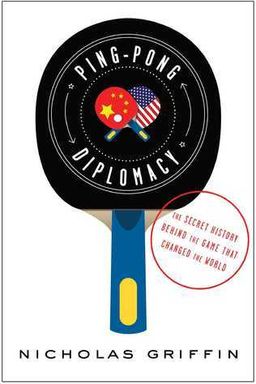
Ping-Pong Diplomacy cover

Ping-Pong Diplomacy

by Nicholas Griffin

Ping-Pong Diplomacy by Nicholas Griffin explores how a seemingly trivial sport became the linchpin of a significant diplomatic breakthrough. Discover how a simple game helped dismantle decades of US-China hostility, highlighting the influence of individuals like Ivor Montagu in altering the world''s political landscape.

Table Tennis as Global Politics and Cultural Power

Table Tennis as Global Politics and Cultural Power

This book tells an extraordinary story: how a simple game, table tennis, became an instrument of political power, espionage, and diplomacy across the twentieth century. It unveils how cultural gestures can act as geopolitical levers — how Ivor Montagu’s vision created institutions that carried Communist ideals, how China transformed sport into propaganda, and how a single exchange in 1971 reshaped Cold War strategy. You move from parlors to palace banquets, from student clubs to state-engineered spectacles, connecting personalities, technologies, and ideologies through the bounce of a small ball.

The origins: Ivor Montagu and the politics of play

The story begins with Ivor Montagu — a privileged Briton who rejected aristocracy to turn table tennis into a global institution and a subtle political instrument. By founding the International Table Tennis Federation (ITTF) from his family’s library and promoting the Swaythling Cup, Montagu showed how rules and governance could cloak ideology. To him, sport was an egalitarian channel, cheap and accessible to working-class players, ideal for spreading non-capitalist culture.

Montagu’s influence, however, stretched far beyond gameplay. He collaborated with Alfred Hitchcock, founded the Film Society, and used cultural networks as conduits for Soviet ideas. Later decrypted codes confirmed him as a GRU agent (“INTELLIGENTSIA”), proving how easily cultural credibility could disguise espionage. In his hands, sport became both symbol and strategy — a “Trojan Dove” capable of crossing borders that diplomats could not.

From innovation to ideology

After Montagu, table tennis became the theater for global soft power. The Soviets used front organizations and film propaganda; Mao built “physical culture” (tiyu) into national strength. Both saw sport as politics by other means. The game’s democratic nature — lightweight equipment, universal rules — made it the perfect medium for nations seeking symbolic influence. It traveled faster than embassies, reaching hearts through harmless gestures.

As technology advanced, Asia rose to dominance. Japanese innovators like Hiroji Satoh and Ichiro Ogimura redefined the sport, introducing sponge paddles, rigorous drills, and film analysis. China soon studied these methods and built its own machine: a national training complex selecting “108 heroes,” reinforcing patriotism, political study, and scientific discipline. Programs fused ideological loyalty with athletic perfection, producing champions like Rong Guotuan and Zhuang Zedong — national icons trained as diplomats.

The rise, fall, and rebirth of China’s team

China’s transformation was dramatic. The 1961 Beijing World Championships marked its arrival as a modern superpower in sport. Twenty thousand spectators cheered synchronized rallies under engineered airflows — an athletic performance doubling as propaganda. But the same athletes later suffered under the Cultural Revolution. Heroes became “bourgeois” scapegoats; coaches like Fu Qifang committed suicide; Rong Guotuan’s death reflected the costs of ideology. Sport’s triumph turned to tragedy when symbols outlived their political use.

Yet by 1971, those same players emerged from persecution into diplomacy. Zhou Enlai rebuilt the sports apparatus and turned table tennis into statecraft, reviving the motto “Friendship First, Competition Second.” Athletes once exiled were redeployed as emissaries — their smiles and trained civility became China’s visible outreach.

The handshake that altered history

The climax came in Nagoya, 1971, when American Glenn Cowan boarded a bus of Chinese players and accepted a silk-screen gift from Zhuang Zedong. The photo of their handshake traveled worldwide. Mao saw it, smiled, and ordered: “Invite the American team to China.” Within days, the amateur U.S. delegation — students and clerks, not diplomats — became prophets of peace. Their innocence made the gesture believable. When they entered Beijing’s carefully staged events, cameras caught a new narrative — the human face of détente.

Behind that spontaneity lay masterful planning. Zhou’s staff scripted camera angles, gifts, and speeches. The Foreign Ministry kept warehouses of calibrated presents by rank. Chinese hosts cultivated Western correspondents they could manage. As Kissinger remarked later, “The Chinese are masters at making meticulously planned things look spontaneous.” The handshake was performance as diplomacy — artful theater that made policy possible.

Ripples and consequences

From that bus photo flowed geopolitical transformation. Nixon and Kissinger used the publicity as cover for secret engagement. Kissinger’s July 1971 visit and Nixon’s February 1972 trip were both made politically viable by the “Ping-Pong” thaw. United Nations votes soon recognized Beijing; Moscow reassessed its alliance calculus. In hindsight, soft contact had generated hard outcomes — proof that cultural gestures can engineer diplomacy of astonishing scale.

Core insight

This book reveals that the boundaries between sport, culture, espionage, and statecraft are thinner than they seem. A ping-pong ball can travel where ideology cannot — and behind each casual exchange there may lie decades of rehearsal, control, and strategic foresight.

Ultimately, you learn how people — Montagu, Zhou, Zhuang, Cowan — carried political meaning far beyond their individual roles. Sport became the common language bridging class and nation, and its story teaches you that global change can start not from summit meetings, but from a handshake over a game table.


Montagu and the Origins of Political Sport

Montagu and the Origins of Political Sport

Ivor Montagu’s life embodies the entanglement of culture, ideology, and espionage. Born into privilege in Britain’s Swaythling family, he turned away from aristocratic leisure toward creating sport as public politics. His obsession with table tennis was never just play — it was an attempt to build a global mass movement that could rival capitalist entertainment systems.

Creating institutions

At Cambridge, Montagu founded student clubs, defined uniform rules, and used his family’s home to establish the International Table Tennis Federation. His mother funded the first world trophy, the Swaythling Cup. These bureaucratic steps were revolutionary: they transformed a domestic pastime into an international organization capable of transmitting ideology under the guise of regulation.

Using sport as cultural activism

Montagu conceived sport as working-class empowerment: “If sport can be organized cheaply and widely, it becomes an instrument of culture and politics.” To him, table tennis was inexpensive enough for factories and workers’ clubs, creating contact networks free from commercial exploitation. This ideal of shared physical culture mirrored Soviet ideas of “mass tiyu” — collective fitness as moral and political virtue.

Espionage and ideology

Montagu’s cultural activism merged with covert work. He befriended thinkers like H. G. Wells and J. B. S. Haldane while exchanging information with Soviet contacts. In the 1930s, he was linked to the GRU’s “X Group” — his alias INTELLIGENTSIA appearing in Venona decrypts. He passed intelligence on British weapons research through cultural cover. MI5 suspected but never prosecuted him due to higher classified priorities. Montagu’s immunity came from social class and the difficulty of prosecuting elite intellectuals for ideological sympathy.

Key takeaway

Montagu’s legacy lies in proving that international sport can be used deliberately as ideological infrastructure — disguised in entertainment but built for influence.

When you see the later Chinese use of table tennis for diplomacy, remember that its blueprint came from Montagu’s English drawing rooms: he taught Communist networks that cultural goodwill can carry serious strategic execution.


Asia’s Rise Through Technique and System

Asia’s Rise Through Technique and System

Political use alone could not have made Asia dominant in table tennis; technical innovation did. Japan in the 1950s and China in the 1960s paired engineering ingenuity with state systems, proving that mastery of technique could become mastery of the world stage.

Japan’s sponge revolution

In 1952, Hiroji Satoh’s sponge racket — thick foam replacing pimpled rubber — silenced rallies at the Bombay championships. Rivals failed to predict the spin and bounce, giving Satoh an almost mystical advantage. The rulebook never anticipated such equipment. This single innovation redefined how nations approached training and technology. Shortly afterward, Ichiro Ogimura institutionalized mental and physical rigor, “51 percent doctrine” attack logic, and scientific film analysis. Japan’s athletes became engineers of their own bodies.

China’s systematic synthesis

China borrowed Japan’s technical insights but elevated them through nationalism and bureaucracy. In 1960, the government gathered “108 heroes” into central academies — a number evoking classical literature. Athletes lived under military schedules, studied opponents’ films, and received superior rations amid famine. Every serve and diet became state data. Leaders like Zhou Enlai and He Long monitored breakfast menus and crowd choreography in sports halls.

The first world champion, Rong Guotuan, emerged from that system. His triumph was treated as proof of political strength — a propaganda victory disguised as athletic excellence. When you see China win, you are watching thousands of bureaucratic decisions executed with ideological precision.

Insight

Technical innovation and state organization formed an inseparable alliance: when science met centralized will, Asia overturned Europe’s sporting hierarchy.

You can read this as a metaphor for postwar geopolitical shifts: mastery of technique and system replaced old imperial prestige with disciplined modernity.


Sport, Espionage and Propaganda

Sport, Espionage and Propaganda

Sport’s innocence hides intelligence. Across decades, athletes and officials gathered not just medals but information. From Montagu’s coded transmissions for the GRU to China’s photographic espionage at tournaments, table tennis evolved into a safe framework for reconnaissance.

Montagu’s covert networks

Through the X Group, Montagu delivered military data under cultural cover. His access to high society made him undetectable to MI5. Cooperation with Simon Kremer and recruitment of figures like J. B. S. Haldane exemplified how ideology operated through intellectual clubs as much as through embassies.

China’s operational intelligence

China extended the idea physically: Zhuang Jiafu’s Hong Kong mission disguised tactical study as spectator photography. Under “Mr. X,” he watched Japanese serves at close range and sent rapid photos to analysts in Beijing. The information generated new training protocols. This form of espionage was technical rather than violent, refining milliseconds of reaction time into national strategy.

Propaganda as continuous control

By the early 1960s and later during Ping-Pong diplomacy, propaganda and spycraft merged: everything was rehearsed. The dictum “Friendship First, Competition Second” codified friendly behavior as political data. Athletes were taught gestures as scripts, gifts were ranked by status, media attendance was curated to shape stories of cooperation. Control extended from what journalists could see to how they saw it.

Lesson

In a controlled society, propaganda and espionage feed each other. Sport becomes a laboratory for both — data collection dressed as friendship.

So when you watch smiling exchanges, ask not only who competes but who observes: every camera, crowd, and gesture may also be a surveillance tool.


Collapse and Rebirth Under the Cultural Revolution

Collapse and Rebirth Under the Cultural Revolution

The Cultural Revolution tore apart the system China had built. From 1966 onward, sport became suspect. Athletes were accused of elitism and foreign ties. Public struggle sessions replaced tournaments; promotion turned to punishment.

From champions to enemies

World champions like Rong Guotuan and Fu Qifang — once living embodiments of patriotic success — were tortured or driven to suicide. Zhuang Zedong, previously adored by Mao, was imprisoned and humiliated. Red Guards forced athletes into “airplane” positions during rallies, branding medals as capitalist excess. The same propaganda engine that hailed them turned them into cautionary examples.

Destruction of infrastructure

Training complexes emptied. Coaches were reeducated on farms, digging canals in Shanxi. Sports tables turned into makeshift furniture for peasant entertainment. China’s soft power collapsed. Yet, paradoxically, the suffering of athletes simplified future diplomacy: survivors were politically purified by their ordeals and could later be trusted to serve the state’s agenda.

Restoration through policy pragmatism

Zhou Enlai quietly rebuilt sport as a diplomatic instrument, reintroducing the same players. Bureaucrats reassembled the “108 heroes,” prepared scripts of friendliness, and revived the public face of national sport. This was both moral and strategic — demonstrating unity while signaling to international partners that China was again open for dialogue.

Reflection

The Cultural Revolution’s paradox reveals how easily symbols are recycled: persecuted ambassadors can later become instruments of reconciliation.

In understanding Ping-Pong diplomacy, this cycle matters — it explains how China could turn trauma into theater and forge emotional authority from suffering.


Ping-Pong Diplomacy and Media Stagecraft

Ping-Pong Diplomacy and Media Stagecraft

When Glenn Cowan and Zhuang Zedong smiled on that Nagoya bus, cameras didn’t just record—they triggered history. Zhou Enlai transformed a casual moment into state invitation, and global headlines converted public curiosity into policy momentum. “Ping-Pong diplomacy” became the most successful example of image-controlled foreign relations.

The architecture of spontaneity

Every move after the photo was orchestrated. Song Zhong handled invitations; diplomats used unofficial channels to manage security; American players — amateurs like Tim Boggan and Graham Steenhoven — were ideal because they looked non-political. The Chinese team rehearsed smiles, applause timing, even gift exchanges. Zhou’s office wrote announcer scripts and chose experienced Western reporters to balance authenticity and control.

America’s role as accidental envoy

The U.S. delegation’s naiveté became its advantage. Poor funding and disorder made them credible as civilians. The State Department approved their trip precisely because it could be defended as private exchange. Their weakness unlocked policy freedom. The power came from contrast: disciplined Chinese hosts versus spontaneous American visitors — a visual of bridge-building between opposites.

Media as diplomatic accelerant

Photos in the Associated Press reached Mao faster than official cables. Western television amplified the message that China sought friendship. Leaders followed imagery rather than memos. The photo of a handshake thus rewrote calendars—Kissinger saw opportunity, Nixon planned his visit, the United Nations tilted toward PRC recognition.

Essence

Media does not just report diplomacy; it manufactures it. Visual simplicity and emotional resonance turn orchestrated gestures into irreversible geopolitical acts.

The book shows that when artful optics meet strategic timing, soft power becomes real power—demonstrating that a photograph can open doors that years of negotiation could not.


Human Costs and Lessons of Manipulated Sport

Human Costs and Lessons of Manipulated Sport

Behind the triumphs were lives broken by politics. The final chapters turn the spotlight from diplomacy to people—athletes caught between national idealism and personal survival.

Victims of the system

Fu Qifang and Rong Guotuan, once national icons, were destroyed during purges. Zhuang Zedong’s trajectory from Mao’s favored diplomat to prisoner illustrates how volatile ideological tides could reverse personal fortunes. His years of isolation, surviving by reading *The Count of Monte Cristo*, show the emotional collateral of propaganda systems.

American parallels

Glenn Cowan’s post-visit fame reveals the Western side of exploitation. Transformed overnight into a media symbol, he suffered mental illness and poverty, dying forgotten despite shaping history with a handshake. The symmetry of his decline with Zhuang’s confinement underscores how both sides instrumentalized individuals for narrative gain.

The moral of symbolic diplomacy

The book insists on empathy: those smiling faces in photos bore unbearable pressure. Governments treat them as avatars, not humans. The mechanics of soft power create glittering outcomes but devastate private lives. Diplomacy through people often sacrifices those people.

Closing insight

Politicized sport reveals both genius and cruelty: it can unite nations while disassembling the individuals who make union possible.

So as you celebrate cultural diplomacy, remember the unseen price — and ask how states might pursue human connection without consuming the humans who deliver it.

Dig Deeper

Get personalized prompts to apply these lessons to your life and deepen your understanding.

Go Deeper

Get the Full Experience

Download Insight Books for AI-powered reflections, quizzes, and more.