
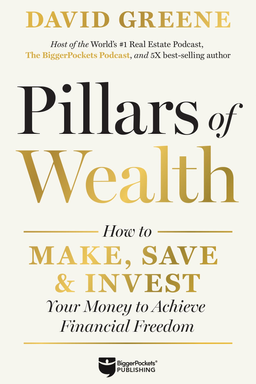
Pillars of Wealth cover

Pillars of Wealth

by David M Greene

Pillars of Wealth by David M Greene (2023) unveils a practical guide to achieving financial independence through three key strategies: saving, income growth, and real estate investing. By adopting the right mindset and leveraging proven tactics, readers can systematically build a multi-million-dollar net worth.

The Three Pillars of Financial Freedom

How do you build lasting wealth that resists economic shocks, lifestyle creep, and emotional burnout? In Pillars of Wealth, David Greene argues that financial independence rests on three connected foundations: defense, offense, and investing. Each pillar serves a unique function—defense protects your earnings, offense expands them, and investing transforms them into passive income—but they only work when aligned and balanced.

Through Greene’s own story—from waiting tables to owning a national real estate portfolio—the book shows that wealth is not luck; it’s a system of disciplines that amplify each other. You start by protecting your resources, then grow your ability to earn, and finally convert your capital into scalable, income-generating assets.

Defense: Protect and Preserve

Defense means keeping what you make. Greene redefines money as stored energy—the physical representation of your time and effort. Every dollar reflects your life’s energy, and spending it without awareness leaks that energy. You strengthen defense through practical actions: paying yourself first, budgeting toward goals rather than comfort, creating an emergency fund, and building an identity around being disciplined and future-focused. Defense isn’t deprivation—it’s freedom through intention.

He cautions against get-rich-quick traps and trend chasing (NFTs, speculative crypto, or Beanie Babies in earlier decades). Debt and lifestyle inflation erode even high incomes. Like Michael Jackson or lottery winners who fell into ruin, poor defense guarantees collapse no matter how strong your offense.

Offense: Expand Your Earning Power

The second pillar, offense, is about intentionally increasing your value in the marketplace. Greene teaches that skills, leadership, and mindset—not luck—determine earning capacity. The key is the Pareto principle: identify the 20% of activities that produce 80% of your results, then double down. For him, that started with maximizing tips and overtime before evolving into real estate sales and investing.

Offense also means acting like a leader before you’re given the title. Drawing from Jocko Willink’s “extreme ownership,” Greene reframes leadership as accepting full responsibility for outcomes. You lead by improving systems, mentoring others, and solving problems before they reach your boss. Over time, this spirit compounds into new opportunities, promotions, and business growth.

Mindset underpins every action on offense. You cultivate urgency (respect for time), seek feedback to shorten your learning curve, and pursue mentorship to model success. Consistent improvement beats innate talent when paired with ownership and service orientation.

Investing: Multiply Through Real Assets

The third pillar transforms income into lasting freedom through strategic investing. Greene is passionate about real estate as the amplifying engine—it harnesses inflation, leverage, appreciation, and compounding to grow equity while tenants pay down your debt. You cannot save your way to wealth in an inflationary world, he argues, but you can own assets that benefit from inflation.

He blends financial literacy with tactical detail: track your return on equity (ROE), understand cycles of amplification (flipping, BRRRR, refinancing), and reinvest proceeds into additional assets. His system resembles a flywheel—earn, save, buy equity, force appreciation, refinance, and repeat—until passive income replaces your paycheck.

Why Balance and Sequence Matter

Greene’s warning is clear: neglect any pillar and the structure collapses. Saving without earning caps growth; earning without saving builds nothing permanent; investing without cushion risks disaster. The sustainable path is sequential—defense first, offense next, investing last—but also cyclical, as each feeds and reinforces the others.

A cord of three strands is not easily broken.

Defense buys time; offense expands opportunity; investing converts both into freedom. Together they form a self-sustaining engine for wealth.

Throughout, Greene invites readers to treat finance as a moral and mental discipline rather than a purely mathematical one. Wealth is the byproduct of habits, identity, and systems that align your energy with your long-term goals. When you master the three pillars, you gain not just money but freedom—the time and choice to live life on your terms.


Mastering Defensive Wealth

Defense is the first pillar for good reason—it secures your foundation so every future gain is preserved. Greene defines defense as the collection of habits, decisions, and mental frameworks that keep you from losing money unnecessarily. Without it, your offense and investments will bleed out under poor decisions, debt, or distractions.

Money as Stored Energy

Greene reframes money as a store of human energy. When you trade time for wages, you’re converting hours of your life into currency. Spending impulsively depletes that energy before it can compound. This shift—from seeing money as a means to buy comfort to recognizing it as stored life force—creates natural discipline.

He draws from Michael Saylor’s concept of “economic energy,” contrasting real assets with volatile speculative plays. Greene favors real estate for average investors because it preserves energy in something tangible that appreciates over time.

Budgeting and Behavioral Defense

Budgeting is not punishment—it’s pre-deciding what you value. Greene urges you to build budgets for the future you want, not the comfort you have. Start by auditing past expenses, cutting waste, and directing savings toward emergency funds and investment capital. He critiques the 50/30/20 rule as too conservative for people who want to accelerate financial freedom.

Tools like Mint automate awareness, while envelope systems ensure accountability. Greene’s example couple, Kyle and Katie, demonstrate how small trade-offs—moving apartments, cooking at home—converted everyday decisions into a home purchase faster than peers with similar income.

Identity-Based Saving

Behavioral science plays a major role in defense. Drawing from James Clear’s Atomic Habits, Greene stresses identity: decide you are “the kind of person who saves.” Each deposit becomes a micro-proof reinforcing that self-image. Games, challenges, and automation help sustain progress when motivation dips. Greene’s own journey—from waiting tables to funding his first down payment—shows how gamification of savings accelerates results.

He also integrates Rachel Cruze’s “money personalities” concept, teaching readers to anticipate friction between savers, spenders, and free spirits. Instead of shame, he recommends structure: if you love novelty, create lower-cost excitement that doesn’t sabotage savings.

Managing Debt and Compound Interest

Compound interest works both ways: as friend or foe. Greene illustrates with vivid math: a $1,000 credit card at 17% doubles in cost over nine years; the same $1,000 invested at 17% triples your money. The key is to pay off high-interest debt so compounding starts serving you. Use the avalanche method for pure efficiency or snowball strategy for psychological wins—what matters is consistent progress.

Greene’s mantra, “Every dollar you make is yours to keep,” captures the defense mindset. You win by being intentional—planning raises before you get them, resisting lifestyle creep, protecting energy from advertising manipulation, and automating systems that move money to safety the moment it appears.


Building Market Value Through Offense

Once defense stabilizes your finances, offense accelerates your trajectory. Greene describes offense as the active creation of greater value in the marketplace through skill, attitude, and leadership. Where defense preserves what you earn, offense multiplies it.

Developing Transferable Skills

Greene treats skill acquisition as an investment. You create income security not by job-hopping but by mastering useful, portable skills. Drawing from research by Adda and Dustmann, he shows that trained workers face lower unemployment and higher lifetime earnings. The faster you shorten feedback loops, the faster you grow. Like Scott Young’s pottery class experiment, frequent practice cycles outperform perfectionism.

Greene recommends immediate feedback: track your performance KPIs (Prospect–Lead–Appointment–Negotiate, or PLAN for Realtors), review metrics weekly, and solicit critique rather than praise. Learning equals earning when you refine through iteration.

The Leadership Advantage

Leadership is offense at scale. Borrowing from Jocko Willink’s “Extreme Ownership,” Greene teaches that leaders outperform because they take full accountability. When a project fails, leaders ask not “Who’s fault?” but “How could I have led better?” This mindset builds team trust and produces outsized results.

He divides leadership into three dimensions—learn, leverage, and lead. You first master a craft (“learn”), then multiply your impact through others (“leverage”), and finally shape direction and culture (“lead”). Each level multiplies freedom. Like Michael Jordan evolving from player to owner, your value expands as you scale from execution to strategy.

Mindset, Attitude, and Urgency

Mindset determines performance. Greene recounts a restaurant lesson: service is emotional, not just technical. Your attitude is part of your product. He contrasts two mindsets—the devil (entitlement, blame) and the angel (ownership, improvement)—and argues that daily discipline builds long-term momentum. Mentorship shortcuts this growth; watching and emulating experienced performers accelerates understanding.

Urgency anchors offense. Greene cites Ed Mylett’s “three six-hour days” method to compress time and fight Parkinson’s Law (work expands to fill time). Respecting your hours multiplies output, just as respecting dollars multiplies capital. Combine urgency with repetition, and your earning potential increases geometrically.

Offense is the art of expanding your market value faster than expenses rise. By honing skills, adopting leadership principles, cultivating mentors, and acting with urgency, you build the engine that fuels investing and long-term wealth.


Operating at Peak Performance

High performance isn’t about endless hustle—it’s about structure, energy management, and focus. Greene’s tactical guidance transforms vague “grind harder” advice into a system for sustained productivity.

Design the Day and Use the Calendar as a Contract

Scheduling is your silent coach. Greene blocks work by task type—deep work, meetings, review—to preserve mental clarity. A defined calendar frees you from decision fatigue and fosters consistency. Like athletes with training blocks, professionals sustain excellence by ritualizing focus.

Visualization and Preparation

Visualization, supported by Blankert and Hamstra’s research on athletes, rewires focus and confidence. Rehearse tough conversations, negotiations, or emails before they occur. Prepare “tomorrow tonight”—lay out materials, pre-open tabs, leave bullet notes. Starting fast builds momentum and minimizes morning friction.

Protecting Energy and Cognitive Bandwidth

Time blocking only works if your energy aligns with it. Greene emphasizes physiological upkeep: eat lighter at midday (Harvard research links heavy meals to energy dips), move your body, and set boundaries with “energy vampires.” He recommends alternating between analytical, social, and physical tasks to rest different mental “muscles.”

Communication discipline complements personal focus. Greene shares before/after email examples showing how concise structure signals leadership. Respect others’ time, and you’ll gain influence.

Performance mastery is a compounding advantage. Small efficiencies—visualization, block scheduling, deliberate rest—produce exponential impact over years. They make offense sustainable and prevent burnout during the wealth-building journey.


Investing for Compound Growth

The third pillar—investing—turns your active income into freedom. Greene champions real estate as the most versatile and proven vehicle for building lasting wealth, but his principles apply across assets: own productive things that appreciate and generate income, not consumables that depreciate.

Why Real Estate Wins

Real estate benefits from inflation, leverage, and forced appreciation. When consumer prices rise, property values often rise faster. In 2021, while CPI hovered around 7%, Case-Shiller home prices climbed nearly 19%. Fixed-rate mortgages mean you repay tomorrow’s debt with cheaper dollars, while tenants’ rent covers costs. This asymmetry compounds wealth.

Greene identifies five wealth ingredients—capital, knowledge, results, time, and leverage—and five steps to financial freedom: save, reinvest income, acquire assets, replace active income with passive, and reinvest again. Each cycle multiplies momentum.

Asset Classes and Strategies

Greene categorizes asset options for different stages. Beginners start with primary residences and house hacks; intermediates graduate to BRRRR (Buy, Rehab, Rent, Refinance, Repeat) or small multifamily; advanced investors pursue large commercial or syndications. Each requires aligning capital, time, and risk tolerance.

He highlights tools such as 1031 exchanges, creative financing, and portfolio rebalancing via ROE tracking. The principle: match strategy to your stage, then evolve. Real estate becomes a sandbox to practice leverage safely while compounding learning.

The Equity Flywheel

Greene outlines three wealth cycles: amplification (flips, lending, wholesaling), self-sustaining (rent-covered debt), and equity (create, increase, convert, manage). Together, they describe a perpetual motion engine for capital. Each property creates new equity that can be harvested through refinance or sale to acquire more assets.

The key mindset shift is velocity—keep your money moving through assets that generate and recycle value. When your capital works harder than you do, you reach the turning point where investments sustain your lifestyle.


Designing Durable Wealth

The ultimate goal is not just accumulating wealth but keeping it. Greene closes by focusing on portfolio architecture, risk management, and mindset—how to build wealth that survives downturns, distractions, and human emotion.

Equity versus Cash Flow

While cash flow feels secure, equity growth is often the real engine of wealth. Greene contrasts “Carl,” who buys cash-flow-heavy properties, with “Barbara,” who targets equity growth through appreciation and forced value. After five years, Barbara’s approach produces far higher net worth even with modest rents. The lesson: optimize for total return, not just monthly surplus.

The Portfolio Pyramid

Greene’s portfolio pyramid balances safety and upside. The broad base includes stable, low-risk assets like small multifamily or NNN commercial; the middle involves blended growth assets like SFRs or regional markets; the top holds speculative or high-reward ventures like short-term rentals or startups. The pyramid ensures resilience through diversification and liquidity.

Defensive Investing and Emotional Control

Wealth endures through prudence. Greene notes that fear and FOMO ruin more investors than market crashes themselves. Two things cause foreclosure: losing cash flow and exhausting reserves. Keep both. Avoid opaque ventures like unverified crypto exchanges; invest where mechanics are transparent.

When fear strikes, “zoom out.” Review your numbers across the long timeline of real estate cycles. Refinancing a fully paid property, as Greene did during a downturn, can save a portfolio without fire-selling assets. Patience is a weapon.

The long game is stability and autonomy—letting your assets buy your time, not your paycheck buying liabilities. True freedom lies not in the number of properties you own but in how well your system defends, sustains, and multiplies them.

Dig Deeper

Get personalized prompts to apply these lessons to your life and deepen your understanding.

Go Deeper

Get the Full Experience

Download Insight Books for AI-powered reflections, quizzes, and more.