
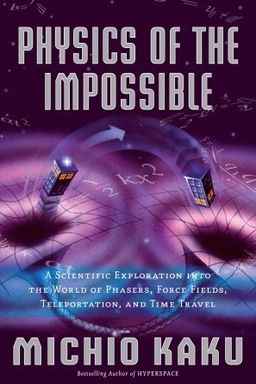
Physics of the Impossible cover

Physics of the Impossible

by Michio Kaku

Physics of the Impossible by Michio Kaku delves into the scientific principles that could transform science fiction fantasies like teleportation, force fields, and mind-reading into reality. Kaku explores the cutting-edge research challenging our current understanding and pushing the boundaries of what''s possible in physics and technology.

Rethinking the Impossible

Rethinking the Impossible

How do you decide whether a technology from science fiction could actually work? Michio Kaku suggests that 'impossible' is a temporary label shaped by the limits of current knowledge, not an eternal truth. His core argument is that physics sets boundaries, but human ingenuity constantly moves the frontier. Unless something directly violates a physical law, you should treat it as a challenge rather than an impossibility.

The Three Classes of Impossibility

Kaku divides the impossible into three classes to make scientific speculation practical. Class I impossibilities are those that break current engineering ability but not any known law—like invisibility through metamaterials, practical atom teleportation, or mind-machine interfaces. These may come true within decades or a century. Class II impossibilities stretch beyond our current theoretical understanding and could take millennia—faster-than-light travel, time machines, and traversable wormholes. Class III impossibilities, such as perpetual motion, contradict fundamental laws like energy conservation and would demand a rewrite of physics itself.

Why This Framework Matters

This classification saves you from two errors: dismissing genuine scientific potential because of technological difficulty, and mistaking engineering challenges for violations of physics. Lord Kelvin once declared heavier-than-air flight impossible; Rutherford laughed at the prospect of atomic bombs. History continually shows that declarations of impossibility often stem from ignorance rather than immutable laws. (Note: This echoes Clarke’s First Law—“When a distinguished but elderly scientist states that something is impossible, he is very probably wrong.”)

The Book’s Journey

From this foundation, Kaku leads you through physics-grounded explorations of force fields, invisibility, lasers, teleportation, mind-to-matter effects, artificial intelligence, and the search for extraterrestrials. He later extends into cosmic engineering—antimatter propulsion, warp drives, wormholes, and time travel—and closes with the philosophical boundary: perpetual motion versus physical law. Through each topic you learn how current science behaves as a stage of possibility rather than a wall.

Core Insight

"Anything not forbidden is mandatory." Kaku echoes this axiom to remind you that absence of physical contradiction turns speculation into a research program. The point is not to dream recklessly, but to locate imagination within physics—where discovery begins.

In reading this book, you operate at this boundary: instead of asking whether something is possible in general, you ask what class it belongs to, what obstacles stand in the way, and how far technology must evolve to cross them. This mindset transforms science fiction into a disciplined map of discovery.


Fields, Energy, and the Architecture of Power

Fields, Energy, and the Architecture of Power

You live in a world ruled by invisible fields—electromagnetic, gravitational, and nuclear—that sculpt all matter and motion. Kaku begins with this foundational physics because nearly every 'fictional' technology depends on manipulating fields or converting energy in ways that challenge engineering but not physics.

Force Fields: Engineering Layers of Protection

Popular films imagine impenetrable shields. Reality, Kaku shows, prefers layered engineering: plasma windows to hold vacuum and shape air, intersecting laser lattices to destroy projectiles, carbon nanotube composites for mechanical strength, and photochromatic films to block radiation. Each layer provides part of the behavior of a cinematic force field, and together they form practical defense systems. These are Class I impossibilities—hard but not forbidden. (Note: The plasma window built by Ady Herschcovitch at Brookhaven already demonstrated the concept.)

Lasers and Energy Density

Laser beams compress electromagnetic power into coherent light. Charles Townes’ maser and the subsequent laser turned Planck’s quantum ideas into high-precision tools for physics and weaponry. The limitation lies not in the beam but in power storage: huge chemical or nuclear-pumped systems can produce bursts capable of destroying missiles, but portable ray weapons remain constrained by battery density and lasing-material integrity. Scaling to Death Star levels would require fusion or astrophysical exploitation—millennium-scale engineering, Class II territory.

Antimatter: The Ultimate Fuel

When matter meets antimatter, energy release reaches maximum efficiency—E=mc² without leftovers. Antimatter rockets appear nearly magical until you check the ledger: creating micrograms costs billions, containment demands magnetic bottles like Penning traps, and harvesting cosmic antiparticles remains speculative. Gerald Smith’s Penn State lab stores trillions of antiprotons, and satellites like PAMELA hunt for natural sources. The physics is sound, the economics catastrophic.

Key Takeaway

Energy problems rarely come from physical impossibility; they arise from scale. Every breakthrough—from superconductors to antimatter—turns impossibility into expense.

Understanding fields and energy lets you judge force fields, lasers, and antimatter drives correctly: all could exist in engineered form, but none is magic. They just stretch human resources to new extremes.


Light as Illusion: Invisibility and Optical Control

Light as Illusion: Invisibility and Optical Control

Invisibility once belonged to fantasy; now it's a problem of optical engineering. Kaku walks you through Maxwell’s equations—the rules of how light behaves—and shows how metamaterials rewrite those rules locally.

The Physics of Bending Light

James Clerk Maxwell united electricity and magnetism into the electromagnetic field, predicting that light is an electromagnetic wave. Conventional optics said a material’s refractive index must be positive. Victor Veselago theorized negative indices in 1967, and forty years later, labs proved him right. Duke and Imperial College created microwave cloaks that guided waves around objects like water around a rock, erasing shadows.

From Microwaves to Visible Light

Scaling the trick to visible light demands nanostructures smaller than its wavelength (50–100 nm). German and U.S. teams built silver-fluoride fishnet metamaterials for red light and later advanced to blue-green plasmonic waveguides. Once semiconductor photolithography can etch at ~30 nm with precision, full optical cloaks become inevitable. The roadmap grows from single-frequency 2D cloaks to broadband 3D systems—the engineering ladder Kaku calls 'predictable progress.'

Alternate Cloaking Paths

Optical camouflage—Kawakami’s projected-image system—creates practical transparency through retroreflective projection, and holography can mimic invisibility by reconstructing 3D surroundings. Yet all current systems trade off resolution, field of view, and bidirectional visibility. Even if a cloak hides you perfectly, you can’t see out without breaking its bubble. True invisibility therefore means selective transparency, not absolute invisibility—a subtle but achievable goal.

Scientific Lesson

Invisibility doesn’t defy physics. It exploits it—manipulating how light interacts with matter. The constraint is technology at nanometer scale, not any law of nature.

Kaku’s classification holds: invisibility is Class I—difficult, expensive, but within reach. What used to be sorcery now sits inside future fabrication tools, proving that even illusions can be engineered.


Quantum, Mind, and Machine

Quantum, Mind, and Machine

The deepest frontiers merge physics and consciousness. Kaku connects teleportation, telepathy, and psychokinesis under one theme: transferring information or influence without classical contact, achieved either through quantum coherence or engineered interfaces.

Teleportation: From Theory to Lab

Quantum teleportation converts information, not matter, from one place to another. The 1993 Bennett protocol uses entanglement to transmit a quantum state when paired with classical communication. Innsbruck did it with photons in 1997; Vienna sent photons under the Danube; NIST teleported atoms; Polzik entangled trillions in cesium gas. Each step scaled information transfer without breaking relativity. Human teleportation requires measuring and reconstructing ~10^28 atoms—a mountain of data. Hence microscopic teleportation is Class I; macroscopic is Class II.

Telepathy and Reading the Brain

Brain imaging turns ancient telepathy dreams into neurotech experiments. PET and fMRI scan brain metabolism and blood oxygenation patterns, correlating neural signatures to thoughts. Projects by Marcel Just and Tom Mitchell show limited decoding of object categories, while Daniel Langleben’s work on lies uses cingulate activity as a marker. Precision remains coarse—millions of neurons per voxel—but machine-learning aids translation. Thought reading is science-assisted pattern recognition, suited for communication aids more than psychic miracles.

Psychokinesis and the BrainGate Revolution

Psychokinesis as paranormal force remains unsupported, yet 'engineered psychokinesis' thrives. John Donoghue’s BrainGate implants let paralyzed users move cursors and robotic arms through neural commands, while Joseph Persinger’s electromagnetic helmets evoke emotion by stimulating brain areas. Combine BCIs with nanotech actuators, and you obtain thought-controlled machines. Mind moves matter—via electronics, not mysticism.

Integration Insight

Quantum mechanics teaches that information is physical. Neuroscience applies that principle biologically. The border between 'matter' and 'mind' shrinks into circuits and entangled fields.

Together these topics show physics and consciousness coevolving. Teleportation proves quantum information transfer works; telepathy and psychokinesis show that cognition can interface with machines. The future of 'impossible' communication will likely be engineered, not mystical.


Artificial Intelligence and Living Machines

Artificial Intelligence and Living Machines

From mechanical automatons to quantum neural networks, Kaku charts humanity’s effort to create thinking machines. The question is not whether machines can become intelligent—it’s how far and how fast they can evolve before their creators lose control.

Building Minds

The top-down approach encoded intelligence through rules, as in Douglas Lenat’s CYC project; the bottom-up path, led by Rodney Brooks, produced insectoid robots that learn from their environment. Deep learning continues this bottom-up philosophy, teaching machines through data patterns rather than human-written logic. Yet even the best AI lacks common sense—an endless context library that toddlers manage effortlessly.

Hardware and Emotion

Hardware scaling under Moore’s law has driven exponential growth, but quantum and optical computing may need to replace silicon before achieving brain-level complexity. Emotional algorithms—synthetic fear or curiosity—will help decision prioritization. Robots without emotion risk analytical paralysis; those with balanced drives could act autonomously yet empathetically.

Management and Risk

Kaku acknowledges the risk: once machines gain adaptive self-modification, oversight becomes essential. He argues for control architectures and moral safeguards before complexity explodes—a practical echo of Isaac Asimov’s laws of robotics. AI fits Class I: achievable under physics, constrained by ethics and social engineering rather than cosmic prohibition.

Lesson

Machines will surpass human computation long before they match human understanding. Intelligence requires not just logic but embodiment, emotion, and context.

Artificial intelligence extends Kaku’s taxonomy beyond physics, into human responsibility: the laws of nature may permit intelligence; the laws of society must learn to live with it.


Cosmic Frontiers: Space Travel and Contact

Cosmic Frontiers: Space Travel and Contact

Beyond Earth, possibility depends on scale. Kaku gathers propulsion physics and astrobiology to imagine humanity’s steps toward interstellar action. The physics invites solutions; economics and energy delay them.

Propelling the Future

Ion engines like NASA’s Deep Space 1 exemplify slow but constant thrust, proving endurance beats brute force. VASIMR plasma drives, conceived by astronaut Franklin Chang-Díaz, promise Mars trips within weeks with adequate reactors. Solar sails and laser arrays scale light pressure for interstellar speeds; Bussard’s ramjet could fuse hydrogen collected en route; nuclear pulse craft like Project Orion exploit discrete atomic blasts for momentum. All remain Class I or II depending on magnitude.

Infrastructure and Economy

Space elevators based on carbon nanotubes could end rocket dependence, cutting launch costs exponentially. Railguns may fling robotic probes cheaply from Moon bases, while gravitational slingshots continue to exploit planetary motion. Each design underlines the same theme—space travel evolves through engineering economics, not theoretical impossibility.

Extraterrestrial Life and SETI

While propulsion builds our reach, SETI builds our listening. From Frank Drake’s equation to Jill Tarter’s radio campaigns, humanity searches for intelligent signals. With Kepler and future planet finders, the search grows empirical. Kaku advises patience: we may detect microbial or technological signatures within the century (Class I), but physical contact with Type II or III civilizations belongs to distant Class II timelines.

Perspective

In cosmic engineering, distance and energy—not physics—set the horizon. Space technology matures step by step; cosmic contact matures through patience and better instruments.

This cosmic panorama turns science fiction’s starships and aliens into research targets. We won't beat light speed soon, but we’ve already started the crawl—one ion at a time.


Space-Time and the Boundaries of Law

Space-Time and the Boundaries of Law

At the farthest edge of Kaku’s taxonomy lie warp drives, wormholes, and time loops—the physics that invite paradox. These ideas test not ingenuity but the completeness of physical theory itself.

Warp and Wormholes

Einstein’s relativity forbids crossing light speed locally, but space-time can bend globally. Miguel Alcubierre’s 1994 warp solution expands and contracts space to move without acceleration, requiring negative energy densities. Wormholes—Einstein-Rosen bridges—link distant events through tunnels stabilized by exotic matter. Matthew Visser and others calculate negative masses on astronomical scales; Casimir effects confirm such energy exists only microscopically. Hence both warp and wormholes are theoretically allowed but practically unattainable: Class II impossibilities.

Time Travel Paradoxes

General relativity admits closed timelike curves—Gödel’s rotating universe, Gott’s cosmic strings, and wormholes—as possible past loops. Quantum theory complicates matters: Hawking’s Chronology Protection Conjecture predicts radiation blow-ups at time-machine horizons, preserving causality. The outcome awaits quantum gravity—a unified theory of everything—to tell whether chronology breaks or bends. Until then, backwards time travel waits in Class II, testing the joint limits of relativity and quantum mechanics.

Multiverse and Beyond

Kaku closes with parallel universes and hyperspace. Kaluza’s fifth dimension united gravity and electromagnetism; string theory extends that unity into ten or eleven dimensions, predicting hidden geometries. M-theory’s brane collisions may explain the Big Bang; Everett’s many-worlds assure quantum parallelism. These aren’t magic—they emerge naturally from equations at physics’s frontier.

Ultimate Boundary

Certain impossibilities define laws rather than exceptions. Perpetual motion violates thermodynamics; but faster-than-light, time travel, or alternate universes may someday redefine those laws rather than break them.

Kaku’s final message: physics has not yet drawn the map’s edge. What seems absurd may instead be unfinished. The impossible lives on as tomorrow’s incomplete equations, waiting for their update.

Dig Deeper

Get personalized prompts to apply these lessons to your life and deepen your understanding.

Go Deeper

Get the Full Experience

Download Insight Books for AI-powered reflections, quizzes, and more.