
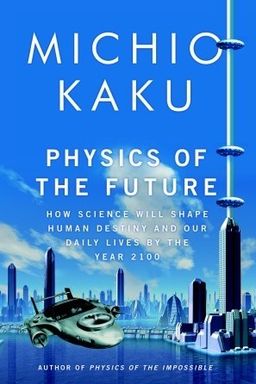
Physics of the Future cover

Physics of the Future

by Michio Kaku

Physics of the Future unveils the astonishing possibilities of the 21st century, as seen through the lens of leading scientists. From AI and genetic breakthroughs to sustainable technologies, Michio Kaku predicts how these innovations will transform society, offering profound insights into our destiny.

Science as a Map of the Future

How can you make predictions about the next century that are grounded in science rather than fantasy? In The Physics of the Future, Michio Kaku — a theoretical physicist and popular science communicator — argues that you already live in the first steps of tomorrow. By combining interviews with hundreds of scientists and entrepreneurs, anchoring forecasts in the laws of physics, and filtering them through human psychology, he presents a disciplined way to imagine what your world might look like by 2100.

A method for credible forecasting

Kaku has no patience for science fiction detached from physics. He constructs a three-part test for prediction: focus on technologies with working laboratory prototypes, test every forecast against the fundamental laws (relativity, quantum mechanics, and thermodynamics), and consider human nature as a limiting factor. He calls this last principle the Cave Man Principle — the reminder that despite advanced gadgets, your brain and social instincts are shaped by ancient evolutionary patterns. Thus, technologies must enhance human desire for connection and experience, not replace it.

His conversations with lab heads, engineers, and startup founders — more than 300 interviews — become a composite sketch of the future that is already half-built: contact lenses that project internet data, self-assembling materials, brain-controlled prosthetics, and zero-resistance superconductors. Kaku’s humility before physics and respect for social behavior make his vision both ambitious and plausible.

The map of transformations ahead

Kaku organizes the coming century into converging revolutions. The information revolution (ubiquitous computing and AI) merges with the biotechnology revolution (genomics, nanomedicine, tissue engineering) and an impending transformation in energy (solar, fusion, and superconductivity). Each begins in a laboratory context, scales economically, and then encounters social friction as human instincts reshape its adoption.

He revisits the notion of a Type I civilization on the Kardashev scale — humanity’s potential to harness and coordinate all planetary energy. To reach that milestone, Kaku argues, requires mastering these revolutions not just technically but ethically. It involves moving from a patchwork of national systems to a planetary network of knowledge, governance, and sustainability.

Prediction through physics and prototypes

Physics sets hard boundaries: you can accelerate objects but not exceed light speed; you can miniaturize transistors until quantum tunneling destroys reliability; you can replicate biological cells, but only by following molecular laws. For Kaku, these constraints are liberating — they filter out fantasy and direct attention to the plausible. He places prototypes like Babak Parviz’s electronic contact lenses, BrainGate’s neuron-reading chips, and Anthony Atala’s lab-grown organs as milestones along a trajectory you can confidently extrapolate.

Core principle

“Every scientific development mentioned in this book is consistent with the known laws of physics.” That statement — Kaku’s litmus test — ensures a forecast tethered to reality, not wishful prediction.

Humanity as both driver and bottleneck

Even with laboratory readiness, adoption depends on the human appetite for experience. Telepresence will never replace concerts because people crave physical presence. Genomic data will not automatically transform health unless societies handle privacy and equity. AI may build sophisticated robots, but cultural fears still define where they're welcome. Kaku reminds you that the real barrier to utopia is not physics — it’s psychology, politics, and culture.

In sum, Kaku’s central argument is that the next century will not be random: its outlines are visible in today’s prototypes, governed by immutable physical laws, and shaped by persistent human instincts. To forecast wisely, you must think like a scientist — anchored in experiment, conscious of limits, and alert to how deeply ancient behaviors mediate the adoption of modern miracles.


Intelligence Everywhere

The first major transformation you experience is the diffusion of intelligence into the environment. What began as desktop computing now dissolves into everyday life: sensors in walls, processors in glasses, and intelligent fabrics that respond to your body. Kaku calls this convergence of electronics and reality the age of ubiquitous computing and augmented reality.

Invisibility through Moore’s law

Moore’s law — the doubling of transistor density roughly every 18 months — propels this shift. As chips shrink and costs plunge, computation becomes ambient. Mark Weiser once said “the destiny of computers is to become invisible,” and Kaku shows that this vision is no longer metaphorical. Internet-enabled glasses, retinal displays, and flexible OLED walls transform passive rooms into interactive partners. (By the 2020s, chips under a penny make “smart dust” feasible.)

Devices that blur physical and digital

You might wear Babak Parviz’s contact lenses that overlay data streams over your world, or decorate your home with wall-sized displays that shift function with a voice command. Laboratories at MIT and elsewhere demonstrate augmented reality tools — from Susumu Tachi’s invisibility cloak to Pattie Maes’s SixthSense projector — that let you gesture to summon information in midair. These inventions expand your senses rather than replace them, illustrating Kaku’s Cave Man Principle in action: enhancement wins where substitution fails.

AI companions and the edge of consciousness

As computing infuses objects, the boundary between machine and mind blurs. Robots acquire mobility, perception, and limited emotion; AI assumes repetitive labor and routine decision-making. Yet true consciousness — the flexible, emotional intelligence of humans — remains elusive. Kaku distinguishes rule-based AI (top-down) from learning systems (bottom-up) and warns that common sense remains unsolved. Projects like Blue Brain and DeepMind simulate fractions of cortex but use megawatts where the human brain uses 20 watts. Conscious AI, he predicts, will emerge gradually, not as a sudden singularity.

Practical implication

Expect machines to perceive, predict, and assist — not replace your judgment. Your value will lie in what remains distinctly human: creativity, empathy, and ethical reasoning.

Together, miniaturized computation and emerging AI create an ambient cognitive field — a world where the wall listens, your desk suggests, and your glasses translate. Yet the ancient desire for tactile presence ensures that real encounters, not holograms, remain central. The future becomes less about replacing humans with machines and more about embedding intelligence into every surface that serves them.


Mind, Biology, and Machine Merge

Kaku shifts focus from silicon to flesh. As biology becomes an information science, genetic code and neural signals turn into software you can read, rewrite, and integrate with machines. You enter the age where thought can move matter and genomes are editable blueprints.

Reading and writing the brain

The BrainGate project shows that electrodes on your cortex can translate neural firing into mechanical motion. Paralyzed patients move cursors and robotic arms by thought alone. EEG and fMRI now decode simple images and intentions non-invasively. These early systems, Kaku observes, foreshadow a future where your ideas become direct inputs to the digital world — telekinesis achieved through physics and computation. Yet he issues ethical alarms: privacy, interrogation, and intimacy all shift once thoughts can be read or shared.

Genomics and personalized medicine

At the cellular level, cost curves echo Moore’s law. Stephen Quake’s cheap genome sequencing paves the path for individualized medicine: chips detect disease markers before symptoms appear, and therapies adapt to your genetic profile. Anthony Atala’s tissue engineering lab grows replacement organs; Robert Lanza’s stem cells regenerate damaged tissue. Diseases once managed chemically may instead be repaired biologically. But as gene therapy and enhancement blur, Kaku notes society’s ethical crossroads — from fixing mutations to designing traits.

Nanomedicine and the molecular frontier

Nanotechnology scales that precision down to atoms. Drug-delivery nanoparticles from BIND biosciences target tumors like smart bombs, while Atala’s bioengineered tissues use nano-scaffolds that dissolve inside the body. Molecular nanocars, catalytic rods, and smart pills illustrate medicine shrinking into the bloodstream. The next generation of therapy is programmable, local, and continuous — a surgeon’s logic executed by molecules.

The convergence of neuroscience, genetics, and nanotech collapses boundaries between organic and synthetic. Your body becomes upgradable hardware, your genome editable software, and your mind another interface within the network. Kaku celebrates this as the ultimate empowerment of human agency — if ethical wisdom keeps pace.


Reinventing Matter and Machines

Beyond biology, Kaku leads you into a future where matter itself becomes programmable. Nanotechnology, molecular manufacturing, and quantum computing promise to rebuild physical reality with atomic precision and computational intelligence.

From catoms to replicators

Catoms — tiny programmable modules pioneered by Intel researchers like Jason Campbell — are prototypes of programmable matter. By manipulating electric charges, each grain-sized robot can attract or repel its neighbors, assembling into arbitrary shapes under software control. Imagine a chair that reconfigures into a table or a phone that morphs into a tablet; this is geometry turned into code. Scaling from inch-sized prototypes to billions of micron-scale catoms is the next grand challenge.

At the molecular extreme lies the replicator debate. Eric Drexler envisions atomic-scale assemblers that could build anything from raw materials, while Richard Smalley doubts that sticky, “fat-fingered” molecular manipulators can ever work precisely. Kaku mediates between optimism and constraint: nature already performs molecular assembly via enzymes, but building universal assemblers safely will require new chemistry and rigorous controls. “Gray goo” nightmares, he notes, are avoidable with design discipline.

Quantum and molecular computing

As silicon miniaturization nears atomic limits, computing seeks new physical bases: quantum coherence, photonics, molecular transistors, and graphene. Qubits exploit superposition to compute in parallel, promising exponential speed for certain problems, but coherence is fragile. Graphene’s one-atom-thick lattice and molecular switches, meanwhile, extend classical computation to the threshold of quantum effects. Kaku foresees hybrid architectures—classical chips integrated with quantum or molecular co-processors—that reflect physics rather than fight it.

Key reflection

The ambition to program matter, from catoms to qubits, symbolizes humanity’s deeper trend: using computation to command nature at ever finer scales, bounded only by physical law.

Together these technologies move manufacturing, computation, and design toward atomic precision. They promise abundance and efficiency—but also demand oversight, security, and public trust. Kaku’s balanced tone acknowledges both thrill and risk: matter becomes a medium of information, and the tool that builds anything can also undo everything if misused.


Energy Revolutions and a Sustainable Planet

No future works without energy. Kaku aligns technological optimism with environmental realism, tracing how renewables, nuclear innovation, and superconductivity could help humanity escape fossil dependence and stabilize climate.

The arc beyond oil

As Hubbert’s peak hints at declining oil flow, solar, wind, and hydrogen systems rise. Photovoltaic efficiency climbs while costs plunge, leading to solar parity in many regions. Electric and fuel-cell vehicles cut local emissions but shift attention to power generation sources, demanding cleaner grids. Kaku emphasizes systemic integration — renewables, storage, and electrified transport — as the necessary triad for sustainable power.

Fusion and superconductivity

Fusion, the holy grail of clean energy, progresses through massive experiments like ITER and NIF. They attempt to replicate stellar reactions using lasers or magnetic fields, aiming for “break-even” energy. A functioning fusion plant, Kaku projects, could virtually end fuel scarcity. Complementing this, room-temperature superconductors promise lossless transmission and magnetic levitation for transport. The so-called Age of Magnetism could unlock globally efficient grids and frictionless vehicles.

Climate response and planetary stewardship

Kaku does not downplay the urgency of climate change. He explains evidence from melting ice sheets, CO2 history, and warming trends, framing them as a physical, not political, reality. He surveys mitigation ideas—from carbon capture and reforestation to geoengineering proposals like sulfur aerosols and ocean fertilization—but cautions that technical patches can’t replace behavioral change. The sustainable path depends on scientific literacy, policy discipline, and planetary-scale coordination.

Energy innovation thus mirrors civilization’s maturity: cleaner production, smarter distribution, and conscious restraint. The same physics that enables fusion or superconductivity defines your ecological limits. Mastery without mindfulness, Kaku warns, risks converting progress into entropy.


From Planetary Crisis to Civilization

In his closing synthesis, Kaku turns from technology to society. Physics may outline what’s possible, but the trajectory you follow depends on economics, institutions, and collective wisdom. The final horizon is not a gadget—it’s a civilization.

Jobs and creativity in an automated age

As automation spreads through AI and robotics, the labor market polarizes. Routine tasks vanish, while creative, social, and judgment-based roles rise in value. Artists, teachers, caregivers, engineers, and leaders remain relevant because synthesis and empathy evade algorithms. Kaku calls this shift from commodity capitalism to intellectual capitalism, where ideas replace raw materials as the new currency of wealth.

Cycles of innovation and resilience

Every major technology, he notes, passes four stages — novelty, utility, ubiquity, and fashion — spawning speculative bubbles that later burst but leave enduring infrastructure. The lesson from railways, dot-coms, and biotech is that crashes prune excess but preserve progress. You must therefore treat downturns as transitions, not failures, in the long innovation arc.

The planetary threshold

On the Kardashev scale, humanity hovers below Type I status, using only a fraction of Earth’s energy. Reaching Type I demands integrating global communication, cooperation, and sustainable energy management. It is as much a political as a physical transition. Yet entropy — waste heat, pollution, inequity — could arrest progress if left unchecked. Civilization’s real challenge is balance: growth that respects thermodynamics and ethics simultaneously.

Final teaching

Science empowers, but values steer. The tools of physics, biology, and computation can deliver prosperity only if guided by education, democracy, and ecological humility.

In Kaku’s imagined day in 2100, citizens commute on magnetic roads, consult AI assistants embedded in contact lenses, and travel via space elevators — yet still face aging infrastructure, climate risks, and identity questions. The scene reminds you that progress never ends problems; it only creates new ones at a higher level of capability. Planetary civilization is therefore not inevitability but responsibility — the ultimate experiment where science and conscience must finally converge.

Dig Deeper

Get personalized prompts to apply these lessons to your life and deepen your understanding.

Go Deeper

Get the Full Experience

Download Insight Books for AI-powered reflections, quizzes, and more.