
Idea 1
Philosophy as a Practical Therapy for Living
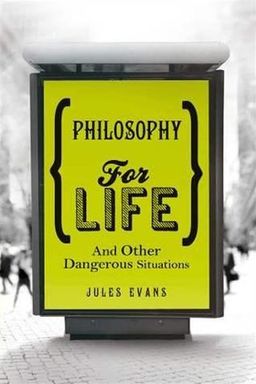
What if philosophy were not a remote academic subject but a toolkit for living — a therapy for the mind and a training in freedom? In Philosophy for Life, Jules Evans argues that ancient philosophy can be revived as an everyday practice to help you think, act, and endure better. His project reframes philosophy as a living art: an ongoing dialogue between Socratic self-scrutiny, Stoic self-mastery, Epicurean enjoyment, and Aristotelian flourishing, all tested in the laboratory of modern psychology and social life. The book blends history, science, personal narrative, and ethical reflection to show that these old schools are immensely usable today.
From Panic to Philosophical Practice
Evans begins from experience: haunted by panic attacks and public humiliation, he turns to Cognitive Behavioral Therapy (CBT), only to discover that its foundations are explicitly philosophical. Aaron Beck and Albert Ellis borrowed from Socrates and Epictetus when they taught that your suffering comes not directly from events but from the beliefs you attach to them. Question those beliefs, test their truth, and you begin to regain freedom. Thus, philosophy re-emerges as therapy — a conversation that helps you make the unconscious conscious and replace destructive judgments with rational ones.
Evans’s recovery in a church-hall CBT group becomes his modern Stoa. There, he learns to write down automatic thoughts, ask whether they are accurate, and replace catastrophic stories with realistic alternatives. The method works because it trains habits through repetition. Philosophy, it turns out, is not abstract — it's embodied practice.
Ancient Schools Reimagined
The rest of Evans’s book unfolds as a modern tour of the ancient schools. Each school offers a different emphasis: the Stoics teach resilience through cognitive control; the Epicureans model simple joy and friendship; the Cynics dramatize freedom from convention; the Aristotelians and Platonists debate civic virtue and moral education; and later figures like Plutarch and Seneca turn moral ideas into psychological techniques. Evans aligns these with current science — neuroscience, behavioral economics, and positive psychology — to bridge ancient wisdom and contemporary research.
In this panorama, philosophy ceases to be an intellectual luxury. It becomes a systematic set of thought-experiments, emotional drills, and community rituals — ways to train perception, feeling, and conduct. Philosophy is self-help with rigor.
From Self-Control to Social Vision
Evans reminds you that the ancient schools were not only psychological but also ethical and political. Stoic exercises like the Dichotomy of Control foster autonomy, but Stoicism can slide into passivity if you forget civic duty. Epicurean simplicity lightens anxiety but must avoid hedonistic complacency. Plato’s ideal of philosopher-kings captures the dream of rational governance but warns that disciplined education easily turns coercive, as seen in modern quasi-Platonic experiments like the School of Economic Science. Each philosophy proposes an answer to anxiety — and a vision of community — that you can adapt critically rather than adopt wholesale.
The heart of the argument is balance: philosophy should neither retreat into private therapy nor harden into dogma. The good life demands both interior mastery and public responsibility.
The Modern Evidence
Evans enriches his argument with modern psychology. Controlled studies of CBT, mindfulness training, and self-control exercises (like Baumeister’s experiments) corroborate the ancients’ intuition that reasoned practice can reshape emotion and habit. Neuroscientific findings about cognitive reappraisal trace emotional shifts to changes in interpretation — evidence for the Socratic idea that beliefs mediate feelings. Yet, Evans acknowledges that not every condition is cognitive: biochemical illnesses resist mere introspection. Philosophy offers skills, not omnipotence.
His interviews — from marines using Stoic mantras to activists performing Cynic protest — show the diversity of application. In each case, philosophical exercises help people write meaning into adversity, but they work only when tethered to realism, ethics, and community.
Living, Dying, and the Limits of Reason
The book’s closing movement asks how philosophy holds up at the edge of death and irrationality. Evans recounts stories of individuals who meet mortality — Socrates, Seneca, soldiers with terminal diagnoses — and learn to compose their own final scripts. He also acknowledges the shadow side: when reason falters, the Dionysiac tradition of music, ritual, and embodied release reminds you that vitality matters as much as reflection. The goal is synthesis: combine Socratic questioning with emotional intelligence, science with spirituality, reason with rhythm.
Core Vision
Philosophy for life is not about quoting Plato or mastering logic. It is about testing beliefs, cultivating virtues, and rehearsing readiness — so that when crisis, success, or death arrives, you can respond with steadiness rather than confusion.
In short, Evans restores philosophy to its original role: a living education for freedom. You learn to take care of your soul through reasoned conversation, daily practice, and courageous acceptance — a way of thinking that is as empirical as it is ethical, as ancient as it is urgently modern.