
Idea 1
Mapping Work, Navigating Life Through Personal Kanban
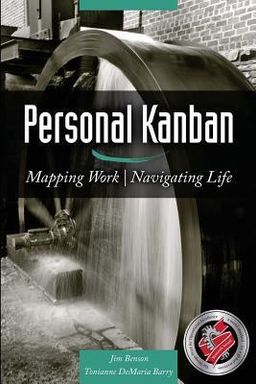
Have you ever felt so overwhelmed by commitments that you couldn’t even remember what you accomplished yesterday? In Personal Kanban: Mapping Work | Navigating Life, Jim Benson and Tonianne DeMaria Barry ask this simple but profound question to surface a modern epidemic: we are drowning in tasks, both personal and professional, yet have little clarity on what we’re actually doing. Their answer is deceptively simple—make your work visible, and limit what you take on at once. But behind this simplicity lies a rich framework for managing not just tasks, but consciousness, context, and meaning in everyday life.
Seeing the Invisible Flow of Work
Benson and Barry build their argument on two rules that drive Personal Kanban: 1) Visualize your work; and 2) Limit your work-in-progress (WIP). These rules sound basic, but they combat centuries of productivity dogma that celebrates multitasking and busyness. By visualizing your commitments—using sticky notes across a board that tracks tasks from “Ready” to “Doing” to “Done”—you convert the abstract pressure of work into concrete, navigable form. You can finally see what you owe to others, how your efforts flow, and when your workload exceeds your capacity. The book likens this to installing a dashboard on the freeway of your life: instead of guessing how fast or far you’re going, you watch the gauges directly.
In the authors’ story, this approach began with chaotic software experiments, failed whiteboards, and long lists that only magnified stress. But when they replaced those lists with Kanban-style boards borrowed from Lean manufacturing (popularized by Toyota), clarity emerged. What made Toyota’s system revolutionary—visual control and flow—proved life-changing on an individual level too. The result was “Personal Kanban,” a humane, flexible system that adapts to chaotic daily life while maintaining discipline through visible limits.
Work as Story and Environment
Throughout the book, work evolves from static tasks into a living story. Every sticky note is not just a job, but a chapter—moving from backlog through development to resolution like the plot of a narrative. This storytelling lens transforms work from punishment to meaning, reminding you how each task connects to larger goals and relationships. (Similar ideas appear in Flow by Mihaly Csikszentmihalyi, where deep engagement turns activity into joy.) For Personal Kanban, this story isn’t only for self-reflection—it’s also an open conversation. The visual board becomes an “information radiator,” broadcasting progress and bottlenecks in real time to teams, families, or anyone sharing your workload. Collaboration replaces isolation.
The Psychology Behind Simplicity
Benson and Barry are clear that Personal Kanban isn’t a rigid process. Life changes; so should your system. What matters are the underlying human principles: comprehension, kinesthetic feedback, narrative clarity, and reduction of existential overhead. Moving a sticky note physically across your board satisfies the mind’s deep need for closure—a cognitive phenomenon known as the Zeigarnik Effect. When tasks are incomplete or invisible, they consume mental space, haunting you even at rest. By representing work visually, your brain relaxes, freeing capacity for creativity and focus. Every note moved into “Done” delivers what the authors call “brain candy.”
Why It Matters Now
The authors situate their ideas in an age of endless interruption, where calendars are overloaded and multitasking has become a false badge of honor. They cite Stanford research showing that chronic multitaskers perform worse on simple cognitive tests than those who focus. The takeaway is stark: we have mistaken speed for effectiveness. Benson and Barry reclaim productivity’s true purpose—not to do more work, but to do the right work at the right time. Their system respects human variation, turning productivity from mechanical repetition into thoughtful adaptation. Life, after all, isn’t an assembly line; it’s knowledge work, unpredictable and alive.
Personal Kanban thus becomes both a philosophy and a practice. It teaches that visualization breeds clarity, clarity breeds calm, and calm fosters continuous improvement—what Lean calls kaizen. By uniting professional and personal realms under one map of work, Benson and Barry challenge the false separation of “work-life balance.” Everything you do—caring for family, managing projects, pursuing creative goals—belongs on the same board. Because all of it is your life.
The Journey Ahead
Over the course of the book, Benson and Barry guide you from the basics of building your first board, through the deeper insights of flow, cadence, and slack, into realms of psychology, philosophy, teamwork, and even existential well-being. You meet Cookie the dog (whose Cocoa Puff catching limits teach WIP), Flameau the Juggler (whose flaming torches dramatize overload), and real-world examples from clients and families who found peace through visualization. Ultimately, Personal Kanban invites you to confront work not as punishment, but as possibility—to visualize, limit, reflect, and continuously improve. It’s not a tool for control; it’s a map for living.