
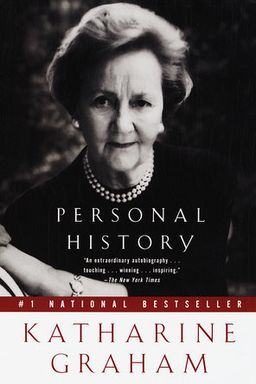
Personal History cover

Personal History

by Katharine Graham

In ''Personal History,'' Katharine Graham chronicles her extraordinary rise to become one of America''s most influential media figures. From a challenging childhood to leading the Washington Post during pivotal moments like Watergate, Graham''s story is one of resilience, innovation, and breaking barriers. This Pulitzer Prize-winning memoir offers profound insights into leadership and personal growth.

Inheritance, Identity, and the Making of a Publisher

How does a person shaped by privilege, restraint, and paradox become one of the most consequential publishers in modern journalism? In Personal History, Katharine Graham traces the intertwined stories of her family, marriage, and leadership of The Washington Post Company, showing how inherited duty and acquired courage create a unique form of power. The book navigates not only her personal transformation—from shy daughter to commanding CEO—but also the moral architecture of journalism, politics, and gender across the twentieth century.

The foundation: civic ambition and emotional reserve

Katharine’s parents, Eugene and Agnes Meyer, embody contrasting archetypes: Eugene, the meticulous investor and public servant, and Agnes, the brilliant but unstable patron of art and ideas. Between them she learns discipline and doubt, aspiration and fragility. Material privilege defines her childhood, but emotional silence shapes her psychology. The Meyer household is polished yet cold—money discussed rarely, affection withheld, and performance prized.

Those conditions seed Katharine’s lifelong tension between self-confidence and insecurity. She grows up thinking in public terms—philanthropy, civic responsibility—but feels privately unsteady. That paradox becomes the lens through which she later governs herself and her organization.

Education and early apprenticeships

Vassar and the University of Chicago supply intellectual ballast. Under Robert Hutchins and Mortimer Adler, she learns rigorous argument—reading Plato and Aristotle, defending positions aloud—and discovers a capacity for analytic thought that counterbalances emotional hesitation. Her apprenticeship at the San Francisco News gives her ground-level experience in labor reporting and civic observation. Those formative experiences link the world of ideas to the world of work; they teach her that truth is found as much in sweat and dialogue as in archives and abstractions.

Marriage and entry into power

Her marriage to Philip Graham fuses intellect and ambition. Phil—farm-boy turned Harvard Law graduate—shares her sense of public duty and joins her father’s enterprise after the war. Together they inherit The Washington Post. Phil modernizes operations and defines mid-century publisher-activism: integrating public service with political influence while sometimes blurring boundaries between editorial independence and policy. Their partnership mixes love, strategy, and imbalance—his manic creative energy and her reflective steadiness create both dynamism and eventual tragedy.

Public mission and private catastrophe

When Phil’s illness and suicide rupture her world, Katharine faces grief multiplied by corporate uncertainty. Suddenly the quiet observer must become the visible owner. Her response—learning accounting from scratch, consulting mentors like Warren Buffett and Fritz Beebe, and rebuilding confidence through action—defines the central argument of the book: leadership is less inherited than learned through adversity.

The transformation of The Post

Under Katharine and Ben Bradlee, The Washington Post evolves into a modern, independent powerhouse. Bradlee energizes the newsroom, recruits talent, and fosters daring. Together they steer through the Pentagon Papers, Watergate, and strikes, defending press freedom against political retaliation. Each episode tests institutional integrity: when Nixon’s administration tries to cripple the paper through license challenges, or when mistakes like Janet Cooke’s fabrication expose vulnerabilities, Graham’s leadership depends on transparency and resilience rather than personal charisma.

Gender, cultural change, and self-definition

The later chapters reveal a woman becoming conscious of feminism not through theory but through practice. Lawsuits by women at Newsweek and the Post awaken her to structural unfairness. She transitions from being a cautious exception to a deliberate reformer—inviting women into management, challenging restrictive rituals, and changing the newsroom’s culture. (Note: her evolution parallels the broader tide chronicled by contemporaries like Betty Friedan and Gloria Steinem.)

Legacy: humility as power

Across four decades, Graham transforms fragility into authority grounded not in dominance but in humility. She situates institutional courage—the decision to publish when threatened, to verify when discredited—as the real measure of leadership. By the end, fame and fortune are secondary; what matters is stewardship of truth against the pressures of politics and profit. Her story insists that growth, both personal and corporate, comes through accepting fear and mastering responsibility, not escaping them.

Core reflection

Katharine Graham’s life demonstrates that power, when fused with conscience, can elevate journalism to civic service. It is the story of learning to speak—and lead—after generations of silence.


Private Roots and Parental Paradox

Katharine Graham’s childhood unfolds as a study in privilege without tenderness. Her father, Eugene Meyer, builds a civic-minded empire through meticulous planning and public fidelity; her mother, Agnes Ernst Meyer, creates intellectual commotion through art patronage and restless emotion. You learn that her sense of responsibility originates not in affection but in expectation.

Eugene’s disciplined creed

Eugene’s “Map of Life” exemplifies a Protestant-like secular ethic—systematic education, work, service, and philanthropy. His career from Lazard banker to Federal Reserve governor to Post owner teaches Katharine the mechanics of research and structure. He is thoughtful, reserved, and publicly altruistic: his moral code becomes her later management methodology—truth, fairness, decency, and civic duty.

Agnes’s revolutionary temperament

Agnes, by contrast, channels avant-garde energies, befriending Stieglitz, Brancusi, and Thomas Mann. Her brilliance dazzles but also terrifies; depression and self-absorption damage family intimacy. Katharine inherits Agnes’s literary curiosity but also the burden of instability. (Note: their dynamic echoes Virginia Woolf’s reflections on mothers who oscillate between creation and collapse.)

Emotional scarcity and silent taboos

Katharine’s youth at Mount Kisco is opulent yet emotionally vacuumed. Servants fill roles parents vacate. Topics like money, religion, and sex are forbidden. Inside this silent architecture she learns to be socially adept and emotionally guarded—a combination that later produces leadership polish but personal loneliness.

Formative contradictions

Privilege without warmth breeds twin instincts: perfectionism and self-doubt. She grows confident in presentation, anxious beneath it. What she calls feeling “safe but gypped” captures that contradiction. This early psychological map prepares her to cope with future crises: she reflexively compensates through responsibility and composure when affection falters.

Interpretive insight

Graham’s childhood reveals how emotional restraint can incubate managerial focus. But it also warns that brilliance and order, without empathy, carry generational cost.


Building The Post and Civic Journalism

Eugene Meyer’s 1933 purchase of The Washington Post marks the family’s public legacy. You enter an era when newspapers were partisan organs; Meyer wants independence. His principles—truth, fairness, decency—become the company’s charter and eventually the moral compass for Katharine’s own leadership.

Rebuilding under Meyer

At auction, Meyer acquires the bankrupt Post and reimagines it as an instrument of civic enlightenment. He recruits editors, reinstates wages, and insists on factual sobriety. Even seemingly trivial battles—like lawsuits over comic strips—train him in competitive realism. Losing money becomes the price of maintaining political neutrality.

Phil’s era: modernization and activism

After World War II, Phil Graham takes control and electrifies the paper. He hires Herblock, Russ Wiggins, and Alan Barth, enforces independence from police and political influence, and expands into radio and TV. His biggest gambits—the Times-Herald merger (1954) and Newsweek purchase (1961)—catapult the Post from local to national stage. Phil’s editorial audacity fuses reporting with advocacy: promoting Marshall Plan aid, civil rights, and anti-corruption work, while wrestling with ethical boundaries about publishers influencing policy.

Institutional ethics and structure

Eugene’s safeguards—share classes, supervisory committee, employee stock—build mechanisms to preserve independence beyond personalities. Phil amplifies profits through broadcast diversification; financial discipline becomes the enabler of editorial courage. Later, under Buffett’s tutelage, Katharine extends this logic—learning to allocate capital as carefully as Meyer once allocated civic ideals.

Moral synthesis

Civic journalism here is portrayed as hybrid: moral enterprise demanding financial realism. A newspaper’s independence is not simply virtue; it is funded principle.


Crisis, Loss, and Reluctant Succession

Phil Graham’s breakdown and suicide in 1963 shatter both marriage and corporation, forcing Katharine into roles she never sought. Her transformation—grieving widow to corporate president—becomes a case study in accidental leadership.

The human crisis

Phil’s manic depression, oscillating between brilliance and paranoia, culminates in tragedy at Glen Welby. Katharine’s grief merges with bewilderment; she discovers multiple wills, rumors, and precarious finances. Friends like Fritz Beebe and lawyer Ed Williams become her anchors. The widow must now guard both memory and equity.

Taking control

Elected company president, she faces offers to sell and widespread doubts. Her response is both emotional and pragmatic: she refuses quick sales, learns corporate operations, and forges a partnership with Beebe based on trust and shared stewardship. She absorbs management through iteration—each failure a tutorial. Similar to how Eleanor Roosevelt learned politics through immersion, Graham learns business through necessity.

Emergence through practice

Her education becomes experiential: understanding ledgers, managing executives, and negotiating labor contracts. Later, Warren Buffett continues her financial tutoring, translating valuation logic into everyday decisions. The unlikely pairing of anxiety and perseverance yields competence.

Enduring theme

Leadership, Graham discovers, begins not with confidence but with responsibility accepted amid fear. Her succession story reframes power as the outcome of endurance, not ambition.


Editorial Courage and National Trials

Under Ben Bradlee’s watch and Katharine Graham’s shield, The Post faces its defining battles—the Pentagon Papers, Watergate, and the Nixon administration’s retaliation. You see the convergence of moral conviction and managerial nerve that makes the paper a guardian of democratic transparency.

Pentagon Papers: principle over profit

When the Post receives photocopies from Daniel Ellsberg amid the Times injunction, lawyers warn of criminal exposure and IPO risk. Graham, torn between fiduciary caution and journalistic duty, chooses publication. That decision—its Supreme Court defense and near-loss—cements her identity as protector of public truth. (Note: comparable to Sulzberger’s stand at the Times, but harder given her corporate vulnerabilities.)

Watergate: method and persistence

The Post’s slow-worked investigation transforms civic skepticism into accountability. Woodward and Bernstein’s meticulous different-sources rule exemplifies verification as resistance. The newsroom’s collective rigor, insisted upon by Bradlee, shields against White House counterattacks. Graham’s refusal to yield under license sabotage and public smears sustains institutional morale until truth prevails.

Aftermath and principle

The same courage later faces reversal—public opinion glamorizes the press, but fame breeds mistakes, as the Janet Cooke fabrication shows. Graham answers with transparency, reinforcing that credibility rests on self-scrutiny. By the mid-1970s, through the strike and transition, she proves independence is always earned anew.

Historical resonance

The Post’s battles stand as journalism’s moral rehearsal: courage is measured by verification and willingness to publish under threat.


Gender, Culture, and Learning Leadership

Katharine Graham’s evolution mirrors her era's shift in gender consciousness and managerial expectations. She begins doubting women’s executive capacity, yet ends as a national symbol of competent female leadership.

Awakening and reform

Newsweek’s female journalists file EEOC complaints; Post women demand fairness and reform. Confronted with evidence, Graham acknowledges systemic bias and pursues structural correction—mentoring women, modifying promotion criteria, appointing more females to publishing boards, and challenging Washington’s social exclusions. These adjustments are slow but symbolic, showing progress through self-education.

Learning leadership form

Her management lessons come through mistakes—speeches handled poorly, negotiations misread, construction and budgeting errors corrected through humility. She redefines authority through listening and partnership. Ben Bradlee’s collaboration exemplifies her adaptive leadership: she empowers talent instead of controlling it.

From anxiety to influence

As the first woman to chair significant boards and public councils, Graham learns to translate presence into advocacy—using her own anxiety as a bridge rather than a barrier. Later associations with Warren Buffett teach her disciplined, nonreactive decision-making, reinforcing that competence can coexist with emotional openness.

Transformational lesson

Leadership maturity, the book concludes, rests not in aggression but in authenticity—acknowledging fear, trusting collaboration, and persisting toward fairness.

Dig Deeper

Get personalized prompts to apply these lessons to your life and deepen your understanding.

Go Deeper

Get the Full Experience

Download Insight Books for AI-powered reflections, quizzes, and more.