
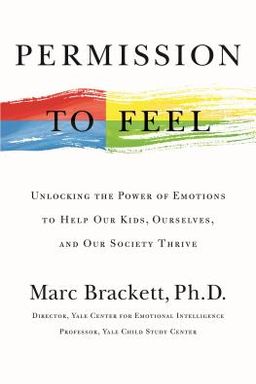
Permission to Feel cover

Permission to Feel

by Marc Brackett, PhD

Permission to Feel reveals how understanding and embracing our emotions can enhance decision-making, reduce stress, and improve relationships. Through emotional intelligence skills, learn to transform emotions into powerful allies for a healthier, more fulfilling life.

The Power of Permission to Feel

What if emotional honesty were treated not as a weakness but as an essential skill? In Permission to Feel, Marc Brackett—director of the Yale Center for Emotional Intelligence—argues that emotional awareness and regulation are not luxuries, but foundations of learning, health, and social equity. His thesis is direct: giving yourself and others permission to feel unlocks the data hidden within emotion, and learning the skills to read and use that data can change schools, workplaces, and entire cultures.

Why permission matters

Brackett begins with a striking observation—our culture often discourages emotional expression. In families, classrooms, and offices, people are told to hide, minimize, or “manage” feelings before they are even understood. This denial breeds stress, isolation, and illness. His own childhood illustrates the cost: raised by parents who couldn't handle emotions, Brackett internalized pain until one caring adult, Uncle Marvin, asked a simple question—“How are you feeling?”—and truly listened. That one act of empathy gave him permission to feel and began the path from secrecy to self-understanding.

Across society, the consequences of emotional denial ripple outward. Data from Gallup, UNICEF, and the ADL show rising stress, anxiety, suicide rates, bullying, and disengagement in schools and workplaces. Teachers experience stress levels equivalent to nurses; adolescents describe three-quarters of their school emotions as negative—tired, bored, and stressed. Denying emotion costs economies trillions and blinds individuals and institutions to the information feelings carry.

Emotions as data, not noise

Brackett reframes emotion as an internal signal system evolved to help you navigate life. Emotions influence attention, memory, decision-making, creativity, and health. Fear sharpens focus; joy broadens perspective. Chronic stress floods your body with cortisol, impairing learning and immunity, while gratitude and laughter boost resilience. In decision-making, emotions serve as heuristics—attention shortcuts. You must learn whether a feeling is relevant (“I’m angry because this meeting is unfair”) or incidental (“I’m angry because I skipped lunch”). Emotional awareness thus becomes a form of scientific literacy about oneself.

Toward emotional education

From the evidence, Brackett moves to practice. He introduces his RULER framework—a teachable set of skills to Recognize, Understand, Label, Express, and Regulate emotion. RULER fuses cognitive science (from Damasio, Sapolsky, Barrett, and Lieberman) with lived experience in schools and families. These skills can be taught, measured, and applied systematically. They are not traits or innate tendencies but trainable competencies that transform how people learn, lead, parent, and make decisions.

Emotion as public policy

Brackett argues that emotional intelligence must not remain personal—it should be woven into institutions. Just as national programs addressed nutrition and physical health, public policy must address the neglected domain of emotion. He envisions schools that track daily emotional climate, workplaces that train managers in empathy and regulation, and communities that value feelings as legitimate information. His closing message is systemic and moral: denying emotions wastes human potential, but granting permission to feel—through skill, structure, and culture—unlocks the possibility of healthier, more compassionate societies.

“Permission is both attitude and action.”

Empathy without action is insufficient; sustainable change requires curiosity, validation, and the daily practice of skillful emotional engagement.

Taken together, Permission to Feel asks you to become an emotion scientist of your own life—someone who investigates rather than suppresses, who teaches others to read feelings as information, and who participates in the emerging emotion revolution that treats emotional literacy as essential for human flourishing.


The RULER Framework

RULER is the operational core of Brackett’s vision. It translates permission into practice through five learnable steps: Recognizing, Understanding, Labeling, Expressing, and Regulating. Each component builds cognitive and social skill, turning raw emotion into informed action.

Recognizing and understanding emotion

Recognition begins with awareness. Using the Mood Meter—a grid of energy and pleasantness—you learn to locate yourself and others: yellow for high-energy pleasant states, red for high-energy unpleasant, green for calm-positive, blue for low-energy negative. Recognition means noticing facial cues, tone, and physiological shifts before jumping to conclusions. Brackett notes how technology dulls this ability—spent faces behind screens lose nuance. Understanding then asks why a feeling arose, drawing on appraisal theory. Each emotion carries a “core relational theme”: anger signals injustice, sadness loss, anxiety uncertainty. Asking why helps you respond wisely instead of merely reacting.

Labeling and expressing with precision

Labeling refines recognition into language. When you have the right word—jealousy instead of vague anger, disappointment instead of “bad”—your brain shifts from the amygdala’s threat response to the prefrontal cortex’s reasoning circuits (based on Lieberman’s neural research). Emotional granularity, pioneered by Lisa Feldman Barrett, means expanding your vocabulary to dozens of terms across intensity ranges. Expressing follows: sharing feelings appropriately for context and culture, guided by norms that balance authenticity and impact. As sociologist James Gross’s research shows, expression influences social connection and health—suppression breeds isolation, but unfiltered venting can harm trust. Skill means expressing strategically.

Regulating emotions purposefully

Regulation integrates all prior steps. You use breathing, cognitive reframing, and the Meta-Moment—a practiced pause—to manage intensity in line with goals. These tools aren't about stifling emotions but steering them: selecting which feelings to amplify or quiet in pursuit of values and relationships. Through RULER, emotions move from being private storms to shared signals of meaning. Evidence shows classrooms and workplaces trained in RULER report reduced conflict, improved performance, and greater well-being.

“If you can name it, you can tame it.”

Brackett’s mantra encapsulates the neuroscience behind emotional vocabulary: precision in labeling is the first step toward mastery in living.

RULER reframes emotional intelligence from trait to skill—available to anyone willing to learn. Teach these tools to children, practice them in workplaces, and emotions become assets for insight, connection, and intentional living.


Tools for Regulation and Reflection

Knowing how to regulate emotion transforms your daily experience. Brackett integrates techniques rooted in psychology and mindfulness: cognitive reappraisal, the Meta-Moment, and lifestyle foundations that support brain and body resilience.

Reappraisal and adaptive reframing

Reappraisal involves reinterpreting an event to alter its emotional impact. For instance, you can recast a partner’s curt tone as stress at work rather than hostility. Research confirms its benefits: reframing stress as enhancing boosts performance, and reappraising anxiety improves test results. Yet Brackett warns against using reappraisal as avoidance—calming yourself must not replace confronting patterns that need change. Ask the meta-question: “Am I reframing to grow or to deny?”

The Meta-Moment: deliberate pause

The Meta-Moment gives you a structured pause between stimulus and action. You sense emotional activation, stop, visualize your best self, strategize a response, and act with integrity. It’s a neurological breather—allowing the prefrontal cortex to regain control from the amygdala. Brackett’s own teaching stories show its value: when confronted by a disrespectful student or colleague, pausing transformed potential conflict into composed engagement. Short pauses prevent destructive decisions based on temporary emotions.

Building the foundation: body and lifestyle

Behind every advanced strategy lies basic self-care. Diet, sleep, exercise, social connection, and mindful breathing create the energy and attention necessary for emotional regulation. Regular movement boosts serotonin; stable blood sugar supports self-control; adequate sleep restores prefrontal activity. Mindful breathing—daily, not occasional—reduces cortisol and strengthens the pause reflex that enables the Meta-Moment. As Brackett puts it, “You can’t regulate your emotions if you’re physiologically depleted.”

“Pause as protection.”

The Meta-Moment teaches resilience—every pause safeguards your values from the volatility of emotion.

Regulation thus spans from reframing thoughts to nourishing the body. Practiced consistently, these tools turn emotion management into a life discipline—balancing acceptance of feelings with accountability for your actions.


Emotion in Families

Home is the first emotional laboratory. Brackett shows that children learn how to feel by watching parents handle their own emotion. You model regulation long before you teach it explicitly.

Modeling and vocabulary

Parents who value emotion become 'coaches.' They validate feelings, expand vocabulary, and show how to calm and plan. Those who fear or dismiss emotions often create shame and repression. Using diverse feeling words—irritated, discouraged, excited—helps children distinguish and manage subtle states. Studies show that parents with richer emotional language raise children with better regulation and empathy.

Co-regulation and family charters

Brackett promotes co-regulation—supporting children through shared calm and conversation rather than punishment. His family charter tool creates written agreements about how everyone wants to feel and behave, bringing emotional literacy into household culture. Moving examples, such as a son writing comfort notes to his father, show how awareness triggers repair and change. Parents are urged to practice the Meta-Moment before disciplining—to see their best selves and respond constructively.

Practical parenting sequence

Brackett offers a simple four-step framework: set yourself up with calm routines, explore your child’s feelings with curiosity, strategize solutions collaboratively, and follow up. In one story, when his niece faced racial teasing, her mother modeled empathy, brainstormed responses, and engaged the school—teaching resilience by example. Emotional skill at home becomes both prevention and repair, ensuring future adults who can communicate rather than suppress.

“You teach your children by expressing your own feelings skillfully.”

Emotional education starts in self-awareness; no script for children works if parents avoid looking inward.

Homes that practice permission to feel—through charters, open dialogue, and emotional modeling—cultivate competence not just in children but in generations to come.


Emotion in Schools and Leadership

Schools and workplaces form society’s emotional backbone. Brackett argues that emotional intelligence must be taught systemically across all institutions to improve learning, equity, and performance.

SEL and educational transformation

In schools, emotions shape readiness to learn. Students and teachers report overwhelmingly negative daily feelings—disengagement, stress, and boredom. RULER lessons infused across subjects transform classrooms into emotionally literate communities. Teachers use literature or science lessons to analyze emotions underlying decisions. Schools with RULER integration show higher attendance, improved grades, and fewer behavioral incidents. Meta-analyses confirm a strong return on investment—every dollar spent on SEL yields elevenfold benefits.

The adult piece

Brackett learned that SEL fails if adults are excluded. Principals, teachers, and staff must model behaviors they wish to cultivate in students. Emotionally intelligent leadership improves morale and trust. In a Connecticut and New York rollout, systemic training from district leaders down created sustainable change. Emotionally healthy adults make emotionally safe schools.

Workplace emotion cultures

In organizations, emotional climate drives engagement, creativity, and ethical behavior. Studies by Sigal Barsade and David Caruso show mood contagion’s impact on teamwork and fairness. Managers with high emotion skills elevate happiness and reduce burnout; poor emotional climates cost billions. Brackett emphasizes that leadership must combine empathy with regulation—leaders cannot manage feelings they refuse to acknowledge. Workplace charters and feedback on emotional climate make culture measurable and accountable.

“SEL is not a detour from academics—it’s how learning succeeds.”

Emotion and cognition are intertwined; ignoring one undermines the other.

From classrooms to corporate boardrooms, treating emotion as data rather than distraction builds systems of inclusion, motivation, and integrity—conditions where both people and ideas thrive.


The Emotion Revolution

Brackett closes the book with a bold vision: an emotion revolution that embeds emotional learning into culture at every level. Emotional intelligence should be a shared public skill set, as vital as literacy.

Scaling emotion literacy

A true revolution requires policy, funding, and cross-sector collaboration. Teacher preparation programs must include emotion science; family engagement must be built into curricula; workplaces and health systems must train emotional leaders. Citywide and statewide implementations in Connecticut and New York show what’s possible when policy and research align. Emotional competence becomes infrastructure—not an elective workshop but a pillar of societal health.

Your role in the movement

Change begins locally. You can practice RULER at home, advocate for SEL at your school, check your workplace’s emotional climate, and support mental health initiatives in public life. Brackett’s closing plea combines science with compassion: personal adversity may motivate individual growth, but systemic support ensures that every child and adult has the same permission to feel.

“Developing emotion skills isn’t a program—it’s a way of life.”

The revolution expands the circle of empathy; emotions become shared data for collective understanding.

An emotion revolution asks you to live as an emotion scientist—curious, compassionate, and deliberate. The promise is not utopian idealism but practical hope: communities where people listen before judging, pause before reacting, and act guided by empathy and informed reason.

Dig Deeper

Get personalized prompts to apply these lessons to your life and deepen your understanding.

Go Deeper

Get the Full Experience

Download Insight Books for AI-powered reflections, quizzes, and more.