
Idea 1
The Pursuit of Perfect Confidence
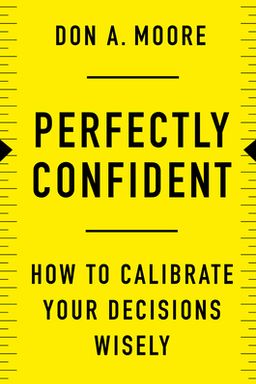
Can you ever be too confident? Don A. Moore argues that you absolutely can—and that both extremes of confidence, too high or too low, can sabotage your decisions, relationships, and success. In Perfectly Confident, Moore challenges the popular self-help mantra that more confidence is always better. He contends that confidence should be neither a swagger nor self-doubt but a careful calibration of what you believe against what is true. The goal is not blind optimism; it’s an honest belief aligned with evidence.
Moore draws from decades of psychological and behavioral economics research, as well as his own life, to show how overconfidence and underconfidence each lead to their own kinds of error. Overconfidence produces “errors of action”—risky leaps you later regret—while underconfidence breeds “errors of inaction,” missed opportunities you’ll never get back. His central mission is teaching you to find the middle way: the narrow, evidence-based path between arrogance and timidity.
Why Confidence Is Misunderstood
Moore begins by admitting his own history as a believer in the “power of positive thinking.” As a teenager, he tried subliminal tapes claiming to make him more popular; as an adult, he attended Tony Robbins’s fire walk event, where his overconfidence literally burned his feet. These stories set the tone for the book’s exploration of why society idolizes confidence as a cure-all. Self-help literature, from Dale Carnegie’s successors to modern motivational gurus, often preaches that your goal should be to maximize confidence, as though courage alone guarantees success. Moore sharply disagrees. If there are confidence disorders—like believing you can drive blindfolded—then you can definitely have too much of it.
To combat this myth, he redefines confidence as a belief about a future outcome or performance that must be tested against actual results. Confidence is not personality or self-worth; it’s an assessment of reality. Shaquille O’Neal dunking a basketball is confident; Moore’s child thinking he could dunk if he tried hard enough is overconfident. Confidence becomes “perfect” when it reflects what evidence warrants.
The Three Faces of Confidence
Throughout the book, Moore distinguishes between three dimensions that keep confidence honest: Estimation (how good you think you are), Placement (how you rank compared to others), and Precision (how sure you are that you’re right). Overconfidence appears in each: overestimating your abilities or chances, overplacing yourself above others, and overprecision—being too sure about uncertain facts. If you think you’ll finish a project in two days when it takes ten, that’s overestimation. Believing you’re a safer driver than the rest of your city exemplifies overplacement. And assuming your stock-market prediction is guaranteed shows overprecision.
Interestingly, underconfidence has its own perils. When people feel less capable at rare or difficult tasks, they experience impostor syndrome. Moore cites Maya Angelou, John Steinbeck, and Jodie Foster—all extraordinary achievers—who confessed fears that their success was luck. Their doubts mirror what many competent people secretly feel: since they know their own struggles intimately but not others’, they assume everyone else is better.
The Middle Way
Moore proposes the Aristotelian “middle way,” drawing from Aristotle’s and Theodore Roosevelt’s advice to avoid both rashness and timidity. Perfect confidence is not arrogance or self-sabotage—it’s the truth about your abilities and your odds. That means calibrating beliefs using facts, feedback, and probabilities, not wishful thinking. It’s about seeing clearly what is possible, what isn’t, and where the data actually lie.
“Confidence isn’t about fooling yourself into believing you can walk through fire—because you’ll get burned if you try.”
Moore teaches that confidence doesn’t grow from affirmations or posture; it grows from calibration. Those who master it make better bets—in careers, investments, relationships, and even self-belief. The book’s eight chapters act as a toolkit: they show how confidence leads us astray (Part I: Over and Under) and how to recalibrate it back to truth (Part II: Just Right). Using psychology, philosophy, and real-world disasters—from Boeing’s flawed plane software to the 2008 crisis—Moore demonstrates that arrogance and fear are twin mirrors of misunderstanding reality. By learning to trust your reason, scrutinize your beliefs, and see both risk and potential with sober eyes, you can develop what he calls perfect confidence: a state of mind where optimism meets evidence and self-belief meets truth.