
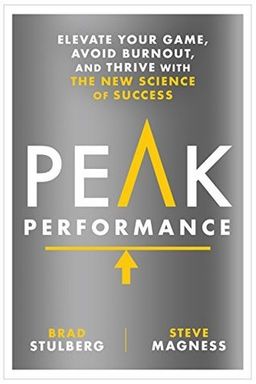
Peak Performance cover

Peak Performance

by Brad Stulberg and Steve Magness

Peak Performance combines success stories and scientific insights to guide you toward achieving your best self. Discover how balancing stress and rest, focusing on one task at a time, and embracing a purposeful mindset can elevate your performance and help you thrive in a competitive world.

Peak Performance: The Science of Thriving Under Pressure

Have you ever wondered why some people seem to rise to every challenge—achieving remarkable goals without burning out—while others crumble under pressure? In Peak Performance, authors Brad Stulberg and Steve Magness uncover the science behind sustained excellence. They argue that true peak performance isn’t about constant hustle or motivation; it’s about mastering the balance between stress and rest, building effective routines, and fueling your effort with a meaningful purpose.

Drawing from cutting-edge research in psychology, physiology, and neuroscience, as well as stories from elite athletes, artists, and scientists, Stulberg and Magness present a simple but profound equation: Stress + Rest = Growth. Whether you’re an entrepreneur, artist, student, or athlete, they show that your body and mind respond to challenges the same way a muscle does—it grows stronger when stressed correctly and given time to recover.

Why This Formula Matters

Most people overemphasize productivity and chronic effort, believing that working longer and harder is the only route to success. Yet the authors identify this approach as the root cause of burnout, diminished creativity, and declining motivation. Through examples like Olympic runner Deena Kastor and chess prodigy-turned-martial artist Josh Waitzkin, they reveal that elite performers grow by cycling between intense focus and deliberate rest, not by grinding nonstop.

The book expands this core principle into three intertwined pillars that underpin lasting performance: the Growth Equation (stress and recovery), the use of intentional Priming and Routines to prepare the mind and body, and a deep sense of Purpose that sustains motivation through adversity.

A Whole-System Approach to Excellence

This isn’t a book about hacks or quick wins. Like Carol Dweck’s concept of the growth mindset or Mihaly Csikszentmihalyi’s idea of flow, Peak Performance invites you to think holistically about what improvement really means. Excellent performance stems not just from biological conditioning but from cultivating psychological flexibility, emotional resilience, and purposeful consistency.

Stulberg and Magness take you behind the scenes of athletes, scientists, musicians, and business leaders who have mastered this rhythm. You’ll meet Google engineers integrating mindfulness, musicians like Taylor Swift’s drummer Matt Billingslea ritualizing routines, and thinkers like Viktor Frankl and Angela Duckworth explaining the role of purpose and grit. Collectively, their experiences reinforce that performance isn’t an act of pushing past limits—it’s learning when and how to push, and when to recover.

What You’ll Learn

Across three main sections, you’ll discover practical ways to elevate your productivity and prevent burnout:

  • In The Growth Equation, learn how controlled stress, paired with adequate recovery, builds capacity—why skills come through struggle and why the hardest work must be balanced with rest.
  • Priming teaches you how environment, routine, and self-organization shape focus and performance consistency.
  • Purpose explores motivation that transcends ego—how connecting to something larger than yourself ignites long-term drive and protects against burnout.

By the end of the book, you’ll understand how to manage your energy like a renewable resource—alternating strain with rejuvenation. You’ll see why elite performers design daily habits that align with their biological rhythms and how cultivating purpose fosters resilience. The authors guide you from managing work and rest cycles to developing a mission-driven mindset that sustains passion for years, not days.

The goal isn’t to become superhuman—it’s to become sustainably human at your best. That’s the essence of Peak Performance: a science-based roadmap to thriving in high-pressure environments while staying healthy, balanced, and fulfilled.


Stress + Rest = Growth

The book’s central formula—Stress + Rest = Growth—summarizes an insight grounded in physiology and psychology: our minds and bodies adapt only through cycles of challenge and recovery. Like muscles that grow through tension followed by repair, your cognitive and emotional systems improve when they experience stress—but only if balanced with downtime.

Stress as a Catalyst, Not the Enemy

We often associate stress with negativity, but research (like Kelly McGonigal’s The Upside of Stress) shows that how you perceive stress determines its physiological effects. Deena Kastor’s Olympic training demonstrates this: she ran 110–140 miles a week at high intensity but matched her strain with adequate recovery—sleep, massage, and relaxation. Her long-term success proves that growth depends not on avoiding stress, but managing it intelligently.

The Role of Deliberate Practice

Psychologist Anders Ericsson’s research on expertise found that practice alone doesn’t create mastery; deliberate practice—focusing deeply on specific weaknesses, exerting effort, and resting purposefully—does. Musicians, surgeons, and athletes all improve through structured cycles of effort and renewal, confirming that the “grind” myth leads to exhaustion, not excellence.

Rest as a Skill

Stulberg and Magness reveal that rest isn’t passive; it’s a productive state where repair, creativity, and subconscious problem-solving occur. When Hans Selye’s rats adapted to stressors in his groundbreaking experiments, they mirrored how humans grow stronger through adversity—so long as recovery followed. Google’s mindfulness programs and athlete naps serve this same principle. Resting well is training for the mind.

From chess champion Josh Waitzkin to physician Mike Joyner, the best performers aren’t those who push hardest, but those who design rhythms of strain and release. In your own life, this may mean structuring your day into 90-minute focus blocks followed by short breaks or alternating work-intensive weeks with true recovery time. Over time, this creates sustainable improvement—what the authors call “systematic growth.”


Harnessing the Power of Rest

It turns out that the world’s best performers rest harder than they work. In one of the book’s defining sections, the authors explore rest not as laziness, but as an active recovery protocol for creativity, focus, and well-being. From athletes to intellectuals, recovery habits determine long-term sustainability and innovation.

Mindfulness: The Gateway to Recovery

At Google, engineer Chade-Meng Tan created the Search Inside Yourself program, teaching mindfulness to overwhelmed employees. The results were transformative—participants reported sharper focus, calmer minds, and higher productivity. Mindfulness strengthens the prefrontal cortex, enabling people to override “amygdala hijacks”—emotional overreactions that prolong stress. By training calm awareness, you can switch from stress to rest on command.

Sleeping, Walking, and Unplugging

Sleep replenishes both body and mind. Elite athletes like Mirinda Carfrae and Stanford University’s research on basketball players show that extra hours of sleep significantly enhance physical and cognitive performance. Similarly, simple walking breaks or nature exposure, as psychologist Marc Berman found, improve memory and creativity by activating the brain’s default-mode network—a subconscious problem-solving system.

Social and Emotional Rest

Social recovery—spending time in relaxed, supportive company—triggers hormonal changes that aid recovery. As neuroscientist Kelly McGonigal and physiologist Christian Cook showed, connection boosts oxytocin, a natural anti-stress hormone. Whether through family meals, laughter, or shared downtime, human connection accelerates return to balance. Rest is not just solitude—it’s renewal through relationships.

“The courage to rest,” write Stulberg and Magness, “is the courage to trust the process.” Real recovery is an act of discipline, not indulgence, and the foundation for sustained high performance.


Priming Yourself for Peak States

Stulberg and Magness show that top performers don’t wait for motivation—they prime their minds and bodies to deliver on demand. Routines aren’t superstition; they’re deliberate cues that set biological and psychological conditions for excellence.

Creating a Pre-Performance Ritual

Taylor Swift’s drummer Matt Billingslea prepares every show with a custom physical routine that warms his muscles, regulates breathing, and brings him into the zone. Olympic cyclist Megan Gaurnier uses yoga before each race to focus her mind and synchronize movement. Both performers show how repetition and predictability ease anxiety and optimize focus.

Designing for Focus

Environmental design—like Stephen King’s writing space or minimalist work habits—anchors mental states to specific surroundings. Our brains associate objects and places with certain actions (a principle from ecological psychology). By keeping consistent cues like a certain chair, playlist, or workspace, you condition your body for flow. Over time, your environment becomes an extension of your discipline.

The Science of Habitual Excellence

Priming builds neurological pathways that automate excellence. This echoes B.F. Skinner’s behavioral conditioning—actions repeatedly followed by reward become self-reinforcing. Whether you’re an athlete visualizing victory, a writer immersing in your workspace, or an executive preparing for meetings, consistency trains your mind to switch into performance mode faster and with less effort.

In practical terms, create routines that align with your energy cycles, mood, and goals. By “showing up” the same way each day, you don’t rely on willpower—you rely on structure. Routine is ritual in service of excellence.


Minimalism: Focus on What Matters

One of the most liberating insights in Peak Performance is the idea that to be a maximalist in results, you must be a minimalist in focus. The authors highlight examples like Mayo Clinic physician Mike Joyner, Facebook’s Mark Zuckerberg, and President Obama—all of whom simplify everyday decisions to conserve mental energy for meaningful work.

Decision Fatigue and Cognitive Load

Every decision we make uses mental energy. Studies on judicial rulings and physicians show that complex decision-making deteriorates with accumulated fatigue. This “decision fatigue” explains why the best performers automate trivial tasks—like choosing clothes, meals, or schedules—to preserve focus for high-impact work. (In Essentialism, Greg McKeown echoes this principle: eliminate the nonessential to amplify what truly counts.)

Finding Your Natural Rhythm

Great performers tailor their work to their personal chronotype—the body’s biological clock. Morning larks schedule deep work early; night owls perform creative tasks later. By aligning with your natural energy cycles, you harness biological efficiency rather than fight it. As research from the Sleep Research Center shows, matching tasks to peak alertness improves both output and mood.

Choosing Your Circle

The people around you shape your performance. Studies from the Air Force Academy found that motivation spreads socially: a single unmotivated person can lower group results, while positive peers elevate the collective. Surrounding yourself with driven, supportive people creates upward momentum—a living culture of excellence. As the authors summarize, motivation is contagious; choose yours wisely.


Purpose: Transcending the Self

Beyond schedules and routines lies the real engine of peak performance: purpose. Stulberg and Magness argue that sustainable drive emerges when your motivation transcends ego. When you focus on something greater than yourself, you override fear, pain, and fatigue. This is how athletes, artists, and entrepreneurs endure impossible challenges.

The Neuroscience of Purpose

Drawing from the work of Dr. Victor Strecher and Viktor Frankl (Man’s Search for Meaning), the authors explain that purpose reduces the brain’s natural “central governor” mechanism—the part that limits endurance to prevent failure. When survivors, athletes, and creators connect their effort to a mission beyond themselves, they can literally go farther.

Overcoming Limits Through Transcendence

Real-world stories bring this to life: Tom Boyle lifting a car to save a stranger; Jennifer Pharr Davis breaking the Appalachian Trail speed record by hiking out of faith and love, not ego. These moments reveal that when attention shifts from “me” to “we,” human potential expands dramatically. Motivation anchored in service or meaning ignites endurance and creativity alike.

Purpose as Antidote to Burnout

Purpose also protects against burnout. Giving back—teaching, mentoring, or contributing—reconnects you with intrinsic motivation. Adam Grant’s research shows that professionals who help others regain energy and happiness. Similarly, Angela Duckworth’s studies link grit to passion and long-term purpose. When ambition aligns with contribution, resilience follows effortlessly.


Developing and Living Your Purpose

Purpose doesn’t appear overnight—it’s cultivated through reflection and daily alignment. In the book’s final section, readers are guided through practical exercises to uncover personal values and translate them into a self-transcending purpose. The process is grounded, not mystical.

Finding Core Values

Begin by identifying 3–5 fundamental values—like community, creativity, compassion, or growth. Then personalize them: What do they mean to you? Ranking and defining values clarifies why you strive and what “success” truly looks like. This exercise mirrors Viktor Frankl’s insight that meaning arises not from self-inspection, but from service and love directed outward.

Making Purpose Practical

Transform your purpose into an actionable statement—something short, clear, and inspiring. Then, reinforce it through visual cues (sticky notes, wallpapers, affirmations), self-talk (purpose-driven mantras), and reflection. Brief nightly check-ins—“Did I live with purpose today?”—help integrate meaning into everyday decisions.

Purpose as Lifestyle

As the authors conclude, living your purpose transforms performance from a pursuit into an expression. Purpose shapes what you do, how you recover, and how you persist when the work gets hard. When you act from your deepest “why,” performance becomes self-renewing. In the words of Ryan Hall, the fastest American marathoner, “Living your purpose is the best feeling in the world.”

Dig Deeper

Get personalized prompts to apply these lessons to your life and deepen your understanding.

Go Deeper

Get the Full Experience

Download Insight Books for AI-powered reflections, quizzes, and more.