
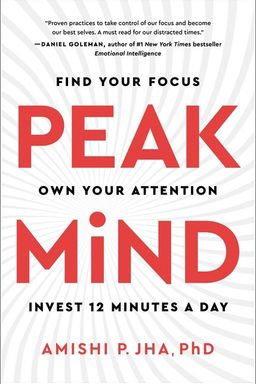
Peak Mind cover

Peak Mind

by Amishi Jha

Peak Mind explores the science of attention, revealing how to maintain mental focus amidst life''s chaos. Through a simple daily practice of mindfulness, learn to strengthen your attention, enhance memory, and improve overall mental well-being.

Attention: The Hidden Driver of Life

If your mind were a movie projector, attention would be the lens—it determines what gets focused, recorded, and experienced. In Peak Mind, neuroscientist Amishi Jha argues that attention is the brain’s most powerful yet vulnerable system, one that shapes perception, emotion, memory, and even identity. But while attention can be hijacked by stress and threat, it can also be trained—just like muscle—through targeted mindfulness practices. The book combines laboratory neuroscience, military field trials, and personal anecdotes to show how cultivating attention gives you presence, performance, and peace.

The unseen cost of lost attention

Jha opens with a striking image: if your day were a quilt, half its squares are missing. Those missing squares represent moments lost to mind-wandering, ruminating on the past, or worrying about the future. When attention drifts, experience is no longer encoded into memory—the moment effectively vanishes. This loss is not trivial; it shapes who you believe yourself to be. Everything you perceive, remember, and feel depends on where your mental flashlight points.

Attention can amplify what matters or suppress what distracts. Yet it is drained by stress and poor mood, misdirected by automatic threat signals, and continually pulled by internal narratives. The book’s central promise is that you can reclaim those missing squares—and thereby live more fully—by learning to notice, control, and strengthen attention.

Three truths that anchor the science

Jha’s two decades of neuroscience research reveal three enduring facts: attention is powerful, fragile, and trainable. It is distributed across interlocking systems—orienting, alerting, and executive control—that work together to direct cognition. Each system can be degraded under load or fortified through training. Understanding these mechanisms allows you to protect your cognitive edge under high demand—whether you’re a Marine on deployment, a surgeon in the OR, or a parent at the dinner table.

Her experiments using fMRI and EEG demonstrate how stress triggers attentional collapse, while mindfulness practice enhances resilience. These findings form the book’s backbone: attention is your brain’s boss, and with practice, you can keep it on task despite chaos.

From crisis to clarity

The book’s real-world stories make the science vivid. A Marine captain nearly drives off a bridge when his attention is hijacked by traumatic combat memory. A judge learns to notice anger rising during court sessions and recalibrates before responding. A fireline worker develops cues to recognize when his focus has narrowed dangerously. Each shows the same principle: awareness of attention is what saves it. Meta-awareness—the ability to notice when your flashlight has drifted—is the safeguard that keeps you from being run by your reactions.

Mindfulness as strategic training

Jha reframes mindfulness not as retreat or relaxation but as performance training for the brain. Through short, structured practices, you create attentional “push-ups” that stabilize focus and working memory under pressure. Across her lab’s studies—from football players to soldiers—those who practiced roughly twelve minutes per day maintained attention while controls declined. This tiny habit, repeated daily, protects you against cognitive burnout and the “vigilance decrement” that normally erodes sustained performance.

(Note: This practical dose echoes themes in James Clear’s Atomic Habits—small, consistent actions yield compound returns—but here the focus is not behavior but cognition.)

Dropping stories and leading with attention

Later chapters expand from self-regulation to leadership. When you pay attention fully, you connect deeply—whether to data, people, or mission. Jha shows how leaders like Congressman Tim Ryan and Colonel Walt Piatt use mindfulness to create calm, empathic awareness amid volatility. She also explores how internal “stories”—your mind’s quick narratives—can distort your flashlight, causing bias and misjudgment. Mindfulness helps you drop those stories in real time, notice what’s actually happening, and respond proportionately. Attention, then, becomes not just cognitive power but relational currency.

The book’s essential prescription

Jha’s practical conclusion: you can train attention, meta-awareness, and emotional balance through a four-week scaffold anchored in brief daily practice. Twelve minutes a day—Find Your Flashlight, Body Scan, River of Thought, and Connection Practice—develop focus, awareness, and compassion. These are not techniques for escape but skills for engagement. They help you meet the world’s volatility, uncertainty, complexity, and ambiguity (VUCA) with clarity instead of collapse.

Core insight

Attention defines experience. When you train it intentionally, you recover presence, precision, and perspective—the three pillars of a peak mind capable of clear thought and authentic connection.

In short, this book argues that reclaiming attention is not a luxury but a necessity. The world will keep getting louder and more volatile; your edge depends on keeping your flashlight steady, your floodlight calibrated, and your juggler strong. The mind’s superpower, Jha insists, is attention—and by training it, you restore the full richness of your life.


The Three Modes of Attention

Attention is not one thing—it is a trio of systems that interact to create awareness and control. Jha calls them the flashlight (orienting focus), the floodlight (alert vigilance), and the juggler (executive coordination). Each mode has strengths and vulnerabilities, and understanding them helps you shift intelligently between focus and responsiveness.

Flashlight: concentration and selection

Your flashlight selects what to amplify, directing cortical resources to the chosen target. In vision, this selection is literal—the high-acuity fovea covers only about two degrees of your field of view yet commands half your visual cortex. Anything inside its beam becomes vivid; outside, information fades. The famous Invisible Gorilla experiment dramatizes this mechanism: people counting basketball passes miss the gorilla entirely, proving how effectively attention filters the world.

Floodlight: alertness and readiness

Your floodlight spreads wide, scanning for anomalies or danger. It activates under threat and uncertainty—your senses heighten, posture stiffens, heartbeat quickens. This diffuse mode was vital for survival (predator detection) but in modern life, chronic floodlight activation leads to exhaustion and distraction. The art lies in balancing flashlight precision with floodlight flexibility.

Juggler: goals and regulation

Your juggler holds goals, inhibits impulses, and updates actions in real time. It’s the system that keeps you aligned with intention—writing the report instead of scrolling social media. When the juggler falters, your attention drifts toward immediate gratification. Strengthening this executive component through mindfulness improves task persistence and decision-making, echoing findings from cognitive-behavioral theory and research on working memory training.

Practical application

Use mindfulness to train all three: steady your flashlight (breath practice), calibrate floodlight awareness (body scan), and sharpen your juggler (open monitoring). Together, they build a well-rounded attention capable of depth, breadth, and control.

When you start noticing which mode is active, you can adjust for context—tightening focus for analysis or widening awareness for empathy. Attention, in Jha’s terms, is multipurpose: cognitive, emotional, and social. Knowing its modes lets you navigate complexity with agility and composure.


Stress, Mood, and Threat: Attention’s Kryptonite

Attention may be powerful, but it is fragile. Stress, poor mood, and perceived threat act like kryptonite—sapping focus and hijacking cognition just when you need it most. These forces subtly reroute the brain’s attentional networks toward survival loops that block higher reasoning.

Stress and mental time travel

Under stress, attention slips into the past or future. You replay mistakes or rehearse disasters, losing access to present data. Jha’s Marine example—Captain Jeff Davis reliving a battlefield while driving in Florida—shows how vividly stress can commandeer attention. Laboratory tests confirm this: even moderate stress reduces sustained attention and increases mind-wandering.

Mood loops and working memory collapse

Bad moods narrow your mental bandwidth. Repetitive negative thinking occupies working memory, leaving no space for task goals. The result is what Jha calls whiteboard overload—you lose recall and reasoning. This explains everyday errors: forgetting a colleague’s name or missing a meeting detail when upset.

Threat reconfigures priorities

Perceived threat triggers hyper-vigilance, shifting attention from goal-directed to stimulus-driven. It’s adaptive in combat but harmful during tests or meetings—stereotype threat alone can reduce performance. Julio Frenk’s remark that stress feels like background noise illustrates how invisible this degradation can be.

Key insight

Using attention to fight stress only deepens the drain. Suppression and forced positivity both consume cognitive power. Training awareness to notice stress and re-center breaks the loop—preventing exhaustion before performance collapses.

Instead of resisting kryptonite directly, Jha’s approach builds resilience through training. By learning to catch the hijack—recognizing when stress pulls your flashlight—you preserve cognitive energy and can act with proportion rather than reaction.


Mindfulness and the Science of Training

Mindfulness in Peak Mind is not philosophy—it’s brain training. Jha’s research demonstrates that even short daily practice strengthens attention, stabilizes working memory, and guards against stress-induced decline. Mindfulness works where other mental regimens fail because it directly exercises the circuits that control focus.

The biology behind attention training

Neuroplasticity enables adults to rewire their brains through repeated activation. Jha’s inspiration came from patients recovering movement through mental rehearsal. Mindfulness uses the same mechanism: each repetition of noticing and returning reinforces attentional networks, much like physical repetitions strengthen muscle.

Evidence across settings

In controlled experiments—from a contemplative retreat to military bases—Jha’s team measured real gains. Participants at Shambhala Mountain Center cut cognitive errors by a third. Football players who practiced maintained attention through preseason stress, while non-practicing peers declined. Marines who meditated twelve minutes daily preserved mood and memory during deployment preparation.

Why mindfulness succeeds

Most brain-training games improve only isolated skills. Mindfulness generalizes because it trains the governing mechanism—attention itself. By noticing lapses and returning to the present, you strengthen regulation, not content-specific memory. The result is portable performance: stable focus anywhere.

Practical dose

Twelve minutes a day for four weeks yields measurable improvement. Beginners can start with three minutes. The gain comes from consistency, not intensity—each moment of noticing mind-wandering is an attentional push-up.

In field terms, mindfulness is mental armor. It doesn’t eliminate challenge; it prevents the mental spiral under challenge. That’s why Marines, athletes, and professionals adopted it—not for serenity, but for sustained clarity when life feels like combat.


Mind-Wandering and Working Memory

A wandering mind can be creative—but it’s costly when you need precision. Jha explores how attention fluctuates under load and how working memory, your mind’s whiteboard, depends on keeping the flashlight aimed correctly. Understanding these dynamics explains why we forget names mid-sentence or lose track under pressure.

Load theory: attention never rests

You always use 100% of attention—it just reallocates. On easy tasks, spare capacity invites daydreaming. On demanding tasks, all bandwidth funnels into the moment. The “vigilance decrement” describes how sustained tasks slowly degrade accuracy, not from boredom but predictable attentional drift.

Working memory: the mental whiteboard

Your temporary workspace holds a few items—usually three to four. Attention is the pen that writes on it; distraction erases. Jha’s tragic example of a soldier forgetting a GPS step under stress shows the stakes: cognitive overload can cost lives. Encoding requires present attention. If your whiteboard fills with worry, you can’t “press record” for new experience.

Mindfulness as protection

Mindfulness declutters the whiteboard. By noticing mind-wandering early, you reconnect before performance drops. Jha’s teacher studies prove this: mindful students had higher working memory capacity and reading comprehension. The takeaway—pay attention to attention if you want memory that lasts.

Balanced wandering

Some wandering fosters creativity. The skill is intentional toggling—letting the mind breathe during breaks but returning before accuracy suffers.

When you master this toggling, you become both focused and imaginative—a core trait of peak cognitive performance.


Stories and the Art of Decentering

Your mind runs on stories—instant simulations of what’s happening and what comes next. These mental movies guide behavior but also mislead you when they hijack attention. Jha shows that catching and “dropping the story” through mindfulness restores accurate perception and emotional stability.

How stories run the show

Your brain treats imagined scenes almost like real ones. When a story is vivid, it steals your flashlight—filtering data to fit the narrative instead of adjusting the narrative to new facts. Everyday biases illustrate this: you “see” what fits expectation. Jha recounts missing male helpers at a party because her cultural assumption blinded her until someone spoke up.

Simulation versus mindfulness mode

Simulation mode builds rich narrative but high reactivity; mindful mode observes data directly, non-judgmentally. Shifting between them is critical. You need simulation to plan but mindfulness to calibrate perception. Decentering—the ability to watch thoughts as mental events—is the pivot. “Don’t believe everything you think,” Jha tells Pentagon staff. This gap between thought and truth protects against mental overreaction.

Practical decentering tools

Micro-practices like Bird’s-Eye View and Stop, Drop, and Roll create breaks in identification. Labeling thoughts (“thinking,” “worry”) or visualizing them as bubbles helps detach. You regain perspective before the story hardens into conviction. In life-or-death situations—as with soldiers reassessing an erroneous insurgent narrative—dropping the story avoids disastrous decisions.

Transformation

The goal is not suppression but flexibility. Mindfulness teaches agility—to step into simulation for planning and step out for clarity. This dual capacity marks high-level awareness.

By training decentering, you prevent automatic bias from becoming action. You learn to see clearly and respond wisely—a skill that expands both cognition and compassion.


Building Meta-Awareness

Meta-awareness is awareness of attention itself—a mental mirror that alerts you when your focus has drifted. Without it, you are lost in thought; with it, you can redirect before collapse. Jha argues that meta-awareness is the linchpin of a peak mind, enabling recovery from distraction and regulation under stress.

How meta-awareness works

Metacognition tells you what kind of thinker you are, but meta-awareness lets you catch thinking in real time. Imagine sitting in a press box overlooking a football field—the field is your mind, full of sensations and thoughts in play. From the press box you can watch where the ball is moving. That perspective gives choice.

Body cues as triggers

Your body signals attention changes before awareness does—jaw tension, shallow breath, tight chest. Professionals in Jha’s stories use these cues: heli-rappeller Steven expands focus when he feels “delicious satisfaction” tightening his stomach; judge Chris McAliley grounds below the neck to retain composure. These embodied anchors build self-regulation across contexts.

Practices for cultivating awareness

  • Use breath awareness to notice drift and return.
  • Scan body cues periodically to detect tension early.
  • Ask “Where is my attention right now?” during long or stressful tasks.

Research confirms that performance declines as meta-awareness fades over time. Training this skill keeps vigilance steady. Each act of noticing is not failure—it is the workout that strengthens recovery speed.

In essence

Meta-awareness transforms lapses into practice. You stop losing hours to distraction because you catch them in real time. Recovery, not perfection, defines mastery.

When you learn to watch your mind, attention becomes self-correcting—a dynamic process that fuels resilience in both personal and professional life.


Connection, Leadership, and Resilience

Attention powers not only thinking but connection. Jha expands her science to social and leadership domains, showing that presence—complete, undistracted attention—is the foundation of empathy, trust, and effective decision-making. In volatile conditions (VUCA), trained attention becomes cognitive armor.

Connection through attention

The Latin root of attention, attendere, means “to stretch toward.” When you stretch attention toward another, you form shared mental models—spaces of mutual understanding. Leaders like Tim Ryan and Walt Piatt show how calm, attentive listening transforms chaos into cooperation. Mayor Sara Flitner used focus and civility to steer local politics with compassion, proving attention can counter aggression.

Practicing mindful connection

Simple exercises—listening for two minutes without interruption, reflecting back what you heard—reveal how rarely we give full attention. Jha calls attention “the highest form of love.” Even domestic moments, like baking cookies with her daughter, illustrate that giving undivided focus nourishes relationships as deeply as conversation.

Resilience under VUCA

Modern life is volatile, uncertain, complex, and ambiguous. Through mindfulness, you train tolerance for discomfort—the “burn” of awareness. Like muscles adapt to exercise, attention systems adapt to practice. Micro-practices such as body scans or Stop-Drop-Roll stabilize cognition amid crisis (for instance, calming a panicked child on a flight or staying rational during conflict). The discomfort is progress—it signals training.

Leadership takeaway

Attention leads before authority. When you model presence, others follow. Mindful leaders create clarity and civility—an antidote to modern volatility.

Ultimately, attention connects inner composure with outer influence. In crisis or calm, the trained mind remains proportionate: it sees what’s real, listens fully, and acts wisely.


The 12-Minute Habit

All the science leads to a single pragmatic prescription: twelve minutes of mindfulness a day. Jha’s fieldwork refined this number through trial—enough to yield measurable improvement, short enough for busy lives. The regimen builds cumulative resilience across attention, emotion, and connection.

How the dose was discovered

Initial studies asked for thirty minutes a day, but compliance was poor. When researchers split participants by actual practice time, those averaging twelve minutes showed true gains—prompting a redesign of protocols for soldiers, athletes, and professionals. This was translational science done in broom closets and barracks, proving theory under real-world stress.

The four-week scaffold

The recommended plan mixes four practices: Find Your Flashlight (breath focus), Body Scan (embodied awareness), River of Thought (open monitoring), and Connection Practice (loving-kindness). Alternating them across four weeks trains complementary subsystems—concentration, receptivity, compassion, and self-regulation.

Building the habit

Start small, anchor the practice to a routine (after coffee), and celebrate completion. Perfection isn’t required—each noticing counts. This approach mirrors behavioral science insights from BJ Fogg and James Clear: success relies on simplicity and repetition, not intensity.

Peak Mind Pivot

The shift is subtle but profound: stop practicing thinking to think better; start practicing noticing that you are thinking. The skill of awareness, not control, defines mastery.

In closing, a peak mind is not built by removing distraction but by refining response. Twelve minutes a day rebuilds the missing squares in your quilt of attention—giving you presence, clarity, and depth across every domain of life.

Dig Deeper

Get personalized prompts to apply these lessons to your life and deepen your understanding.

Go Deeper

Get the Full Experience

Download Insight Books for AI-powered reflections, quizzes, and more.