
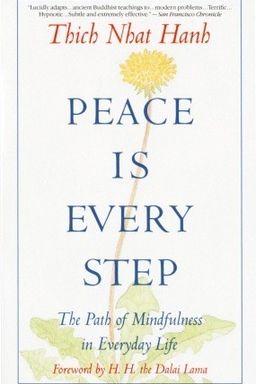
Peace Is Every Step cover

Peace Is Every Step

by Thich Nhat Hanh

Peace Is Every Step provides powerful teachings on mindfulness, guiding readers to be present in each moment. Thich Nhat Hanh''s insights help transform negative emotions, cultivate awareness, and foster compassion, leading to authentic happiness and well-being.

Peace In Every Step: Finding Joy in Mindful Living

What if peace wasn’t something you had to chase or achieve, but something available to you in every single step you take? That’s the radical invitation Thich Nhat Hanh offers in Peace Is Every Step: The Path of Mindfulness in Everyday Life. He argues that true happiness doesn’t come from escaping the noise of modern life but from returning, again and again, to the present moment with full awareness. Peace isn’t a distant goal—it’s a way of being with ourselves and the world right now.

As one of the most influential mindfulness teachers of the twentieth century, Thich Nhat Hanh blends Buddhist philosophy with practical exercises drawn from his decades as a monk and peace activist. Through stories, simple meditations, and vivid examples, he teaches us how to wash dishes, drive, eat, breathe, and walk as acts of deep meditation. He helps us see how each moment, when touched by awareness, reveals the fullness of life.

The Core Message: Peace as Presence

Thich Nhat Hanh’s central claim is stunningly simple: peace is not a product of circumstances but of consciousness. Most of us live as if happiness depends on something external—on success, wealth, or even world peace. But, as he reminds us with gentle urgency, peace must begin with ourselves. “We are very good at preparing to live,” he writes, “but not very good at living.” In other words, we spend our days planning the future and revisiting the past while neglecting the one moment that is truly real—the present.

This idea runs through the entire book. Each breath, each step, each smile can become a doorway back to life. When we breathe consciously—“Breathing in, I calm my body. Breathing out, I smile.”—the here and now opens to peaceful awareness. It isn’t escapist spirituality; it’s emotional courage. We become more alive, more caring, and more present in all we do.

Mindfulness in Everyday Life

The beauty of Peace Is Every Step lies in its practicality. Thich Nhat Hanh turns the most mundane activities into opportunities for awakening. Washing dishes becomes joyful worship; eating breakfast becomes communion; even answering the telephone becomes an act of mindfulness. Every situation—whether peaceful or stressful—is a teacher. He writes that a ringing phone can be a “bell of mindfulness,” reminding you to pause, breathe, and return to your true self before you answer. A traffic jam can become a meditation on patience. A red light, instead of frustration, can invite you to smile and breathe.

Unlike many spiritual texts that ask readers to withdraw from the world, Thich Nhat Hanh’s mindfulness is deeply engaged. His activism during the Vietnam War, leading the School of Youth for Social Service and building villages amid destruction, shaped his belief that inner peace and social peace are inseparable. To wage peace in the world, he says, we must first make peace within ourselves.

Transformation and Healing

If Part One of the book centers on daily mindfulness, Part Two explores how to use that mindfulness to transform emotions—especially anger, fear, and sorrow. Thich Nhat Hanh likens our emotions to rivers that flow through us. When anger arises, instead of suppressing or expressing it destructively, we can cradle it as a mother holds her crying baby. Through gentle awareness, anger becomes insight. He calls this process “non-surgery,” a compassionate self-care that replaces repression and resistance with understanding. Anger, he says, is not an enemy to destroy but compost to nurture compassion.

This deep acceptance of emotions resonates with contemporary psychology (similar to Jon Kabat-Zinn’s work in Wherever You Go, There You Are). But here, mindfulness becomes not just therapy—it becomes a spiritual path. When we observe our fear, sadness, or resentment with loving awareness, they transform naturally.

Interbeing and Universal Connection

In the final section, “Peace Is Every Step,” Thich Nhat Hanh expands mindfulness to a global vision. He introduces the concept of interbeing—the idea that all things exist in interdependence. He asks us to look at a sheet of paper and see clouds, sunshine, the logger, and the baker—all within it. Nothing exists independently; everything “inter-is.” Once you see this truth, compassion naturally arises, because harming another being or the planet is ultimately harming yourself.

This insight becomes the foundation for ecological awareness, social justice, and peace activism. Whether in waging peace, reconciling conflicts, or even writing to your congressman, Thich Nhat Hanh urges mindfulness as the method and message. Real political change, he says, begins with consciousness—seeing that our separation from each other and from nature is an illusion.

Why These Ideas Matter

In a world of constant noise, distraction, and speed, Peace Is Every Step offers both refuge and revolution. It teaches that calm is not passivity, that deep breathing is not an escape, and that mindfulness is not simply relaxation—it’s a powerful act of reclamation. When you wash the dishes with joy, walk mindfully, or breathe through anger, you are restoring the whole world’s peace in miniature.

As readers journey through the book, they find that mindfulness is not limited to the meditation cushion; it is life itself, lived fully and lovingly. Thich Nhat Hanh gives us tools to transform irritation into laughter, fear into tenderness, and separation into solidarity. His message—echoing sages like the Dalai Lama, Martin Luther King Jr., and Thomas Merton—is that world peace begins with inner peace, and the next peaceful step starts right where you are.


Mindfulness in Daily Moments

Thich Nhat Hanh teaches that mindfulness isn’t reserved for monasteries—it belongs in kitchens, offices, traffic jams, and grocery lines. The most ordinary acts, when done with awareness, can become moments of liberation. You don’t need incense or silence, only presence. In his words, “Washing the dishes is at the same time a means and an end.” You wash to clean, but also to fully live in that moment.

Breathe, You Are Alive

At the heart of every practice is conscious breathing—“Breathing in, I know that I am breathing in. Breathing out, I know that I am breathing out.” This simple awareness brings body and mind back together. You stop running mentally into the future or past, and rediscover yourself right here. Even saying “In” and “Out” can refresh your spirit. Thich Nhat Hanh calls breathing a bridge between body and mind—a way to unify what our culture’s busyness has split apart.

Smiling as a Spiritual Act

In one touching story, he describes how even a half-smile relaxes hundreds of facial muscles and invites peace into our body. “Mona Lisa’s smile,” he says, “is just enough to calm worries and fatigue.” When you smile, you remind yourself—and everyone around you—that you are present and alive. It’s a radical act of gentleness in an anxious world.

Mindful Eating and Walking

He recalls eating a cookie as a child for almost forty-five minutes, savoring each bite while watching the sky and touching the dog’s fur with his feet. You can restore this same joy by eating your meals without haste or distraction. “The purpose of eating,” he writes, “is to eat.” Such simplicity dissolves the compulsive drive for productivity.

Walking meditation extends mindfulness to motion. “Walk as if you are kissing the Earth with your feet,” Thich Nhat Hanh advises. Each step prints peace on the planet. Instead of rushing toward a destination, the act of walking becomes fulfillment itself. It’s reminiscent of other mindful practices taught by Jon Kabat-Zinn and Pema Chödrön—walking as a form of embodied serenity.

Every Sound is a Bell

Where tradition uses temple bells, modern life offers car alarms and phone rings. Thich Nhat Hanh turns even these into cues to wake up. At the University of California, he urged students to stop and breathe every time the campus bell rang. Each pause reclaims sentience from busyness. “Listen, listen,” he teaches, “this wonderful sound brings me back to my true self.” Whether in silence or noise, mindfulness is a matter of attention, not environment.

Practicing in this way, you transform your entire day into meditation. Moments at the sink, steering wheel, or supermarket can return you to life. Every breath becomes a small revolution against thoughtlessness—and every smile, a quiet protest for peace.


Transforming Anger and Fear

Anger and fear are part of the human condition, but Thich Nhat Hanh insists they can be healed without suppression or explosion. Using Buddhist psychology, he describes emotions as energies flowing in a river within you. You can’t dam or destroy this river; you can only learn to navigate it mindfully.

Mindfulness as Healing Energy

He calls mindfulness the “mother” of all emotions, capable of holding anger tenderly like a crying child. As you breathe and acknowledge it—“Breathing in, I know that anger is here; breathing out, I calm my anger”—you invite peace into the storm. Unlike suppression, which adds anger to anger, mindful attention transforms the emotion naturally. His organic metaphor is striking: compost, though foul, gives birth to flowers. Anger is our compost; compassion is the bloom it can become.

Non-Surgery and Transformation

Western medicine and psychology often approach emotions like unwanted tumors to remove. Thich Nhat Hanh calls this “non-surgery”—a refusal to excise parts of ourselves. Instead of deleting anger, we nurture mindfulness until transformation happens. Walking meditation, conscious breathing, and compassion become our medicine. If anger is the raw potato, mindfulness is the fire that cooks it until it’s nourishing.

Understanding the Roots

He teaches that anger’s roots lie not only in external provocations but also in internal misunderstandings passed through generations. The fourteen-year-old boy who realizes his father’s shouting comes from ancestral pain embodies this insight: compassion arises when we see that others’ suffering produces their cruelty. Healing begins through understanding, not blame. “Blaming never helps,” Thich Nhat Hanh writes. “When the lettuce doesn’t grow, you don’t blame it.”

(This relational approach mirrors systems thinking in modern psychology and family therapy, where behavior is viewed as the product of interconnected causes rather than isolated choice.)

With patience, breathing, and awareness, even fear and anger become guides to compassion. They cease to be enemies, becoming teachers pointing us back to presence.


Interbeing: The Web of Connection

One of Thich Nhat Hanh’s most profound gifts to modern spirituality is his teaching on interbeing. He asks you to look at a single sheet of paper and notice its hidden stories—the clouds that brought rain, the loggers who cut trees, the sunshine that nourished the forest, the baker who fed the logger. Suddenly, the paper is no longer a blank object; it’s a tapestry of the universe. You realize it cannot exist alone—neither can you.

Seeing Beyond Separation

To inter-be means to recognize that everything is made of non-itself elements. The rose contains the compost. The garbage contains the rose. Wealth contains poverty; joy contains sorrow. “There is no defect and no perfection,” he says, “only transformation.” When you grasp this truth, arrogance dissolves, and compassion grows. You stop seeing humanity as divided into categories—clean and impure, rich and poor, good and bad. You see life itself as an ongoing conversation of mutual creation.

Beyond Dualism and Judgment

He extends the teaching to moral understanding. A man who becomes a pirate has not fallen from grace alone; he is a product of social suffering. In the poignant account of the twelve-year-old refugee girl who drowned herself after being assaulted by a sea pirate, Thich Nhat Hanh meditates deeply and sees the pirate within himself. “If I had been born in the same village,” he writes, “I might have become him.” Through this realization, hatred transforms into compassion. Interbeing becomes forgiveness enacted at the level of the soul.

Ecological and Global Implications

When applied beyond human relationships, interbeing becomes ecological consciousness. If the sun stops shining, we die. If rivers die, we die. The Earth is not our environment; it is our extended body. “The sun is our second heart,” he reminds us. Knowing this, caring for the planet becomes self-care. Pollution of rivers and air is pollution of our own being.

This expanded empathy connects Buddhism with modern environmental ethics (similar to Arne Naess’s “deep ecology”). Seeing ourselves as the forest and the sky dissolves the barrier between meditation and activism, revealing peace as planetary care.

To live in interbeing is to walk gently, see deeply, and act compassionately—for every act ripples through the entire web of existence.


Engaged Mindfulness and Social Action

Thich Nhat Hanh insists that mindfulness must be engaged. Peaceful awareness isn’t a private escape—it’s the foundation of social responsibility. During the Vietnam War, he and fellow monks left their monasteries to rebuild bombed villages, founding the School of Youth for Social Service. For him, spirituality means practical compassion: mindfulness in motion.

Peace Begins with Action

Meditation, he says, should not end when we stand up from our cushion. It must penetrate our work, relationships, and politics. “Once there is seeing, there must be acting.” Each mindful breath gives birth to ethical clarity. Whether feeding refugees or writing to political leaders, the quality of consciousness shapes the impact. He calls for writing “a love letter to your congressman,” believing that peace cannot be spread through hate or blame. Communication rooted in understanding carries transformative power.

Everyday Engagement

You engage with mindfulness by transforming habits of consumption and attention. Television, he warns, is pollution for the mind when watched unconsciously. Choose programs that nourish compassion instead of fear. The coffee you drink, the clothing you buy, even the electricity you use—each contains human labor and environmental impact. Being mindful transforms citizenship into ethics. “Peace work,” he writes, “means, first of all, being peace.”

Community as Refuge

At Plum Village in France, his community of mindful living models this philosophy. Adults and children practice breathing, smiling, and sharing silence together. The community replaces the fragmented Western family with an extended “cloud of friends.” Joy is collective, not solitary. When one member smiles, all benefit. When one suffers, all nurture compassion. This view echoes Martin Buber’s I and Thou—relationship as sacred encounter.

For Thich Nhat Hanh, peace activism is not about ideology but insight. To transform the world, we must first transform perception. If citizens breathe calmly, walk gently, and act kindly, governments will follow. Meditation becomes activism, not escape.

Engaged mindfulness is revolutionary precisely because it begins within you and radiates outward. It turns spiritual practice into daily citizenship and makes every step an act of peace-building.


Healing the World Through Awareness

In the final chapters, Thich Nhat Hanh widens his lens to global healing. The suffering of wars, ecological destruction, and injustice all stem from collective unawareness. The cure, he argues, lies not in more weapons or policies, but in awakening. The same compassion we cultivate for ourselves must expand to encompass the whole Earth.

Waging Peace, Not War

He recounts retreats with Vietnam veterans struggling to find peace after witnessing horror. Through breathing and mindfulness, these soldiers slowly rediscover safety and humanity. His message is clear: “Real strength is not in power, money, or weapons, but in deep, inner peace.” When we encounter suffering—whether in our family or in the global community—mindfulness enables empathy, not judgment. Anger breeds more warfare; awareness births reconciliation.

Turning Suffering into Flowers

Drawing from Zen and his own war experience, he teaches how pain becomes compost for compassion. The twentieth century’s traumas—wars, genocide, refugees—can fertilize the twenty-first century’s garden of tolerance if we learn. “We need a policy for suffering,” he writes, urging humanity to use past pain to grow wisdom. This radical reframing transforms victimhood into transformation.

Ecology of Mind

He extends his compassion to the planet itself, noting that pollution outside mirrors pollution inside. Violent media, greed, and distraction cloud the ecology of consciousness. Caring for the Earth requires caring for perception. Every plastic bag, television image, or hateful word contributes to universal toxicity. Peace demands purification of both soil and soul.

By seeing life as interbeing, by transforming suffering through mindfulness, and by practicing understanding rather than blame, Thich Nhat Hanh offers not just a philosophy but a path to survival for humanity. His final vision is both poetic and practical: sitting with a child on the grass, breathing and smiling together. That, he says, is peace education.

In the end, it’s simple: to breathe is to live, to walk is to heal, and to smile is to begin changing the world.

Dig Deeper

Get personalized prompts to apply these lessons to your life and deepen your understanding.

Go Deeper

Get the Full Experience

Download Insight Books for AI-powered reflections, quizzes, and more.