
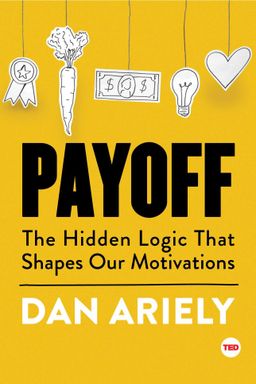
Payoff cover

Payoff

by Dan Ariely

In ''Payoff,'' Dan Ariely explores the intricacies of motivation, revealing how meaning and personal investment fuel our drive. Discover the hidden factors that inspire achievement and how to leverage them for personal and professional success.

The Hidden Forces That Drive Human Motivation

Why do you get up every morning and do what you do? Is it the paycheck, a sense of pride, or the feeling that your work means something? In Payoff: The Hidden Logic That Shapes Our Motivations, Dan Ariely explores this timeless question and reveals that much of what truly drives us isn’t about money or external rewards at all. Instead, it’s about meaning, connection, ownership, and our deep desire to leave something that lasts beyond our lives.

Ariely shows how our understanding of motivation is often tragically misguided. We assume people are like rats in a maze—pushing forward for rewards and avoiding punishment. But his experiments, stories, and reflections uncover a richer truth: humans are emotional creatures who crave significance, love, trust, and identity. When those elements are stripped away—when our work is ignored, dismissed, or destroyed—motivation dies faster than any paycheck can revive it.

The Spark Beyond Happiness

From Ariely’s own experience recovering from severe burns as a teenager, we learn that meaning can arise even in pain. He recalls years in the hospital, undergoing torturous treatments, only later to discover that those experiences, though far from happiness, gave him purpose. Helping another burn victim decades later made him realize that true motivation isn’t about pleasure—it’s about making sense of suffering. Meaning, he argues, is the antidote to helplessness. Whether you’re in a hospital bed, an office cubicle, or raising your children, you are most alive when your effort connects to something bigger than yourself.

The Anatomy of Motivation

The book pieces together what Ariely calls the motivation equation: Money + Achievement + Happiness + Purpose + Progress + Caring + Legacy + Pride—plus countless other subtle forces. While money plays a part, it’s far from the main driver. Ariely’s wide-ranging experiments show that people often work harder when tasks give them a feeling of accomplishment, autonomy, or creativity—even when those tasks are tedious or underpaid. Remove that sense of meaning and motivation plummets.

(In contrast, psychologist Viktor Frankl—whose writings Ariely references—argued that meaning sustains life even in despair. Frankl’s words echo through Ariely’s findings: “Life is never unbearable by circumstances, but only by lack of meaning and purpose.”)

From Cubicles to Creativity

Ariely examines workplaces, both soul-killing and inspiring. Companies often rely on bonuses, ratings, and efficiency metrics, yet these tools can backfire. When employees are treated as cogs—denied ownership or acknowledgment—their energy collapses. But when they’re trusted, appreciated, and allowed to take pride in their creations, productivity soars. This paradox lies at the heart of Payoff: money matters less than connection, compliments, and the magic of feeling seen.

Beyond the Paycheck: Building a Life That Matters

Through studies like the “IKEA effect,” the shredded-paper experiment, and the surprising power of pizza and praise, Ariely reveals that effort and emotion intertwine. We love things we struggle to make; we feel proud of tasks we’ve poured ourselves into; and we stay loyal to jobs and people that recognize our humanity. Even in death, he notes, we crave “symbolic immortality”—a legacy that outlives us. This craving quietly powers us to create, to teach, to build, to write, and to leave something worth remembering.

Ultimately, Ariely invites you to see motivation not as a carrot-and-stick formula but as a living ecosystem of emotions, meaning, and human connection. If you want to motivate yourself or others—at work, at home, or in life—you must nurture trust, recognize effort, and offer purpose. Understanding these deeper forces doesn’t just make people work harder; it makes life richer, more compassionate, and infinitely more worthwhile.


Meaning as the Core of Motivation

Ariely insists that meaning—not pleasure—is the bedrock of motivation. Even the most painful experiences can become sources of drive when they’re tied to purpose. His own story of surviving third-degree burns gave him firsthand insight into the mystery of meaning. Unable to control his world as a 'pain person' in the hospital, he learned that people fight hardest when they can see how their suffering connects to something beyond themselves.

Pain and Purpose

When Ariely visited a young burn victim, he realized that his past agony had shaped his empathy. What once felt meaningless became the reason he could help another person. This transformation—from helpless suffering to purposeful helping—captures what he means by finding meaning in adversity. Similarly, hospice volunteers and disaster responders derive motivation not from ease but from the sense that their work matters.

Happiness vs. Meaning

Research supports Ariely’s claim that happiness and meaning diverge. Happy lives tend to be easy, focused on comfort, self-satisfaction, and pleasure. Meaningful lives, on the other hand, involve sacrifice, service, and long-term significance. You may be tired or even miserable, but you feel fulfilled. (Roy Baumeister and colleagues found similar distinctions between happiness and meaning—where helping others increased meaning but often reduced short-term happiness.)

“Life is never made unbearable by circumstances, but only by lack of meaning and purpose.” —Viktor Frankl, quoted by Ariely

Whenever you feel stuck or demotivated, Ariely suggests reframing your task in terms of who it benefits and what long-term value it creates. By asking, “Whose life will this improve?” or “What will endure because of this effort?” you transition from short-term discomfort to long-term motivation.

In essence, meaning transforms suffering into strength. It turns routine into significance, and it’s the fuel behind every lasting achievement—from parenting and teaching to science and social change. Without it, motivation dissolves into mere motion.


The Power of Acknowledgment and the “Sisyphus Effect”

If you’ve ever had a project canceled or a proposal ignored, you’ve felt what Ariely calls the 'Sisyphus Effect.' In Greek myth, Sisyphus was condemned to roll the same boulder up a hill endlessly—his effort perpetually erased. Ariely’s Lego Bionicle experiment recreated this futility in the lab: participants built figures for money, but when their creations were dismantled before their eyes, their motivation collapsed.

Why Futility Kills Drive

When participants saw their creations destroyed, they produced nearly half as many as those whose work was preserved. Even those who loved Legos lost enthusiasm when their effort was invalidated. Ariely used this study to explain why the Seattle software engineers he met were so demoralized—their company had canceled a major project after two years of investment, robbing them of any sense of progress or meaning.

The Shredded Paper Experiment

Another test revealed how simple acknowledgment sustains motivation. When participants solved letter puzzles and handed their sheets to a researcher who merely said “Uh-huh” before placing them on a stack, they worked twice as long as those whose papers were ignored or shredded. Merely seeing their work recognized doubled persistence.

Key takeaway

Acknowledgment is human magic: a simple gesture that transforms effort into pride and turns routine labor into meaning.

The lesson for leaders? Never treat work as disposable. Even minor recognition—a thank-you, a display of results, a sense of progress—can reignite motivation. Ignore someone’s contributions, and you essentially “shred” their drive.

(Ariely’s findings echo those of psychologist Teresa Amabile, whose research on creativity shows that seeing progress—even tiny wins—inspires sustained engagement. The opposite, she writes, “kills the soul of work.”)


The IKEA Effect: Loving Our Own Creations

Why does assembling IKEA furniture, despite frustration and missing screws, fill you with pride afterward? Ariely’s “IKEA effect” explains how effort creates attachment. When we build something ourselves—even poorly—we overvalue it compared to an identical product made by others. It’s not quality that matters; it’s ownership born of effort.

From Cake Mixes to Origami

Ariely traces this idea back to history. In the 1940s, P. Duff & Sons’ boxed cake mixes failed because they were “too easy.” Housewives disliked them because the process lacked personal contribution. When the company required users to add real eggs and milk, sales soared. Adding effort made the cakes feel homemade and meaningful.

In Ariely’s origami experiments, participants (“builders”) valued their misshapen paper cranes five times more than outsiders (“buyers”). Even when instructions were incomplete and results uglier, creators loved their work more. The harder they struggled, the more affection they felt—an irrational but deeply human tendency.

Effort, Identity, and Blindness

Effort not only builds affection—it blinds us. Builders believed others would love their origami equally, exposing our egocentric bias. We assume our creations are universally cherished when, in truth, only effort makes them precious to us. Ariely connects this phenomenon to parenting, home renovation, and even idea creation: from kids we raise to saunas we build, we overestimate the world’s appreciation because our sweat makes things sacred.

The takeaway is liberating: if you want deeper satisfaction, don’t outsource all effort. Build, fix, or create something yourself. Whether it’s writing, cooking, or designing, the act of doing turns ownership into meaning. (Behavioral economist Michael Norton, Ariely’s coauthor on the study, later applied the IKEA effect to entrepreneurship—showing that founders love their startups partially because they built them piece by imperfect piece.)


Why Money Demotivates More Than It Inspires

Money is supposed to motivate. Yet Ariely’s experiments at Intel proved otherwise. Employees assembling computer chips performed best when rewarded with pizza or a compliment—and worst when offered cash bonuses. The reason? Financial rewards trigger market norms, turning relationships transactional and killing goodwill.

The Intel Experiment

Over several days, Intel chip makers were randomly assigned rewards: a cash bonus, a pizza voucher, a “well done” text, or no reward at all. On Day 1, all incentives raised productivity, but praise and pizza slightly outperformed money. By Day 2, performance for the cash group fell 13%, as workers subconsciously felt “paid off” and disengaged. Gratitude endured longer; cash wore off instantly.

Market vs. Social Norms

Why did praise work better? Ariely distinguishes market norms (money-for-labor transactions) and social norms (relationships built on trust and goodwill). The cash reward pushed workers into market-mode thinking (“I work, I get paid”), while a compliment tapped social-mode thinking (“I’m appreciated and part of a team”). Once money enters a social context—it poisons it. (Think of paying your mother-in-law for Thanksgiving dinner, an absurd scenario Ariely uses to show how money erases love.)

“When we add cash to caring, we subtract meaning.” —Dan Ariely

Similar studies by Ayelet Fishbach and Kaitlin Woolley confirm this logic: when we engage in activities, we focus on intrinsic enjoyment; when we plan them, we focus on extrinsic gains. The disconnect explains why we wrongly assume money will motivate us but discover later that it drains our enthusiasm.

Bosses and parents alike can learn from Ariely’s insight: rewards that express appreciation work better than those that monetize performance. Compliments build loyalty; bonuses build cynicism. Motivation lasts longest where relationships, not transactions, define effort.


Trust, Goodwill, and Long-Term Relationships

Trust and goodwill are the invisible glue of motivation. Ariely describes how small gestures of appreciation—and the belief that others act with integrity—unleash enormous energy. Conversely, contracts, bonuses, and metrics often crush goodwill by making every act seem conditional.

The Collapse of Goodwill

Ariely recounts a company that replaced handshake deals with lawyer-written contracts. Though legally tight, these agreements poisoned relationships. Suppliers felt accused by clauses predicting accidents and failures. Cooperation turned into suspicion, and every new request became a negotiation. The company gained protection and lost partnership—a vivid demonstration that legalism kills trust.

Social vs. Market Relationships

Whether between businesses or families, short-term contracts destroy long-term goodwill. Ariely’s story of “Anne” and “Rob”—friends planning to have a child through IVF—illustrates this beautifully. Their friendship thrived until a lawyer asked them to formalize every possible conflict in a contract. The discussion of custody and education decisions turned love into litigation. They never spoke again.

In contrast, long-term commitment breeds cooperation. Married couples tolerate sacrifices (“I’ll slow down my career to support yours”) because they see themselves as part of one entity. Companies that invest in employees’ well-being send the same message: “We’ll grow together.” Former Campbell Soup CEO Doug Conant embodied this principle, handwritten thirty thousand thank-you notes to staff—a small act that created vast goodwill.

Goodwill is fragile but regenerative—easy to nurture, easier to destroy.

The takeaway: motivation thrives where trust replaces transaction. Leaders who replace fear and metrics with appreciation, compassion, and commitment build loyalty that no paycheck can buy.


The Human Need for Symbolic Immortality

Why do people obsess over legacies? Ariely’s final chapters explore our peculiar drive for “symbolic immortality”—the desire to live on through our creations, children, or influence. Whether you’re Lady Dai of ancient China or a modern philanthropist, you crave permanence in a transient world.

Lady Dai’s Eternal Appetite

Lady Dai, a 2,100-year-old mummy, was lavishly buried with meals, cosmetics, and silk—proof of humanity’s timeless fight against oblivion. Ariely links this to modern funerals and wills. The extravagant rituals serve less the dead than the living, offering comfort and the illusion of continuity. Funerals, he finds, reveal how deeply our motivation stretches beyond life: we spend what we don’t have to honor those who now feel nothing.

Naomi’s Will and the Quest for Reconciliation

A wealthy widow named Naomi left most of her fortune to her estranged son to “reconcile after death.” Others tried stranger postmortem gestures—one man asked to turn his skin into drums; another forced his wife to smoke cigars in revenge. These bizarre wills highlight the irrational but profound urge to control relationships even after life ends.

Ariely’s insight: this same desire for immortality motivates our actions while alive. Artists strive to leave timeless works; parents build families; inventors patent solutions; even children carve names in trees. We seek traces—proof we mattered.

Understanding this instinct helps us grasp why meaning is so powerful. We don’t just want pleasure or recognition; we want permanence. Motivation, at its deepest level, is our fight against impermanence—a symbolic survival achieved through love, legacy, and work that outlasts us.

Dig Deeper

Get personalized prompts to apply these lessons to your life and deepen your understanding.

Go Deeper

Get the Full Experience

Download Insight Books for AI-powered reflections, quizzes, and more.