
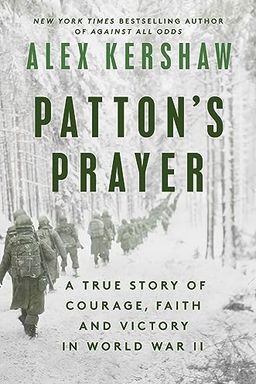
Patton's Prayer cover

Patton's Prayer

by Alex Kershaw

The author of “Against All Odds” chronicles Gen. George Patton’s actions during World War II.

Patton’s War: Speed, Will, and Consequence

How do leaders turn chaos into momentum? In this narrative of George S. Patton and the Ardennes, the book argues that decisive leadership, intelligent anticipation, and the orchestration of morale, logistics, and airpower can reverse even a strategic surprise. Patton embodies this thesis. His visible presence, intolerance for delay, and appetite for risk become operational tools—tools amplified by timely intelligence (Oscar Koch), weather shifts, and the moral resolve of units like the 101st Airborne at Bastogne. Yet the same temperament that fuels victory also courts overreach, culminating in the Hammelburg fiasco and a postwar political fall.

You watch a campaign turn on three levers: presence, preparation, and environment. Presence means a commander who shows up forward, theatrically and purposefully, to change the psychology of the fight. Preparation means fusing signals into options so surprise becomes manageable. Environment means mastering what you cannot command (weather, terrain) through readiness and narrative (a prayer card becomes a force multiplier). This triad reaches its apex around Bastogne, where faith, radar beacons, and tanks converge to hold a road hub under siege until relief arrives.

The Human Engine of Operations

Patton’s persona—ivory-handled pistols, polished helmet stars, Willie the dog—looks like theater, but you see it work. A mud-spattered jeep near Metz, a blistering pep talk to inert officers, or a morphine syringe administered to a wounded GI all communicate the same message: urgency, care for basics, and relentless forward drive. His creed on courage—"The courageous man is the man who forces himself, in spite of his fear, to carry on"—sets a standard for chaplains at the front and for battalion commanders expected to push at night and in foul weather. (Note: Compare Patton’s tempo to Rommel’s dash; both exemplify operational initiative, though Eisenhower and Bradley favored methodical mass.)

Intelligence that Buys Options

Surprise in the Ardennes doesn’t paralyze Third Army because Koch’s G-2 team reads rail traffic, fuel hoarding, and radio silence as pre-assault telltales. Patton absorbs this, still plans a Rhine blow for December 19, yet quietly repositions III Corps reserves and armored divisions for a pivot north. When Eisenhower issues orders at Verdun on December 19, Patton shocks the room by promising to attack in three days. That speed rests on groundwork: alternate plans already drafted, roads preassigned, and units tuned to move.

Weather, Prayer, and the Sky

Fog and low cloud initially ground Allied air, gifting the Germans cover. Patton asks Monsignor James O’Neill for a "prayer for weather"—250,000 cards circulate with his signature and a Christmas greeting. Meanwhile Ninth Air Force meteorologists spot a rising barometer and an eastward high. When skies clear on December 23, P-47s rake German columns, C-47s drop supplies into Bastogne, and air becomes the hinge of the campaign. Whether you credit providence or pressure systems, the ritual matters: soldiers regain agency, and commanders convert hope into coordinated action. (Note: The book treats belief as operational capital, similar to how Victor Frankl or James Stockdale describe meaning as survival fuel.)

Bastogne as Crucible

Inside encircled Bastogne, Brig. Gen. Anthony McAuliffe answers a surrender demand with "Nuts!"—a one-word morale anchor. Medics operate in stables; paratroopers scrounge sheets for snow camo; artillery fires sparingly. Once skies lift, pathfinder beacons and Captain James Parker’s radios guide an air bridge: 150 tons on December 23, nearly 1,000 tons more in days. Meanwhile, Creighton Abrams and the 4th Armored Division shoulder through woods and villages; on December 26, C Company’s "Cobra King" breaks into town. Air keeps the garrison alive; armor opens the door. That triangle—leadership, logistics, and timing—turns defense into endurance.

From Victory to Reckoning

The German gamble—Wacht am Rhein—stuns at first but withers under fuel starvation, Allied air, and counterstrokes. Alongside victory come atrocities (Malmedy, Wereth) that harden resolve and shape conduct. Patton’s spring dash includes a daring Rhine crossing at Oppenheim, executed at night with minimal artillery and low casualties, and theatrical gestures (he scoops Rhine soil, urinates in the river) that signal dominance. But momentum tempts excess: the Hammelburg raid, sized too small and warped by personal motive (his son-in-law among POWs), becomes a needless loss. Then the moral floor drops out at Ohrdruf and Buchenwald—Eisenhower orders troops to look so history cannot deny what they see. Postwar, Patton’s blunt talk on denazification and the Soviets costs him Third Army; Eisenhower shunts him to the Fifteenth Army history post.

Why It Matters to You

You learn how to lead in uncertainty: be seen, think ahead in branches and sequels, harness symbolism when physics closes options, and move before conditions feel perfect. You also learn restraint: the same will that smashes a salient can wreck a good cause if it outruns prudence. The book’s throughline is simple and usable—speed plus sense beats surprise; morale multiplies materiel; and character, for better and worse, scales into strategy.


Frontline Presence that Moves Armies

Patton’s leadership converts visibility into velocity. He insists that you lead where it is "unhealthy," because presence stiffens spines and compresses decision cycles. You meet him in a mud-splattered jeep near Metz, wearing polished stars and ivory-handled pistols, cracking jokes and orders in the same breath. That theater isn’t idle: one tanker remembered columns straightening the instant "Old Blood and Guts" appeared. Presence becomes a weapon as real as artillery.

Lead From the Front

Patton rides open jeeps in sleet, walks smoke-screened pontoon bridges into Germany, and literally pushes stalled trucks alongside replacements. He expects chaplains to share risk and be with the men; Third Army chaplains suffer high casualty rates as a result. When he injects morphine into a wounded soldier and waits for the ambulance, you see "practical empathy": tending socks, hot meals, and medicines because they directly improve combat performance.

Rituals and Symbols

Uniform flash, riding crops, and Willie the dog create shared identity. Rituals—handing the Distinguished Service Cross to McAuliffe in besieged Bastogne, pinning a Bronze Star on Monsignor James O’Neill—broadcast values. They turn leadership into a story soldiers tell themselves under fire. (Note: As in Shackleton’s Antarctic expedition or Napoleon’s bulletins, symbols maintain cohesion when conditions degrade.)

Patton’s creed of courage

"If we take the generally accepted definition of bravery as a quality which knows not fear, I have never seen a brave man... The courageous man is the man who forces himself, in spite of his fear, to carry on."

Demand and Direction

Patton scorns "piddling around." He orders the 4th Armored to "drive like hell" toward Bastogne and browbeats the 94th Infantry Division’s officers with public threats of relief if they lag. The result, repeatedly, is forward motion. He tolerates messy logistics—night convoys without lights, cannibalized track links, even "borrowing" a freight train—because he believes speed denies the enemy time to think. (Note: This prioritization echoes Boyd’s OODA loop—acting faster than the adversary can orient.)

Costs and Contradictions

The strengths cut both ways. Six hours a day near the front risks a one-of-a-kind commander. Pushing divisions beyond endurance raises casualties and friction. His temper and quips create postwar liabilities. Yet in battle, his visibility turns mixed units into moving formations. When Creighton Abrams points the 37th Tank Battalion down icy, narrow roads, he is operating in Patton’s emotional slipstream—confident that initiative will be backed, risks accepted, and results rewarded.

Transferable Rules for You

First, be physically and psychologically present where outcomes are decided; proximity cuts ambiguity. Second, choreograph symbols—awards, rituals, language—to reinforce desired behavior. Third, obsess over soldier basics (or team basics in civilian life): warmth, food, sleep, tools; they are performance fuel. Fourth, accept that momentum exacts costs—create guardrails (trusted deputies, candid staff) to check excess. Patton’s charisma moves armies; your calibrated presence can move teams the same way.


Anticipation: Intelligence to Options

Surprise favors the prepared mind. Colonel Oscar W. Koch, Patton’s G-2, pieces together rail movements of armor, hoarded fuel, and radio silence north of Third Army. Instead of treating each as noise, he reads them as a pattern of impending attack. Intelligence here is synthesis, not secrets. Koch forecasts a 500-tank danger and, crucially, briefs a commander willing to act before consensus forms.

Building the Picture

Trains loaded with panzers mean massing; absent armored formations opposite Third Army imply they are somewhere else; fuel stockpiles suggest offensive intent. Radio silence—the dog that doesn’t bark—often precedes movement. Koch’s team fuses these indicators into a specific warning. Rather than waiting for "proof," they generate options for a commander who prizes tempo over certitude. (Note: This is classic signal detection; see Kahneman’s work on pre-mortems for analogous planning.)

Koch’s judgment

"The massive armored force the enemy has built up in reserve gives him the definite capability of launching a spoiling offensive to disrupt the Allied drive."

Plans in Branches and Sequels

Patton keeps his December 19 Rhine attack on the board while ordering contingency plans to pivot north. He positions the 6th Armored Division and 26th Infantry under III Corps for flexible response. When Eisenhower convenes commanders at Verdun on December 19, Patton can promise an attack "in position to start on the twenty-second" because his staff has drafted road nets, fuel points, and priorities "by fair or foul means." You see the discipline behind daring.

Friction at Higher Levels

Even good intel meets institutional drag. Eisenhower and Bradley initially discount the scope of the German assault; Montgomery appears complacent. Resources shift on contested timelines (Bradley detaches 10th Armored), and boundaries between army groups complicate immediate responses. Patton pushes anyway, accepting imperfect clarity to protect opportunity. (Note: Clausewitz’s "friction" is on full display; organizational bias and delay are part of the battlefield.)

Patterns You Can Use

Build a mosaic of weak signals; act on convergence, not unanimity. Maintain your primary plan and stage reserves to exploit or blunt plausible futures. Communicate estimates in clear, decisive language so decision makers can convert them into moves. And expect friction: design options that survive partial funding, re-tasking, or late-arriving authority. Koch’s craft plus Patton’s bias for action shows how to turn intelligence into maneuver.


Weather, Prayer, and Airpower

In December 1944, the sky dictates the fight. Fog and low cloud ground Allied airpower, blinding reconnaissance and freeing German armor to lunge through thin lines. Patton answers with an unusual dual play: meteorology and morale. He has Monsignor James O’Neill draft a "prayer for fair weather" and orders 250,000 cards printed with his signature and a Christmas greeting. In parallel, Ninth Air Force forecasters watch a high-pressure system approach from the east. When the skies clear, ritual and physics fuse into combat power.

The Problem the Sky Created

Grounded fighters and transports mean no close air support, no interdiction, and no resupply by air for encircled units like the 101st at Bastogne. German columns exploit hedgerows and forests under cloud cover; U.S. convoys slip and stall on iced roads. Operational advantages—fast reconnaissance and precision strikes—vanish. You feel the Allied machine fight with one arm tied.

Ritual as Operational Lever

Patton presses chaplains to preach action: "Pray when driving. Pray when fighting." He later pins a Bronze Star on O’Neill and quips, "You stand in good with the Lord and soldiers." Belief becomes a unifier; a dispersed army shares a common petition and timeline. (Note: Leaders in crisis routinely harness ritual—Lincoln’s public fasts, Navy SEALs’ mantras—to focus will when control is limited.)

The Meteorological Turn

Major Stuart Fuller and General Sam Anderson chart rising barometers; a "Russian high" is inbound. On December 23, cloud lifts. The Ninth and Eighth Air Forces unleash thousands of sorties: P-47 Thunderbolts shred convoys; P-38s sweep; B-17s strike ground targets. An ecstatic German tank officer grouses, "Airplanes everywhere... Shitting all over us." In Bastogne, colored parachutes bloom as C-47s drop 150 tons on the 23rd and hundreds more after.

Precision, Costs, and Control

Pathfinder crews led by Lt. Col. Joel Crouch seed beacons; Captain James Parker, embedded in Bastogne, vectors fighters and transports. The system works—but not without blood. Friendly-fire incidents scar low-level CAS. Flak downs C-47s. On December 24, Brig. Gen. Frederick Castle’s lead B-17 goes down after delayed fighter cover, a reminder that weather’s gift still demands disciplined execution.

What You Take Forward

You can’t command the weather, but you can be ready to exploit it. Build morale rituals that give people agency, even against impersonal forces. Invest in the connective tissue—pathfinders, radios, shared procedures—that converts a break in constraints into outsized effect. Patton’s prayer campaign and the Ninth Air Force’s forecast didn’t cause clear skies; they made sure clear skies caused victory.


Bastogne: Siege, Air Bridge, Relief

Bastogne concentrates the book’s themes into one cold, starved bowl. The 101st Airborne, short on winter gear and shells, holds a seven-road hub that German armor must take to keep Wacht am Rhein alive. Medics operate in stables; wounded lie on straw; paratroopers tear up bedsheets for snow camouflage. On December 22, a German demand for surrender arrives. Acting division commander Brig. Gen. Anthony McAuliffe answers with one word—"Nuts!"—and the word becomes a wall.

Defiance in one word

"To the German commander: Nuts! From the American Commander."

The Encircled City

By December 18, Bastogne is surrounded. About sixty artillery pieces support the defense but shells run low; rations thin; frostbite spreads. Refugees pour in, panic at their backs. McAuliffe tours hospitals and foxholes to stabilize morale. General Troy Middleton tells the garrison, "I think you’re the best bunch of fighting men in the United States or any other army in the world," a needed vote of confidence as pressure tightens.

The Air Bridge

When skies clear on December 23, a lifeline descends. Pathfinder beacons (Lt. Col. Joel Crouch) and Captain James Parker’s ground radios guide waves of C-47s that drop 150 tons the first day, then nearly 1,000 tons in the days after—ammo, blankets, plasma. Pilots brave flak and icing; some, like Captain Paul Dahl, die so loads land. Thunderbolts rake nearby German convoys, thinning the noose around the town. Airpower turns imminent collapse into sustainable resistance.

The Ground Spearhead

South of the pocket, Patton pivots Third Army ninety degrees in mid-winter—roads reassigned, fuel "procured," 20,000 miles of wire laid—and sends the 4th Armored Division as vanguard. Creighton Abrams drives the 37th Tank Battalion through villages like Bigonville and Clochimont, improvising routes, bypassing strongpoints, and pushing at night. On December 26, 1st Lt. Charles Boggess leads "Cobra King" into Bastogne, linking up with the 101st and cracking the siege. Tankers have urinated in turrets and mechanics cannibalized track links to keep momentum; the price of speed is discomfort and ingenuity.

Integrated Victory

Bastogne falls neither to air nor ground alone; it yields to synchronization. The air bridge buys time; Abrams’ armor buys the corridor. Patton’s presence—arriving to decorate McAuliffe—cements narrative closure for exhausted paratroopers and a jittery home front. For you, Bastogne is a systems lesson: when constrained in one domain (ground movement), switch weight to another (air logistics) while you reconfigure force for a breakout. The story endures because it shows courage, yes, but also because it shows choreography under pressure.


Gamble, Hubris, and Moral Reckoning

The Ardennes begins as a German gamble and ends as an Allied reckoning. Hitler’s Wacht am Rhein banks on secrecy, speed, and weather to split the Allies and seize Antwerp. Under fog and radio silence on December 16, three armies launch; thin U.S. lines bend, then bulge. Kampfgruppe Peiper lunges forward; re-formed divisions of youths and older men surge through forests. Tactical shock is real. Strategic depth is not.

A Plan Outrunning Its Fuel

Each tank’s fuel allotment covers roughly eighty miles; beyond that, German columns must capture Allied depots. Distances to Antwerp are long, roads narrow, and snow deep. Surprise buys space but not sustainment. When skies clear, Allied fighters burn truck lines and gasoline dumps, turning the salient into a cul-de-sac. Commanders like Hasso von Manteuffel had warned of winter constraints; Hitler’s insistence overrides prudence, and the offensive bleeds out.

Hitler’s bet

"This battle is to decide whether we shall live or die... The enemy must be beaten—now or never! Thus lives our Germany."

Atrocities and Hardened Resolve

Peiper’s men massacre American POWs at Malmedy; Black artillerymen are murdered at Wereth. Word travels; U.S. units harden, promising "no quarter" in return. The moral atmosphere shifts: the enemy’s brutality justifies intensified response and stiffened resistance. This is the ugly spiral of total war—atrocity begets ruthlessness—and it affects how quickly and fiercely American units fight back into the Bulge.

Counterstroke and the Rhine

Patton treats the Bulge like a meat-grinder—apply the handle where you can force collapse. His rapid pivot north disrupts German timelines and relieves Bastogne. In March 1945, still pressing speed, he crosses the Rhine at Oppenheim at night with six battalions and minimal artillery, beating Montgomery’s set-piece crossing and seizing a symbolic threshold with just 28 casualties reported. Eisenhower praises him: "You have made your Army a fighting force that is not excelled in effectiveness by any other of equal size in the world." Patton celebrates with earthy theater—scooping soil, urinating in the river—signaling that momentum is now irreversible.

Hubris and a Fiasco

Momentum tempts overreach at Hammelburg. Patton orders a small, deep raid—roughly fifty miles behind German lines—to free POWs reportedly including his son-in-law, Lt. Col. John Waters. He promises replacements for any losses and dangles the Medal of Honor to Major Abraham Baum. Intelligence is thin, force size inadequate, and coordination across army boundaries poor. The raid briefly succeeds, then collapses. Dozens die; hundreds are captured. Eisenhower fumes that a company of tanks and a platoon of lights were squandered. Patton later admits he should have sent a full combat command.

Liberation, Witness, and Political Fall

In April, the moral core of the war is laid bare. At Merkers, Allied leaders uncover looted gold and art—material proof of systemic plunder. At Ohrdruf and Buchenwald, they confront mass graves and skeletal survivors. Eisenhower orders widespread troop visits so no one can deny what was found. Patton vomits at the sight, then records details in his diary; the experience clarifies culpability and justifies public disclosure and prosecution. Yet weeks later, Patton undermines himself with public comments equating Nazis to American political parties and musing about confronting the Soviets. Eisenhower, fearing diplomatic fallout, removes him from Third Army and parks him at the Fifteenth Army history desk, explaining privately that the action was "not for what he had done but for what he might yet do."

Enduring Caution

You leave with a paradox: the same ferocious will that collapsed the Bulge also enabled a reckless raid and a peacetime misjudgment. The book’s final lesson is sobering: battlefield brilliance shortens wars, but without restraint and political sense, it can shorten careers and stain legacies. Victory, in other words, demands both audacity and brakes.

Dig Deeper

Get personalized prompts to apply these lessons to your life and deepen your understanding.

Go Deeper

Get the Full Experience

Download Insight Books for AI-powered reflections, quizzes, and more.