
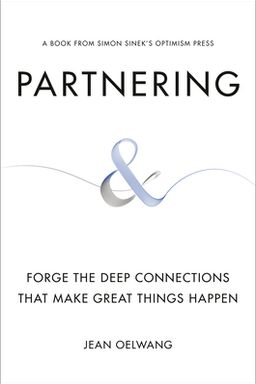
Partnering cover

Partnering

by Jean Oelwang

In ''Partnering,'' Jean Oelwang explores the power of Deep Connections in both personal and professional realms. Through insights from iconic partnerships, the book unveils six principles to forge impactful relationships, fostering collaboration, trust, and resilience to tackle global challenges.

Forging Deep Connections to Change the World

What if the true measure of success wasn’t wealth, fame, or personal power—but the depth of the relationships that shape your life? That’s the question Jean Oelwang asks in Partnering: Forge the Deep Connections That Make Great Things Happen. After decades of working alongside global leaders like Nelson Mandela, Archbishop Desmond Tutu, Richard Branson, and Christiana Figueres, Oelwang argues that meaningful partnerships—not individual brilliance—are what make history’s greatest achievements possible.

Oelwang’s central claim is that deep, purposeful relationships are both the foundation of personal fulfillment and the driving force behind systemic change. Through her work with Virgin Unite and global collectives like The Elders and The B Team, she discovered recurring patterns among enduring partnerships—patterns that transform ordinary relationships into powerful engines for progress. She captures these insights in her framework of the Six Degrees of Connection: six principles that sustain lifelong bonds and allow people to co-create something greater than themselves.

Why Deep Connection Matters

Oelwang begins with a sobering observation: we live amid a global crisis of disconnection. In the workplace, more than half of people feel disengaged; politically and culturally, society is fractured; technologically, social media amplifies division rather than empathy. She contends that this disconnection is not accidental—it stems from the glorification of hyperindividualism. When we prize being the smartest or richest over being the most collaborative, we lose sight of our shared humanity. Her antidote is simple yet profound: cultivate Deep Connections—relationships built on trust, respect, humility, generosity, and mutual service.

Drawing on years of interviewing over sixty partnerships—from Ben & Jerry’s cofounders to Gabby Giffords and Mark Kelly—Oelwang reveals that their success stems not from compatibility or luck, but from intentional design. They treat relationships as active practices, not passive arrangements. “Partnership,” she writes, “is not a noun—it’s a verb.” It’s something you do each day, through listening, forgiveness, and empathy.

The Six Degrees of Connection

The book unfolds around six interconnected principles:

  • Something Bigger: Shared purpose lifts relationships beyond ego and into service.
  • All-In: Partners commit fully, knowing they have each other’s backs.
  • The Ecosystem: Six daily virtues—trust, respect, belief, humility, generosity, empathy—form a moral foundation.
  • Magnetic Moments: Rituals, traditions, and joyful practices keep relationships and teams alive.
  • Celebrate Friction: Conflict becomes creativity when approached with understanding and humility.
  • Collective Connections: Deep partnerships scale outward into global collaborations, proving that unity can solve crises.

Each degree builds on the previous, forming a holistic approach to cooperation that unites individual purpose with collective progress. Oelwang shows how Nelson and Graça Machel’s marriage, for instance, mirrors Ben Cohen and Jerry Greenfield’s business partnership—different in form but alike in spirit. Both are grounded in love, laughter, and service.

Stories that Illuminate Connection

Oelwang’s storytelling makes her argument vivid. We see Archbishop Tutu and Leah Tutu, whose sixty-six-year marriage weathered apartheid through compassion and humor. We meet Azim Khamisa, who forgave his son’s killer and partnered with the boy’s grandfather to fight youth violence. We learn how Bertrand Piccard and André Borschberg, two contrasting personalities, successfully circumnavigated the globe in a solar-powered plane by channeling disagreement into invention. And we see the global ozone community—scientists, diplomats, and business leaders—unite to repair the ozone layer through trust and friendship.

These examples prove that relationships grounded in moral courage can change the trajectory of humanity. Whether saving ecosystems or sustaining marriages, each story shows partnership as a microcosm of cooperation at scale.

A Call to Reimagine Success

Ultimately, Oelwang’s vision echoes philosopher Martin Buber’s “I–Thou” relationships and Simon Sinek’s idea of infinite purpose: To succeed is not to win, but to contribute. She invites readers to reconsider what they measure in life—not followers or profit, but connection. By practicing the Six Degrees of Connection, you can build partnerships that nurture joy, resilience, and collective transformation.

Essential Message

We become who we are through the people we choose to love. The path to a meaningful life—and a better world—starts not with competition, but with collaboration.


Finding Something Bigger Than Yourself

Oelwang’s first degree of connection, Something Bigger, argues that purpose is the fuel that gives partnerships meaning. It starts when two or more people choose to unite around a cause larger than themselves—“a something bigger” that transcends ego, power, and money. You discover fulfillment not through personal gain but through shared service.

Purpose as Shared Mission

The book’s opening story of scientists Frank Sherwood Rowland and Mario Molina captures this perfectly. In 1974, they discovered that chlorofluorocarbons were destroying the ozone layer—a finding that challenged the global chemical industry. Instead of retreating into academia, they courageously took their science public, partnering across governments and corporations to save the planet. Their connection, built on respect and integrity, became a shared mission: saving humanity from ecological collapse. That kind of audacious shared purpose exemplifies the “something bigger.”

Shared Purpose Across Lives

Oelwang draws similar parallels in unlikely places. Chris Anderson (TED) and Jacqueline Novogratz (Acumen) build their marriage on the pursuit of human dignity—each encouraging the other’s separate careers while sharing the belief that “we won’t have dignity as a species until all have dignity.” Their partnership thrives because their individual callings flow into a larger moral compass.

Archbishop Desmond and Leah Tutu also embody this idea. Their love led them through apartheid’s darkness, united by Ubuntu—the African principle of “I am because you are.” They constantly affirmed each other’s courage and kindness, proving that shared purpose isn’t abstract; it’s practiced daily in compassion. (In comparison, Viktor Frankl’s Man’s Search for Meaning similarly emphasizes that meaning arises when suffering becomes service.)

Designing a Living Purpose

Your mission doesn’t need to be world-changing to be meaningful. Oelwang insists that purpose should be perfectly imperfect—able to evolve as you grow. She invites you to write down a clear, simple statement of intent, one that “lights your heart and soul on fire.” For entrepreneurs, that could mean blending profit with purpose; for families, teaching service as part of daily life. Richard Branson’s Virgin Unite, for instance, anchors its business culture in kindness and collaboration—a corporate embodiment of “something bigger.”

The point is that shared meaning creates resilience. When storms come—like tragedy or opposition—purpose keeps partners aligned. Whether it’s Detroit Vegan Soul’s founders pushing past skepticism to bring healthy food to their community or Gabby Giffords and Mark Kelly transforming trauma into activism against gun violence, their “something bigger” turns love into action.

Key Takeaway

Shared purpose is the gravitational center of every great partnership. When you commit to something meaningful together, challenge transforms into inspiration—and your bond becomes a vehicle for change.


Being All-In: Total Commitment Builds Trust

The second degree of connection—All-In—is about wholehearted commitment. Oelwang writes that being all-in means knowing someone will always have your back, no matter what. It’s the difference between conditional attachment and unconditional partnership. Famous couples and friends in the book model this truth: they succeed not because they’re alike, but because they’re fully invested in each other’s growth.

Trust Through Trials

Consider Sherry Rowland and Mario Molina, who endured years of ridicule for their ozone research. Their shared courage kept them going when the world doubted them. Similarly, Jimmy and Rosalynn Carter nearly broke apart while writing a book after leaving the White House, but through honesty and patience they learned to argue constructively (“Each paragraph got a J or an R,” Rosalynn recalled). Their ritual of talking through disagreements each night embodies what Oelwang calls commitment to the commitment—choosing love, even in friction.

Vulnerability and Fear

Keith Yamashita and Todd Holcomb’s story shows how vulnerability deepens bonds. When Todd fell seriously ill with Lyme disease, Keith gave up his career temporarily to care for him. That sacrifice freed Todd to let go of fear and become “the most loving version of his original self.” Their marriage demonstrates that intimacy and independence are compatible when underpinned by trust. (In parallel, Brené Brown’s research on vulnerability resonates: openness is not weakness—it’s courage.)

Friends Before Partners

Ben and Jerry’s founders attribute their success to one simple mantra: “Friends before partners.” They built their company by sleeping on freezers and laughing through exhaustion. Friendship came first, profit second; love and humor replaced bureaucracy. It’s a reminder that being all-in is emotional before professional—you stand beside someone through chaos because shared joy makes endurance possible.

Barriers and Balance

Oelwang warns that fear and imbalance destroy all-in relationships. When one partner withdraws or feels unheard, commitment erodes. Therapist Esther Perel calls this “the choreography of growing apart”—conflict without connection or indifference without care. To avoid this, she urges frequent “bids for attention,” small acts of response and empathy (John Gottman found happy couples acknowledge 86% of these bids). Being all-in means showing up for your partner’s reality, not just your own.

Key Takeaway

Commitment creates safety; safety enables love. Go all-in not by losing yourself, but by daring to trust fully—so both you and your partner can be free to fly.


The Moral Ecosystem of Virtues

The third degree, The Ecosystem, explores what keeps partnerships alive: shared virtues practiced daily. Oelwang describes six moral anchors that interconnect like roots in a living tree—when one weakens, the others suffer. These virtues evolved from her study of partnerships spanning cultures and disciplines, and they form the spiritual framework for the book.

1. Enduring Trust

Trust is faith in each other’s good intentions. Oelwang recounts how Airbnb’s founders rebuilt trust after COVID-19 cancellations angered hosts. Their humility—apologizing, creating a $250 million reimbursement fund—transformed crisis into renewal. Trust grows from transparency, hard conversations, and self-awareness; it begins with trusting oneself before others.

2. Mutual Respect

Respect is treating differences as complementary strengths. She highlights philosopher friends Cornel West and Robert P. George—ideological opposites united by love. They disagree passionately yet listen deeply, proving respect doesn’t require agreement. “Go find a friend who unsettles you,” they urge, echoing Robin DiAngelo’s call to brave discomfort in dialogue.

3. United Belief

Built upon trust and respect, united belief is faith that together you can make the impossible possible. When Richard Branson and Peter Gabriel conceived The Elders—a group of global peace leaders—they faced skepticism from figures like President Carter. Through persistence and belief, they succeeded, proving the power of conviction shared by friends.

4. Shared Humility

Humility tempers confidence. At Draper Richards Kaplan, venture philanthropists Bill Draper and Robin Donohoe credit their culture of service and equality. When Robin joined as a 26-year-old student, Draper insisted her name go on the door as an equal partner—humility transcending hierarchy.

5. Nurturing Generosity

Generosity multiplies love. Dereck and Beverly Joubert’s story after surviving a buffalo attack shows selfless devotion: Dereck threw himself between Beverly and the animal. Oelwang interprets this extreme altruism as metaphor—a reminder to give freely, share gratitude, and celebrate others’ successes without keeping score.

6. Compassionate Empathy

Empathy becomes transformative when it turns into action. Anthony Ray Hinton, wrongly imprisoned for 28 years, forgave his jailer and befriended a KKK member, teaching that “understanding is love.” Empathy means walking beside others, not pitying them—what Stanford psychologist Jamil Zaki calls empathic concern.

Key Takeaway

Practice virtues like skills. Over time they form a moral ecosystem—an environment of kindness and grace that makes love reflexive, not occasional.


Magnetic Moments: Rituals That Strengthen Bonds

In the fourth degree, Magnetic Moments, Oelwang turns to the art of sustaining relationships through intentional rituals. These are the small, joyful practices that keep partnerships in motion—coffee dates, gratitude lists, family dinners, or playful traditions. Magnetic moments are how friendship becomes history and how love remains alive.

Joy and Play

Play is not frivolous—it’s fuel for creativity. Richard Branson and Peter Gabriel built The Elders serious mission but refused to take themselves seriously. Their friendship was cemented in laughter and even silly water fights. Likewise, Mick and Caskey Ebeling of Not Impossible Labs institutionalized joy with weekly date nights, kitchen dances, and the mantra “dotysofus”—“Don’t take yourself so seriously.”

Curiosity and Wonder

Curiosity keeps connection fresh. Stewart Brand and Ryan Phelan reinvent their marriage through endless questioning—breakfast debates about reviving extinct species on their houseboat. Sisters Severn and Sarika Cullis-Suzuki also nurture wonder by returning to nature each summer, swimming and fishing to reconnect with each other and the environment. As Stephen Hawking noted, “Without the people I love, the wonder of it all would be lost.”

Honest Communication

Magnetic moments create safe spaces for truth. Jo Confino and Paz Perlman hold “Friday Talk,” inspired by Zen master Thich Nhat Hanh, to share joys and regrets each week without judgment. The Delle brothers, entrepreneurs from Ghana, use a “Code 10” text to signal urgent calls—ritualizing care in business and family. Rituals make honesty habitual.

Community

Connection thrives in circles. Jane Tewson and Charles Lane’s marriage was blessed by friends reminded “to support them for life.” In Japan’s Okinawa moais—lifelong groups of five friends—members meet weekly for mutual support. IDEO’s creative rituals, from three-minute workouts to “humble-brag” introductions, transform workplaces into families. Deborah and Hank Willis Thomas’s open-door policy—anyone may join in love—demonstrates that community expands connection.

Key Takeaway

Rituals are anchors of love. Whether laughter, meditation, or daily gratitude, these moments remind partners of their shared heartbeat—the joy that keeps purpose alive.


Celebrating Friction: Conflict as Creative Spark

The fifth degree, Celebrate Friction, reframes conflict not as failure but as opportunity. Every partnership encounters disagreement—what matters is how you respond. Oelwang calls productive conflict “the sparkles,” small bursts of insight that occur when difference leads to learning rather than destruction.

Learning Through Differences

Solar Impulse cofounders Bertrand Piccard and André Borschberg initially clashed over public recognition until they reinvented conflict as collaboration: André taught Bertrand to pilot; Bertrand taught André to speak publicly. Turning friction into shared growth allowed them to complete the first solar-powered flight around the world. Their motto became “disagree cheerfully.”

Designing Courageous Spaces

Successful partners create safe zones for hard conversations. Azim Khamisa did this when he invited his son’s killer’s grandfather, Ples Felix, into his home—a brave meeting that birthed forgiveness and the Tariq Khamisa Foundation against violence. Jo and Paz’s “Friday Talk” also models structured safety: by waiting until Friday to vent, they avoid impulsive reactions and foster calm reflection.

Tools and Mindsets

Oelwang presents practical designs for conflict: ask, “What if the other person is right?” (from Cornel West and Robert George), develop a “third way” that integrates both perspectives (from Cindy Mercer and Addison Fischer), and treat humor as oil for tension (Peter Gabriel’s water fights are legendary). Ben and Jerry use veto power to prevent irreparable disagreements, proving boundaries protect respect.

Forgiveness and Perspective

Forgiveness is essential. Azim Khamisa teaches that resentment is “drinking poison hoping it kills your enemy.” Healthy partnerships practice positive amnesia—remembering the ninety-nine things you love about each other instead of one mistake. Therapist John Gottman’s research backs this: happy couples show five times more positive emotion even during conflict. Awareness of triggers and self-reflection complete the toolkit.

Key Takeaway

Conflict can be creative combustion. Approach friction with curiosity, compassion, and humor—and you’ll ignite stronger trust and innovative results.


Collective Connections: Scaling Collaboration Globally

The final degree, Collective Connections, applies partnership principles to global cooperation. Oelwang illustrates through history’s finest example: the Montreal Protocol, the international treaty that healed the ozone layer. Behind this achievement was a web of Deep Connections—scientists, diplomats, businesses—who chose friendship over rivalry.

Design Principles for Collaboration

From this success and others like The Elders or Natura, Oelwang distilled six design principles: (1) an intoxicating shared purpose, (2) starting small and strengthening gradually, (3) an open tent welcoming diverse partners, (4) unlikely connections that spark innovation, (5) relational scaffolding that distributes leadership, and (6) a culture of service and friendship. These principles transform movements from coordination to community.

How Friendship Built a Treaty

Mostafa Tolba and Stephen Andersen—the Egyptian UN leader and American EPA scientist—embodied partnership across difference. Their empathy for developing nations made the Montreal Protocol inclusive, while their trust in each other kept thousands aligned. Margaret Thatcher and Ronald Reagan joined hands with rivals, proving cooperation can transcend politics. The result: 197 countries signed, the ozone hole began to close, and millions of lives were saved.

From Planetary Boundaries to Human Bonds

Oelwang connects their legacy to today’s science. Johan Rockström and Will Steffen’s Planetary Boundaries model shows that Earth’s systems are interconnected; humanity must act collectively to survive. Just as ozone restoration demanded trust, climate repair demands shared purpose. Global citizenship is not idealism—it’s applied partnership.

The Future of Interconnection

In her closing reflections, Oelwang warns that technology and nationalism often isolate rather than unite. But she remains hopeful: from ending smallpox to the Paris Agreement, collaboration is humanity’s superpower. “Impossible is not a fact—it’s an attitude,” says Christiana Figueres, echoing the message that love scaled through systems can heal our world.

Key Takeaway

Partnerships are the blueprint for planetary survival. When Deep Connections ripple into collective connections, ordinary people can do extraordinary things—together.

Dig Deeper

Get personalized prompts to apply these lessons to your life and deepen your understanding.

Go Deeper

Get the Full Experience

Download Insight Books for AI-powered reflections, quizzes, and more.