
Idea 1
Shaping Change: Survival and Renewal in Collapse
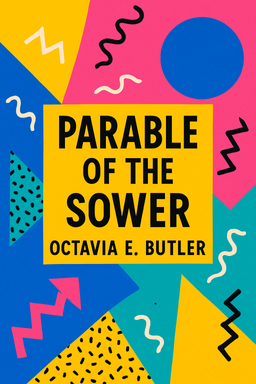
What do you do when the world around you unravels — when water costs more than gasoline, fire spreads like addiction, and belief itself seems obsolete? In Parable of the Sower, Octavia Butler answers this by following Lauren Olamina, a teenager with hyperempathy, through a collapsing California. Butler’s argument is stark yet hopeful: survival requires reinventing both faith and community, not as prayer but as practice. Lauren’s creed, Earthseed: God Is Change, is a living philosophy born from observation, not revelation. Through it, Butler reframes spirituality as strategy, linking adaptation with justice and imagination with survival.
Collapse and Moral Erosion
The story begins inside a gated neighborhood outside Los Angeles — a fragile bubble of order amid systemic decay. Water scarcity, drugs like pyro that make burning ecstatic, and violent gangs destroy public life. Lauren’s father leads community defense, enforcing rules, teaching shooting, and quoting scripture to sustain morality under siege. Yet walls and guns prove temporary; organized arson and chaos breach them. Butler uses these scenes to expose a near-future American dystopia where privatization replaces governance and compassion erodes under scarcity. Everyday violence — murder, theft, neglect — becomes as normal as weather.
Lauren Olamina: Empathy as Liability and Compass
Lauren’s hyperempathy syndrome makes her physically feel others’ pain, a biological mirror forcing moral clarity. To survive, she hides it from everyone, even her family, fearing exploitation or ridicule. (Note: Butler calls this “organic delusional syndrome,” showing how institutions medicalize difference rather than value it.) Hyperempathy turns each act of violence into self-injury; each act of mercy into shared release. When Lauren kills attackers to protect her group, she suffers their agony and embodies the ethical paradox of collapse: compassion and brutality inhabit the same body. Her condition becomes both curse and conscience — a symbol of interdependence that the new society must learn to honor rather than suppress.
The Birth of Earthseed: Religion Remade as Strategy
Lauren’s journals become The Books of the Living, texts that articulate Earthseed. Its core statement — “God is Change” — replaces divine intervention with ecological realism. God isn’t an omnipotent savior but the process of transformation itself. You can shape God, Lauren says, through education, preparation, and collective action. Prayer becomes planning; worship becomes work. This theology turns belief into adaptability, insisting that spiritual resilience equals strategic foresight. (In sociological terms, Earthseed fuses religion and systems thinking, bridging moral imagination and survival pragmatics.) The faith spreads not through conversion rhetoric but through practice: every survival class, every escape pack, every lesson on edible plants becomes catechism.
From Wall to Road: Mobility as Liberation
When her neighborhood burns, Lauren flees north. The road teaches new ethics. Travelers become moving economies — sharing food, weapons, and vigilance. Lauren disguises herself as a man to reduce assault risk, organizes three-hour night watches, and adopts strict fire discipline. Every gesture, from rationing water to choosing camp sites, embodies Earthseed’s ethos: adapt, learn, shape. On highways filled with desperate migrants, Lauren learns that mobility is freedom only when combined with deliberate learning. Her leadership grows through action, merging empathy, tactical sense, and vision.
Building Community: From Pack to Acorn
Along the road, Lauren attracts others — Harry, Zahra, Travis, Natividad, Bankole, and others — forming a pack that evolves into Acorn, a communal settlement on Bankole’s land. They bury their dead, plant oak trees, and adopt Earthseed verses as shared prayer and rulebook. The group learns governance through necessity: rotate watches, assign labor, forbid theft. Bankole’s medical skill and Lauren’s teaching merge into an ecology of trust. Acorn becomes the prototype of political renewal through spiritual imagination — a seed not of nostalgia but of new human possibility.
Destiny and Vision: Take Root Among the Stars
Earthseed’s ultimate goal — “to take root among the stars” — transforms survival into transcendence. Lauren reads about astronauts and planetary science and sees human space migration not as escape but continuation of evolution. The Destiny provides a horizon beyond daily fear. It teaches that even amid collapse, meaning persists through effort and imagination. Butler uses this cosmic ambition to argue that faith is future-oriented work: sustainability and space travel become moral imperatives. (In philosophical comparison, it combines Teilhard de Chardin’s evolution mysticism with pragmatic humanism.)
By the novel’s end, Lauren’s Earthseed is both creed and community, a system reminding you that survival demands moral reconstruction equal to physical endurance. Through change, Butler insists, you reshuffle humanity’s lost rhythms — empathy, adaptation, and vision — and begin again.