
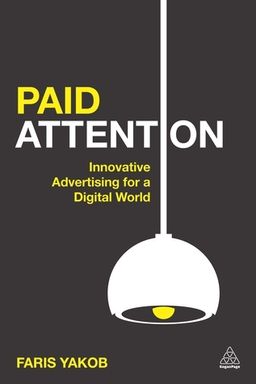
Paid Attention cover

Paid Attention

by Faris Yakob

Paid Attention reveals transformative strategies for advertisers to thrive in a digital age marked by fleeting attention and vast consumer choice. Learn how to craft authentic, value-driven messages that resonate emotionally, ensuring your brand''s success in today''s competitive media landscape.

The New Economy of Attention

Have you noticed how it’s getting harder to focus on anything for long? In Paid Attention, Faris Yakob argues that we’re living through a profound shift — from an economy built on scarce media to one where attention itself is the rare commodity. Once, ad dollars bought time and space in a few mass outlets. Now, with infinite content and infinite creators, what’s scarce isn’t media — it’s you.

Yakob’s central contention is that modern marketing has been fighting the wrong battle. Brands keep paying for eyeballs, but in a world of abundance, attention must be earned, not bought. To thrive, advertisers must understand not only how attention works but how ideas, culture, and human behavior interact in this new, fluid ecosystem.

From Mass Media to the Attention Economy

Yakob begins with media history. In the mid-20th century, broadcasters aggregated human attention and sold it to advertisers. Media scarcity made this simple: buy airtime, interrupt content with commercials, and rely on audience inertia. But after digital encoding and the democratization of production tools, we hit an inflection point. The web allowed anyone to publish or share, and suddenly, humanity produced more content every two days than in all prior history (as Eric Schmidt once noted at Google).

This glut changed the economics of communication. Media bandwidth expanded exponentially thanks to Moore’s Law, but human attention — limited by biology — did not. So attention became what Herbert Simon called a scarce cognitive resource. Yakob defines modern media as the worldwide bandwidth of human perception, now oversaturated by brands, creators, memes, influencers, and individuals—all scrambling for slivers of our finite focus.

Communication as Persuasion — and the Nature of Attention

The author reframes communication itself as persuasion. From Harold Lasswell’s early communication model (“Who says what, to whom, in which channel, with what effect?”) to neuroscience, Yakob shows that every human exchange—be it storytelling, branding, or politics—is about altering another mind. Brands, he argues, are not simply products but ideas competing in an evolutionary marketplace for attention.

Attention, Yakob writes, “is like water.” It flows, it pools, and it can erode or nourish depending on how it’s channeled. Using psychological research, he distinguishes between voluntary (focused), involuntary (stimulus-driven), and social attention (the things we follow because others do). The 20th century model of interruption advertising—buying slices of attention—worked when there were only a few “rivers” to divert. Today, with infinite tributaries, that model leaks everywhere. Now, brands must design ways for attention to flow toward them naturally.

From Buying to Earning Attention

The shift from buying to earning attention is not just tactical; it’s philosophical. Advertisers used to operate under the logic of the AIDA funnel (Attention → Interest → Desire → Action). But this linear model presumes passive consumers and predictable behavior. As attention fragments and consumer behavior becomes nonlinear, paying for exposure delivers diminishing returns. Yakob instead urges marketers to invest in actions that people will pay attention to willingly—acts that earn relevance, curiosity, or emotion.

For example, he explores how military metaphors still pollute marketing (“target markets,” “campaigns,” and “executions”). But people don’t want to be targets; they want to participate. Brands that behave generously—creating experiences, tools, or cultural moments—earn trust and attention. Coca-Cola’s viral “Happiness Machine” or Red Bull’s Stratos jump didn’t shout messages; they did something so interesting and shareable that audiences voluntarily spread them.

Why Attention Matters Now

The reason this matters extends beyond marketing. As Yakob notes, our collective cognitive bandwidth—what we notice, learn, and care about—shapes culture and society itself. The “attention market” doesn’t just sell soap; it defines public discourse. And with algorithms curating what we see, how brands act inside this attention matrix influences everything from elections to self-image. That’s why Yakob blends philosophy, psychology, media theory, and economics: to give us a modern philosophy of advertising for a digital world.

In the chapters that follow, he explores how brands are modern myths, why market research often fails to explain real behavior, how emotion governs persuasion, and why creativity today is recombinant—built by stealing and remixing ideas. He argues that successful modern marketers must become philosophers of attention: understanding human cognition, cultural systems, and technological change all at once.

Ultimately, Paid Attention is not about advertising per se—it’s about how ideas move in a chaotic information ecology. Yakob’s message is clear: in an economy where content is infinite, attention is the gold standard. Brands that earn it through creativity, integrity, and generosity will thrive; those that try to buy it will fade into the noise.


Brands as Modern Myths

To understand modern branding, Yakob asks us to think anthropologically. He argues that brands now perform the role of myth in a secular, consumerist world. Where religion once gave people meaning, brands offer micro-mythologies—stories, symbols, and rituals that help us define who we are.

Drawing on Levi-Strauss and Joseph Campbell, he describes brands as socially constructed ideas—narratives held in the collective mind of consumers. When Procter & Gamble paid billions for Gillette, they weren’t buying razors; they were buying the social meaning of smoothness, masculinity, and technological prowess. Like myths, these meanings evolve through interaction between storytellers (companies) and believers (consumers).

The Mythic Language of Brands

Yakob borrows Levi-Strauss’s concept of mythemes—the elemental symbols of myths—and applies it to branding as “brandemes.” For Coca-Cola, these include redness, youth, Father Christmas, and the contour bottle. Together, they form an interlocking narrative of “happiness.” When people buy Coke, they’re not merely consuming sugar—they’re participating in a story whose power comes from cultural memory.

This idea resolves one of marketing’s paradoxes: brands are everywhere, yet what they are is fuzzy. They are “dominant and vague” because myths must be open to interpretation, allowing everyone to find personal meaning (just as religion adapts to its followers). That ambivalence, Yakob suggests, is strength, not weakness.

Examples: Google, Nike, and Tide

Yakob’s case study on Google exemplifies myth-making. The brand’s founders, geeky origin story, and “Don’t be evil” mantra created a narrative of benevolent intelligence. Even if Bing outperformed it in blind tests, people still preferred Google because its myth of “helping you find truth” resonated emotionally. Similarly, Nike’s myth (“Just Do It”) transforms customers into heroes of self-discipline. And P&G’s Tide, whose brand became so powerful it was used as street currency, shows how myths create economic outcomes through irrational loyalty.

Embracing the Dark Side

Interestingly, Yakob also explores the “dark side” of brands: how authenticity isn’t about being perfect but being consistent, even with flaws. By embracing shadows—sadness, imperfection, vulnerability—brands become more human. Dove’s “Real Beauty Sketches” or P&G’s tearjerker “Best Job” ads mark the rise of “sadvertising,” emotional storytelling that acknowledges human complexity. (This aligns with Adam Ferrier’s argument in The Advertising Effect that strong emotion, even negative, strengthens attachment.)

Ultimately, to build robust modern brands, Yakob says we must stop reducing them to one-word essences like “innovation” or “trust” and instead craft multi-dimensional myth systems people can live by. Brands are social fictions that become real because we collectively believe in them—like money or nations. Their power arises from attention, ritual, and participation.


Why Market Research Gets It Wrong

In an era obsessed with data, Yakob provocatively declares that “all market research is wrong.” Not useless, but misguided—because it assumes people know why they do what they do. Behavioral science suggests otherwise.

Drawing on thinkers like Daniel Kahneman, Dan Ariely, and Leonard Mlodinow, Yakob explains that most decisions are subconscious. We act first, rationalize later. Traditional focus groups and surveys measure conscious opinion, not behavior, making them poor predictors of reality. “Asking people why they buy is like asking them why they dream,” he quips.

From Rational to Behavioral Models

Classical economics treats humans as rational actors—“homo economicus.” But psychologists and behavioral economists dismantled that idea decades ago. We decide through heuristics (mental shortcuts), social proof, habit, and emotion. Yakob cites Niall FitzGerald of Unilever: “Half my advertising is wasted; I just don’t know which half.” He reframes the issue: not waste, but misunderstanding. Ads influence behavior in indirect, non-linear ways that research fails to capture.

He points to Kahneman’s two-system theory: the fast, intuitive System 1 and the slow, logical System 2. Most purchase behavior is governed by System 1—automatic, emotional, and associative. Yet advertising is tested on System 2, in artificial environments, asking rational questions about emotional experiences. This mismatch explains why campaigns that test poorly, like Red Bull’s (initially deemed the “worst product ever” in taste tests), often succeed spectacularly.

Better Ways to Understand People

Yakob advocates triangulation: blending observation, real behavior data, and context. Ethnography—watching people in their natural environments—reveals unconscious drivers. Neuromarketing tools, from fMRI scans to galvanic skin responses, illuminate emotion beyond words. He praises Philip Graves’s “Consumer.ology” for showing why hidden persuaders—scent, texture, color—often outweigh explicit messages.

Crucially, he argues that research should fuel creativity, not replace it. Asking “what people think they think” is fine—but interpreting that within larger behavioral systems is the planner’s art. As George Box said, “All models are wrong, but some are useful.”

Customer Service and Research as Marketing

In the digital age, Yakob observes, the line between research, marketing, and service disappears. Each customer tweet or review is both data and public performance. United Airlines learned this the hard way when musician Dave Carroll’s “United Breaks Guitars” video went viral after months of ignored complaints. One man’s grievance became a brand crisis. Conversely, brands like Zappos have turned public problem-solving into free advertising. “Solving problems in public is the new persuasion,” says Yakob. Every interaction earns or loses attention—and trust.


How Advertising Actually Works

Yakob devotes a section to re-examining the mechanics of advertising, asking: How do ads really change minds? His answer: often, in mysterious, indirect, and subconscious ways. Forget simple cause-and-effect—advertising functions through cultural immersion, emotional triggers, and expectancy violation.

Emotion and Low-Attention Processing

Robert Heath’s research on “low-attention processing” looms large. People absorb brand associations even when not consciously paying attention. This challenges the industry’s obsession with “engagement.” As McLuhan joked, “any ad consciously attended to is comical.” Ads seep in, rather than argue. Heath’s data shows that emotional resonance—music, humor, tone—builds long-term memory more effectively than explicit messages.

This view aligns with neuroscience: feelings precede thoughts. Without emotion (as patients with damaged amygdalae show), we can’t even make choices. Yakob calls emotion the “lubricant of reason.” It doesn’t oppose logic—it enables it.

Curiosity, Surprise, and Awe

Human attention is wired for surprise. Disruption—an unexpected twist, joke, or visual—creates what psychologists call “preferential looking.” Yakob connects this to humor and magic: both exploit violated expectations. The Sony Bravia “Balls” ad, with 250,000 bouncing rainbow spheres, mesmerized viewers not through product features but pure spectacle. Similarly, awe-inspiring or “awesome” content (as in Jonah Berger’s Wharton research) drives sharing more than anything else. Awe, Yakob says, is contagious attention.

He also highlights physical persuasion: experiments show that nodding your head while hearing a message increases agreement. Motion itself can unconsciously bias response—a fascinating bridge between cognition and action.

The Attention Market

Because attention is limited, it behaves like a market, and impressions are its flawed currency. Many “views” aren’t really seen (Comscore estimates 30% of online ads are never viewed). Digital ad fraud eats billions. Programmatic buying, chasing efficiency, often buys fake eyeballs from bots. So metrics like GRPs or impressions, inherited from broadcast, no longer describe reality. The only true measure is voluntary attention—what people choose to engage with, share, or remember. That’s why Yakob calls for “earning attention” through awesomeness, utility, or authenticity rather than buying empty reach.

In short, effective advertising doesn’t persuade through argument—it changes behavior by shaping context, emotion, and culture. As Heath and Field found in their IPA studies, ads with little or no rational content consistently outperform those laden with facts. You can’t logic someone into love—or loyalty.


Advertising, Spam, and Value Exchange

Yakob delivers a blunt diagnosis: most advertising is spam. Not because it’s evil, but because it’s uninvited. Every time we interrupt someone’s attention without consent, we withdraw value from an already strained system. Yet he doesn’t see this as fatal—just as a call to reinvent the exchange between brands and people.

From Interruption to Value Creation

In the broadcast era, the deal was implicit: watch this ad, and you get free content. But digital media fragmented that pact. With ad blockers, subscription models, and algorithmic filters, consumers now control what they see. Yakob argues that the only sustainable model is a balanced value exchange: brands must give something meaningful—entertainment, utility, or purpose—in return for attention.

He introduces the concept of value-added communication, where ads themselves deliver something of worth. Examples include HP’s HYPE Gallery, where users could upload digital art that HP printed and exhibited, and Red Bull’s long-running support for creative communities through the Red Bull Music Academy. Both projects fused brand, behavior, and cultural enrichment.

Brands as Patrons of Culture

Yakob draws a parallel with Renaissance patronage: corporate sponsorship now plays the role once held by royalty. When done with taste and humility, this patronage keeps culture alive. Museums, films, even online platforms often exist because brands finance them. The question isn’t whether commerce and art can coexist—they always have—but how ethically they do it. “Selling out,” he quotes digital sociologist Danah Boyd, “is meaningless in a commercial world; what matters is doing it well.”

Ultimately, Yakob defends advertising as a necessary lubricant of the creative economy—but only if it evolves. Quoting Martin Boase of BMP, he concludes: “If you invite yourself into someone’s living room, don’t shout or bore them. Be charming.” The future of advertising, then, lies in being invited—not in shouting louder.


Content, Media, and the Collapse of Boundaries

“Content is king,” the internet cliché goes. Yakob disagrees: in the digital republic, everyone is king—and everything is content. The boundaries between content, media, and advertising have dissolved completely. He explains how digitization detached ideas from their original containers—TV, magazines, radio—creating a platform-agnostic ecosystem where the audience defines what “media” means.

The Unbundling of Media

Historically, a medium bundled content with its distribution and consumption platform: a book was printed words; television was broadcast video through channels. Digital technology broke that trinity. Now, Netflix streams “TV” without being TV, and an iPad can deliver both newspaper and film. With near-zero distribution cost, everyone from brands to individuals can produce media. As Yakob notes, the internet’s architecture “turns all receivers into broadcasters.”

The Attention Republic

Still, abundance creates new hierarchies. Duncan Watts’s research shows that success online depends as much on network structure and timing as on quality—a phenomenon he calls cumulative advantage. A song or video that gets an early head start snowballs into dominance, even if others are equally good. Hence, fame and attention become self-reinforcing currencies. “If it doesn’t spread, it’s dead,” says media scholar Henry Jenkins (whose work Yakob references). Winning attention now means designing for shareability, not perfection.

Yakob cautions against content mania: brands rush to become “publishers,” flooding feeds with mediocre posts. Instead, he points back to the past: the Michelin Guide and Guinness Book of Records were early forms of branded content—useful, delightful, and enduring. The goal is not to make more content but to make content that adds value to culture. Advertising must now compete not with other brands but with humanity’s entire creative output. That’s a high bar.


Doing, Not Just Saying: Brand Behavior

Yakob insists that in a world of infinite expression, actions speak louder than ads. The most powerful brands no longer tell stories; they perform them. “Do things, then tell people,” he urges.

Technology as Magic and Medium

Advertising once thrived by mastering language and film; today, technology is its new canvas. Quoting Arthur C. Clarke’s dictum that “any sufficiently advanced technology is indistinguishable from magic,” Yakob argues that brands can use tech to enchant. WWF’s invention of a file format that can’t be printed (to save trees) shows how technological action communicates values better than words ever could.

But tech is also a cultural language: creative technologists must translate between engineers and storytellers. Yakob recounts the merger of digital agency Dare with traditional shop MCBD, which faltered because of culture clash—one prized craft and hierarchy, the other agility and collaboration. Integration, he concludes, requires shared culture, not just shared clients.

Acts of Scale and Acts of Happiness

While individuals can make content, only brands can act at scale. Red Bull’s Stratos jump—Felix Baumgartner falling from the edge of space—embodied the brand promise “gives you wings” in real life. Coca-Cola’s “Happiness Machine,” dispensing gifts through a vending machine, turned generosity into shareable joy. Both campaigns created earned attention by doing something worth watching instead of paying to be seen.

Yakob also redefines the term platform. For technologists, it’s a foundation that others build upon; for marketers, it’s an idea that organizes campaigns. Brands like Nikon bridged both meanings with their Nikon Film Festival—a participatory platform enabling users to create films and share stories. “If platforms are the future of business,” he quotes strategist Adrian Ho, “brands aren’t what we do—they’re what we can do together.”


Recombinant Creativity and Stealing Ideas

Creativity, Yakob reminds us, isn’t divine inspiration—it’s recombination. Quoting TS Eliot’s line that “immature poets imitate; mature poets steal,” he reframes originality as intelligent theft. Ideas are new combinations of old elements.

The Science of Combination

Drawing from John Locke’s notion of the mind as a “tabula rasa,” Yakob argues that imagination rearranges sensory input to form novelty. Jonah Lehrer (in How We Decide) calls creative insight the merging of distant ideas; Stephen Johnson describes innovation as exploring the “adjacent possible.” To reach the frontier, you must combine diverse inputs—art, science, culture. Hence his company’s name, Genius Steals: good thinkers collect ideas; great ones connect them.

Cultural Remix as Default

In digital culture, remix is the dominant art form. From memes to mashups, creators live “after the death of originality.” Banksy illustrates this: his graffiti often vandalizes classic paintings or museum walls, reframing them through satire. In his Bristol exhibition, he even engraved Picasso’s aphorism—then crossed out Picasso’s name and signed it “Banksy.” That meta-theft embodies Yakob’s thesis: stealing gives birth to new meaning.

Warhol’s pop art anticipated the same logic—mass-producing art to mirror mass media. Today, filters, reposts, and algorithms extend his assembly-line aesthetic across Instagram. As Warhol said, “good business is the best art.” In this remix economy, fame equals value: “people pay more for something people have paid attention to.” Brands, art, and virality now operate on identical principles.

By embracing recombination, creatives can turn abundance into advantage. You don’t need to invent ex nihilo—just blend non-obvious ideas until sparks fly.


The Future: Integrative Strategy and Attention Ethics

In its final chapters, Paid Attention turns from analysis to blueprint. Yakob calls for integrative strategy—a model that unites creativity, technology, and behavior under one guiding idea. Advertising agencies, he warns, must decide what business they’re really in: making ads, or solving problems with creativity. One is tactical; the other is eternal.

Planning for Behavior, Not Messages

Yakob challenges planners to move beyond messaging toward brand behavior. Instead of asking “what should we say?”, strategists should ask “what should we do?”—then design communications that amplify those actions. He proposes new tools: briefs built around problems and behaviors rather than slogans. Brands like BMW, whose ActiveE electric car program turned customers into beta test “Electronauts,” treat marketing as a social experiment—inviting participation, gathering data, and improving products in real time. Behavior is both medium and message.

Reverse the Polarity

Traditionally, advertising told customers what brands thought. Now, Yakob says, brands must listen and build campaigns from audience input—“reverse the polarity.” Old Spice’s rapid-response videos to tweets, or Domino’s turnaround campaign featuring real customer criticism, illustrate this feedback-loop creativity. With cultural latency approaching zero, speed and responsiveness become strategic virtues.

Ethics of Attention

Finally, Yakob underscores an ethical dimension. Attention is finite and precious—a form of generosity, as Simone Weil wrote. To waste it is disrespectful. The future of communication must therefore balance profit with empathy. Agencies and brands that treat attention as a gift, not a resource to be exploited, will lead the next era of marketing—one defined by truth, usefulness, and cultural enrichment rather than interruption.

Yakob concludes optimistically: creative industries can reinvent themselves as stewards of meaning in a hyperconnected world. Advertising isn’t dead—it’s evolving into philosophy. Those who understand how attention flows can help shape not just brands, but the culture itself.

Dig Deeper

Get personalized prompts to apply these lessons to your life and deepen your understanding.

Go Deeper

Get the Full Experience

Download Insight Books for AI-powered reflections, quizzes, and more.