
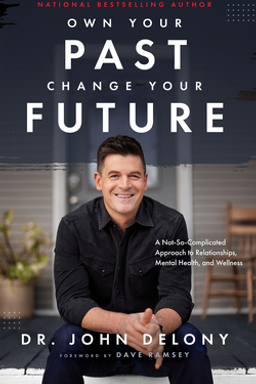
Own Your Past Change Your Future cover

Own Your Past Change Your Future

by John Delony

John Delony''s ''Own Your Past Change Your Future'' presents a straightforward five-step approach to healing from past traumas and fostering mental health. Discover how to own your stories, form genuine friendships, and transform your thoughts, setting the stage for a fulfilling and well-balanced life.

Owning Your Past to Change Your Future

Have you ever felt like the cracks in your life are signs of collapse instead of new beginnings? In Own Your Past, Change Your Future, Dr. John Delony argues that the stories we believe—about the world, about others, and especially about ourselves—shape every part of our reality. The book’s central claim is that healing begins the moment you acknowledge those stories, take ownership of them, and intentionally rewrite what comes next. It’s a manifesto for personal agency amid chaos, blending psychology, storytelling, and faith into a deeply practical guide for becoming whole again.

Delony, a mental health and leadership expert in the Ramsey Solutions network, introduces his method through his own near-collapse—crawling outside in his underwear during a Texas rainstorm convinced his house was falling apart. That cracking foundation became a metaphor for his interior world: stress, disconnection, exhaustion, and denial. From that moment, he began asking why he and the people around him were struggling so much despite professional success. His answer: the stories guiding our lives had become toxic, and our unwillingness to face them kept us trapped.

The Book’s Central Premise

Delony’s model is built on five repeating steps: own your stories, acknowledge reality, get connected, change your thoughts, and change your actions. He calls these practices the lifelong rhythm of wellness—a doable yet demanding path toward freedom, peace, and love. These simple steps contrast with the cultural obsession for quick fixes and hacks. The book emphasizes that transformation is hard work—it requires honesty, courage, and consistent practice—but it’s the only way to experience wholeness.

Why Stories Matter

“The stories are the problem—and the stories are the solution.” With this phrase, Delony frames the book’s argument: all our pain, dysfunction, and even physical symptoms come from the stories that shape our beliefs. These stories are embedded in our families, cultures, and faith traditions; they’re the invisible narratives running beneath everything we do. Some are true and healing—others are lies that keep us anxious, bitter, or stuck. The challenge is to pause long enough to notice them, unpack them, and decide whether they still serve us.

Delony identifies four kinds of stories that govern us: those we’re born into (our culture and family systems), those we’re told (the messages we inherit from others), those that actually happened (our real-life experiences), and those we tell ourselves (our private interpretations). In his view, owning these stories doesn’t mean blaming your parents, your trauma, or your culture—it means claiming creative authorship. You can’t rewrite your past, but you can determine what happens next.

Why This Matters Now

Delony situates his book in a world that is fast, disconnected, and anxious. Technology, debt, and isolation have rewired the human experience, leaving us overwhelmed yet starving for meaning. Drawing from psychological research (like Bessel van der Kolk’s The Body Keeps the Score) and cultural critique, he argues we’re suffering from story sickness—a kind of existential inflammation caused by living out scripts that deny our need for connection, rest, and purpose. His thesis resonates with works such as Viktor Frankl’s Man’s Search for Meaning and Gabor Maté’s When the Body Says No: without honest self-awareness, our minds and bodies revolt.

A Roadmap for Wholeness

Each section of the book unpacks one of his five steps through vivid anecdotes from his work with students, callers to his show, and his own life. Readers first learn to acknowledge painful truths and grieve the gap between expectations and reality. Then they rebuild healthy relationships by choosing genuine connection over independence. From there, they learn to control their thoughts—recognizing that “you decide what lives in your head”—and eventually align actions with identity through discipline and integrity. The culmination is redemption: turning old “bricks” of trauma into building blocks of legacy.

A Message of Hope and Responsibility

The heart of Delony’s message is radical personal responsibility: no one will come to save you, but you hold the power to heal yourself. Yet unlike hyper-individualistic self-help, his remedy is not isolation but belonging. Healing happens in connection, in honesty, and in grief shared with others. The cracks in your life, he reminds you, are not conclusions—they’re invitations to growth.

“The cracks are not the end. They’re the beginning of light.”

By the end, Own Your Past, Change Your Future reads less like a self-help book and more like a compassionate companion. Delony’s tone alternates between gentle coach and firm therapist—humorous, grounded, and deeply empathetic. He doesn’t promise ease, but he does promise freedom. The result is a remarkably holistic guide that blends science and soul, urging you to set down your burdens, rewrite your story, and become the kind of person who leaves behind a road of redemption for others to walk.


The Stories You Live By

Every one of us lives according to stories—narratives about who we are, what’s possible, and what the world is like. Dr. John Delony contends that most of our emotional pain and dysfunction exist because we’ve never examined those stories. They run silently beneath our daily decisions like background apps draining the battery of our lives. If we want peace, we must bring them into the open and take responsibility for them.

Four Kinds of Stories

Delony divides life’s scripts into four categories. First are the stories we’re born into: cultural, familial, or religious expectations that predate us. These include inherited beliefs like “real men don’t cry” or “women must sacrifice to be good.” Second are the stories we’re told—messages from parents, teachers, coaches, and media that shape our self-worth. A single careless comment (like “you’re not college material”) can fossilize into decades of self-doubt. Third are the stories that actually happened—our lived experiences, from joyful victories to traumas that alter our nervous system. Finally, there are the stories we tell ourselves: interpretations, assumptions, and inner dialogues that turn those events into identity. “I failed once” morphs into “I am a failure.”

Turning Blame into Ownership

One of Delony’s most disarming truths is that blaming others for our pain traps us. He acknowledges systemic injustice and real trauma, but insists that healing begins only when we stop outsourcing responsibility for our wholeness. “I was the common denominator in all my pain,” he admits, describing how years of overwork, arrogance, and denial nearly wrecked his marriage and health. Viktor Frankl’s insight echoes here: when we cannot change a situation, we must change ourselves.

The Courage to Go Off-Book

Owning your stories requires courage because it often means discarding scripts that gave you security. Delony compares it to being an actor suddenly thrust “off-book,” forced to perform without a script. It’s terrifying—but it’s also freedom. You get to write your own lines. He illustrates this transformation through his decision to step back from his high-powered university career and rebuild his life from the inside out. Letting those stories die made space for something more authentic to emerge.

Ultimately, this idea reframes therapy and personal growth as authorship rather than excavation. You are both the protagonist and the writer. By acknowledging your old stories and intentionally composing new ones, you reclaim your power to direct the narrative of your life.


Stories About the World

We were born into a world of astonishing advances—smartphones, global connectivity, and endless convenience—but beneath the glitter lies despair. In one of the book’s most sweeping sections, Delony explores the cultural narratives shaping modern life. These are the “air we breathe,” stories about what makes a good life and how to get it. Problem is, most of them are lies. They promise salvation through speed, consumption, and independence, yet they leave us burned out and alone.

Technology as Savior

We’ve been sold the story that technology and innovation will save us—that the right app, algorithm, or device can fix our loneliness or heal our anxiety. But as Delony points out, our bodies still run on Stone Age wiring. Smartphones and social media hijack our nervous systems with endless novelty and outrage, while true connection erodes. He writes, “We got to work from home, but we never got to go home from work.” The result: constant vigilance, isolation, and exhaustion disguised as productivity.

Debt as Normal

Another deadly myth is that debt will save us. In a world where you can buy anything instantly, credit cards and loans masquerade as progress. Delony, echoing his mentor Dave Ramsey, calls debt “a jail cell disguised as opportunity.” Owing money strips us of autonomy—the psychological core of well-being. When we’re enslaved to payments, someone else writes our story.

The Lie of Self-Sufficiency

Finally, there’s the myth of radical independence: “I can save myself.” Western culture idolizes self-reliance, but Delony argues it has metastasized into loneliness. The result is what he calls “the hotline generation”—people so isolated they have to call strangers for comfort. Research backs him up: loneliness is now as lethal as smoking fifteen cigarettes a day (Julianne Holt-Lunstad et al., 2010). Humans are tribal by design; when we detach, our bodies panic. Loneliness isn’t weakness—it’s biology screaming for connection.

This chapter reveals how cultural progress has outpaced our humanity. We’re running faster than our souls can keep up. The remedy, he argues, isn’t to abandon technology or ambition but to rewrite their stories—to reclaim connection, limit noise, and use tools rather than worship them.


Stories About Ourselves

If stories about the world explain our environment, the stories about ourselves explain our biology. Delony’s thesis here is startlingly simple: we thought we were smarter than our bodies, and now our bodies are revolting. Modern life has convinced us we can outthink sleep, food, and death itself—but science and lived experience keep proving otherwise.

Smarter Than Sleep

Sleep, Delony reminds us, is not a luxury—it’s survival. Yet we’ve turned it into an inconvenience, replacing rest with caffeine and screens. Citing researcher Matthew Walker (Why We Sleep), he notes that every major system in the human body suffers without it—immune, reproductive, cardiovascular, emotional. Our belief that “I’ll sleep when I’m dead” is literally a death sentence. Reclaiming wellness means submitting again to our circadian design, not fighting it.

Smarter Than Food

Our diets are another rebellion against reality. The modern food industry, he argues, has hijacked our primal hunger cues. Multibillion-dollar corporations engineer flavors that bypass our satiety systems. “They don’t sell nourishment; they sell addiction.” Delony admits his own history of numbing anxiety with food, cycling through fad diets while ignoring the emotional and cultural roots of consumption. His advice? Stop outsourcing nutrition to corporations; eat real food, share meals, and treat your body like an ally instead of an enemy.

Smarter Than Death

Perhaps the most haunting denial, he says, is our refusal to face death. Once a communal process surrounded by rituals of mourning, death is now hidden in hospitals and euphemized as “passing.” We avoid discussing mortality even though it’s the most democratic human fact. This denial breeds fear. “When we ignore death,” Delony writes, “we forget how to live.” Accepting mortality restores gratitude and presence—the foundation of peace.

Through these stories, Delony dismantles modern hubris. Wellness, he concludes, isn’t about optimization—it’s about reverence. Your body isn’t a problem to hack; it’s the oldest wisdom you have.


Stories About Relationships

Our most important stories are relational ones—how we love, parent, and connect. Delony devotes an entire section to these changing narratives, showing how modern relationships often collapse under the weight of unrealistic expectations. What once functioned as communal survival partnerships has become a search for soulmates, perfection, and validation. The stories shifted—and so did the pain.

Marriage: “You Complete Me”

For most of history, marriage was about duty, economics, and family stability. Now, Delony says, we’ve replaced shared survival with shared self-expression. We expect one person to be lover, therapist, best friend, and spiritual guide. That’s a crushing weight. Drawing on therapist Esther Perel’s Mating in Captivity, he argues that passion dies when we place divine expectations on human partners. The path back to intimacy is mutual respect and autonomy—not completion but companionship.

Parenting and Family Myths

Modern parents, Delony observes, have turned children into mirrors of their own worth. Our kids have become trophies; their performance validates our identity. That shift creates fragile families and exhausted parents. His remedy is humility: children are not extensions of us—they are separate people to guide, not control. Likewise, families no longer fit a single mold. He affirms blended, foster, and nontraditional homes as legitimate spaces of love, challenging nostalgic “2.3 kids and a picket fence” ideals.

Friendship and Digital Illusion

Finally, Delony laments the decline of true friendship. Social media’s “friends” are spectators, not allies. Connection, he insists, happens only in flesh and presence: people who know your kids’ names, who show up at 2:00 a.m., who weep and laugh with you. His class experiment—sending students into public to recreate online behavior by asking strangers intimate questions—served as satire but revealed the absurdity of our digital norms. Friendship, he concludes, is a skill: it requires time, risk, and showing up.

Our relational health mirrors our inner stories. Healing begins when we stop demanding perfection from others and start practicing connection ourselves.


The Power of Bricks and Grief

One of the book’s most memorable metaphors is the “bricks in your backpack.” These bricks represent the weight of unprocessed stories, traumas, and responsibilities we carry through life. Some were handed to us by others; others we picked up ourselves. To be well, says Delony, you have to stop, unzip the bag, and lay each brick on the ground. That process is painful but liberating.

Owning Trauma

Delony draws on trauma experts like Bessel van der Kolk and Nadine Burke Harris to explain how our bodies store painful memories as physiological responses. You may forget what happened, but your nervous system remembers. Eventually the weight manifests in anxiety, depression, or illness. “Your body is trying to keep you safe,” he writes, “but carrying bricks forever will kill you.” The first act of courage is to own your pain—to recognize that trauma isn’t weakness; it’s evidence that you survived.

Good Grief

After owning your stories, you must acknowledge reality through grief. Grief, Delony explains, is “the space between what we hoped for and what happened.” It’s not limited to death—it can follow betrayal, lost dreams, or missed opportunities. Drawing on David Kessler’s Finding Meaning and Elisabeth Kübler-Ross’s research, he emphasizes that grief must be felt, not bypassed. “You can’t run from the gap,” he writes. “The only way to heal is to walk through it.”

Letting Go and Rebuilding

Once grief has been acknowledged, the task is to excavate and rebuild—a metaphor he borrows from post-9/11 reconstruction in New York. You can’t rebuild your Twin Towers with the same twisted metal. You must clear the rubble, grieve its loss, and begin anew with stronger foundations. Healing begins when you stop fighting for your old normal and create a new one.

Through stories of students, callers, and personal loss, Delony shows that our bricks can become building blocks. We can turn suffering into compassion, trauma into wisdom, and responsibility into freedom.


Connection: The Antidote to Loneliness

Modern wellness often preaches self-sufficiency, but Delony insists that you cannot heal alone. Step three in his framework, “Get Connected,” redefines human connection as biological necessity, not emotional luxury. He calls friendship the emergency fund for life: you will need it when—not if—crisis comes.

The Biology of Belonging

Our brains are wired for connection, Delony explains, citing John Cacioppo’s research on loneliness as a public health crisis. Disconnection activates the body’s stress systems; relationships calm them. “Our bodies co-regulate,” he writes. “Without people who hug us, challenge us, and laugh with us, we unravel.” This science reframes community as medicine.

Friendship as Skill

To rebuild connection, we must relearn the art of friendship. Delony breaks it down into four diagnostic questions: Who can you tell good things to? Who can you tell bad things to? Who can you share dark things with? Who shows up? If you have even one person in all four categories, you are rich. If not, you must learn to “go first.” Invite people over. Say yes. Be awkward. Connection requires risk, but the alternative—loneliness—is deadly.

Reconnecting at Home

Delony notes that many people sleep beside spouses they barely know and parent children they don’t really talk to. Getting connected sometimes means turning toward those closest to you. It means listening more than fixing, making time for real presence, and forgiving without keeping score. The practice is simple yet revolutionary: authenticity instead of performance.

Connection, in Delony’s model, isn’t the goal of healing—it’s the vehicle. The journey to wholeness is always relational.


Changing Thoughts and Actions

The final two steps in Delony’s framework—change your thoughts and change your actions—transform insight into movement. He reminds readers: You decide what lives in your head, and you prove who you are through what you do. Thought patterns and behaviors are intertwined, and mastery of one refines the other.

Taking Control of Thought

Delony tells a story from graduate school, when a colleague taught him that “you choose who hurts you.” This insight became his mental boundary practice—the “box” metaphor. Only a handful of people get to hurt you; everyone else stays outside. Building from David Kessler’s exercises for grief, he offers simple cognitive tools: write your thoughts down, demand evidence, and replace lies with truth. Borrowing imagery from Caroline Leaf, he says thoughts are real—they have mass, they change our biochemistry. To clean them, we must curate our inputs: limit toxic media and meditate on hope and gratitude.

Choosing New Actions

Behavior change, he argues, begins by shifting identity. Drawing from James Clear’s Atomic Habits, he writes, “Decide who to be—and go be it.” Discipline beats motivation. Excuses are just disguised inaction. He challenges readers to prove new identities through small, consistent steps: exercise, pay debts, show up for friends, or apologize sincerely. Every tiny action is a vote for your new self.

Ultimately, changing thoughts and actions is about freedom: freedom from rumination, resentment, and paralysis. Delony’s tough-love message echoes stoic wisdom: you can’t control everything, but you can control what you think and what you do next. That’s enough to rewrite your entire story.


Redemption and the Road Ahead

Delony closes his book not with perfection but redemption—the transformation of pain into purpose. After all the ownership, grief, and action, what remains is the slow work of turning old “bricks” into a legacy path others can follow. “Your bricks become the road your children and neighbors will walk on,” he writes.

From Hopelessness to Healing

He illustrates redemption through true stories—a woman who forgave her husband’s $750,000 mistake by literally quilting her resentment into art; the grieving father of a student lost to suicide; friends rebuilding marriages and faith after collapse. These examples show that wellness isn’t about avoiding suffering; it’s about transforming it. Like the Japanese art of kintsugi, we become beautiful not by hiding cracks but by filling them with gold.

A Realistic Vision of Wellness

Wellness, Delony warns, isn’t a destination or a feeling—it’s an orientation. To live well is to practice ownership, connection, forgiveness, and gratitude daily, even when life remains hard. “You will still have peace when the world is on fire,” he promises. Wellness doesn’t erase suffering; it equips you to carry it differently.

In his final scene, Delony writes from his porch recovering from Covid, exhausted yet content, remembering his cracked Texas foundation. What began in the mud ends under a healing moon. The moral is simple but profound: wholeness isn’t found in denying pain, but in redeeming it. You own your past not to stay there—but to change your future.

Dig Deeper

Get personalized prompts to apply these lessons to your life and deepen your understanding.

Go Deeper

Get the Full Experience

Download Insight Books for AI-powered reflections, quizzes, and more.