
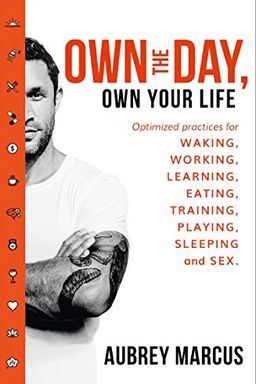
Own the Day, Own Your Life cover

Own the Day, Own Your Life

by Aubrey Marcus

Own the Day, Own Your Life offers practical hacks for a balanced life, from diet and exercise to productivity and relationships. Discover simple, actionable tips to enhance well-being, boost energy, and achieve personal growth daily.

Own the Day, Own Your Life

Aubrey Marcus’s core premise in Own the Day, Own Your Life is simple but profound: your entire life is lived one day at a time. You don’t change your fate through grand resolutions or decade-long plans—you transform it by mastering the 24-hour cycle you live in right now. Each day is a complete unit, a laboratory of practice and pattern. When you optimize this micro-unit, you unlock the power of compounding—small wins that scale to lifelong transformation.

Why the 24-hour system works

Marcus builds his philosophy from both ancient wisdom and modern performance science. Nick Saban’s “Process” emphasizes winning each seven-second football play—the same way that winning one day builds a great life. Samurai strategist Miyamoto Musashi taught that mastering one small model lets you master one thousand things—the same fractal principle of excellence. In each 24-hour loop, you have full agency over actions that amplify or erode your health, strength, and mindset.

The day becomes a condensed training ground for mastery. You can design it deliberately—from wake to sleep—by understanding your body’s natural rhythms, leveraging small high-impact decisions, and aligning them with purpose. This is not about self-punishment, but self-alignment.

The architecture of an owned day

Marcus divides the day into distinct segments that move with the body’s cycles of energy and attention. Morning is about activation and priming—hydration, movement, light, breath. Midday focuses on work, focus, and physical performance. Evening restores balance with connection, play, sex, and sleep. Each segment uses levers—hormonal, nutritional, behavioral—so the physiology of the day works with, not against, your goals.

Marcus frequently draws analogies to fields outside wellness: athletes who win through consistency, entrepreneurs who use habit stacking, philosophers who stress the present moment. (In that way, his message parallels James Clear’s Atomic Habits—both argue that tiny, repeatable actions are the fundamental unit of change.)

Designing small tipping points

Your day is a domino line of decisions. A single early choice—hydrating properly, eating fats instead of sugar, stepping into the sun—tilts downstream choices in your favor. Marcus calls these “upstream wins.” Each choice compounds, like small victories that build momentum and confidence. By contrast, when you default to convenience and distraction, the chain tilts the other way—low energy, poor focus, and reactive living. By engineering these tipping points intentionally, you make discipline automatic.

From knowledge to embodiment

Marcus warns that information alone changes nothing. Transformation requires embodiment—living the practices physically until they become identity. That shift occurs only when knowledge is internalized through daily repetition. Resistance, as Steven Pressfield calls it, always strikes when you approach growth, so self-compassion and small, consistent rules (“ethos”) transform intention into reliability.

Core insight

You can’t own your life in the abstract—you can only own the day you’re living. One fully mastered day becomes the replicable template for every day that follows. Change the micro, and the macro takes care of itself.

The rest of the book applies this framework hour by hour: start your morning like a biological upgrade session, eat and train strategically, master work and social flow, reconnect in the evening, and sleep like an athlete. The throughline is agency—when you design your 24 hours deliberately, you reclaim authorship of your energy, health, relationships, and purpose.


Start Strong: Morning Architecture

Marcus calls the morning your day’s ignition sequence. The first twenty minutes determine momentum, hormonal rhythm, and decision quality. His triad—hydration, light, and movement—is foundational. Overnight you lose electrolytes, suppress sunlight exposure, and build inertia. Reversing those deficits flips the switch from sluggish to primed.

Hydrate and remineralize

Begin with a mineral cocktail: water with sea salt and lemon. It replenishes sodium, magnesium, and potassium—nutrients that regulate nerve firing and energy metabolism. Many fatigue issues aren’t psychological—they’re osmotic. This practice restores conductivity literally, improving alertness within minutes.

Step into the light

Natural light resets your circadian pacemaker by signaling the suprachiasmatic nucleus—the brain’s “master clock.” Being outdoors within ten minutes of waking anchors cortisol at its healthiest spike, ensuring better melatonin release at night. (In darker climates, Marcus suggests tools like HumanCharger ear lights to mimic solar cues.)

Move to awaken

Your body needs movement cues to finalize the hormonal transition from sleep. A brief burst—yoga flow, air squats, short burpees, or rebounding—activates endorphins without creating fatigue. Marcus calls this movement “morning activation, not workout.” It circulates lymph, signals wakefulness, and builds momentum for later training sessions.

Strategic additions

After this triad, Marcus stacks additional upgrades: Wim Hof breathing—thirty power breaths with retention—enhances oxygen saturation, and cold exposure acts as a forge for willpower. Brief cold showers or ice plunges create hormetic stress that builds resilience, boosts mood via norepinephrine release, and teaches “mental override.” This combination resets stress biology from chronic to acute, building stronger physiology and mindset.

Morning principle

Hydrate deeply, get bright natural light, move intentionally, and face one brief discomfort (like cold). Start with mastery of minutes, and the rest of the day aligns automatically.

This ritual doesn’t seek perfection. It seeks consistency. You’re not biohacking—you’re aligning with your biology. The payoff is steady energy, emotional balance, and momentum that cascades through the workday.


Fuel Smart: Eat for Energy and Focus

Nutrition in Marcus’s framework is about energy stability, hormones, and digestion more than calorie counting. Breakfast, lunch, and dinner each play strategic roles: morning meals stabilize focus, daytime meals sustain output, and dinner restores digestion and intimacy.

Breakfast: fat over sugar

Traditional sugar-heavy breakfasts—cereal, pastries, fruit juice—create insulin spikes and mid-morning crashes. Marcus swaps this for fats and proteins: eggs, avocado, bone broth, or a high-fat smoothie with MCT oil. If quality food isn’t available, he recommends skipping breakfast entirely through intermittent fasting. Stable energy sustains discipline, while sugar starts the domino of poor decisions.

Supplements: bridging the deficit

Modern living depletes essentials once abundant in ancestral diets. Marcus’s minimalist supplement stack fills predictable gaps: greens for micronutrients, magnesium for calm, omega-3s for inflammation control, vitamin D with K2 for hormones, and probiotics for gut health. Supplements aren’t miracles—they bridge lifestyle deficits so your internal chemistry matches your ambitions.

Dinner: pleasure, performance, and digestion

Marcus reframes dinner as sacred, merging enjoyment and physiology. The “performance meal” includes nitric-oxide-rich plants—beets, arugula, Swiss chard—that prime blood flow for intimacy and recovery. The mantra is: chew thoroughly, skip ice water (which dilutes stomach acid), and add ginger for faster digestion. “What you think about food matters,” he emphasizes, citing studies showing belief affects metabolism.

Cheating intelligently

Marcus doesn’t demonize indulgence. Instead, he offers “cheat codes”: pair sugar with fat or fiber, choose dark chocolate or sprouted carbs, time desserts after exercise, and use apple cider vinegar or cinnamon to blunt glucose spikes. The question isn’t whether you’ll indulge—it’s how intelligently you’ll do it so pleasure doesn’t sabotage performance.

Food philosophy

Eat real food deliberately, prioritize digestion, and link meals to your physical and emotional goals—from sharper mornings to sensual evenings.

Marcus’s nutrition playbook isn’t about restriction—it’s about reclaiming intentionality. Eating becomes an act of energy management, not guilt. You eat to live fully—not to chase numbers on a label.


Train and Move with Purpose

Marcus’s approach to training—summed up in his “Training Pyramid”—shifts you from motivation-driven workouts to system-driven routines. The pyramid’s hierarchy places durability (mobility and flexibility) at the base, then builds upward through cardio, muscular endurance, strength, and power. You spend more time where the impact is high and injury risk low.

Build a functional base

Durability is longevity insurance. Ten to fifteen minutes of mobility—foam rolling, hip openers, or joint rotations—protects your nervous system and posture. You can’t build strength on dysfunction. This foundation allows consistent, pain-free training that feeds long-term progression.

Climb the pyramid

After mobility comes aerobic work to activate metabolism, then short muscular-endurance blocks (like circuit intervals), followed by slow-tempo strength and brief explosive power. Marcus provides example templates—bodyweight-only or kettlebell-based—lasting less than an hour. The day you train should serve the day you live, not destroy tomorrow’s energy.

Play as movement

Training isn’t confined to the gym. Marcus promotes “Primal Play”—games like shoulder tag, animal crawls, and partner drills that combine cardio, coordination, and joy. This blurs the line between exercise and play, making fitness sustainable. (Relatedly, other thinkers like Darryl Edwards and Ido Portal echo this ethos—movement as celebration, not punishment.)

Training core insight

Consistency beats intensity. Train to move well, recover fully, and express strength playfully. Power matters, but durability keeps you in the game.

Owning your body each day means integrating movement across categories—activation in the morning, focused gym work midday, and spontaneous play at night. Movement becomes not a punishment but a daily ritual of vitality.


Work as Purposeful Practice

Marcus reframes work from a grind to a spiritual dojo—a place where mission, environment, and focus converge. The aim is not “work-life balance” but “work-life coherence.” You align your efforts with purpose, your workspace with focus, and your schedule with effectiveness.

Clarify the mission

Without a mission, you drift and resent labor. With it, you convert tasks into service. Whether your job directly expresses your passion or simply funds it, clarity replaces resistance with intention. Knowing why you grind keeps motivation renewable even under stress.

Own your space

Marcus treats environmental curation as performance leverage. Scents like lemon can cue productivity, standing desks energize posture, and clean energy dynamics among coworkers protect emotional stability. He calls it “energetic hygiene.” Like athletes control their locker room, you must control your workspace’s vibe.

Master attention

Email triage systems, priority lists, and the ability to say “no” are Marcus’s antidotes to overload. He argues that time isn’t the bottleneck—attention is. Protecting it through boundaries, minimal multitasking, and deep-work blocks yields far more than hours logged.

Work principle

Connect your daily work to a larger mission, consciously design your environment, and guard your attention like it’s currency. Work becomes training for purpose, not exhaustion.

Marcus’s goal is not just productivity—it’s integrity. When your physical, emotional, and purpose-based selves align, even labor becomes an act of self-expression.


Evening Rituals and Restorative Recovery

The book’s closing rhythm turns from productivity to regeneration. Marcus urges you to close each day intentionally through three overlapping zones: reconnecting socially, powering down technology, and sleeping skillfully. Evening is where physical recovery and emotional connection meet.

Disconnect to reconnect

Your phone, he writes, is a dopamine loop that hijacks presence. Cut digital ties before bed—use Inbox Pause, airplane mode, or simply another room. Replace screens with presence: meals, conversation, music, cuddling, or analog games. Social connection repairs both love and longevity; isolation, research shows, shortens life expectancy by roughly 30%.

Journal and plan

Marcus’s “Law of Three” journaling technique trains focus: write your mission and three key objectives for tomorrow, then release lingering thoughts. This simple purge clears cognitive load and reduces anxiety. Expressive writing, shown in multiple studies to improve mood and health, becomes an evening mental cleanse.

Recharge through play and care

Evenings should contain fun and tactile joy—music, pets, board games, yoga, or sex—anything that reminds you you’re human, not a productivity machine. Personal care completes the ritual: choose clean body products, hydrate modestly, and use natural scents. Rest and connection intertwine.

Sleep as strategy

Inspired by Nick Littlehales, Marcus views sleep through cycles, not rigid hours. Target thirty to thirty-five cycles weekly using 90-minute blocks and naps as currency. Cool, dark, tech-free rooms are nonnegotiable. For anxiety nights, try his “Emergency Sleep Cocktail” (electrolyte + turmeric + black pepper) to calm inflammation. He even offers hangover recovery tools using salt, magnesium, and molybdenum.

Evening principle

End the day as deliberately as you began it: disarm tech, reconnect with humans, summarize your mission, and stage your recovery environment for tomorrow’s success.

Marcus closes by looping back to the 24-hour thesis: recovery isn’t collapse—it’s investment. The day ends not in depletion but renewal, setting the stage to own the next one with enthusiasm and power.


Overcome Resistance and Sustain Mastery

Even the best-designed day collapses without consistency. Marcus ends with the psychology of resistance—the invisible friction that derails good intentions. Drawing on Steven Pressfield’s concept, he reframes resistance not as enemy but as threshold: proof that change is close. The antidotes are forgiveness, ethos, visualization, and community.

Forgive and restart

Failure is inevitable; shame is optional. Marcus teaches radical self-forgiveness through practices like the Hawaiian Ho‘oponopono mantra (“I love you. I’m sorry. Forgive me. Thank you.”). Each recitation resets the nervous system toward self-compassion, removing emotional drag that blocks growth.

Create an ethos

An ethos is a small creed that makes action nonnegotiable—like Pete Carroll’s “Always compete.” It converts motivation into identity. For example, “Complete my three objectives daily” becomes a compass for behavior. Ethos saves cognitive bandwidth: you don’t decide—you enact.

Visualize and affirm

Visualization, used by athletes and entrepreneurs alike, primes neural pathways for execution. Marcus pairs it with positive self-talk—his breakthrough came when he told himself “Good job, Aubrey” after small wins. Simple language becomes reinforcement; belief reshapes action at the subconscious level.

Leverage your tribe

Change thrives under accountability. Declare goals publicly—post them, tell friends, join supportive communities. When you’re seen, you sustain. Social responsibility transforms fragile motivation into durable commitment.

Final message

Resistance is inevitable. But progression—the art of owning today despite fear or imperfection—is the true measure of mastery. Forgive, recommit, and repeat.

The circle completes itself: one day owned leads to another—and another. Over time, the compounding of small, deliberate days becomes the architecture of a life fully lived.

Dig Deeper

Get personalized prompts to apply these lessons to your life and deepen your understanding.

Go Deeper

Get the Full Experience

Download Insight Books for AI-powered reflections, quizzes, and more.