
Idea 1
Owning, Loving, and Making Work Meaningful
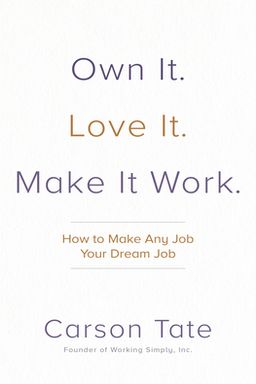
When was the last time you genuinely looked forward to Monday morning? For millions of people, work feels like an endless series of obligations instead of an opportunity to contribute, grow, and thrive. In Own It. Love It. Make It Work., Carson Tate challenges the modern mantra that the only way to find fulfillment is to leave your job. Instead, she argues that true satisfaction comes when you stop waiting for your employer to fix your work life and start taking ownership of your own experience.
Tate believes that disengagement at work stems from a broken version of the employer–employee social contract. For decades, organizations have focused on managing engagement from the top down—through perks, programs, and company culture—while employees have been passive participants. Tate flips this script, asserting that engagement is a two-way street. You, the employee, share responsibility for shaping your relationship with work. The book and companion workbook guide you step-by-step through the transformation from passive worker to empowered designer of your professional experience.
Work as a Social Contract
Drawing on social exchange theory pioneered by sociologist George Homans, Tate likens the employee–employer relationship to a partnership built on reciprocity. Healthy relationships depend on both parties evaluating benefits and costs, and workplaces function best when this give-and-take is balanced. Rather than viewing your job as something done to you, Tate invites you to see yourself as an active participant with agency, voice, and choice. You are not trapped in the 9-to-5; you can negotiate, adapt, and redesign. This is the foundation of what Tate calls “Door Number Four” — the door of choice and possibility that allows you to make any job your dream job.
The Five Essentials of Change
At the heart of Tate’s framework are five essentials for transforming how you experience work: Admit, Align, Develop, Cultivate, and Design. Together, these steps create a holistic process for reclaiming satisfaction and engagement. You begin by admitting your true needs, then aligning your strengths with organizational goals. Next, you develop new skills to stretch and engage yourself, cultivate relationships that energize and support you, and finally, design your job to integrate meaning and purpose. Each step blends psychological insight, neuroscience research, and practical exercises to move from awareness to action.
A Broader Vision of Engagement
Tate builds her approach upon William Kahn’s early work on employee engagement, which identified three conditions for authentic participation: psychological safety, meaning, and availability. These principles echo throughout her book. To be fully engaged, you must feel safe expressing yourself, find meaning beyond your paycheck, and have the energy and capacity to bring your full self to work. This idea connects to positive psychology (Martin Seligman’s concept of flourishing) and neuroscience (David Rock’s SCARF model of social behavior) to illuminate how emotional, cognitive, and relational well-being reinforce motivation.
Fear, Power, and Transformation
Every meaningful change begins with fear. Tate argues that fear isn’t a sign you should stop—it’s proof that you’re on the edge of growth. Drawing inspiration from neurosurgeon Mark McLaughlin, she frames fear as a data point: it focuses your attention, sharpens your priorities, and forces you to decide what truly matters. The key is not to eradicate fear but to use it as fuel. This shift depends on embracing your two “superpowers”: choice and control. You might not control your boss, your workload, or your company’s culture, but you always control how you respond and what you choose next. Psychologist Julian Rotter called this mindset an internal locus of control—and research shows it’s one of the most consistent predictors of success and happiness.
Making Your Dream Job Where You Are
Rather than idolizing escape routes—entrepreneurship, sabbaticals, or job hopping—Tate’s model helps you create meaning exactly where you stand. Maybe your role feels stagnant because your strengths aren’t being used, or your need for recognition goes unmet. Through reflective journaling, structured exercises, and practical frameworks, Tate teaches you to notice what energizes you, articulate your contributions, and align them with organizational needs. This not only renews your enthusiasm but also strengthens your leverage—your “relationship currency.”
As the journey continues through later chapters, you learn to identify your unique appreciation language, excavate your professional strengths, invest in continual learning, and cultivate authentic relationships grounded in trust and mutual respect. By the book’s end, you are not just performing your job—you are designing it. You are reshaping not only what you do but how and why you do it.
“You can make any job your dream job,” Tate writes. “Work can be the full expression of who you are.”
Her message is clear and empowering: engagement, growth, and fulfillment are not gifts granted by employers—they are skills you cultivate through ownership. In this sense, Own It. Love It. Make It Work. is both a philosophy and a practical guide for rewriting your relationship with work. Whether you manage teams or type behind the scenes, you can redefine your sense of purpose, connection, and contribution from the inside out. That’s how any job can become your dream job.