
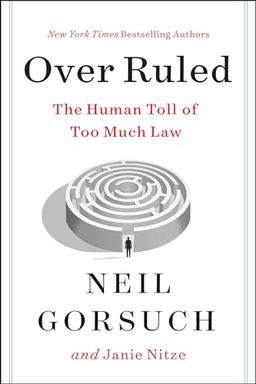
Over Ruled cover

Over Ruled

by Neil Gorsuch And Janie Nitze

An associate justice of the United States Supreme Court questions the amount and complexity of laws in America.

Keeping Liberty in a Legal Storm

How can you keep your footing when laws, rules, and directives multiply faster than you can count them? In this book, Justice Neil Gorsuch argues that the United States has drifted from a system where law is knowable, stable, and checked by separation of powers toward a sprawling administrative state that often writes, enforces, and judges its own rules—all while expanding criminal liability and shrinking the space for civic life. He contends that if you want a free, fair, and flourishing society, you must restore clarity in criminal law, reassert constitutional limits on delegation and deference, revive federalism’s laboratories of democracy, and reinvest in the civic institutions and habits that make self-government work.

Across vivid stories—John Yates’s fish case, Marty Hahne’s rabbit disaster plan, Ernest Hemingway’s six-toed cats, the Butte Superfund saga, and the pandemic’s uneven restrictions on worship and assembly—you see how abstract doctrines meet real lives. The book also mines history: James Landis’s rise as architect of the administrative state and his later disenchantment provide a human mirror; Madison and Tocqueville supply the older wisdom about multiplicity of laws and the social glue of local associations; and economists like George Stigler explain why regulation so often serves insiders.

The paper blizzard and its human cost

Where you once had a single volume of the U.S. Code, you now face shelves of statutes and a Code of Federal Regulations that sprawls to hundreds of volumes. Agencies add tens of thousands of Federal Register pages each year, and informal guidance proliferates beyond easy discovery (recall Justice Brandeis’s “Hip Pocket” episode, when crucial executive orders weren’t even published). When law becomes unfindable and fast-changing, people like the Yates family lose livelihoods to shifting rules and sweeping statutory language—like Sarbanes-Oxley’s “tangible object” clause wielded against a fisherman.

You also pay in less obvious ways: billions of hours in paperwork, compliance costs that small operators like the Ten Eyck apple growers can’t absorb, and unequal burdens as the poor and elderly struggle with forms and filings. Madison warned that too many mutable laws favor the “sagacious and moneyed few.” Gorsuch shows how that warning has come true.

Agencies as lawmaker, prosecutor, and judge

Congress’s broad delegations, coupled with judicial doctrines like Chevron deference and flexible “substantial evidence” review, let agencies both define and interpret the rules that bind you. Administrative adjudication places you before decisionmakers inside the very agency pursuing you, with relaxed evidentiary rules and limited discovery. Cases like Biestek (vocational expert’s secret data in a Social Security hearing) and Patel (restrictions on judicial review in immigration) reveal how thin the safety net can be when you’re caught in the system. Landis, the expert-administration evangelist, later chronicled this gap between theory and practice—delays, capture, and procedural shortcuts (compare Philip Hamburger’s civil-liberties critique of administrative power).

Overcriminalization and plea pressures

Federal crimes number in the thousands; regulatory crimes reach far higher. Mens rea protections erode as Congress writes broad offenses and agencies tack on criminal penalties. You can land in felony territory for conduct that once drew civil remedies. Plea bargains resolve about 97% of federal felonies; prosecutors can stack counts to induce pleas, creating a choice between a sure but heavy sentence and the risk of decades at trial. Bobby Unser’s snowmobile conviction, Aaron Swartz’s tragic prosecution, and Justice Jackson’s insistence on “evil-meaning mind” in Morissette highlight the stakes.

Federalism’s fading guardrails

National uniformity can be efficient, but it often sidelines local knowledge. Butte’s Superfund case shows residents blocked from pursuing stricter cleanup on their own land because federal choices prevailed. By contrast, local experiments—from the Kalamazoo Promise to state-court innovations that paved the road to Brown—demonstrate how decentralized authority nurtures solutions and accountability. When Washington centralizes, you lose diversity and adaptability; when states lead, you can learn and copy what works.

Community, rights, and the pandemic stress test

COVID-19 magnified every pressure point: emergency edicts limited assembly and worship, often inconsistently (casinos open while churches closed in Nevada). Cases like Tandon v. Newsom and the Calvary Chapel disputes pressed courts to apply equal treatment to religious exercise. Catholic Social Services in Philadelphia won a unanimous Supreme Court ruling after years of halted foster placements, illustrating the costs when government undervalues plural institutions that serve the vulnerable.

A recurring refrain

“Almost always,” Gorsuch observes, when one life is upended, “we should really focus on the greater good our laws and regulations seek to achieve.” The book asks you to measure that “greater good” against the rule-of-law demands of clarity, fairness, and human dignity.

Where this book takes you

You travel from legal theory to kitchen-table reality: from Landis’s vision and disillusionment to the rabbit plan on Marty Hahne’s desk; from Superfund maps to a foster child’s empty bed; from lofty pandemic policies to lonely AA participants on Zoom. Along the way, you encounter practical reforms—state sunset reviews, licensing reciprocity, legal sandboxes, and doctrinal fixes like reinvigorated mens rea and lenity—that can rebalance power and restore space for self-government. The closing call is civic: learn your Constitution, practice civil dialogue, and find the courage to insist that law serve people, not the other way around.


Too Many Crimes, Too Little Notice

Gorsuch argues that criminal law should target blameworthy conduct with clear rules and robust intent requirements. Instead, you live under an ever-thickening web of crimes scattered across statutes and regulations, where vague language and strict liability can criminalize ordinary mistakes. The result is a system that trades trials for pleas and clarity for leverage.

The mushrooming code you cannot read

There is no definitive count of federal crimes; credible estimates run into the thousands, with regulatory offenses multiplying into the hundreds of thousands. These prohibitions sit in dozens of titles and agency rules, making it unlikely you know when conduct becomes criminal. That undermines fair notice—the basic right to plan your life without surprise prosecutions. (Note: This echoes Harvey Silverglate’s “three felonies a day” warning; while the exact number is debated, the direction is clear.)

Mens rea: from moral anchor to afterthought

Classic criminal law required an act and a culpable mental state. Justice Jackson’s opinion in Morissette reaffirmed that the government must prove an “evil-meaning mind” for serious crimes. Modern statutes often skip or dilute mens rea, and agencies layer criminal penalties atop technical rules. That shift risks punishing the morally blameless—people who made errors in complex systems rather than sought to do harm.

Cases that make the abstract personal

John Yates faced Sarbanes-Oxley charges for allegedly tossing undersized fish—because “tangible object” was read to sweep in anything, even fish, not just financial records. Bobby Unser, disoriented in a snowstorm, ended up with a federal conviction for inadvertently entering protected wilderness on a snowmobile. Aaron Swartz confronted aggressive charges under computer-fraud laws for mass-downloading academic articles; after prosecutors escalated counts when he declined a plea, he took his life. These stories are not rare aberrations; they reveal structural features—overbroad laws and prosecutorial leverage—that can threaten anyone.

The plea-bargaining machine

About 97% of federal felony cases end in pleas. Prosecutors can stack counts to inflate exposure; defendants face a “trial penalty” if they insist on their day in court. Even innocent people can rationally plead when the risk of catastrophic sentences looms. That dynamic hollows out the jury’s role as the people’s check and turns the courtroom into a negotiation chamber where statutes’ vagueness becomes bargaining power.

Reviving guardrails: lenity, clarity, and calibration

Two doctrines can help you: the rule of lenity (resolve ambiguity in favor of the accused) and robust mens rea defaults (require the government to prove intent unless Congress clearly says otherwise). Courts can apply them more consistently; Congress can draft with specificity and resist using criminal sanctions to police regulatory minutiae. Agencies should avoid criminalizing technical missteps better handled through civil remedies. (Compare the Model Penal Code’s structured approach to mens rea.)

What this means for you

If you run a small business, fish for a living, code for fun, or just navigate federal lands, you can stumble into criminal territory without intending harm. Stronger mens rea rules, narrower statutes, and a more modest use of criminal penalties make it less likely you—or your kids—face life-altering consequences for technical violations. Placing trials back at the center, and lenity back on the bench, helps restore the moral legitimacy that criminal law requires to command your respect.


When Agencies Rule, Police, and Judge

The Constitution separates powers so that no single hand writes, enforces, and adjudicates the rules that govern you. Gorsuch shows how modern agencies often do all three. Delegations from Congress, judicial deference, and in-house adjudication combine to put your fate in the hands of officials who are not fully accountable to you.

Delegation and deference: how we got here

Throughout the twentieth century, Congress outsourced broad policy questions to agencies, trusting expertise to manage complexity. Courts then told themselves to defer to reasonable agency readings of ambiguous statutes (Chevron), and to accept agency fact-finding if supported by “substantial evidence.” These moves shift lawmaking power from your representatives and judges to administrators—leaving you to navigate rules and interpretations that can change with administrations.

The APA’s promise and its gaps

The Administrative Procedure Act (1946) was supposed to supply process and review. But much weight now falls on informal guidance, subregulatory documents, or adjudication tracks with looser protections. Discoverability remains a chronic problem (think Brandeis’s “Hip Pocket” episode), and courts sometimes decline to probe methodology or demand transparency, as in Biestek, where a vocational expert’s undisclosed data helped deny benefits.

The human face of in-house justice

When you contest an agency’s action, you often appear before administrative law judges or even non-ALJ officials employed by that agency. Evidence rules are relaxed, discovery limited, and win rates favor the government. Immigration and veterans’ benefits cases—like Patel and George—illustrate how jurisdictional bars and deferential review can insulate mistakes. Meanwhile, small operators confront “absurd-but-real” demands: Marty Hahne’s 28-page rabbit disaster plan and the Hemingway Home’s cat-containment orders show how one-size-fits-all rules miss local nuance.

Landis’s double life: enthusiasm to disillusion

James M. Landis helped build the administrative state and celebrated its promise in The Administrative Process. After years inside and then advocating before agencies, he warned of delays, capture, and procedural unfairness. His blistering report to President Kennedy conceded that expertise does not equal accountability or justice. (Note: His arc parallels broader critiques, from Jerry Mashaw’s process pragmatism to Philip Hamburger’s liberty-centered objections.)

Rebalancing the triangle

You do not need to abolish agencies to restore constitutional balance. Narrower delegations, clearer statutory standards, and less reflexive judicial deference can push major policy back to Congress and ensure courts independently say what the law is. Agencies should publish all binding norms, cabin guidance to nonbinding advice, and ensure adjudicators enjoy independence comparable to Article III judges when they decide individual rights. Transparent evidence and discovery rights should be the rule, not the exception.

What this means for you

Whether you seek a benefit, license, or simply want to keep your small museum’s cats, you deserve a process you can understand and trust. A regime that separates rulemaking from judging, demands notice before enforcement, and invites real judicial review gives you a fairer shot. It also restores democratic accountability by making your elected representatives own the hardest policy choices.


Federalism’s Promise and Centralization’s Costs

If you want tailored solutions and genuine accountability, look close to home. Gorsuch argues that federalism—dividing power between national and state governments—protects liberty by enabling local experimentation and competition. Centralization, by contrast, can impose uniform answers that fit poorly and smother civic initiative.

Why power migrated to Washington

Crises and reforms in the twentieth century—wars, depressions, civil rights, environmental protection—propelled national legislation and agency power. Grants-in-aid further nudged states to follow federal priorities. The attractions are real: national standards can coordinate complex problems. But the tradeoffs are steep: distant decisionmakers lack local knowledge; one-size rules foreclose learning by doing; and accountability blurs when you cannot tell who made the choice that governs you. (Tocqueville warned that centralization breeds uniformity and weakens the civic arts of self-rule.)

Butte’s Superfund: when locals want more

In Butte, Montana, decades of mining left arsenic and heavy metals across hundreds of square miles. The EPA’s Superfund cleanup set thresholds—250 ppm for residential yards, 1,000 for pasture. Homeowners wanted more stringent remediation on their own land and sought state-court remedies; the Supreme Court read federal law to preempt those efforts. For you, the lesson is stark: a faraway agency’s judgment can override your community’s willingness to do better, even at your expense. (Gorsuch dissented from that reading.)

Local laboratories, national breakthroughs

Federalism makes room for “try-it-here-first.” The Kalamazoo Promise—tuition guarantees funded by donors—transformed a city’s prospects. State-court innovations helped pave the way from Mendez v. Westminster to Brown v. Board of Education. When many jurisdictions test different approaches, you get evidence, not ideology. People vote with their feet; policymakers copy what works.

State reforms: pruning and permissionless innovation

States are leading pragmatic cleanups. Texas’s Sunset Commission reviews agencies and sunsets the unnecessary. Idaho simplified or eliminated about 40% of its rules after public meetings; Rhode Island cut roughly 30% of its administrative code. Arizona now recognizes many out-of-state licenses; Florida and Ohio eliminated low-risk occupational licenses. Utah’s legal sandbox lets supervised nonlawyers and tech tools expand access to justice. These are bipartisan, iterative, and measurable wins.

Federal example: when deregulation works

The Airline Deregulation Act of 1978—championed by Senator Ted Kennedy and then-professor Stephen Breyer—eliminated the Civil Aeronautics Board and ushered in competition that lowered fares and expanded routes. It shows national reform can work when it restores markets and reduces capture. (Note: Airline consolidation later raised other concerns, but fare and access gains were real and large.)

What this means for you

If you want policies that fit your town’s environment, culture, and economy, federalism is your friend. It lets your community try solutions, correct errors quickly, and hold decisionmakers to account. When national action is necessary, keep it narrow, transparent, and open to feedback from state experiments. That blend—local first, national when needed—keeps the system responsive to you.


Capture, Licensing, and Barriers to Work

You may believe regulation protects consumers and levels markets. Gorsuch shows how often it does the opposite: concentrated incumbents shape rules to disadvantage diffuse competitors and consumers. From funeral casket cartels to eyebrow threading and hair braiding, licensing becomes a moat around jobs and entrepreneurship—especially for immigrants, military spouses, and those without capital. Add the legal profession’s own barriers, and you get a system where access to justice and access to work both cost too much.

How capture happens

Insiders have time, money, and organization; outsiders do not. When the state must write rules, organized groups show up to steer them (George Stigler’s public choice insight). Licensing boards packed with practitioners can design costly training, exams, and facilities—often unrelated to genuine safety—to shrink competition. Enforcement then lands hardest on the smallest players.

Stories behind the statistics

Saint Joseph Abbey’s monks built simple wooden caskets to help grieving families; the Louisiana funeral board tried to shut them down, forcing years of litigation before the monks prevailed. In Texas, eyebrow threaders—Mr. Patel’s employees like Ms. Rokhti and Ms. Yogi—faced 750-hour cosmetology mandates including irrelevant coursework; the Texas Supreme Court struck them as “so oppressive” as to violate economic liberty. Isis Brantley taught hair braiding to lift up mothers and daughters but confronted rules requiring 2,000-square-foot barber schools; after decades of advocacy, Texas deregulated braiding.

Small operators under compliance mountains

Family farmers like the Ten Eycks juggle thousands of food-safety rules—about ladders, ring sizes, and handling—that cost tens of thousands of dollars and favor large agribusiness. Fishermen live with shifting, technical regimes that can turn honest mistakes into career-ending enforcement (see Yates). Museums like Hemingway’s home endure repeated inspections and mandates as if they were zoos, even when risks are low and the public interest modest.

Access to justice: the profession’s own moat

As law grows, your need for counsel grows too—but traditional legal markets keep prices high. Six-figure law-school debt, bans on nonlawyer ownership, and unauthorized-practice rules against firms like LegalZoom constrain innovation and scale. Most lower- and middle-income legal needs go unmet. Compare the United Kingdom’s post-2007 “alternative business structures,” which enabled outside investment and consumer-facing firms to expand lower-cost services. In the U.S., Utah’s regulatory sandbox, Colorado’s and California’s limited-license roles, and triage systems are early signs of change.

Reforms that open doors

States can: (1) replace blanket licenses with targeted, lower-hour specialty certificates; (2) adopt interstate reciprocity; (3) sunset and review licensing schemes periodically; (4) permit supervised nonlawyer roles and technology-assisted services for routine legal needs; and (5) require boards with market participants to include consumer and public-interest members. Agencies should run cost-benefit reviews that include small-entity impacts up front, not as afterthoughts.

What this means for you

If you want to braid hair, thread eyebrows, build caskets, fish, or farm, the law should protect your customers without pricing you out of work. When incumbents turn safety into scarcity, your choices shrink and prices rise. Clearing those moats—while preserving real protections—expands dignity, mobility, and justice for you and your neighbors.


Freedom, Community, and the Pandemic Test

Gorsuch ends where liberty lives or dies: in your daily associations—churches, schools, clubs, recovery groups, and families—and in the courage to defend them. The pandemic stress-tested core freedoms of speech, worship, and assembly. Emergency edicts, private platform moderation, and prolonged isolation frayed civic bonds. The law’s task is not just to protect you from the state; it’s to protect the social spaces where you learn to govern yourself.

Three freedoms and their social function

The freedoms to think and speak, to assemble and associate, and to pursue a chosen life do more than serve individuals—they sustain civil society. Catholic Social Services in Philadelphia served foster families for a century. When the city cut off placements because CSS would not certify same-sex couples, beds sat empty and children waited, even though CSS referred couples elsewhere. The Supreme Court unanimously vindicated CSS, underscoring that plural institutions enrich the common good even amidst disagreement.

Pandemic rules: uneven burdens, lasting costs

COVID-19 required swift action, but rules sometimes treated religious and secular activity unequally. In Nevada, casinos could operate while churches faced strict caps; in California and New York, tiered schemes restricted worship more heavily than comparable secular gatherings. Cases like Tandon v. Newsom and Calvary Chapel affirmed that governments must treat religious exercise at least as well as similar secular conduct. Meanwhile, people like Pastor Jeremy Wong and organizer Chris Reed watched addiction meetings vanish, pastoral counseling stall, and nursing-home visits end. Loneliness surged, students fell behind, and overdoses climbed.

Speech, platforms, and the new censorship debates

Private platforms moved to combat misinformation about public health; many Americans endorsed more government involvement in content moderation. The book urges caution: once you normalize suppressing “false” speech, today’s orthodoxy can become tomorrow’s heresy. The cure for bad speech is usually more and better speech, not coerced silence. (Note: This echoes John Stuart Mill’s case for open debate and resonates with recent litigation over government-platform contacts.)

Civic education and the courage to disagree

Self-government is not a spectator sport. Institutions like the National Constitution Center, iCivics, and Colonial Williamsburg teach constitutional literacy and model civil dialogue. The framers dined together and wrote rules of debate to channel conflict productively. You can revive those habits: seek out opposing views, argue in good faith, and defend the dignity of your adversary. Courage is the hinge—signers of the Declaration risked everything; today, people like Sandra Yates, the monks of Saint Joseph Abbey, and Isis Brantley show how ordinary citizens can repair institutions by insisting on rights.

Designing for the next emergency

Emergencies will come again. You can prepare by clarifying legal standards for restrictions on assembly and worship, building local capacity for targeted responses, preserving judicial review, and maintaining sunset clauses for emergency orders. Treat civil society as essential infrastructure, not an afterthought. Tocqueville warned that isolated individuals are easy prey for paternalistic power; the pandemic proved him right.

What this means for you

Freedom is not just restraints on government; it is the space your community needs to grow virtues, trust, and resilience. Guard that space. Practice the civic arts—learn, listen, speak, assemble—and find the courage to say no when rules forget the people they exist to serve. That is how you keep a republic—through law that respects liberty and citizens who insist upon it.

Dig Deeper

Get personalized prompts to apply these lessons to your life and deepen your understanding.

Go Deeper

Get the Full Experience

Download Insight Books for AI-powered reflections, quizzes, and more.