
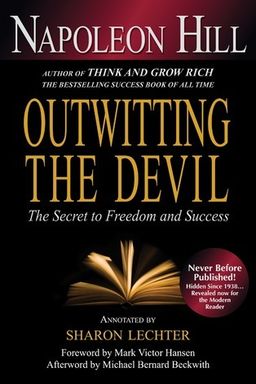
Outwitting the Devil cover

Outwitting the Devil

by Napoleon Hill

Outwitting the Devil, written by Napoleon Hill and edited by Sharon Lechter, explores timeless principles to conquer fear and achieve success. Delve into Hill''s insights on positive thinking, purposeful living, and overcoming societal limitations to unlock your true potential and lead a successful life.

Facing the Devil Within: Napoleon Hill’s Hidden Philosophy of Mastery

Have you ever felt that invisible forces—fear, procrastination, uncertainty—were blocking you from living the life you envision? In Outwitting the Devil, Napoleon Hill confronts those forces head-on through one of the most provocative metaphors in self-help history: his imagined interview with the Devil himself. Written in 1938 but suppressed for decades due to its controversial nature, Hill’s work is part autobiography, part psychological manifesto, and part spiritual allegory that aims to expose how the “Devil” manipulates our minds. Hill contends that the Devil is not a supernatural being but the embodiment of negative thought and destructive habits. His bold claim is simple yet unsettling: the Devil controls approximately ninety-eight percent of humanity through fear, indecision, and drifting.

Hill’s Radical Premise: The Battle for Your Mind

According to Hill, the real struggle in life isn’t between good and evil in a cosmic sense—it’s between our own thoughts of faith and fear. His interview reveals that the Devil gains power through psychological weakness, not temptation alone. Whenever you drift—allowing external circumstances, critics, or emotions to control your direction—you effectively hand over control to negative forces. On the other hand, those who think, choose, and act with definiteness of purpose become immune to this mental enslavement. Hill thus transforms spiritual warfare into a framework for mental discipline and self-mastery.

This framing connects directly to Hill’s earlier masterpiece, Think and Grow Rich, which explored similar ideas of belief and conscious application of thought. However, Outwitting the Devil adds a darker layer: it uncovers how subconscious forces manipulate people through schools, churches, the economy, and even daily habits, turning intelligence into submission. Hill’s goal is liberation—he wants readers not merely to build wealth but to free their minds from invisible chains.

Fear, Faith, and the Law of Hypnotic Rhythm

Central to the book is Hill’s discovery of what he calls hypnotic rhythm—a natural law that fixes our thought patterns into permanent habits. Just as gravity governs physical matter, hypnotic rhythm governs mental behavior. Negative thoughts repeated over time become permanent and attract more negativity, while positive thoughts yield creative power, confidence, and progress. Hill’s “Devil” uses this law to trap people into predictable cycles of fear, poverty, and failure. Conversely, those who consciously apply definite purpose and faith can use the same law to build lasting success. The concept mirrors modern psychological ideas about neuroplasticity and habit loops (Charles Duhigg’s The Power of Habit echoes this same insight decades later).

Definiteness as the Weapon Against Drifting

Throughout Hill’s interview, the Devil admits he is powerless against individuals who are definite in purpose and thought. This theme becomes Hill’s solution for achieving freedom—spiritual, mental, and economic. Definiteness means knowing exactly what you want and refusing to compromise with fear or indecision. It manifests in disciplined habits, controlled emotions, and persistence. The Devil’s victims, by contrast, are “drifters”—people who never set clear goals, rely on chance, and float through life reacting to circumstances instead of creating them.

Hill’s allegory thus turns readers inward. He questions not only the institutions that impose conformity but also the psychological tendency to seek comfort in indecisiveness. He saw the Great Depression as humanity’s collective drifting—a wave of fear that destroyed initiative and crippled creativity. Through faith and disciplined thought, he offers a positive revolution of self-determination, one that begins in the mind and ripples outward into society.

Why These Ideas Matter

Although presented through a fantastical conversation, Hill’s arguments resonate deeply with modern audiences struggling with distraction and anxiety. The Devil’s tools—fear of poverty, criticism, ill health, loss of love, old age, and death—mirror modern fears amplified by social pressures and information overload. Hill’s prescription—faith, definiteness, and self-discipline—serves as timeless strategies for resilience and success. He’s reminding you that the most dangerous enemy isn’t outside of you; it’s the voice of hesitation, the default to drift, the surrender of creative power.

In the pages to come, we’ll unpack Hill’s key ideas: from understanding fear as a mental parasite, to mastering definiteness of purpose, to applying the law of hypnotic rhythm. You’ll learn how adversity becomes a catalyst for growth, why your environment shapes your destiny, how time and harmony govern your success, and why caution—and not fear—is essential to making wise choices. Taken together, these principles reveal how you can reclaim control of your mind and, by extension, your future. Hill’s provocative thesis may shock—but if you follow it, you might just learn to outwit your own inner devil.


The Six Great Fears That Control You

The Devil’s first admission to Napoleon Hill is that he controls ninety-eight percent of people through fear. According to the Devil, six specific fears are his greatest weapons: poverty, criticism, ill health, loss of love, old age, and death. These fears immobilize thought, weaken initiative, and prevent people from acting with decisiveness. Hill’s interview reads like psychological warfare—each fear is analyzed as a mental virus that can dominate the subconscious if left unchecked.

Fear of Poverty and Criticism

Hill insists that poverty is not merely a lack of money—it’s a mindset of scarcity. Those who fear poverty are too intimidated to act boldly in pursuit of opportunity. Similarly, fear of criticism—the need for social approval—causes people to conform and accept mediocrity rather than risk rejection. Hill’s Devil points to politicians, business leaders, and even church officials who manipulate these fears to maintain control, reinforcing a culture of obedience instead of innovation. In modern terms, this equates to the paralysis caused by comparison and public judgment that social media amplifies every day.

Fear of Ill Health and Death

The Devil claims he thrives when people fear sickness—even more so when that fear is taught to them. Hill contrasts this with the observation that those who maintain faith and emotional balance are often healthier, suggesting that mental harmony protects physical well-being. Fear of death, on the other hand, is his ultimate tool because it’s universal. The uncertainty around what happens after death fuels superstition, manipulation, and religious control. Hill argues that most people live half-dead—afraid to live fully because they fear dying.

Fear of Loss of Love and of Old Age

Fear of losing love makes people jealous, dependent, and irrational. It erodes freedom of thought because emotional insecurity takes over logic. Fear of old age, meanwhile, fails to recognize the potential of wisdom and accumulated experience. Hill notes that society corresponds youth with power and neglects the creative strength of maturity. The Devil exploits this misconception, leading people to worry about decline rather than purpose.

The cure for these fears, Hill declares, is faith. Not blind belief—but faith as a mental state that clears conflict and connects you to Infinite Intelligence, or what he calls the universal source of thought. When faith operates, your mind becomes harmonious and impervious to fear’s negative charge. This idea anticipates modern positive psychology’s assertions that belief and mental framing profoundly affect wellbeing (echoing authors like Viktor Frankl).

Hill’s Challenge

“Faith is the antidote to fear. Defeat fear and you close the door through which the Devil enters your mind.”

Hill isn’t merely teaching optimism; he’s prescribing a disciplined practice of replacing fearful thoughts with deliberate faith-driven ones. Each fear, when examined, reveals what you truly value. By learning to neutralize them one by one, you shift mental power back to yourself. The Devil may use fear to enslave, but faith—expressed through clarity, gratitude, and purposeful action—is the force that liberates.


Drifting: The Devil’s Silent Weapon

In Hill’s symbolic interrogation, the Devil reluctantly reveals his most effective device: the habit of drifting. A drifter, in Hill’s definition, is anyone who lacks clear purpose and allows external forces to decide their actions. While fear paralyzes, drifting sedates. The Devil claims that as soon as someone stops thinking for themselves, he “moves in and occupies the unused space of their brain.” In today’s language, drifting is mental autopilot—the tendency to live reactively rather than intentionally.

How Drifting Works

Hill’s Devil describes drifting as a progressive hypnosis. It begins in youth, often cultivated by parents, teachers, and religious instructors who discourage independent thought. Schools, he argues, emphasize memorization rather than creativity; religion, when misused, fuels conformity through fear. The combination produces adults who rarely question their beliefs or goals. Once a person becomes mentally idle, hypnotic rhythm reinforces the pattern—thoughts of passivity become permanent habits of compliance.

Drifters vs. Non-Drifters

Hill contrasts the drifter with the non-drifter—the person who acts with deliberate direction. Non-drifters think for themselves, adapt, and persevere. They are “self-determining,” achieving mastery not by luck but by intelligent habit. His description of drifters reads like a warning poster: they lack self-confidence, depend on others for validation, criticize frequently, make excuses, and change direction at the first sign of difficulty. Most people, Hill laments, fall into this category because they never consciously train their mind to resist the pull of inertia.

Breaking the Spell

To break this hypnotic rhythm, Hill suggests deliberate thinking and definite planning. Even choosing one major goal and committing to consistent daily action protects against drifting. This echoes modern productivity philosophy—Cal Newport’s idea of deep work and James Clear’s definition of system-based habits fit perfectly within Hill’s framework. He recommends replacing idle thoughts with active learning, purposeful reading, and service to others, since positive action rewrites subconscious rhythm.

Hill’s Warning

“Drifting is the habit through which I silently take control of the mind. Control the thoughts you dwell upon, and you control your destiny.”

Drifting may sound innocuous, but Hill treats it as the root of all failure. He saw the Great Depression as the world collectively drifting through fear and passivity. Each person, he argues, must awaken to thought. When you stop drifting—when you claim definiteness of purpose—you reclaim your freedom from the Devil’s invisible control.


Definiteness of Purpose: Hill’s Central Law

If drifting is defeat, definiteness of purpose is victory. Hill elevates this principle to near divinity, calling it the master key to freedom and success. Definiteness means knowing exactly what you want, why you want it, and pursuing it with unwavering focus. The Devil admits he cannot control anyone who lives this way. Every leader, inventor, or thinker Hill admired—from Henry Ford to Lincoln—embodied definiteness as their guiding discipline.

How Definiteness Liberates You

When you act with definite purpose, your thoughts align harmoniously; fear loses power because there’s no mental vacancy for it. Definite purpose orchestrates effort and attracts resources through what Hill calls Infinite Intelligence—the network of creative thought underlying the universe. He frames this not as supernatural but as scientific law, similar to the idea of planning and visualization explored by contemporary psychologists. Leaders succeed not because of luck but because they move with clear intent and decision-making.

Obstacles, Faith, and the Law of Compensation

Definiteness does not guarantee easy success. Hill and the Devil both acknowledge the law of compensation: those who misuse purpose for selfish or unjust ends ultimately destroy themselves. Dictators like Mussolini and Hitler embodied definiteness but turned it toward manipulation and cruelty—illustrating that power without morality leads to downfall. True definiteness requires ethical alignment and faith. Faith, Hill explains, transforms purpose into magnetic energy that attracts favorable results naturally, whereas fear paralyzes and disperses effort.

Definiteness in Action

In practice, Hill’s formula for definiteness mirrors goal-setting principles: define your chief aim, set intentional plans, and maintain persistence regardless of temporary defeat. He observed that Edison’s thousands of failures were stepping stones, not setbacks—an example of definite purpose reinforced by hypnotic rhythm. Hill insists that indecision opens the door to weakness, while definite decision concentrates power. The person who knows what they want will make Life pay in their own terms.

This principle invites you to look inward and ask: what is my definite purpose? Without it, external noise dictates your direction. With it, your life becomes an act of deliberate creation rather than reaction. Definiteness isn’t merely a tactic—it’s liberation from the invisible captivity of fear and chance.


Hypnotic Rhythm: The Law of Habit and Destiny

Hill called hypnotic rhythm his greatest discovery—a natural law that explains not only success and failure but human destiny itself. Just as gravity governs matter, hypnotic rhythm governs thought and behavior. Every repeated thought or act is absorbed into the subconscious and made permanent. It can serve you or enslave you.

The Rhythm of Repetition

According to Hill’s interview, Nature uses hypnotic rhythm to fix all habits—mental, emotional, and physical—into enduring patterns. When thoughts of fear, doubt, or laziness are repeated, they solidify into permanent negativity. Conversely, positive habits—clarity, self-discipline, faith—become automatic sources of strength. Every action shifts you closer either to freedom or bondage, but never stays neutral for long. This idea foreshadows later behavioral science showing how repeated neural pathways form the basis of habit and identity.

Using Rhythm to Build Success

Hill insists that hypnotic rhythm can be mastered deliberately. The process begins with awareness: recognize your habitual thoughts and redirect them toward definiteness and constructive desire. It requires persistence—every deliberate positive action strengthens new patterns and weakens the old. Momentum builds until success becomes effortless. This principle parallels the modern concept of compound interest in self-development—small consistent changes accumulate exponentially.

Breaking Negative Rhythm

Breaking bad habits is difficult because hypnotic rhythm resists sudden interruption. Hill advises replacing destructive patterns with useful ones rather than trying to eliminate them through willpower alone. Faith and purpose provide the emotional fuel needed to reprogram rhythm. He famously tells readers: “The law of hypnotic rhythm cannot be changed—but you can change yourself to align with it.” It’s a law that never compromises, never forgets, and never stops working.

Hill’s Realization

Your repeated thoughts become permanent through hypnotic rhythm. You either command it or you serve it.

Understanding this law reframes life as an ongoing act of conditioning. Success and failure are not events—they are rhythms set in motion by consistent thinking. Hill’s breakthrough remains one of the most profound ideas in motivational literature because it connects spirituality, psychology, and habit science into a unified explanation of human behavior.


Self-Discipline: Mastering the Four Appetites

Hill’s conversation with the Devil on self-discipline is both shocking and practical. He claims that personal mastery begins with conquest over four fundamental appetites: food, sex, expression of opinions, and spiritual indulgence. Each represents energy that, when misused, leads to drifting and self-destruction. Controlled, however, these appetites become engines of creativity and strength.

Physical Appetite

Overindulgence in food dulls thought and drains vitality, Hill insists. He describes the body as a sewer system that must be kept clean—his metaphor, though extreme, emphasizes balance and awareness of health. When you eat mindlessly, you weaken both body and will. The disciplined mind regulates consumption, freeing energy for purposeful action.

Sexual Energy

Sex is portrayed as life’s most powerful creative force. Hill refuses to condemn it; instead, he argues for transmutation—redirecting sexual energy toward productive goals. Great leaders, he notes, channel passion into persistence, charisma, and vision. Overindulgence dissipates energy; control transforms it into inspiration. This echoes Sigmund Freud’s theory of sublimation and aligns with Hill’s consistent theme that emotional forces must be consciously directed.

Opinion and Spiritual Excess

The desire to express opinions can become destructive when uninvited or uninformed. Hill warns that talking excessively erodes judgment and invites conflict. Similarly, the appetite for religious “orgies”—emotional fanaticism and blind faith—clouds reason. Discipline means maintaining balance, thinking accurately, and preserving mental harmony. He reminds readers that even virtuous impulses must be moderated.

Ultimately, self-discipline is not denial—it’s intelligent management of energy. Each appetite fuels either clarity or confusion, depending on how you use it. The Devil thrives on indulgence; success thrives on restraint. Hill concludes that mastering these four appetites gives one power over the self—the first victory that precedes all others.


Learning from Adversity

Hill treats adversity not as punishment but as a tool of nature—a corrective force that pushes people toward growth. In his interview, the Devil begrudgingly admits that every setback carries the seed of an equivalent benefit. Failure breaks destructive rhythms and opens pathways for new habits. This insight became one of Hill’s most celebrated ideas, later condensed in Think and Grow Rich: “Every adversity brings with it the seed of an equivalent advantage.”

Adversity as a Catalyst for Evolution

Adversity forces change. When habits, businesses, or relationships collapse, hypnotic rhythm is disrupted, giving the mind a chance to rebuild on stronger foundations. Hill compares this to nature’s storms, which cleanse and rebalance ecosystems. The Great Depression, he argues, wasn’t a regression—it was civilization’s moral reset, exposing greed and forcing cooperation. The same pattern applies individually: crises reveal both weakness and untapped strength.

Defeat vs. Failure

Hill differentiates temporary defeat from permanent failure. Defeat is feedback; failure is acceptance of defeat. Non-drifters treat setbacks as cues to adapt and learn, while drifters interpret them as proof of helplessness. Each adversity tests faith and clarity. When you persist through hardship with definite purpose, you reverse hypnotic rhythm from negative to positive. This process builds resilience—the mental muscle that the Devil cannot penetrate.

By reframing adversity as creative opportunity, Hill unites spiritual, psychological, and pragmatic dimensions of success. Pain, he says, is nature’s way of forcing growth. When you recognize adversity as the breaking of old destructive rhythms, you can rebuild yourself stronger than before. Failure, then, is not final—it’s formative.


Environment, Time, Harmony, and Caution

In later chapters, Hill explores four interconnected principles—environment, time, harmony, and caution—that shape thought and destiny. Each represents an aspect of natural law that determines whether hypnotic rhythm works for or against you.

Environment: The Builder of Character

Your surroundings dictate thought habits. Hill insists that people absorb mental vibrations from those they associate with most frequently. Choose your relationships as carefully as you choose food, he warns. Negative minds infect like contagion; supportive networks elevate character. This anticipates modern neuroscience’s view of mirror neurons and social modeling—our brains literally synchronize with our environment.

Time: The Agent of Permanence

Time solidifies habits and knowledge. Positive efforts, sustained over years, become wisdom; negative ones calcify into misery. Hill calls time “nature’s seasoning influence.” It grants proportional reward to thought—what you think persistently becomes permanent reality. Just as time grows an oak from an acorn, it grows both success and failure from seeds of thought.

Harmony and Caution

Harmony means alignment—living in cooperation with natural law and with others. It’s the opposite of friction and conflict, which lead to drifting. Caution, meanwhile, is clarity without fear. Hill distinguishes between prudent evaluation and paralyzing hesitation. Lack of caution leads to gullibility and mistakes; over-caution becomes fear disguised as wisdom. The balanced mind moves thoughtfully but decisively. Together, harmony and caution sustain success: think accurately, act deliberately, live cooperatively.

In these closing principles, Hill completes his map of self-mastery. The laws of environment, time, harmony, and caution remind you that success is cumulative—every thought and choice builds momentum through natural law. When aligned, these elements create freedom; when neglected, they invite drifting and defeat. Hill’s final warning is timeless: “Control your environment, choose your rhythm, respect time, act with caution, and you will outwit the Devil forever.”

Dig Deeper

Get personalized prompts to apply these lessons to your life and deepen your understanding.

Go Deeper

Get the Full Experience

Download Insight Books for AI-powered reflections, quizzes, and more.