
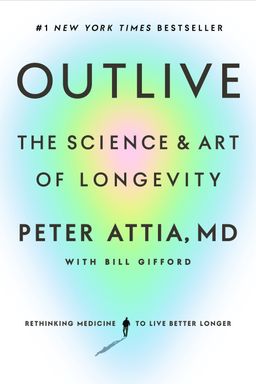
Outlive cover

Outlive

by Peter Attia, with Bill Gifford

Outlive by Peter Attia presents a transformative guide to longevity, blending cutting-edge science with practical advice. It empowers readers to optimize exercise, nutrition, sleep, and emotional health, ensuring a longer, more fulfilling life. Discover personalized strategies and actionable tips to enhance your well-being and thrive in every decade.

Outliving the Four Horsemen

How can you live not just longer but better? In Outlive, physician Peter Attia argues that modern medicine has mastered rescuing people from fast deaths—accidents, trauma, infection—but fails to prevent the slow deaths that now dominate: heart disease, cancer, neurodegeneration, and metabolic dysfunction, what he calls the Four Horsemen. His mission is to teach you to think like a risk manager, acting early to extend healthspan (years of vitality) rather than merely prolonging lifespan (years alive).

Fast death vs. slow death

Attia’s training at Johns Hopkins was defined by fast death—gunshot wounds, septic shock, emergency surgeries. He calls this Medicine 2.0, optimized for acute care. But after witnessing patients die slowly despite heroic interventions, he realized that saving lives at the edge was not the same as creating long life. Slow death—decades of gradual metabolic and cellular decline—is now the real epidemic. To beat it, you must climb upstream and stop the thrower, not chase falling eggs.

The shift to Medicine 3.0

Medicine 3.0 reframes health as proactive management of risk over time, not reactive treatment after diagnosis. It emphasizes prevention, personalization, and probabilistic thinking. Attia compares it to predictive modeling in finance—McKinsey’s risk assessment taught him that doing nothing is still a risky position. You must act before disease manifests, thinking in decades, not in ten-year risk calculators designed for the short term.

(Parenthetical note: This echoes Nassim Taleb’s concept of antifragility—the earlier you reduce risk exposure, the more resilient your system becomes over time.)

The Four Horsemen—and why they matter

Heart disease creeps through decades of atherogenic particle exposure (apoB); cancer grows under the radar until too late; metabolic dysfunction slowly destroys insulin signaling; and neurodegeneration erodes cognition often before diagnosis. Attia argues these share upstream roots—especially metabolic disorder—and thus can be delayed by early correction of insulin resistance, lipoprotein burden, and inflammation.

His paradigm is quantitative and trackable: measure apoB, Lp(a), fasting insulin, liver enzymes, and VO2 max; act long before pathology appears. Early action yields compounding benefits, just as early investing does—the difference between a ten-year plan and a 40-year horizon determines whether you face crisis or continuity.

Beyond longevity: the meaning of healthspan

Attia’s philosophical anchor is the myth of Tithonus—immortality without youth is a curse. He differentiates more years from more good years. Examples like centenarians who remain physically robust and mentally sharp well into their nineties illustrate the achievable aim of compression of morbidity: shifting disease to the very end of life while maximizing vitality earlier.

In Attia’s dream metaphor, rescuing eggs represents modern medicine’s obsession with salvage; climbing to stop the thrower represents prevention. His purpose—and yours—is to become a proactive steward of future health, cultivating choices that extend both life and meaning.

Core message

If you want to outlive your genetics, you must act before the crisis begins. Medicine 3.0 is about mastering risk early, measuring intelligently, and valuing healthspan as the true currency of a long life.


Medicine 3.0: Thinking in Decades

Attia calls for a medical revolution—one that prizes foresight over firefighting. Medicine 3.0 departs from the reactive disease model and instead focuses on detecting early signals, quantifying risk, and intervening long before symptoms appear. It builds on four pillars: prevention, individualization, risk honesty, and healthspan focus.

From acute care to forethought

Under Medicine 2.0, you wait until a biomarker crosses a cutoff—until you “have” diabetes or CVD—before acting. Under Medicine 3.0, you recognize disease as a continuum. The system becomes predictive, not diagnostic. Studies like Allan Sniderman’s long-range cardiovascular analysis reveal that early apoB reduction over 30 years prevents far more heart attacks than reactionary care does over 10.

Data as decision support

You can’t rely solely on randomized trials—they’re too short to model decades. Attia recommends triangulating evidence: mechanistic biology, Mendelian randomization, centenarian data, and population modeling. Think probabilistically, not perfectly. For example, if apoB reduction and improved metabolic metrics signal reduced long-term risk, you act even if there’s no 40-year trial.

(Note: this approach parallels preventive finance—portfolio diversification under uncertainty.)

Practical application

Medicine 3.0 means shifting to proactive screening: apoB and Lp(a) instead of only LDL-C, CGM for glucose patterns, CT angiogram for soft plaque, sleep quality assessments, and mental health check-ins. Prevention merges medical science with self-tracking. Interventions—from statins or PCSK9 inhibitors to zone 2 training and circadian-aligned sleep—are personalized according to your data and tolerance for risk.

The payoff of thinking in decades is compounded benefit: long-term metabolic efficiency, fewer crises, and a compressed final decline. The new art of medicine is understanding your unique risk portfolio and acting early enough that your trajectory bends toward resilience, not rescue.


Metabolic Health: Where Slow Death Begins

Metabolic dysfunction sits at the root of chronic disease. Attia reframes obesity, insulin resistance, NAFLD, and diabetes not as lifestyle failures but as biochemical maladaptations to abundance. The modern environment overwhelms ancient pathways tuned for scarcity, creating a cascade that silently damages nearly every organ system.

The liver as the early warning system

Fatty liver disease (NAFLD/NASH) mirrors the slow poisoning of modern diets. It begins with fat spillover—when subcutaneous depots exceed capacity and fat infiltrates liver and muscle. This drives insulin resistance, which further accelerates fat deposition, inflammation, and ultimately diabetes. Indicators appear years before lab “normals” fail: fasting insulin, triglyceride/HDL ratio, or small shifts in liver enzymes signal the start.

Fructose and the evolutionary mismatch

Biochemist Rick Johnson’s research shows that fructose uniquely drives fat synthesis and uric acid, prompting hunger and fat storage. In prehistoric times, this helped humans survive winters; now it fuels year-round metabolic harm. Liquid sugars—sodas, juices—are particularly potent offenders. The lesson: cutting refined and liquid sugars is the simplest step toward reducing disease risk.

Measuring early, acting early

Continuous glucose monitors (CGMs) expose your food responses in real time. Attia urges everyone to try them briefly: seeing your glucose spikes transforms theory into behavior. Combined with fasting insulin and liver imaging when warranted, this approach identifies pre-disease years before formal thresholds.

The prescription is simple yet demanding: reduce refined carbohydrates, move more (especially zone 2 and resistance training), prioritize muscle, and monitor metrics long before you reach pathology. If you take control of metabolic health, you take control of 70% of chronic disease trajectory.


Heart Disease: The Preventable Killer

Of all Four Horsemen, atherosclerotic cardiovascular disease is the most measurable and preventable. Heart attacks seem sudden, but they’re decades in the making. Attia’s family history and his own early calcium score of six reframed his career: he set out to beat the inevitable by thinking in lifetime exposure, not short-term probability.

ApoB: the true causal agent

The driving force of atherosclerosis is not merely LDL-C but apoB particle number—each particle a potential infiltrator into arterial walls. The longer your arteries are exposed, the greater your cumulative risk. Thus, the prevention strategy is straightforward: lower apoB deeply and early, using any tools available—dietary changes, statins, ezetimibe, or PCSK9 inhibitors. Waiting for a ten-year risk threshold wastes precious time.

Testing and imaging smarter

Beyond cholesterol, measure Lp(a) (a genetic lipoprotein variant), and consider CT angiography to see both calcified and soft plaque. Calcium scores tell you history; angiograms show current activity. Identifying subclinical disease lets you intervene while arteries can still remodel.

Attia’s message is clear: treat risk exposure as cumulative. Lowering apoB early is like reducing toxic exposure: minimal early pain, maximal long-term gain. In the realm of cardiovascular disease, aggressive prevention buys you decades of life.


Cancer and Early Detection

Cancer reveals the limits of modern medicine—often discovered late, it becomes nearly unstoppable. Attia explores three interlocking advances that can change this: addressing metabolic risk, optimizing immune-based treatment, and dramatically enhancing early detection.

Metabolic and immune interplay

Tumors hijack energy metabolism. The Warburg effect—tumor cells’ reliance on glucose fermentation even with oxygen—links obesity and insulin to cancer growth. Drugs targeting PI3K pathways faltered partly because they spiked insulin, feeding the very tumors they aimed to starve. Combining metabolic control (e.g., low-insulin diets, fasting protocols) with newer immune therapies enhances results.

Immunotherapy breakthroughs

Steve Rosenberg’s and Jim Allison’s pioneering interventions—CAR-T and checkpoint inhibitors—proved that harnessing the immune system can cure cancers once deemed terminal. Yet results are unpredictable; Attia stresses that only combining early detection and metabolic optimization gives these therapies consistent leverage.

The promise of earlier detection

Emerging tools like liquid biopsies and cfDNA blood tests (Grail, Galleri) may identify cancers years before symptoms. Max Diehn’s studies show even minimal quantities of tumor DNA can signal hidden disease—a transformative shift for screening.

The core principle: prevention begins decades before diagnosis. Reducing insulin resistance and maintaining vigilant screening stack the odds strongly in your favor—a realistic, evidence-informed way to outlive cancer’s reach.


The Centenarian Decathlon

Exercise is medicine, Attia reminds you, and the most potent one for longevity. It not only counters every Horseman but also builds the reserve that defines aging well. His metaphor of the Centenarian Decathlon asks: what physical tasks do you want to accomplish in your eighth or ninth decade—and what must you train now to retain them?

Functional training framework

To prepare for your future self, prioritize four pillars: aerobic efficiency (zone 2 training), peak aerobic capacity (VO2 max intervals), strength, and stability. You train these not for vanity but for utility—lifting grandchildren, climbing stairs, carrying luggage without fear of falling. Each decade you delay preparation, capacity loss accelerates.

Zone 2 and VO2 max

Moderate, conversational-intensity exercise builds mitochondria and fat-burning efficiency (Iñigo San Millán’s research). Include higher-intensity intervals to maintain cardiovascular resilience. Together they reduce insulin resistance, preserve cognitive health, and fight sarcopenia—the metabolic sinkhole of aging.

Strength and stability

Functional strength—especially grip, hip hinge, carries—and eccentric control correlates strongly with mortality risk. Stability training, grounded in dynamic neuromuscular stabilization (DNS), keeps you injury-resistant. As Attia says, “you must slow down to go fast”: build control before adding load. A few minutes daily of breath work, toe yoga, and single-leg balance drills preserve lifelong mobility.

Exercise isn’t optional longevity insurance—it is the foundation of your future autonomy. Every rep is a vote for your future healthspan.


Nutrition 3.0: Personalizing Food

Attia’s nutritional philosophy rejects one-size-fits-all diets. Nutrition 3.0 treats food as adaptive biochemistry—evaluate how your body responds, then design your intake accordingly. Rather than ideology (keto vs. vegan), you adjust the three primary levers: caloric, dietary, and time restriction.

Protein as priority

Longevity demands muscle; muscle demands protein. Attia recommends 1.6–2.2 g/kg of body weight, split into four roughly equal meals to maximize muscle synthesis. Older adults should aim higher due to anabolic resistance. His mantra: “Undermuscled is the new overweight.”

Carbs, fats, and individuality

Carbohydrate tolerance depends on activity level and sleep. CGM data exposes your unique responses. Eliminate liquid sugars universally and match carbohydrate timing to exercise. For fats, prefer MUFA-rich sources and sufficient omega‑3s but personalize saturated fat intake depending on apoB and Lp(a) levels.

(Parenthetical note: Attia echoes David Ludwig and Kevin Hall’s differing models—energy balance matters, but quality and metabolic context determine outcome.)

Data meets discipline

Use metrics—apoB, fasting insulin, body composition—to guide adjustments. Adopt short CGM experiments to map spikes and design meals with stable glucose response. Nutrition 3.0’s success lies not in restriction but in iterative learning: small tweaks informed by precise feedback over time.

When your diet stabilizes your blood sugar, maintains muscle, and matches your life, you apply Medicine 3.0 to the dinner plate—a lifelong, data-driven experiment in self-optimization.


Sleep and Emotional Health

No matter how well you train or eat, chronic stress and poor sleep will sabotage your longevity. Attia devotes equal weight to these invisible variables—your body and mind’s nightly maintenance and emotional regulation systems.

Sleep as brain and metabolic repair

Slow‑wave sleep clears amyloid and tau through the glymphatic system. REM orchestrates emotional learning and stress calibration. Deprivation impairs insulin sensitivity, hormonal balance, and cognitive resilience. The fix isn’t gimmicky—it’s consistency: dark room, cool temperature (~65°F), no late caffeine or alcohol, and regular bedtime. CBT‑I remains the gold standard for chronic insomnia.

Emotional fitness and trauma work

Attia’s personal reckoning—confronting rage and trauma during inpatient therapy at the Bridge and PCS—cemented emotional health as equal to physical. Using DBT and relational therapy, he built tools of mindfulness, distress tolerance, and reframing. He shares the Trauma Tree metaphor: adult dysfunctions grow from unseen childhood roots of neglect or abuse. Healing means re‑training reactions just as you re‑train muscles or stability.

Sleep and emotional regulation are the substrate of every other tactic. Without them, exercise and nutrition lose traction. With them, you gain clarity, patience, and purpose—the ultimate drivers of a life worth extending.


Integrating the Longevity System

Attia closes by showing how to integrate movement, nutrition, sleep, and emotional work into a coherent system. Longevity is not achieved through one domain but through their convergence—each reinforcing the others.

Phase 1: Assess and measure

Gather baseline data: apoB, Lp(a), fasting insulin, DEXA, and basic mobility tests like dead-hang or step-down control. Use CGM for two weeks to read metabolic flexibility. Identify weak links before intervening.

Phase 2: Build foundations

Repair sleep habits and basic stability first—DNS breathing, toe yoga, and strength basics. Push protein intake to optimal levels and cut liquid sugar. Add steady zone 2 movement several times weekly.

Phase 3 and 4: Progress and maintain

Layer in strength cycles, progressive overload, and periodic data reviews. Use emotional self-assessment alongside medical metrics. Update strategies annually; longevity is an iterative discipline, not a static goal. The true purpose, Attia reminds you, is not just to live longer but to live better—physically capable, mentally clear, and emotionally steady enough to enjoy the bonus decades you’ve earned.

Dig Deeper

Get personalized prompts to apply these lessons to your life and deepen your understanding.

Go Deeper

Get the Full Experience

Download Insight Books for AI-powered reflections, quizzes, and more.