
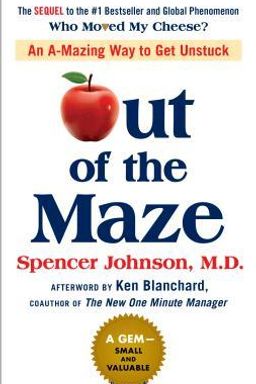
Out of the Maze cover

Out of the Maze

by Spencer Johnson

Out of the Maze by Spencer Johnson offers a compelling narrative about adapting to life''s inevitable changes through the power of belief. This sequel to Who Moved My Cheese? delves into how altering our perspectives can unlock new opportunities and lead to personal fulfillment, both in our careers and personal lives.

Escaping the Maze of Limiting Beliefs

When life changes suddenly—your career shifts, relationships end, or your health fails—how do you respond? Do you stubbornly cling to what was, or do you adjust your thinking to discover what could be? In Out of the Maze, Dr. Spencer Johnson invites you to step beyond fear and into freedom by changing not just your actions, but your beliefs themselves. This sequel to the global bestseller Who Moved My Cheese? continues the story of Hem, the Littleperson who refused to adapt when his Cheese disappeared. This time, it’s his turn to face transformation.

Dr. Johnson argues that the biggest obstacle to adaptation isn’t change itself—it’s the beliefs we cling to about what’s possible, what’s safe, and who we are. Whereas the original fable dealt with adapting behavior to change, Out of the Maze explores how our beliefs shape that behavior in the first place. To escape your personal maze, you must first challenge the thoughts you take for granted as truth.

From Cheese to Belief: A Shift in Focus

In Who Moved My Cheese?, the Cheese represented external success—comfort, love, career, security. Losing it forced the characters to chase new sources of fulfillment. In Out of the Maze, the spotlight shifts inward. The question isn’t just “How do I find new Cheese?” but “What do I believe about Cheese, and what if those beliefs are wrong?” It’s a profound change in perspective—from doing to being, from strategy to mindset.

Hem’s story mirrors our own struggles to release certainty. His assumptions—“Cheese is food,” “The Maze is dangerous,” “I’m all alone”—sound logical, but they imprison him. Only when he meets Hope, a new character who challenges his limits, does he begin to see that beliefs are optional. That realization becomes the book’s beating heart: every fact you trust might just be another opinion in disguise.

The Power of Noticing and Letting Go

This fable works as an allegory for personal awakening. Hem learns step by step to notice his thoughts, question them, and replace those that no longer serve him. When he eats an apple—a strange, non-cheese food—he risks breaking his own rules and discovers that life outside his beliefs is not only survivable but nourishing. The apple becomes a symbol of curiosity and renewal. It’s reminiscent of what psychologists like Carol Dweck call a “growth mindset”—the willingness to view challenge as opportunity rather than threat.

As readers, we’re invited to examine our own Mazes: the mental structures built from years of habits, fears, and so‑called “facts.” According to Johnson, it’s not the Maze that traps you, it’s your certainty that the walls are real. When you dare to unlearn, new pathways appear almost by magic.

A Simple Story with Deep Human Lessons

Johnson’s genius lies in using a childlike story to expose adult complexity. His characters—Hem, Hope, Haw, Sniff, and Scurry—embody the voices inside us: fear, curiosity, logic, and intuition. Hem’s journey from resistance to acceptance represents the universal human transition from survival mode to growth. His rediscovery of Haw, and their reunion in sunlight, symbolizes how shifting beliefs can reconnect us with others and with our authentic selves.

The outer Maze doubles as the inner prison of old thinking. Emerging into open light becomes an allegory for liberation. It echoes teachings from Viktor Frankl’s Man’s Search for Meaning and even cognitive‑behavioral therapy: between what happens to you and how you respond lies your freedom to choose a new perspective.

Why It Matters Now

In an era of constant reinvention—technological, professional, even emotional—Johnson’s message feels more urgent than ever. Change isn’t just inevitable; it’s accelerating. The skill you most need isn’t prediction or planning, but adaptability through belief. “Don’t believe everything you think,” the story warns—a lesson as valuable for a corporate executive as for anyone learning to start over.

Ultimately, Out of the Maze asks you to approach uncertainty with kindness, curiosity, and love rather than fear. As Johnson practiced himself when facing cancer, choosing beliefs based on love transforms pain into purpose. The Maze, it turns out, isn’t something you escape by running faster—but by thinking differently.


Notice Your Beliefs

Dr. Johnson begins Hem’s transformation with one deceptively simple instruction: notice your beliefs. Before you can change what you believe, you must first become aware that you believe it. This act of noticing turns the invisible into the visible—the first crack in the walls of the Maze.

Seeing Thoughts as Thoughts

At the start, Hem confuses his thoughts with facts. His “Facts of the Matter” list—like “I must find cheese or die” and “The Maze is dangerous”—feels unquestionable. We all carry such lists: assumptions about work, relationships, or self-worth that dictate what seems possible. Johnson gently exposes their fragility. When Hem eats the apple and doesn’t die, one “fact” collapses, proving that some truths are merely thoughts you’ve rehearsed long enough to sound convincing.

Catching Beliefs in Action

Much like mindfulness practice, noticing beliefs involves pausing to witness internal dialogue. Hope’s questions play this reflective role. When she asks Hem where Cheese comes from, he balks—he’s never questioned it. That surprise is the beginning of awareness. Therapists often describe this step as “naming the story” you’re in. Only then can you choose to write a new one.

Recognizing the Emotional Cost

Noticing isn’t just intellectual; it’s emotional honesty. Hem initially feels shame and fear as his worldview unravels. Likewise, when you identify a false belief—“I’m not creative,” “It’s too late to change careers”—you might grieve the years lived under that illusion. But awareness always precedes liberation. As he scribbles on his Maze walls, Hem begins a journal of awakening, carving reminders like “A belief is a thought you trust is true.” By naming it, he reclaims power over it.

(Noticing your beliefs is a theme echoed in Byron Katie’s Loving What Is, where she teaches “The Work,” a method of questioning stressful thoughts. Both Johnson and Katie insist that peace begins when you realize your suffering is only a product of unexamined thinking.)


Let Go of What Isn’t Working

Once you can see your beliefs, the next challenge is releasing those that no longer serve you. Johnson cautions that you can’t begin a new quest while carrying old baggage—literally represented by Hem’s heavy sack of hammer and chisel. These tools once helped him dig for Cheese but now only weigh him down, symbolizing outdated methods and mindsets.

The Illusion of Safety

Much like many of us who cling to routines or corporate traditions, Hem keeps his old tools because they feel secure. Letting go feels like losing identity. When Hope gently asks whether the tools ever helped him find new Cheese, his defensiveness reveals the fear underneath change: If I stop believing this, who will I be? Johnson wants readers to realize that clinging to habits or opinions doesn’t preserve security—it preserves stagnation.

Creating Space for the New

Letting go is an act of faith in possibility. When Hem finally sets down the bag, it’s a physical and spiritual release. He no longer measures progress by effort alone (“trying harder”), but by openness to the unknown. This transition parallels concepts in Eckhart Tolle’s The Power of Now, where surrender becomes the doorway to transformation. In both visions, you don’t fight change—you stop resisting it.

The Emotional Weight of Old Beliefs

Old beliefs often masquerade as loyalty—to a company, relationship, or past self. Hem discovers that moving forward requires forgiving himself for having been wrong. By letting go of self‑blame, he becomes capable of curiosity again. The moment he drops his tools and steps forward without them marks his emergence from paralysis to possibility.

Change is less about fighting the old than creating space for the new. Johnson’s parable reminds you that sometimes the heaviest burdens aren’t failures or people—they’re certainties.


Choose New Beliefs Consciously

Midway through Out of the Maze, Hope challenges Hem with a radical idea: that he can choose his beliefs just as he once chose which corridors to explore. At first, Hem insists, “That’s not how it works.” But through experience, he discovers that belief is in fact a decision—a lens you select to view reality.

Belief as a Choice, Not a Condition

This moment transforms the book from a story about coping into one about conscious creation. When Hem writes on the wall, “You can change what you think and still be you,” he articulates the book’s thesis. Identity is larger than opinion. You can alter your worldview without losing your essence. (This idea echoes Carol Dweck’s research on fixed vs. growth mindsets—our sense of self flourishes when we see beliefs as flexible.)

Beliefs That Lift You Up

In the later classroom discussion, seminar leader Dennis asks, “Does a belief lift you up or hold you down?” This practical test replaces moral judgment with functional curiosity. A belief is “good” if it expands your capacity for love, learning, or joy—not because it’s objectively true. Hem’s new beliefs (“Not all dark corners are dark” and “There may be something outside the Maze”) do precisely that—they open doors. By contrast, his old ones (“The Maze is dangerous”) close them.

Practicing the New

Choosing new beliefs requires repetition. Hem writes his discoveries on walls and surrounds them with drawings of apples, anchoring ideas through creative play. Likewise, you reinforce change through small daily affirmations, community, and experimentation. Johnson assures readers that believing differently doesn’t mean denying difficulty—it means facing it with hope rather than fear.

The reward for this mental flexibility is freedom. As Hem steps into the sunshine, the outer Maze dissolves; his mind has expanded beyond it. It’s the moment every person experiences when they stop asking, “What if I’m wrong?” and start wondering, “What else could be true?”


Imagine Beyond the Maze

Hope’s most powerful question—“What’s outside the Maze?”—represents imagination, the ability to envision life beyond current limitations. Hem initially resists the idea, convinced that nothing exists outside. But slowly he experiments with belief: “Maybe there is something amazing outside the Maze.” This single sentence becomes a pivot from survival to expansion.

Imagination as a Catalyst for Change

Johnson bolsters this theme with quotes from Lewis Carroll and Albert Einstein about believing impossible things and the power of imagination over knowledge. For change to occur, you must imagine alternatives before evidence appears. Hope’s candle lighting their path through dark corners symbolizes this creative risk—the courage to bring a little light into what was once feared.

Exploring the Impossible

Their journey into unexplored parts of the Maze mirrors any personal or professional reinvention: starting a new career, healing a relationship, or recovering from loss. Every innovation begins where certainty ends. Hem’s discovery of a tunnel leading to sunlight dramatizes breakthrough thinking—what psychologists call reframing, or seeing a formerly closed situation from a radically new angle.

Freedom Through Expanded Belief

When Hem emerges into open air, everything changes. The Maze wasn’t his true environment—it was his mental map. Outside, he realizes that the “facts” weren’t facts at all. Apples and Cheese coexist, danger and opportunity intertwine, and he’s not alone. The light symbolizes awareness: once you see that perspective constructs reality, you can create a life with no internal ceilings.

(This concept parallels Paulo Coelho’s The Alchemist, where Santiago learns that the treasure he sought was accessible only after believing it was possible. Similarly, Hem’s liberation begins the moment he imagines freedom.)


Living the Lessons: Johnson’s Final Message

The emotional gravity of Out of the Maze deepens with Spencer Johnson’s farewell letter written before his passing. Diagnosed with pancreatic cancer, he applied the very principles he taught to his illness itself. In his “Letter to My Tumor,” he thanks his cancer for teaching him love, gratitude, and purpose. It’s a striking real‑life example of choosing beliefs that lift you up, even amid suffering.

Choosing Love Over Fear

When faced with mortality, Johnson reframed his circumstances. Rather than believing “This is the end,” he believed, “This is my opportunity to grow closer to love.” Ken Blanchard’s afterword recounts how Johnson chose connection over self‑pity, reaching out to friends and family in gratitude. His personal transformation mirrors Hem’s journey—both men left the Maze not by escaping reality, but by embracing it with new eyes.

Belief as Legacy

Johnson’s life demonstrates that beliefs guide not just what you achieve but how you experience existence. His dying lesson reframes success as peace with change. Like Hem, he discovered that the Maze exists only where love hasn’t yet entered. Out of the Maze, everything—including endings—becomes another beginning.

Ultimately, Out of the Maze isn’t just a sequel but a spiritual manual disguised as a fable. It teaches that when you replace fear‑based thinking with love‑based belief, no challenge—not even death—can trap you. The door outward is always in your mind.

Dig Deeper

Get personalized prompts to apply these lessons to your life and deepen your understanding.

Go Deeper

Get the Full Experience

Download Insight Books for AI-powered reflections, quizzes, and more.