
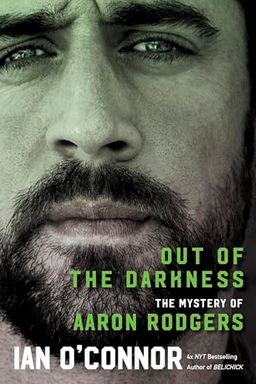
Out Of The Darkness cover

Out Of The Darkness

by Ian O'connor

A portrait of the N.F.L. quarterback Aaron Rodgers detailing his life on and off the field.

Crafting a Champion

How do you build a quarterback who bends probability and outlasts eras? This book argues Aaron Rodgers becomes Aaron Rodgers through a braid of lineage, cognition, coaching, preparation, and conflict. The core claim is simple and demanding: greatness isn’t a solo act or a single gift; it’s a system—seeded by family narrative, refined by coaches who value fit over pedigree, engineered through neuro-muscular precision, and tested by organizational politics, media scrutiny, and injury. To see Rodgers clearly, you must hold the hero story and the human costs at once.

Lineage that sets the terms

You start with Edward Wesley Rodgers in World War II—a B-24 Liberator called the Sassy Lassy, a burning engine over Vienna, a crash and capture over Hungary (July 7, 1944), beatings by a mob, and months in POW camps like Stalag Luft III and Nuremberg-Langwasser. He survives Death Marches and frostbite, is liberated in April 1945, and returns with medals and a quiet center. That stoicism shapes Edward Jr. (Ed), who later parents Aaron alongside Darla with discipline, faith, and sacrifice. The family story frames courage as practical and non-theatrical—an ethic Rodgers later channels on fourth-and-forever and in protracted recoveries. (Note: the book aligns this arc with classic WWII memoirs like With the Old Breed—trauma converted into habits of survival.)

A mind that maps before it moves

Childhood vignettes reveal a cognitive style that precedes size and speed. Rodgers draws plays in kindergarten, moves Starting Lineup figurines across a plywood field, and learns math through box scores. GATE teacher Jan Steliga notes he sees journeys from above, not street by street—an aerial processing style you later recognize in his pocket movement and coverage reads. Multi-sport reps (basketball vision, baseball command, roller hockey agility) compound this map-making, while visualization rituals (via Dr. Joe Kaempf) rehearse outcomes before they happen. Injuries and recruiting snubs (a torn ACL in 2000; small-school visibility) force him to turn stubbornness into strategy.

Opportunity meets fit—and accelerates

Craig Rigsbee at Butte College ignores pedigree and promises reps. Jeff Tedford at Cal recognizes traits in a single slant and installs Rodgers into a complex West Coast scheme within weeks. A Rose Bowl snub in 2004 (Texas overtakes Cal in BCS standings) pushes Rodgers to turn pro. Draft day then flips the script: he free-falls to No. 24 amid “Tedford QB” doubts, and the Green Bay Packers trust their board over sentiment. That pairing—organizational conviction in a moment of public doubt—creates the crucible for a complicated apprenticeship under Brett Favre.

Engineering the thrower

Behind the scenes, Rodgers treats his body like a precision instrument. With Angelo Poli in Chico, he reorders posture, posterior chain, and shoulder alignment; he trains proprioception with tennis balls, laser targets, boxing mitts, and even potato chips taped to his heels. Mike McCarthy and Tom Clements lower his pre-throw ball carriage and sharpen footwork. The result is a thrower who pairs surgical accuracy with decision speed—capable of moon-shot Hail Marys (Lions, Cardinals) and back-shoulder darts the instant a corner’s head turns.

Conflict, consequence, and reinvention

The book insists you can’t separate playoff pain from organizational design. Tactical conservatism (Giants 2012, Seahawks 2014) and roster gaps sour Rodgers on leadership decisions; by 2018, the McCarthy relationship fractures. Media autonomy amplifies the highs (“Relax”) and multiplies the costs (“I’ve been immunized,” a Kimmel dust-up). Family estrangement—the so-called Island—shows boundaries that harden into silence despite financial generosity. Then the Jets trade invites a fresh start and a national stage, only for an Achilles tear four snaps in to force a new identity: patient-engineer of his own comeback.

Key idea

Rodgers’s career is a systems case: narrative (family), cognition (mapping), coaching (fit and mechanics), training (neuro-muscular tuning), organization (alignment or fracture), and communication (platform risks) all interact. Change any node and you alter the arc.

If you’re building talent or a team, the throughline is actionable: honor the origin story, prioritize fit over optics, train for edge cases, measure your decisions against the biggest moments, and communicate with precision. Rodgers’s journey shows how a champion is made—then unmade and remade—by the choices you and your institution repeat under pressure.


Heroic Roots, Household Rules

Rodgers’s operating system begins decades before his first snap. His grandfather, Edward Wesley Rodgers, flies the B-24 Liberator Sassy Lassy over Nazi Europe, survives a crash and capture over Hungary, endures Stalag Luft III and Nuremberg-Langwasser, and limps through Death Marches to liberation in April 1945. He returns with medals and a lifelong bias toward quiet service. That worldview seeps into how Ed Jr. and Darla raise their boys: courage is dutiful, attention-seeking is suspect, and persistence—not drama—earns trust.

A family narrative that becomes an internal compass

Stories told at home matter. Arlington burial, medals in a drawer, a grandfather who doesn’t glorify trauma—these details become the unspoken bar Aaron later sets for himself. You see it in the family’s choices: Darla stays home for stability; Ed pivots careers into chiropractic school; they move for opportunity. House rules (no tattoos or long hair under their roof), church and Young Life involvement, and relentless work ethic form a scaffold that privileges discipline over display.

From play diagrams to pattern recognition

Rodgers’s childhood shows a mind rehearsing systems. He draws plays in kindergarten, moves plastic figurines on a plywood field for hours, and memorizes stats for fun. GATE teacher Jan Steliga recognizes a bird’s-eye mapper who can hold multiple paths at once—a trait that later underpins pre-snap plans and post-snap improvisations. Dr. Joe Kaempf introduces visualization in Little League; Ed’s backyard “Pass Patterns” creates micro-practices that teach rhythm and reads. The habits look like play, but they imprint a quarterback’s brain.

Stoicism without spectacle

Edward Sr. speaks sparingly about horror; he models resilience instead. That emotional economy shapes Aaron’s demeanor in later storms—draft-day free-fall humiliation, Favre-era pranks, boos in Lambeau, media pile-ons, and the silent labor of rehab. The throughline is not invulnerability; it’s capacity: hold pain quietly, then act with intent. (Note: this differs from performative “chip on shoulder” posturing common in sports bios.)

Practical applications for your life

  • Curate your origin story: Which family episodes do you retell, and what behaviors do they reward?
  • Model more than you preach: People copy what you do under stress, not what you say in calm.
  • Turn values into structures: Rules, routines, and environments translate ideals into daily practice.

Key idea

Resilience is inherited as a script and practiced as a habit. Rodgers’s calm, stubborn precision is not an accident; it’s a lineage expressed in choices.

When you watch Rodgers’s poise late in games or hear the restraint in his language during controversy, you’re seeing household codes at work. The book’s wager is that biography isn’t backstory; it’s active software shaping present-tense decisions. If you want to build similar steadiness, start where he started: by turning family myths into daily behaviors that make resolve practical.


Maps, Multipliers, and Grit

Pleasant Valley High is where Rodgers’s mental edge meets the realities of size, injury, and skepticism. He arrives undersized (five-foot-four, ~110 pounds as a freshman), yet coaches Ric Pitsker and Ron Souza spot an unusual arm and a command that outpaces his frame. With Souza’s “check-with-me” freedom, Rodgers turns JV huddles into a lab for college-level thinking—90-yard drives, quick-game precision, and late-game decision-making that belies his age.

A multi-sport base that multiplies quarterbacking

Basketball court vision and baseball mound command are not side quests; they’re transfer skills. As a point guard, he sees lanes before they open; as a pitcher/shortstop, he controls tempo. Coaches compare his feel to John Stockton or Steve Nash—anticipation, angles, and timing. Dr. Joe Kaempf adds pregame visualization in Little League, training Rodgers to run the movie in his mind before the light turns on. These habits later become his edge against disguised coverages and late-rotating safeties.

The ACL decision: stubbornness as strategy

In January 2000, a pickup-basketball torn ACL threatens his path. Instead of full reconstruction, Rodgers chooses arthroscopy to stabilize and braces up to return faster. It’s a calculated bet: less downtime now, more management later. The choice mirrors future calls—accept discomfort for agency, manage risk through preparation. (Note: the book is explicit that injury choices are trade-offs; Rodgers’s path demands an elevated pain threshold and relentless strengthening.)

Recruiting silence, internal volume

Despite 2,101 passing yards and 15 TDs as a senior and a 1310 SAT, Division I programs barely call. His size, Pleasant Valley’s profile, and market biases keep doors shut. Rather than sulk, Rodgers doubles down—film study, weights, backyard reps with Ed. Sterling Jackson later praises his quiet, team-first demeanor, even as Rodgers privately pushes teammates for competence (the Keola Pang anecdote). The slight becomes fuel, not a wound.

A template you can copy

  • Train cognition early: Diagram, visualize, and call your own checks in safe spaces (backyards, JV, scrimmages).
  • Cross-pollinate skills: Use other sports to rehearse scanning, timing, and spatial decisions.
  • Convert slights into structure: When doors close, increase the reps and deepen your library of scenarios.

On mindset

“He learned math by looking at stats… He developed little play cards, little plays, his own plays.” Practical obsession beats abstract ambition.

When rejection stacks and your body’s not ideal, most people flinch. Rodgers designs around constraints. That mix—systems-thinking, multi-sport transfer, and stubborn resolve—becomes the engine that powers every leap to come.


Finding Fit, Accelerating Mastery

Rodgers’s juco-to-Cal rise is a masterclass in how the right fit can outrun pedigree. Butte College’s Craig Rigsbee knocks on the Rodgers door even as four-year programs stay silent. He promises reps, visibility, and an exit ramp if Aaron delivers. The environment—wildlife-refuge heat, mosquitoes, and a no-frills grind—burns away ego. Rodgers rewards that belief with tape that turns heads far beyond Oroville.

Tedford’s decisive eye

Jeff Tedford arrives scouting tight end Garrett Cross and leaves convinced the quarterback is the real prize. A single slant on Butte film sells the staff on Rodgers’s lightning release and anticipation. Tedford drives to Oroville, watches practice, and offers a Cal scholarship within a week. The bet is bold and specific: intelligence + accuracy + fit > résumé. (Compare to programs shackled to measurables and past archetypes.)

Sixty days to fluency

At Cal, Rodgers absorbs the West Coast offense at warp speed. In roughly two months, he’s repping full-field progression concepts that usually take years. Flashpoints follow: a USC completion streak that signals national relevance, an Illinois demolition, and relentless efficiency that re-centers a wobbly program. But 2004’s BCS politics—Texas nudging Cal out of a Rose Bowl—leave a scar and help trigger Rodgers’s early entry into the draft.

Lessons for your scouting and growth

  • Recruit for fit, not fashion: Prioritize cognitive speed, accuracy, and coachability, even if the body type bucks trends.
  • Compress the learning curve: Build immersive, high-rep environments where intelligent players can accelerate.
  • Account for politics: External systems (polls, perception) shape careers; plan around them.

Why it clicked

“That’s the best junior college quarterback I’ve ever seen,” Tedford says after one play. Decision-makers who trust their eyes can change a life in a week.

The arc from Butte to Berkeley shows how preparation meets opportunity: a player tuned by family discipline and high-school autonomy lands in a system that rewards what he does best. When you build teams, seek that synergy—then remove friction so mastery can scale fast.


Fall, Apprenticeship, Ascension

Draft day delivers both humiliation and the perfect landing. Despite a 4.71 combine 40, a 35 Wonderlic, Rolfing-aided posture tweaks, and a Cal pro day completing 91 of 92 passes (thanks to Weatherspoon’s tune-up and gleaming mechanics), Rodgers slides to No. 24 amid the “Tedford quarterback” bias and quibbles about a high ball position. The atrium boos when Green Bay picks him. Ted Thompson, however, trusts the board and the long view.

An awkward apprenticeship with a legend

Brett Favre is an icon with no appetite for grooming his successor. The locker room culture is rowdy; Rodgers is cerebral. Pranks (the signed-helmet gag), cold shoulders, and a combustible media spotlight make learning-by-osmosis the default. A glib “lazy” joke from Rodgers doesn’t help. Yet the constraint becomes a forge: you can learn from someone who won’t teach you if you have structure and patience.

Rebuilding the motion, rewiring the mind

Mike McCarthy’s Quarterback School and Tom Clements reset Rodgers’s mechanics, lowering the ball carriage and synchronizing feet-to-eyes timing. He studies without playing, turning scout-team reps into laboratories. Favre’s retirement waffling creates chaos, but when the handoff finally happens in 2008, Rodgers is prepared. He wins his first start against Minnesota, rides out early boos, and begins turning doubt into data points of readiness.

From heir to architect

The 2010 playoff run cements the shift. Rodgers slices Atlanta in the divisional round (31 of 36), then wins Super Bowl XLV with a blend of precision and improvisation that looks nothing like Favre, yet clearly belongs in Green Bay’s lineage. He keeps his studious core while adding the on-the-move aggression fans once worshiped in Favre. The franchise passes through transition not by copying the past, but by recombining it.

On conflict

“I want to bug him as much as I can to delay the inevitable,” a teammate recalls of Favre’s vibe. Even resistance can be instructive if coaching and self-direction fill the gap.

For your own succession moments, the lesson is sharp: develop in the shadows, separate identity from idol, and let performance answer legacy questions. Green Bay’s gamble works because the player and the structure both commit to the long arc.


Engineering Excellence

Rodgers’s ceiling rises not from brute strength but from precision engineering. Angelo Poli (Whole Body Fitness, Chico) treats him like a high-performance instrument. The goal isn’t bigger biceps; it’s resilient posture, an activated posterior chain, shoulder alignment, and proprioception so sharp he can alter throws mid-release. Rodgers frames the objective simply: “take a hit, get up, keep playing.” Everything—drills, diet, recovery—serves that mission.

Neuromuscular reeducation and multitasking

Sessions look like a circus to outsiders and a blueprint to insiders. Rodgers throws at laser-flagged targets while moving his feet, boxes with mitts to sync hands and eyes, and snatches tennis balls at warp speed. Poli even tapes potato chips to his heels to demand exact foot pressure—break the chip, fix the habit. These make real the abstract trait scouts worship: processing speed under chaos.

Nutrition and recovery as competitive edges

An 80/20 diet anchors consistency without fragility. Fiber, protein, and carb timing support lean mass and inflammation control. Sleep and recovery tools stack benefits so performance doesn’t spike and crash. It’s not vanity (“see the abs” during the lockout) so much as availability: you can’t be elite if you’re absent. Small margins, repeated, become big outcomes—like back-to-back MVP-caliber seasons.

From drill to signature throw

You see the translation on Sundays. Back-shoulder throws arrive the instant a corner turns his head. Scramble drills morph into tight-window lasers released from non-standard platforms. The Miracle in Motown travels 61 yards on a moon arc to Richard Rodgers for a walk-off touchdown; an Arizona postseason heave finds Jeff Janis after a spin-out and reset. These aren’t lucky outliers; they are rehearsed responses to edge cases. Gino Poli’s bruised hands from catching offseason missiles are Exhibit A.

Rodgers’s pattern rule

“It becomes easy the moment the cornerback turns his back.” Pattern recognition + body control = inevitability.

If you’re engineering your own craft, copy the blueprint: identify mechanical bottlenecks; design drills that overload the exact sensory decisions you’ll face; and stack recovery so you can repeat brilliance. Rodgers isn’t just an arm; he’s an operating system optimized for tiny windows when the world screams move.


System vs. Star

The book refuses to divorce Rodgers’s playoff record from the systems around him. Individual brilliance couldn’t always compensate for conservative tactics, clock mismanagement, or roster gaps. Giants 2012 exposed timing and protection issues; Seahawks 2014 turned onside-kick chaos and risk aversion into a heartbreak that still echoes; later seasons (2016, 2018) featured puzzling fourth-down choices and schematic drift. By 2018, Rodgers’s postgame “terrible” critique of the offense signals a relationship past repair.

Leadership realignments and lingering trust

Mark Murphy fires Mike McCarthy in December 2018 despite a strong overall record (125-77-2). Brian Gutekunst rises as GM, Matt LaFleur arrives with new ideas, and the team shifts philosophically. But the 2020 Jordan Love pick—without a candid heads-up to the franchise quarterback—reopens a wound: is the organization building around him or managing his exit? Rodgers wants voice in roster and coaching; the front office wants control and succession options. The gap is cultural, not just tactical.

Comparisons that clarify and distort

Analysts invoke Brady/Belichick as contrast: a relentless competition lab paired with a front office that weaponizes edges. Chris Simms calls Rodgers the greatest thrower ever, implicitly arguing that organizational context, not talent, separates trophy counts. It’s instructive and limited: each franchise is a distinct ecosystem with path dependencies—draft luck, health variance, and leadership philosophies that either compound or cap a star’s impact.

A cautionary playbook for your org

  • Align around your advantage: If your edge is an elite decision-maker, cascade resources (line, play design, analytics) to maximize them.
  • Decide on risk appetite before the moment: Fourth downs feel different when fear runs the headset.
  • Communicate succession with respect: Surprises corrode trust faster than losses.

Flashpoint

“I’m trying to get McCarthy fired,” becomes the whispered headline after a 2018 presser. Regardless of exact intent, the partnership’s foundation is cracked.

Rodgers’s arc inside Green Bay is a case study in the limits of star power. Systems win sustained titles; stars can only bend systems for so long.


Fractures, Voice, Reinvention

Beyond the field, the human costs and communication choices shape Rodgers’s legacy. The “Island”—a practice of abrupt estrangement—cuts off not only acquaintances but also family. Tensions flare in December 2014 involving Olivia Munn and Rodgers’s parents after the Buffalo loss; Aaron emails relatives not to attack the woman he loves. Contact dwindles; he misses key events, including college roommate Francis Blay-Miezah’s 2015 wedding, reportedly injuring his relationship with brother Luke. The paradox: significant financial generosity (a $1M+ home for parents, cars, trips, cash gifts) coexists with emotional distance.

Privacy vs. publicity

Rodgers is furious when private matters surface publicly—Jordan’s Bachelorette appearances and televised family moments amplify strain. Family members argue their experiences are theirs to share; Aaron views the publicity as betrayal. The book carefully avoids a cartoonish villain-victim frame; it shows how fame, boundaries, and divergent values can make reconciliation both necessary and hard.

Owning the mic, risking the brand

Rodgers loves direct channels—Tuesdays with Aaron, podcast stints, The Pat McAfee Show. The upside is authenticity (“Relax” turns a season); the downside is precision risk. The August 2021 “I’ve been immunized” line, technically true by his appeal framing, conveys a misleading impression amid a public-health crisis. Fallout follows: NFL fines, an ended Prevea partnership, and a reputational fog that distracts from on-field work. Later, a Kimmel crack about an “Epstein list” lands like a legal and brand grenade. Platform control brings power and accountability; there’s no editor to save you from yourself.

Break, rebuild, reframe

The Jets trade is both a fresh stage and a systems test. Malibu summits, Woody Johnson’s honey from the Queen’s garden, Hard Knocks charisma, and an instant culture lift (“He came into the team room like Batman”) create lift-off. Then, four snaps in, his left Achilles pops. Dr. Neal ElAttrache repairs it with a SpeedBridge (Arthrex), and Rodgers attacks rehab like a second job: stem cells, hyperbaric oxygen, red light, altered-gravity running, blood-flow restriction, ozone wraps, and daily manual work with movement coach Aaron Alexander, who literally moves in. Rodgers posts, “The night is darkest before the dawn. And I shall rise yet again,” then sits in a Sky Cave darkness retreat to weigh risk, legacy, and return timelines.

The New York experiment’s reality check

Star power can’t instantly fix offensive-line leaks, previous draft misses (Zach Wilson’s struggles), or systemic ambiguity (Nathaniel Hackett’s rough patches; Rodgers as de facto assistant GM). New York magnifies every move; 12 touchdown-less quarters feel like a referendum. The lesson is sober: myth can spark culture, but only alignment sustains it—coaching, scouting, communication, and medical support rowing in sync.

Key idea

Reinvention demands both boundary-setting and bridge-building. Rodgers’s path shows the price of hard lines—and the possibility of renegotiated ties (his later reconnection with chef Jordan Russell hints at it).

For your life, the triad is clear: be precise when you speak, be humane when you set boundaries, and be systematic when you attempt comebacks. Visibility multiplies stakes; systems determine whether your next chapter keeps its promise.

Dig Deeper

Get personalized prompts to apply these lessons to your life and deepen your understanding.

Go Deeper

Get the Full Experience

Download Insight Books for AI-powered reflections, quizzes, and more.