
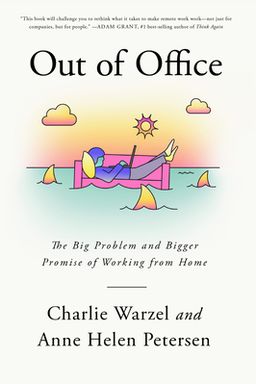
Out of Office cover

Out of Office

by Charlie Warzel and Anne Helen Peterson

Out of Office explores the complexities of remote work, questioning traditional work culture and championing a new era of meaningful work-life balance. By addressing the hidden pitfalls of flexibility and community engagement, it offers a blueprint for a more fulfilling professional and personal life.

Rethinking Work for a Healthier Future

What if working from home could actually make your life better—not just more convenient? In Out of Office, journalists Charlie Warzel and Anne Helen Petersen argue that remote work is not merely about changing where we work but reimagining how and why we work in the first place. They contend that the pandemic revealed a broken relationship with labor—one defined by overwork, burnout, and blurred boundaries—and that this moment offers a once-in-a-generation chance to rebuild work so it supports healthier people, families, and communities.

Warzel and Petersen draw from their own experience leaving New York for Montana years before COVID-19 forced millions of others into home offices. What they discovered was that simply moving work into the home doesn’t fix the deeper cultural rot of modern capitalism. Instead, it often exports the exploitative dynamics of office life to the domestic sphere. They describe early days spent working endlessly from their couch and kitchen, untethered from normal rhythms but still shackled to corporate expectations of constant productivity. Like many of us, they learned that the real problem isn’t location—it’s how work has consumed life itself.

The Broken Work Culture

The authors begin by acknowledging a central paradox: remote work promises liberation but frequently intensifies surveillance and loneliness. The pandemic’s mass experiment demonstrated this vividly—workers weren’t really working from home; they were living at work. Overloaded meetings, late-night emails, and constant Slack messages became the new norm, eliminating even the faint boundary that once separated office hours from personal life. Yet, this collapse also revealed what’s possible if we thoughtfully redesign work: shorter hours, real flexibility, and healthier rhythms that prioritize well-being over presenteeism.

The Four Pillars of Change

To repair our relationship with work, Warzel and Petersen structure their book around four interlinked pillars—Flexibility, Culture, Technologies of the Office, and Community. Each explores a different layer of modern work and invites us to reconsider how we define success and fulfillment. “Flexibility” reimagines time and schedules as worker-centered rather than company-centered. “Culture” exposes the hypocrisy of businesses that claim to be families while exploiting their employees. “Technologies of the Office” examines how tools intended to improve communication have instead turned into surveillance mechanisms that erode trust. “Community” expands the conversation beyond the worker to the social and civic structures that working habits influence, arguing that better work should radiate outward to improve society.

Beyond the Office Walls

A major thread throughout the book is that work cannot be disentangled from broader economic forces. The authors remind us that capitalist systems are designed to extract as much labor as possible, regardless of the consequences for health, family, or civic life. Remote work, they warn, can easily become a tool of corporate cost-cutting—transferring expenses for office space onto employees—unless we collectively rethink the purpose of work itself. Done well, though, remote and hybrid work can serve as acts of resistance: rejecting toxic productivity culture and reclaiming time for creativity, care, and community engagement.

Why Reimagining Work Matters Now

Instead of striving to be better workers, Warzel and Petersen argue we should shift the goal: to make our work serve our lives. Their vision isn’t utopian but pragmatic—an ongoing, messy process of experimentation and reflection. They compare our current moment to a cultural inflection point: we can double down on exploitation and burnout or commit to liberation and wholeness. This transformation won’t come from self-help gurus or trendy corporate slogans about “wellness.” It requires structural guardrails, collective action, and honesty about power. The challenge ahead is not only personal but systemic.

A Roadmap Toward Human-Centered Work

Ultimately, Out of Office invites readers—workers, managers, and policymakers—to see the pandemic not as a temporary disruption but as a catalyst for genuine reform. Remote work can be the starting point for rediscovering balance, equity, and empathy in our professional lives. If we heed its lessons, Warzel and Petersen suggest, we can build a world where we work less but live better—restoring the possibility that labor enhances rather than diminishes our humanity.


Flexibility That Works for People

Warzel and Petersen start with flexibility because it’s the most misunderstood concept in modern work. Corporate leaders have long used the word as a euphemism for precarity—offering gig-style arrangements without benefits, stability, or boundaries. True flexibility, they argue, must be worker-centered, not employer-centered. It should empower people to choose when, where, and how they work while ensuring security, support, and rest.

From Corporate Flexibility to Human Flexibility

The authors trace flexibility’s history back to the 1980s, when corporations embraced “lean management” and “just-in-time” labor. Driven by consultants like Frederick Taylor’s intellectual heirs, companies outsourced, downsized, and replaced stability with “nimble adaptation.” Workers were told they were free agents, but in reality, they were expected to be constantly available and endlessly resilient. This is what Melissa Gregg calls “productivity culture”—a system that celebrates optimization and constant busyness while punishing rest.

Real flexibility, Warzel and Petersen insist, involves redesigning schedules and expectations around human life rather than forcing human life to orbit corporate demands. It means redefining productivity to value outcomes, not hours or Slack messages. It’s the difference between freedom from oversight and freedom to live fully.

Guardrails, Not Boundaries

One of the book’s most resonant metaphors is the distinction between “boundaries” and “guardrails.” Boundaries, the authors explain, are flimsy—easily bulldozed by workplace pressure. Guardrails are structural: policies and norms that actively protect downtime. For example, companies could design systems to block meetings after 4 p.m. or automatically delay emails sent after hours. France’s 2016 “Right to Disconnect” law is a flawed but inspiring attempt at creating national guardrails, restricting work communication after formal hours.

Guardrails also mean building trust. Tools like Front, a collaborative email platform that lets teams truly disconnect by rerouting messages while someone is away, reflect this ethos. It’s not about punishing effort—it’s about respecting human limits. Flexible work cannot rely on heroic individual discipline alone; it needs institutional reinforcement.

Flexibility Across Generations

A central warning in this chapter is not to leave younger workers behind. Early-career employees entering remote jobs during the pandemic often found themselves isolated and unmentored, unsure how to learn soft skills or connect with colleagues. Warzel and Petersen emphasize that flexibility must include intentional mentorship structures—dual mentors for skill and career guidance—to ensure equity across experience levels.

Making It Real

To make true flexibility real, organizations must invest in staffing and planning, not just slogans. Understaffed teams, the authors note, turn time off into resentment and burnout because there’s no one to pick up the slack. Paying for redundancy and trust systems costs money, but it prevents turnover and creates genuine well-being. Flexibility, in their view, is not a perk—it’s a principle of human sustainability.


Building Healthier Work Culture

Culture is where work’s ideals meet its reality. Warzel and Petersen argue that most companies treat culture as a branding exercise—a set of fuzzy values plastered on websites—that masks exploitation and hierarchy. True culture, they write, is how an organization behaves when no one’s watching. It’s not about slogans like “we’re a family” but about how power, respect, and accountability flow daily.

Why Old Cultures Persist

The book digs into how industrial-era management principles continue to shape office life. From Frederick Taylor’s “scientific management” to middle-manager hierarchies, workplaces were engineered around control, not creativity. Even start-ups that pride themselves on disruption reproduce these dynamics: founder cults, long hours, and mandatory fun that disguise relentless labor. The authors compare the “organization man” of the 1950s—whose loyalty defined postwar stability—to today’s “hustle worker” chasing purpose through burnout.

Good Management Is Emotional Intelligence

Management is the hinge point of culture. Many managers, promoted for individual productivity, receive no training in people leadership—creating cycles of micromanagement and alienation. The authors highlight consultants Melissa and Johnathan Nightingale, who train leaders to manage with empathy and clarity. Emotional intelligence, they argue, is the cornerstone of modern management. Distributed companies like GitLab and Ultranauts demonstrate how transparency and documentation—shared READMEs, accessible meeting notes—can replace surveillance with trust.

Inclusion and Breaking the Monoculture

Corporate monoculture, overwhelmingly white and male, perpetuates sameness in leadership and decision-making. The authors spotlight organizations like We Are Rosie, which connect diverse remote talent with companies seeking ethical flexibility. Similarly, equity consultants at For the Culture emphasize that diversity isn’t a metric—it’s a redistribution of power. Hybrid work offers an opportunity to dismantle old hierarchies, especially when paired with universal design practices that make work accessible to people with disabilities, caretakers, and introverts.

Ending the “Family” Myth

Perhaps the most striking insight here is the rejection of the “we’re a family” trope. This phrase blurs professional boundaries and cloaks exploitation in emotional obligation. Real families don’t fire members for missing KPIs. Healthy workplaces, they argue, create community through respect and flexibility—not codependent devotion. You already have a family; what you need from work is fairness and dignity.


Technology: From Surveillance to Empowerment

Technology defines how we experience work, but most office tech now functions as a digital overseer. Warzel and Petersen explore how tools designed to streamline labor—email, Slack, Zoom—have evolved into instruments of constant monitoring and anxiety. The challenge is not innovation itself but the ideology behind it: productivity at any cost.

The Curse of Efficiency

Citing historian Shoshana Zuboff and researcher Abigail Sellen, the authors trace technology’s shift from empowerment to control. The open office plan, originally meant to encourage collaboration, became a nightmare of distraction. Similarly, email promised freedom from paperwork but led to information overload. Every new tool—from Slack to Teams—adds channels of communication without reducing workload, turning workers into what Cal Newport calls participants in a “hyperactive hive mind.”

Surveillance Capitalism at Home

The most alarming trend is surveillance software—“bossware” like Hubstaff—that screenshots employee screens and ranks productivity scores. A reporter tested it and found that it penalized phone calls and reading, rating him as lazy even after a 14-hour day. Such tools erode trust and distort what creativity looks like. Zuboff warns that if we normalize this behavior under remote work, we’ll invite corporate surveillance into our homes.

Reclaiming Tech for Humanity

The solution isn’t abandoning technology but using it intentionally. Companies like Dropbox and Twitter are redesigning their systems to neutralize proximity bias—making the office less appealing and hybrid work more equitable. Tools like Branch, a virtual office that uses voice-based avatars, demonstrate how digital environments can foster spontaneous, human-style interactions. This approach uses tech to simulate presence rather than monitor it.

Designing for Real Change

Warzel and Petersen point to a Danish company, DanTech, which successfully redesigned its workspace by emphasizing sustainability and human systems over flashy innovation. They urge readers to reject utopian promises of “smart” offices and instead focus on small, deliberate changes grounded in empathy. True technological progress is measured not in data but in dignity.


Rediscovering Community and Collective Care

The book’s final section shifts from the individual to society. Warzel and Petersen argue that our fixation on work has weakened community ties, turning us inward and isolated. They draw on sociologist Robert Putnam’s research on America’s “Bowling Alone” phenomenon: the decline of civic organizations and mutual aid. The antidote, they say, is reembracing collectivism through flexible schedules that give us time and energy to participate in social life.

Work and the City

Remote work will reshape cities as populations disperse and commuting patterns evolve. The authors spotlight planners like Leslie Kern and Dror Poleg, who envision “cities as offices” with community spaces, mixed-use developments, and walkable neighborhoods. They caution that without investment in transit, housing, and public amenities, cities will fracture into inequitable enclaves. Supporting public infrastructure—parks, libraries, childcare—becomes a moral as much as economic imperative.

The Care Crisis

Caregiving remains a cornerstone of this vision. The authors revisit the history of childcare policy, explaining how Nixon’s veto of public childcare in 1971 entrenched an individualistic system that undervalues care. Universal childcare, they argue, is essential to genuine flexibility, freeing parents—especially women—from impossible juggling. They praise experiments like Portland’s preschool initiative and Vermont’s proposed “Common Start” bill, showing how care can be treated as a public good, not a private burden.

Solidarity and Mutual Aid

Finally, the authors call for renewed labor solidarity. Knowledge workers, historically resistant to unions, must recognize themselves as part of a broader class. Examples from digital media and tech—like Google’s Alphabet Workers Union—demonstrate how organizing can challenge inequity. Beyond workplaces, they celebrate mutual aid networks that flourished during the pandemic, showing care as community resilience in action. Volunteering, mentoring, and local engagement aren’t hobbies; they’re civic lifelines.

A Collective Future

Warzel and Petersen conclude with hope: flexible work can catalyze a more just society if we choose cooperation over competition. By slowing down and reclaiming time, we can rebuild the connections capitalism has eroded—between workers, neighbors, and generations. Liberation from overwork isn’t just personal peace; it’s a foundation for rebuilding community itself.

Dig Deeper

Get personalized prompts to apply these lessons to your life and deepen your understanding.

Go Deeper

Get the Full Experience

Download Insight Books for AI-powered reflections, quizzes, and more.