
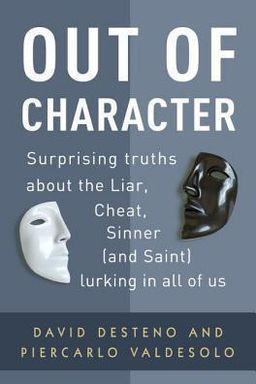
Out of Character cover

Out of Character

by David DeSteno and Piercarlo Valdesolo

In ''Out of Character,'' David DeSteno and Piercarlo Valdesolo reveal how human character is not as fixed as often believed. Through psychological experiments, they show how external circumstances can influence our behaviors, challenging the traditional dichotomy of saints and sinners. This book provides unique insights into the flexibility of our moral and ethical compass.

The Fluid Nature of Human Character

Why do upstanding people suddenly act "out of character"—cheating on spouses, lying to friends, or showing indifference to suffering? In Out of Character: Surprising Truths About the Liar, Cheat, Sinner (and Saint) Lurking in All of Us, social psychologists David DeSteno and Piercarlo Valdesolo challenge the long-held belief that character is fixed. They argue that human morality is not carved in stone but a constantly shifting state—an internal tug-of-war between two competing psychological forces they call the ant and the grasshopper.

Two Minds Within One Person

The authors propose that our moral decisions arise from a biological and psychological duality. The ant in you thinks long-term: it plans, sacrifices, and focuses on cooperation and reputation. The grasshopper, on the other hand, lives for immediate gratification—pleasure, security, and emotional impulses. Both are vital for survival; the ant helps maintain social bonds and stability, while the grasshopper ensures you seize opportunities and protect short-term interests. The human experience of moral conflict, guilt, or temptation is essentially their constant negotiation for control.

Character as a Balancing Act

DeSteno and Valdesolo contend that character is best imagined as a scale—always oscillating, never settled. Whether you act like a saint or a sinner depends less on your personality and more on which side momentarily dominates. Context and emotion play enormous roles. Small, almost invisible cues—a funny video, a warm smile, a sense of disgust, or even the lighting in a room—can tip that scale toward compassion or cruelty, honesty or hypocrisy. In their experiments, these tiny triggers consistently altered people’s moral choices without their conscious awareness.

The Myth of the Fixed Moral Compass

Western culture, from Aristotle to modern psychology, has often portrayed character as a stable essence, refined through reason and willpower. But as DeSteno and Valdesolo show, this view fails to explain why ordinary people alternate between nobility and selfishness. Through decades of research, they find that most people who act “out of character”—like Governor Mark Sanford or astronaut Lisa Nowak—aren’t deviating from who they are. Instead, they are responding to subtle psychological and environmental shifts that temporarily change which mental system, the ant or the grasshopper, takes control.

Emotion: The Hidden Engine of Morality

Our intuitive emotions—guilt, pride, jealousy, gratitude, compassion—are not primitive leftovers but evolved tools guiding moral behavior long before rational thought existed. Emotions represent the unconscious calculus of the ant and grasshopper. Yet our conscious mind, the newer cortical layer, is also biased: it rationalizes, justifies, and often deceives itself to fit whatever side currently serves our interests. In this dynamic system, neither intuition nor reason holds moral authority. Morality is flexible, situational, and embodied—a constant series of recalibrations.

Why This Matters

Recognizing this fluidity isn't cynical; it’s empowering. When you realize that your moral compass can sway under emotion or context, you can start to see your blind spots and learn strategies to recalibrate. DeSteno and Valdesolo’s work carries profound implications: it calls for humility in judging others, vigilance in judging ourselves, and compassion in managing the everyday contradictions of being human. We are not hypocrites by nature, but adaptive creatures living across a moral spectrum. “Saint” and “sinner” are not two kinds of people—they are two sides of us all, flickering back and forth with each new circumstance.


Hypocrisy and the Elastic Mind

DeSteno and Valdesolo’s experiments on hypocrisy reveal how our moral flexibility works in real time. When participants were asked to assign themselves either a short, easy task or a long, tedious one, 92% chose the easier assignment for themselves—yet judged others harshly for doing the same. Here lies the essence of moral hypocrisy: what feels reasonable when we do it feels despicable when someone else does. The authors argue that this discrepancy arises not from corruption but from an internal negotiation between moral ideals and self-interest.

How Rationalization Works

When we act selfishly, our mind quickly constructs rationales—subtle justifications like “I’m busier than others” or “no one will notice.” This is the grasshopper at work, whispering self-protective logic to preserve ego and pleasure. When judging others, however, our moral reasoning flips: the ant dominates, advocating fairness and long-term social trust. The difference isn’t hypocrisy in the usual sense—it’s adaptive moral elasticity helping us balance competing priorities. Yet this flexibility allows us to excuse behavior in ourselves that we condemn in others.

Disabling the Grasshopper

To study whether our sense of guilt is simply suppressed or absent, the authors restricted participants’ ability to rationalize by occupying their working memory—making them remember a string of random numbers while judging their own actions. When cognitive resources were tied up, hypocrisy vanished. Participants judged themselves just as unfairly as they judged others. The conclusion: deep down, we know right from wrong. Our intuitive moral sense (the ant) produces guilt; it’s our rationalization layer (the grasshopper’s ally) that silences it when convenient.

When Emotion Shapes Morality

In a clever “trolley dilemma” study, people had to choose whether to push a large man off a bridge to stop a runaway trolley and save five others. Most refused, guided by gut-level aversion to direct harm—yet when a prior comedy clip lightened their mood, more participants voted to push. Emotion, not logic, swayed moral judgment. Our sense of right and wrong, DeSteno and Valdesolo conclude, is not fixed like Kant imagined; it’s continuously colored by feelings that evolved to serve specific social needs long before philosophy was invented.

“It’s not that we don’t feel guilty—it’s that we talk ourselves out of guilt.”

The power of this finding lies in humility. If your moral sense shifts with something as small as laughter or disgust, then your righteousness is not an achievement but a state—fragile, momentary, and easily swayed. The authors urge readers to understand morality as elastic but not meaningless, rooted in emotions built for survival rather than abstract ideals. Recognizing this elasticity is the first step toward genuine integrity.


Love, Lust, and the Logic of Desire

Why do faithful partners cheat and passionate lovers fade into routine? DeSteno and Valdesolo use the story of Tiger Woods and astronaut Lisa Nowak to reveal that our struggles with fidelity stem from biology and context, not moral weakness. They show that love and lust are dueling evolutionary programs—the ant and the grasshopper in romantic form. Lust is designed for short-term reproduction; love for long-term partnership. Every relationship is the battleground between these systems.

The Biology of Attraction

Physical attraction, the authors note, follows ancient cues of fertility and health: bilateral symmetry, certain waist-to-hip ratios, and hormonal signals such as high testosterone or estrogen. Even smell influences desire—studies showed ovulating women preferred the scent of symmetrical men, suggesting hidden biological detection of “good genes.” These signals bypass rational thought, delivering instinctual urges that override long-term calculation. Lust is the grasshopper’s strongest weapon: immediate, sensory, and often temporary.

Love as the Ant’s Strategy

Love, by contrast, promotes stability and investment. It floods us with hormones like oxytocin and vasopressin that bind partners emotionally, encouraging nurturing, fidelity, and mutual care. When genuine love arises, body language shifts—microexpressions like “Duchenne smiles,” head nods, and synchronized movements signal commitment. The ant’s goal isn’t passion but persistence; it secures long-term cooperation vital for raising offspring and building social trust. Ironically, both systems use pleasure as leverage—lust’s brief spike versus love’s enduring reward.

When Jealousy Emerges

The authors’ jealousy experiments reveal that this emotion—often vilified—is actually adaptive. It guards attachment bonds by alerting you to threats against your social investment. Even mild flirtation in the lab triggered jealousy strong enough to make participants punish perceived rivals with hot sauce or spite, proving how primal the impulse remains. As DeSteno puts it, “Jealousy is love’s bodyguard.” Understanding this helps you see emotional volatility not as moral failure but as the mind’s way of protecting what it values. The trick is using awareness—not suppression—to steer love’s long-term goals without letting short-term impulses sabotage them.


Pride, Hubris, and the Cost of Confidence

Through the story of Tom Cruise’s rise and fall, the authors explore pride as both virtue and vice. Pride motivates perseverance, while hubris corrupts it. Early in life, Cruise’s pride drove him to overcome poverty and dyslexia; later, unchecked self-regard led to arrogance. Pride begins as a social emotion—the feeling you get when others value your efforts—but without balance from humility, it morphs into destructive overconfidence.

Two Faces of Pride

The authors distinguish between authentic pride—confidence rooted in real accomplishment—and hubristic pride, based on inflated self-importance. Authentic pride fuels mastery and leadership; hubris alienates, blinds, and invites downfall. In experiments, participants praised for tedious skills like counting red dots worked significantly longer on new difficult tasks. Pride, when validated socially, fuels effort and perseverance—it’s motivation in emotional form. But when people flaunt pride disconnected from merit, it repels others and diminishes credibility.

Leadership and the Thin Line of Respect

When DeSteno’s lab placed “proud” players in group puzzles, others naturally deferred to them, perceiving them as leaders—and liked them more for it. Confidence inspires trust when it signals competence. Yet the second that pride exceeds evidence, it flips. Like political leaders whose success breeds arrogance, apparent self-assurance without results reads as conceit. Both George W. Bush’s “Mission Accomplished” moment and Professor Obama’s perceived overconfidence demonstrate this fragile status exchange: confidence earns esteem only so long as achievement sustains it.

Hubris as a Short-Term Strategy

Surprisingly, hubris sometimes helps. The “Starbucks executives” of the 2009 recession, who dressed in suits and held fake business lunches after being laid off, projected pride they didn’t yet deserve—and it worked. Fake confidence preserved social standing until real opportunities returned. The grasshopper, it seems, can sometimes bluff for survival. Yet long-term success belongs to the ant: authentic effort that breeds justified pride. In short, the same emotion that builds civilizations also builds downfalls; what matters is whether pride is earned or rehearsed.


Compassion, Cruelty, and the Psychology of Similarity

Why do we sometimes feel intense compassion for strangers and indifference toward others’ suffering? DeSteno and Valdesolo trace compassion and cruelty to one psychological root: perceived similarity. Experiments during wartime truces and laboratory tests alike show that when people sense a shared identity with others—even through subtle synchronies like walking in rhythm—they experience more empathy. But when difference dominates perception, our minds categorize others as “non-human,” enabling callousness or even violence.

The Neuroscience of Dehumanization

Brain scans by researchers Susan Fiske and Lasana Harris revealed that when subjects viewed images of the homeless or drug addicts, areas responsible for social cognition literally shut down. People’s brains processed outgroup members like objects, not humans. Even evolved empathy circuits have an on/off switch tied to perceived similarity. History’s ugliest atrocities—from slavery to genocide—exploited this mechanism by redefining victims as subhuman. Yet, as shown in the Christmas Truce of 1914 or moments of national grief after tragedies like 9/11, compassion floods back when shared humanity is reactivated.

Experiments in Compassion

In one study, participants randomly labeled as “overestimators” or “underestimators” were more likely to help unfairly treated members of their “own” arbitrary group. Even meaningless similarities—same wristband color—trip the empathy circuit. When synchrony was added (two people tapping in rhythm), compassion skyrocketed. Nearly half helped their synchronized partner versus fewer than one in five who didn’t. The conclusion: empathy follows connection, not moral virtue. Your compassionate moments stem as much from context as from character.

The Necessary Limits of Compassion

Unlimited empathy would crush us—we can’t grieve for everyone. The mind evolved a “switch” to ration compassion efficiently. But when dehumanization overrides it too strongly, tragedy ensues. Recognizing this system helps you resist bias: consciously expanding similarity—by perspective-taking, shared movement, or re-categorization—rewires compassion’s scope. Beneath every act of cruelty is not evil but selective empathy; knowing how it toggles is the first defense against indifference.


Gratitude, Fairness, and the Golden Rule

One of the book’s most hopeful discoveries is that fairness often arises not from logic but from the intuitive emotion of gratitude. The authors show that gratitude is our species’ moral memory—a feeling that binds social trust and reciprocity. Through anecdotes like storeowner Mohammad Sohail’s kindness to his would-be robber, we see how gratitude activates the long-term system that favors fairness even when rational benefit is zero.

Gratitude as Social Glue

In laboratory experiments, people who were helped with tedious tasks later volunteered to help others—even strangers—with similarly tedious work, purely out of lingering gratitude. This “pay it forward” instinct, the authors show, operates unconsciously; participants helped an unrelated stranger as if repaying the original benefactor. Gratitude therefore spreads trust beyond its source, strengthening community networks through emotional contagion rather than calculation.

The Logic of Fairness

Studies using economic “Give Some” games showed that gratitude increases cooperation by 50%, even when dealing with strangers. Participants who had recently been helped shared more money, taking risks for communal gain. This finding overturns the purely rational model of fairness: intuitions built on social emotions often outperform logic in maintaining long-term relationships. Gratitude acts as a nudge, aligning immediate pleasure (feeling thankful) with future benefit (mutual trust).

The Dangers of Misplaced Gratitude

However, gratitude’s glow can be misdirected. Charities that mail free gifts exploit this bias, eliciting donations from misplaced indebtedness. Similarly, excessive gratitude can make people give too much or become exploited—the “doormat” effect. DeSteno and Valdesolo caution that the ant also needs the grasshopper’s skepticism: gratitude must match merit. Like all emotions governing fairness, it’s a balancing act between trust and self-protection.


Risk, Fear, and the Myth of Rational Decision

In their exploration of risk-taking, from gamblers to cautious savers, the authors show that judgment is never purely rational. Risk perception swings with emotion, memory, and proximity to reward. The story of Terrance Watanabe—who lost $127 million gambling—illustrates how even disciplined minds can succumb when the grasshopper’s craving for immediate pleasure overwhelms the ant’s prudence. The same neural systems that make heroes brave also tempt gamblers, investors, and lovers to roll the dice.

Proximity and Temptation

When rewards feel close—like smelling cookies or seeing cash—risk appetite spikes. Peter Ditto’s cookie experiment showed that people were far more willing to gamble for tangible cookies baking nearby than for imaginary ones next door. Emotional proximity, not probability, drives daring decisions. Similarly, sexual arousal reduces perceived risk: aroused men judged attractive partners as “less likely to carry disease.” Our bodies deceive our math.

Risk as Emotional Feedback

The Iowa Gambling Task revealed that our bodies sense risk before we can name it—participants’ palms sweated before they consciously knew which decks were dangerous. This subconscious anxiety is the ant’s early warning system. Yet if the grasshopper is fueled—by excitement, happiness, or even anger—it drowns out that signal. The authors note that moods bias risk perception: sadness overestimates negative outcomes; happiness underestimates danger. Emotional framing can make us reckless or paralyzed.

Redefining Courage and Cowardice

Culture celebrates heroes who “beat the odds,” yet the same psychology underlies reckless traders and addicts. The difference is context, not character. Teenagers, whose brains undervalue long-term risk, take wild chances not from bravery but developmental bias. Conversely, caution—mocked as cowardice—is often adaptive. In short, both daring and prudence are situational outcomes of emotional prediction, not fixed virtues. Controlled courage emerges when both ant and grasshopper find equilibrium.


Tolerance, Prejudice, and the Roots of Bias

Prejudice, the authors argue, isn’t a disease of bad character but a side effect of human categorization. Our brains evolved to rapidly sort people into “us” and “them” for safety. The tragic 2007 Apache helicopter attack on Reuters photographer Namir Noor-Eldeen in Iraq exemplifies how perception warps under threat: soldiers mistook a camera for a weapon, possibly because racial and cultural cues triggered unconscious bias. DeSteno and Valdesolo demonstrate that stress, anger, and fatigue shift moral perception, allowing prejudiced behavior to surface.

How Bias is Born

Stereotyping itself isn’t inherently evil—it’s the brain’s shortcut system, similar to recognizing objects. Problems arise when media distortions or fear feed false generalizations. Simple experiments show how easily humans invent prejudice: when participants were randomly labeled “overestimators” or “underestimators,” they immediately favored their own group and disliked the other, especially when angered. Emotional arousal—especially anger—acts as prejudice fuel, flipping the empathy switch off.

Implicit Bias in Action

Implicit Association Tests (IATs) reveal gut-level prejudice even in people who consciously reject racism. Doctors, teachers, and hiring managers unwittingly act on these biases, recommending fewer treatments or job callbacks for names linked to minority groups. DeSteno cites Joshua Correll’s “Police Officer’s Dilemma,” where participants were faster to misidentify Black men as holding guns. Awareness matters: recognizing bias as universal biology rather than moral rot enables correction through deliberate adjustment.

When Color-Blindness Backfires

Ironically, pretending not to see race worsens communication. In Michael Norton’s “Guess Who?” studies, white participants who avoided mentioning race to seem polite came off as more awkward and unfriendly to Black partners. Overcompensation signals discomfort, not equality. The cure, say the authors, is honest engagement—recognizing difference without judgment. Tolerance isn’t blindness; it’s deliberate vision widened through empathy and self-awareness.


Reimagining Character as Continuum

The book ends by redefining “character” not as virtue or vice but as a spectrum, constantly shifting between the extremes of selfish and selfless. Character, like color, has infinite shades; what we call integrity or corruption depends on where the scale tilts in a given moment. This flexible design isn’t moral failure—it’s evolution’s best system for survival in a complex social world.

The Golden Mean of Character

Drawing inspiration from Aristotle’s “golden mean,” DeSteno and Valdesolo frame moral excellence as balance rather than purity. Too much compassion leads to exploitation; too much prudence to paralysis. The goal is not unbending virtue but adaptive calibration—knowing when to trust your instincts and when to pause for reason. This awareness transforms moral struggle from guilt into growth.

Cultivating Emotional Intelligence

Real character improvement, the authors conclude, arises from emotional awareness, not repression. Programs like Yale’s RULER project showed that children taught to identify and manage emotions became both kinder and academically stronger. Similarly, in adults, recognizing biases in our emotional cues predicts stronger leadership and relationship satisfaction. Moral competence, then, is a skill—one built through reflection, empathy, and self-regulation.

“Virtue is not about erasing the sinner or the saint within you—it’s about knowing when each should speak.”

By accepting our moral variability, we gain freedom to evolve responsibly. The authors leave us not with commandments but with compassion: for ourselves, who stumble; and for others, who mirror our same shifting human spectrum. Character, they remind us, is not a noun but a verb—an ongoing conversation between our better and lesser angels, or rather, between the tireless ant and the restless grasshopper within.

Dig Deeper

Get personalized prompts to apply these lessons to your life and deepen your understanding.

Go Deeper

Get the Full Experience

Download Insight Books for AI-powered reflections, quizzes, and more.