
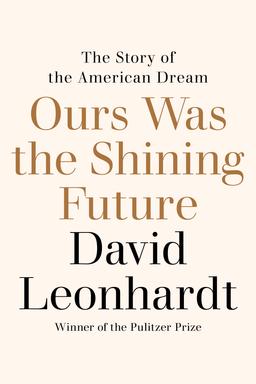
Ours Was the Shining Future cover

Ours Was the Shining Future

by David Leonhardt

Ours Was the Shining Future delves into the intricate history of the American Dream, examining its rise and fall through the lens of democratic capitalism and labor movements. David Leonhardt offers a compelling narrative on bridging economic disparity and revitalizing national prosperity.

Democratic Capitalism and the Story of American Progress

How can a nation combine the power of markets with the moral aims of democracy? In Ours Was the Shining Future, David Leonhardt argues that America’s greatness lay in a system he calls democratic capitalism—a mix of market dynamism and public balance that ensured most citizens could share in prosperity. The story, he contends, is both historical and prescriptive: when governments invest, workers organize, and economic rules restrain concentrated power, markets produce widespread progress. When those checks erode, gains flow upward and stagnation follows.

Two competing economic stories

You should picture two parallel theories. The first, laissez‑faire capitalism, trusts markets entirely: low taxes, light regulation, and profit-driven decisions shape life. The second, democratic capitalism, trusts markets but understands their limits. Because private actors underinvest in public goods and often accumulate political influence, democracy must shape capitalism to serve citizens. Leonhardt tells you that the mid‑20th‑century boom emerged not from abandoning markets but from guiding them through rules, redistribution, and investment.

Power, investment, and culture—the trilogy of progress

Three forces drive the book’s argument. Power refers to workers’ ability to organize and influence politics; investment refers to the state’s willingness to sacrifice short‑term comforts for long‑term public goods; and culture refers to prevailing norms about fairness, patriotism, and collective purpose. Between the 1930s and 1960s, these forces aligned: unions shaped wages and politics; the federal government invested boldly in infrastructure, education, and science; and business elites adopted norms of restraint and national service. Together they produced the economic miracle in which ninety percent of those born in 1940 earned more than their parents (Raj Chetty’s upward‑mobility measure).

Historical lessons and moral paradoxes

The book recounts New Deal institutions—from the Wagner Act to Social Security—and wartime mobilization that expanded scientific capacity and created postwar industries. But progress was moral as well as material. Leonhardt shows that prosperity coexisted with racial exclusion: the FHA redlined Black families even as unions opened new economic doors through inclusive organizing led by figures like Asa Philip Randolph. Democratic capitalism, therefore, is not simple virtue; it requires ongoing work to reconcile moral ideals with political realities.

Crisis, fragmentation, and neoliberal reaction

After the 1960s, cultural fragmentation and a loss of organizing power opened the way for new ideology. Crime and unrest fractured political coalitions; the New Left prioritized cultural issues over economic solidarity; and corporate activists, inspired by Lewis Powell’s 1971 memo and Chicago‑School economists like Milton Friedman and Robert Bork, built think tanks to restore market supremacy. Reagan’s revolution institutionalized this shift: deregulation, anti‑union policy, and judicial appointments anchored a new era of upward concentration.

Why the story matters now

Leonhardt’s conclusion looks ahead. The United States today—aging, unevenly educated, and politically polarized—suffers from an investment shortfall and Olson‑style entrenchment of interest groups that prevent reform. Airports, universities, and trains stagnate; federal budgets favor healthcare over infrastructure and youth programs. If you want to recover shared progress, the book argues, you must rebuild the triad of power, investment, and culture. Restore worker bargaining power, renew public investment, and cultivate a civic culture that prizes common advancement over private gain.

Core message

Democratic capitalism works when democracy steers markets—investing for the future, dispersing power, and honoring civic duty. When markets dominate unchecked, wealth consolidates, politics corrodes, and the American dream withers.

This sweeping history serves as a guide for citizens and policymakers alike: prosperity does not emerge spontaneously; it must be built through organized power, public purpose, and moral imagination. That is Leonhardt’s challenge and invitation.


Building Broad Prosperity Through Power

Leonhardt insists that power—especially labor power—is the engine of shared prosperity. Wages, he reminds you, are not dictated solely by productivity; they fall within a range and depend on who has leverage. Union organizing moves pay closer to fairness, compresses inequality, and fuels a political coalition that supports investment and redistribution.

How unions created progress

From the 1934 Minneapolis Teamsters strike to Section 7(a) of the National Industrial Recovery Act and the 1935 Wagner Act, workers transformed vulnerability into strength. Governor Floyd Olson’s defense of strikers showed the symbiosis between organized labor and sympathetic governance. Frances Perkins embedded collective bargaining into law, ensuring disputes resolved through negotiation rather than violence. Those decades saw wages climb and the consumer economy bloom.

Unions as political institutions

Beyond wages, unions became political actors. They built the New Deal coalition that kept Democrats dominant for forty years and supported redistributive programs that raised living standards nationwide. Inclusive unionism—particularly from the CIO—advanced racial and gender equality by compressing pay across categories.

The decline and partial revival

After 1980, union density fell below 10 percent. Reagan’s firing of air traffic controllers symbolized a cultural shift from cooperation to discipline. As bargaining weakened, wages stagnated even as productivity grew. Yet the twenty‑first century shows hints of revival: Gallup polls report majority support for unions; campaigns like “Fight for $15” demonstrate how mobilization still raises pay and builds solidarity across low‑wage sectors.

Lesson for you

Economic fairness requires more than benevolent employers or technocratic policy—it requires organized citizens who can negotiate, demand, and vote for shared prosperity.

Restoring worker power, Leonhardt concludes, is prerequisite to restoring democratic capitalism itself. Without collective leverage, even enlightened investment or regulation cannot prevent markets from redistributing wealth upward.


Public Investment as the Lever of Growth

Investment, in Leonhardt’s form, means consciously sacrificing short‑term consumption to build long‑term capability. From Vannevar Bush’s wartime research programs to Eisenhower’s interstate highways, midcentury government treated science and infrastructure as national imperatives, not partisan luxuries.

Why private firms underinvest

Firms chase private returns and avoid projects whose payoffs spread widely. Basic research or infrastructure creates spillovers too vast for a single corporation to recoup, so without state underwriting these foundations crumble. Wartime mobilization taught this: radar, computing, and nuclear research seeded industries that later defined civilian innovation. (Think of DARPA, NASA, and the Marshall Plan as enduring examples.)

Education and technology as public multipliers

Mass schooling was the quiet complement to investment. The GI Bill and public‑university expansion turned working‑class Americans into engineers and administrators, multiplying every dollar spent on research and infrastructure. Grace Hopper’s computer revolution embodies the dynamic: government funding enabled innovation, and a democratic spirit of accessibility transformed invention into usable tools like COBOL and commercial computing.

The investment shortfall today

Since the late twentieth century, federal priorities shifted from building the future to maintaining entitlements. Education, transport, and research shrank as shares of GDP while healthcare and retirement absorbed the budget. Leonhardt cites Eugene Steuerle’s line: “We have a budget for a declining nation.” You encounter its results daily—slow trains, crowded airports, and underfunded campuses where students like Matthew Chin sleep in trailers. This misallocation reduces productivity and weakens optimism.

Core principle

Public investment amplifies private enterprise. When you rebuild schools, labs, and transport systems, you enlarge the space in which market innovation thrives.

Leonhardt’s prescription is simple but demanding: cut wasteful medical spending, target more toward children and students, and rekindle the political courage to invest far beyond one election cycle. Prosperity depends on building things that last.


Culture and Corporate Responsibility

Economic institutions sit inside cultures. Leonhardt draws on sociologist Ann Swidler’s insight that crises rewrite corporate “scripts.” The Great Depression and World War II shook executives out of self‑interest and inspired a brief era of civic business leadership—proof that norms can govern markets as effectively as law.

The midcentury cultural toolkit

Paul Hoffman’s Committee for Economic Development urged business leaders to see high wages as patriotic and planning as a civic duty. Executives like Jay Hormel and George Romney internalized voluntary restraint; Romney even capped his own pay to symbolize humility. Corporate patriotism matched Eisenhower’s responsible moderation, sustaining a political culture that accepted unions and social programs as compatible with profitability.

Cultural erosion and fragmentation

By the 1960s, that communal culture fractured. Rising affluence and educational divides produced the “Brahmin left”—highly educated progressives focused on cultural issues (gender, environment, consumer rights) rather than economic solidarity. C. Wright Mills and the Port Huron Statement inspired moral idealism but diverted attention from bread‑and‑butter labor politics. As Pete Hamill observed, many working‑class Americans felt judged by elites and drifted toward politicians who spoke their language of order and belonging.

Bridging culture and economics

Leonhardt praises leaders who combine empathy with realism—Robert Kennedy in 1968, Barack Obama’s civic optimism, and Joe Biden’s working‑class tone. They show that progress needs cultural respect as much as technical policy. Without moral cohesion, even generous budgets fail. (The argument echoes Alexis de Tocqueville’s warning: democracy rests on habits as much as institutions.)

Guiding insight

Economic reform succeeds only when culture grants it legitimacy. Prosperity requires both competence and solidarity.

To revive democratic capitalism, you must rebuild not just institutions but the civic imagination—norms of fairness, humility, and long‑term responsibility among leaders and citizens alike.


Race, Exclusion, and Uneven Democracy

Leonhardt reminds you that the shining future was never evenly shared. The same government that built highways and universities also drew red lines through Black neighborhoods and tolerated violence against families like the Shorts of Fontana. Democratic capitalism advanced justice only fitfully, revealing how structural racism and underinvestment intertwined.

Oppression and constraint

Federal housing policy, local policing, and GI‑Bill administration kept many Black veterans and families out of homeownership. Segregation became economic through mortgage maps and credit norms. These exclusions compounded across generations, shaping wealth inequality that persists today.

Resistance and opportunity

At the same time, labor organizing created openings. Asa Philip Randolph’s Brotherhood of Sleeping Car Porters forced Roosevelt to ban discrimination in defense industries and helped integrate wartime factories. CIO unions lifted Black wages through compression, generating what economists call “distributional convergence.” From the 1940s to 1970s, unionized industries narrowed racial gaps even when workplace discrimination continued.

Lessons for now

Leonhardt applies this historical contrast to present challenges. Closing positional gaps (same job, same pay) needs enforcement and anti‑bias law. But sustaining distributional gains requires rebuilding institutions—unions, minimum wages, and public investments—that raise incomes broadly. Only when those pillars work together does racial democracy deepen.

Moral insight

The midcentury boom combined progress and failure. True equality requires protecting rights and rebuilding broad‑based prosperity that benefits those long excluded.

For you as a citizen, the implication is clear: racial justice cannot rely solely on courtroom victories; it depends on policies that lift the entire working class. That is how democratic capitalism fulfills its promise.


Neoliberalism, Reaction, and Entrenchment

The later chapters chart the rise of neoliberalism—an intellectual and political movement born from Chicago classrooms and corporate boardrooms that reasserted faith in markets. Milton and Rose Friedman, Aaron Director, and Robert Bork provided the theory; Lewis Powell’s 1971 memo to the Chamber of Commerce provided the strategy. Corporations, foundations, and think tanks transformed abstract economics into policy and law.

How the ideas took power

Business leaders funded a network that reached courts and Congress. The Powell memo urged executives to fight intellectual battles head‑on, building institutions like Heritage and Cato to counter liberal dominance. Judges educated in Chicago School reasoning used Bork’s “consumer price” test to relax antitrust enforcement. Deregulation under Reagan made these doctrines governing principles, shrinking both taxes and union strength.

Economic consequences

The Reagan revolution broke inflation but deepened inequality. The top tax rate fell from 70 to 28 percent; Wall Street pay soared; and union membership plummeted. Corporate profits climbed above seven percent of national income—transferring roughly three thousand dollars a year from median families to shareholders. Leonhardt’s data interpret this as prosperity without progress: aggregate output rose while real wages flatlined.

Entrenchment and Olson’s theory

Mancur Olson’s logic explains why reform stalls. Wealth and political stability breed interest groups that defend their rents—healthcare industries preserving high prices, prison lobbies securing budgets, local homeowners resisting housing. Germany and Japan rebuilt efficiently after World War II partly because their old interest networks were destroyed; America carried its lobbies forward. Over time, public money flowed to entrenched programs rather than future‑oriented investment.

Strategic conclusion

Reforming an economy requires shifting power, not just designing brilliant policies. Only broad coalitions can overcome entrenched interests and fund the next generation’s progress.

Leonhardt’s account turns neoliberal triumph into cautionary tale: ideas forged against regulation proved effective at concentrating wealth and limiting mobility. Overcoming their legacy demands new visions—rooted in the democratic capitalism America once practiced.


Immigration and the Politics of Change

The 1965 Immigration and Nationality Act serves as Leonhardt’s final case of democratic idealism meeting complexity. The law ended racist national‑quota systems, fulfilling civil‑rights principles, but its family‑reunification loophole reshaped America more profoundly than its authors expected. Annual admissions eventually topped one million, diversifying society and altering political alignments.

Promises and unintended effects

Kennedy’s A Nation of Immigrants framed reform as moral duty, and President Johnson reassured the public that demographic impact would be modest. Yet family‑chain migration soon became the main vehicle for entry, expanding flows from Asia and Latin America. Economists Raj Chetty, Leah Boustan, and Ran Abramitzky find that immigrant children ascended economically at remarkable speed—a testament to American opportunity—but local wage pressures and political anxieties grew among native low‑wage workers.

Barbara Jordan’s balance

In 1995, civil‑rights icon Barbara Jordan proposed pragmatic limits: defend refugee protection and skilled migration while tightening enforcement and reducing total inflow to preserve cohesion. Her stance treated immigration as a privilege balanced with responsibility—a communal lens often missing from polarized debate. Leonhardt uses her to illustrate that humane policy must remain politically sustainable.

Political consequences

Large demographic shifts interacted with cultural divides to reshape party coalitions. As educated urban voters emphasized multicultural and environmental priorities, many working‑class voters felt neglected economically and voted rightward. Immigration thus became both symbol and accelerant of the broader cultural realignment away from the New Deal’s class‑based politics.

Enduring lesson

A just immigration system must honor diversity and opportunity while preserving solidarity among existing citizens. Economic progress and social cohesion depend on balancing both.

For you as a policymaker or voter, the takeaway is not restriction but foresight: ideals must come with design. Democratic capitalism thrives when openness pairs with shared investment and inclusion.

Dig Deeper

Get personalized prompts to apply these lessons to your life and deepen your understanding.

Go Deeper

Get the Full Experience

Download Insight Books for AI-powered reflections, quizzes, and more.