
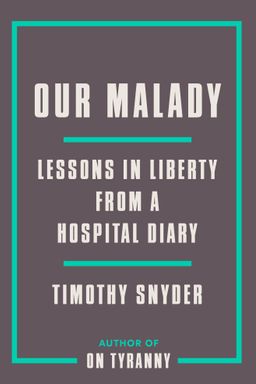
Our Malady cover

Our Malady

by Timothy Snyder

Our Malady by Timothy Snyder highlights the dire state of the American healthcare system, arguing that profit-driven policies undermine public health and freedom. By comparing global systems, Snyder reveals pathways to a healthier, more equitable society.

America’s Public Malady: Health, Freedom, and Democracy

What does it mean to live in a country where one of your most fundamental freedoms—the freedom to live a healthy life—is quietly under siege? In Our Malady, historian Timothy Snyder argues that America’s greatest sickness is not merely biological or political, but a fusion of both: a national malady that robs citizens of their health, erodes their freedom, and profits from their pain. Having nearly died in 2019 due to a mismanaged infection, Snyder uses his own medical ordeal to reveal how the American health care system has metastasized into a machine of inequality and exploitation. His journey through five hospitals becomes a symbolic mirror of the entire United States—a democracy weakened by a toxic mix of commercial medicine and authoritarian politics.

Snyder contends that health and freedom are inseparable. A person who is too sick, too afraid, or too misinformed to make informed decisions is not truly free. The American experiment, founded on the promise of “life, liberty, and the pursuit of happiness,” now fails even at the first word. The system that should uphold life has turned into what Snyder calls “wealth transfer that incidentally involves some health care.” In other words, our medical system is designed not to heal but to harvest—extracting profit from suffering while depriving ordinary people of the conditions that make liberty possible.

Health as a Foundation for Freedom

The book’s central claim is clear: to be free, you must be healthy; to be healthy, your society must care about truth, equality, and solidarity. This idea—health as the foundation of democracy—echoes thinkers from Thomas Jefferson to Frederick Douglass, both of whom saw freedom as the ability to act, choose, and thrive. Snyder extends their vision into the twenty-first century, arguing that our health crisis is also a crisis of freedom. The inability to access reliable medical care leaves citizens dependent, fearful, and manipulable. Illness becomes a tool of control, while healthcare becomes a means of division.

From Personal Infection to National Disease

Snyder’s own near-death experience unfolds like a metaphorical diagnosis of America. He recounts being ignored by distracted doctors in overworked hospitals—from Germany to Florida to Connecticut—before discovering that what nearly killed him was not just an infection but a system-wide failure. Delays, racism, miscommunication, and profit-centered protocols led him close to sepsis and death. His story becomes a vivid demonstration of how commercialized medicine fails its patients daily. The curtain separating him from other sick people becomes an image of national isolation—each patient alone, unseen, and unlistened to. Snyder’s insight is that healing begins not only with antibiotics, but with empathy, solidarity, and truth.

Our Malady Beyond the Hospital Walls

The book moves from the intimate to the national. America’s “malady” shows itself in the declining life expectancy, maternal mortality rates that rival developing countries, and rampant opioid addiction that numbs both pain and democracy. Snyder shows that men and women who lack solidarity—who are told to “tough it out” and fight pain alone—become victims not only of addiction but of despair and political manipulation. This solitary suffering, when multiplied across millions, becomes collective political rage. Snyder calls this transformation “sadopopulism”: a system where leaders manipulate pain for profit and power. The rise of authoritarian politics, especially under Donald Trump, is thus tied to the physical and mental sickness of the population.

Freedom, Truth, and Solidarity

Healing America’s malady demands more than better hospitals—it requires rebuilding the moral infrastructure of solidarity and truth. Snyder argues that freedom is not merely an individual struggle (“a scream in the dark”) but a collective act that depends on empathy, accurate knowledge, and mutual care. When truth collapses—whether through propaganda, social media addiction, or government deceit—both health and democracy perish. Freedom, he reminds us, is “impossible when we are too ill to conceive of happiness and too weak to pursue it.” Thus, public health becomes a civic responsibility, not just a personal concern. The book concludes that restoring America’s freedom requires seeing healthcare as a universal right, reclaiming factuality through local journalism, and putting doctors (not corporations) back in charge.

Why This Matters to You

Snyder’s argument isn’t just political—it’s personal. He asks you to consider how much your own freedom depends on your health and how much your health depends on the society around you. Can you make meaningful choices if illness, medical debt, or misinformation control your decisions? Can you raise healthy children or trust democracy if truth itself is sick? Our Malady offers both warning and hope: warning, that commercial medicine and neglect can kill both body and nation; hope, that solidarity, truth, and empathy can heal them. Through rage and empathy—his twin catalysts for recovery—Snyder offers a prescription not only for his own survival but for America’s revival. The cure begins when we all, together, claim healthcare as a human right.


Health Care Is a Human Right

Timothy Snyder begins his argument from the most personal place possible: his brush with death. In December 2019, after an untreated infection spiraled into life-threatening sepsis, he realized firsthand how America’s medical system fails even the privileged. His struggle in five hospitals—from Munich to New Haven—revealed the moral failure beneath modern healthcare: the idea that treatment is a privilege for the well-connected rather than a right for every human being.

Illness as Mirror of Inequality

Snyder’s illness took him through hospitals crowded with neglected patients, distracted physicians, and broken protocols. The simple act of admission depended on advocacy—a role filled by his friend, a Black woman doctor whose warnings were dismissed. Racism and indifference almost cost Snyder his life, just as they do thousands of others daily. His insight is blunt: when a system grants access based on wealth, race, or connections, it destroys equality at the foundation of democracy. Those inside the system feel superior but remain trapped in anxiety; those outside it suffer or die. He calls this dynamic a “collective of pain”—a social arrangement where everyone loses something vital, from dignity to freedom.

From Profit to Care: What Medicine Should Be

For Snyder, medicine’s true purpose is liberation: enabling long lives filled with freedom and meaning. America’s commercialized healthcare turns this on its head. It makes pain a commodity and suffering a condition for profit. Hospitals discharge patients too soon, physicians are distracted by billing systems, and medication replaces conversation. As Snyder notes, this model transforms citizens into raw economic input—“widgets” to be processed and billed, not people to be cared for.

Freedom Requires Equality in Health

Drawing on the Declaration of Independence and Enlightenment principles, Snyder insists that health is implicit in liberty. To pursue happiness requires bodily well-being; to live freely requires confidence that illness will not strip you of dignity or choice. Jefferson’s trio—life, liberty, and happiness—depends on the freedom from physical fear. When health care becomes competitive, Americans start to see suffering as natural and inequality as inevitable, violating the founders’ hopes for justice and tranquility. Snyder’s historical lens—linking today’s malady to the moral failures seen under regimes like Nazi Germany and Stalin’s USSR—underscores the peril of seeing human beings as biological burdens or economic units.

Pain, Pills, and Solitude: The Cultural Dimension

The chapter also examines cultural solitude: a long tradition of stoicism that turns pain into isolation and isolation into political vulnerability. Men taught to hide pain, like Snyder’s farmer grandfathers, later become men who hide addiction. Enduring hurt without help leads inevitably to opioids and despair—a loop that politicians exploit. Snyder calls this shift political as well as personal: when pain becomes normalized, empathy disappears, and tyranny creeps in. He urges Americans to replace solitary toughness with shared solidarity, where seeking care honors freedom rather than weakens it.

Recovering Moral Health

Snyder’s recovery taught him that health care is more than medicine—it’s human connection. In Europe, doctors listened; in America, screens blinked. Western democracies that treat healthcare as a right allow doctors to be healers, not accountants. For America to heal, citizens must insist that care is not charity or consumer choice but a civic right. Only then, Snyder writes, can we restore our lost equilibrium between solitude and solidarity—the balance that defines both health and freedom.


Renewal Begins with Children

Snyder’s second lesson begins with his children’s drawings taped to his hospital wall—a reminder that health and freedom are generational. He argues that true renewal comes with how a society treats its youngest citizens and supports parents in the act of creation. Health, like democracy, must start at birth, not at crisis.

A Tale of Two Births

To show what humane care looks like, Snyder compares two experiences: the birth of his son in Vienna and his daughter in Connecticut. In Austria, pregnancy was a collective enterprise—prenatal care was free, birthing classes were social, and maternity wards enforced four days of recovery where mothers learned from nurses how to feed and bathe their babies. Fathers had parental leave options up to two years. Snyder describes these policies not as luxuries but as civic expressions of solidarity. In contrast, his wife’s American delivery was short-term, mistrustful, and punitive. Doctors followed protocols designed for profitability, not safety, discharging mothers prematurely and leaving many without support.

Freedom as Shared Support

Snyder contrasts the Austrian model’s logic of life with the American system’s logic of profit. In Vienna, motherhood is supported as a civic right; in America, it’s treated as a private burden. The result is not only inequality but existential isolation. He recalls watching American parents constantly hover over their toddlers in anxiety, driven by the knowledge that “at the end of the day we are doing this alone.” This solitude, he argues, is a symptom of national illness—an absence of solidarity masquerading as independence.

Childhood as the Seed of Freedom

Snyder integrates developmental science into his historical argument: A society’s political freedom depends on children’s neurological freedom. The first five years of life shape how humans regulate emotion, recover from disappointment, and make choices—all skills required for democratic citizenship. (Psychologists like Barbara Fredrickson and scholars at Harvard’s Center on the Developing Child support this link.) When early play, trust, and attention are withheld, adults grow fearful and reactive—traits exploited by autocrats. Thus, early childhood care is not only compassion but prevention; it guards against authoritarianism by nurturing emotional self-regulation and empathy.

Policy as Parenting

Snyder’s prescription goes beyond sentiment. Paid parental leave, sick days, public childcare, and universal health coverage are, in his view, the political expressions of love. Only when families feel secure can children learn autonomy. “Freedom is a loan paid over generations,” he writes—a beautiful inversion of the phrase “freedom isn’t free.” To protect liberty in adulthood, we must invest in the solidarity of childhood. Without time, support, and empathy early on, citizens grow up blind to the very emotion that democracy requires: compassion.


The Truth Will Set Us Free

Snyder’s third lesson—perhaps the most political—is that truth and health are the twin pillars of freedom. Drawing from his hospitalization at the dawn of COVID-19, he reveals how America’s failure to tell the truth about disease led directly to mass death and democratic decay. His argument unfolds on three levels: medicine’s pursuit of truth, government’s suppression of it, and society’s loss of the ability to recognize it.

Truth in Medicine

While hospitalized, Snyder witnessed two models of medical truth: his Chinese roommate’s case, solved through careful storytelling and testing, contrasted with national politics that would soon suppress testing altogether. In medicine, truth emerges through communication and experiment; both demand time and compassion. America’s pandemic response failed on both counts. Trump’s administration dismantled epidemic-response units, refused to acquire COVID-19 tests in January 2020, and punished health officials who told inconvenient truths. As Snyder notes, “Since the truth sets you free, tyrants resist the truth.” Ignorance became policy.

Authoritarianism as Anti-Truth

Snyder ties government denial to the Platonic idea of tyranny: rulers obsessed with their image, surrounded by yes-men, and allergic to bad news. Trump’s refusal to test—because higher numbers made him “look bad”—became fatal for hundreds of thousands. The administration’s lies about miracles, hydroxychloroquine, and disinfectants blurred the boundary between politics and pseudoscience. Snyder shows how authoritarianism feeds on ignorance: when citizens accept fantasy over fact, they surrender agency. Truth, by contrast, restores freedom by giving knowledge of one’s condition—medical or political.

The Death of Local Truth

When local journalism dies, so does local factuality. Snyder laments the rise of “news deserts,” where community reporters once tracked pollution, opioids, and emerging illnesses. Social media filled the void with manipulation. Big data, he argues, collects private cravings but not public truths. Algorithms profit from attention, not accuracy, leaving Americans obese, addicted, and uninformed—the perfect conditions for both disease and dictatorship. Freedom of speech means little if truth itself disappears.

Restoring the Factual World

Snyder calls for a renaissance of reporting and testing—literal and metaphorical. Local journalists, like doctors, create facts that anchor freedom. Both professions require courage and proximity to suffering. Without their labor, democracy drifts into fantasy. He proposes taxing social media giants to revive local newspapers—a concrete way to repair the “factual world” we share. In medicine as in politics, freedom depends on factual knowledge one body, one community at a time.

Truth as Health

At heart, Snyder views truth as medication: bitter but necessary. Lies about illness lead to tyranny, and lies under tyranny lead to more illness. To heal, a nation must choose knowledge over denial. The lesson echoes both Orwell and Arendt—truth is not automatic but earned through courage and solidarity. The civic act of knowing, Snyder suggests, is itself a form of public health.


Doctors Should Be in Charge

In the fourth lesson, Snyder makes his most practical demand: restore authority to the people who actually heal. During his days in a Florida hospital—corridors staffed mostly by volunteers and nurses, not physicians—he realized that American medicine has sidelined its experts. Hospitals run on business models, not medical ethics. Doctors must answer to insurers, investors, and administrators rather than patients. This disempowerment, Snyder argues, kills both health and truth.

Medicine Without Doctors

In Snyder’s Florida hospital, most conversations were with screens and systems, not people. One doctor examined him for three minutes; another diagnosed via Skype. His doctors were not neglectful—they were trapped. Commercial institutions reduce them to “flat smiling faces on billboards,” while managers enforce gag orders that silence complaints about PPE shortages or unsafe conditions. The coronavirus pandemic revealed this dysfunction dramatically: hospitals ran out of masks; doctors were fired for speaking truth; private equity firms profited from chaos.

Profit Over Healing

Snyder links these failings to the logic of “just-in-time delivery.” Like factories, hospitals maintain no excess beds and no safety stock. Epidemics thus arrive into built-in shortages. Patients, including new mothers and appendectomy cases, are expelled before recovery because empty beds maximize profits. Even life-saving innovations—like new antibiotics—are avoided by pharmaceutical companies since they yield limited long-term returns. “If pure capitalist logic is applied to health,” Snyder warns, “the bacteria win.”

Technology’s Distraction

Computers and billing algorithms further degrade care. Nurses now push “computers on wheels,” entering data rather than perceiving patients. Electronic medical records serve billing, not insight, guiding physicians toward profitable diagnoses instead of truthful ones. Snyder’s own experience—where a liver drain failed because it wasn’t “on the list”—illustrates how digital systems replace empathy with compliance. Doctors lose the moral and cognitive space to think.

Reclaiming Medical Authority

Snyder’s solution is structural: break up medical monopolies through antitrust laws, forgive debts for doctors serving needy communities, outlaw gag orders, and re-empower federal agencies led by physicians. Health, he insists, begins in small offices and home visits, not corporate complexes. The rural hospital closures and vanishing general practitioners symbolize a nation losing touch with human-scale care. Reversing this trend means investing in accessibility—doctors who know their patients’ names, not their billing codes.

The Moral Role of Doctors

Physicians embody the intersection of science and empathy—the virtues Snyder sees fading in both medicine and politics. His call echoes Atul Gawande and Elizabeth Bradley’s research: countries that empower doctors and provide universal care achieve healthier, freer societies. Restoring doctors to authority is, therefore, restoring truth to public life. Snyder’s plea is both civic and spiritual: “Doctors should be in charge” is shorthand for “humanity should lead where profit once ruled.”


Our Recovery: Reclaiming Health and Liberty

In his concluding lesson, Snyder turns diagnosis into prescription. America’s malady—its entanglement of sickness and unfreedom—can be cured, but not by medicine alone. Recovery demands rebalancing solitude with solidarity, dethroning oligarchy, and redefining what freedom means. He warns that the medical-industrial complex will defend itself with propaganda, insisting that reform is too expensive. But Snyder flips the script: it is not reform that costs too much; it’s illness.

The Economics of Healing

America pays more for healthcare than any wealthy nation yet lives shorter, sicker lives. The illusion of efficiency hides deliberate exploitation—surprise bills, insurance gaps, and debt traps. Snyder compares this to “trolls on a bridge” charging tolls to the desperate. Removing these middlemen through a single-payer system would save money and restore dignity. Healthier citizens, he argues, sustain healthier economies.

Freedom Through Security

Citing Friedrich Hayek—the economist often invoked against social reform—Snyder shows that even advocates of free markets supported social insurance to preserve liberty. True freedom requires security; only people free from fear can act independently. Solidarity, in this sense, is not socialism but sanity. It transforms healthcare from a transaction into a shared investment in collective freedom.

Children as the Measure of Renewal

Snyder returns to his earlier theme: renewal begins with children. Societies that provide parental leave, childcare, and education sustain democratic optimism. These investments yield emotional resilience and civic health. Happiness, Jefferson taught, depends on physical wellbeing; Snyder modernizes that principle—our children’s wellbeing is our democracy’s immune system.

Healing as Civic Act

Recovery, then, is not just medical but moral. It requires courage to imagine systems rooted in empathy rather than profit. As Snyder writes, pandemics expose both vulnerability and opportunity: the same crisis that deepens inequality can spark collective healing. To recover, Americans must demand universal healthcare, revive factual journalism, and empower doctors—the trio of truth, solidarity, and science that underpin liberty. Freedom is not the absence of illness; it is the presence of care.

A Vision of Renewal

Snyder closes with hope. Scars remain after recovery, but they are marks of learning. Just as his own infection altered his language and habits, America’s trauma can reshape its values. If we reclaim health as a right, restore truth as a civic duty, and rebuild empathy as a national instinct, we can pursue happiness as the founders intended. “Each of us has a torch that rages against death,” Snyder writes, “and each of us is a plank of a raft that floats through life with others.” The raft—his enduring metaphor for solidarity—becomes our collective cure.

Dig Deeper

Get personalized prompts to apply these lessons to your life and deepen your understanding.

Go Deeper

Get the Full Experience

Download Insight Books for AI-powered reflections, quizzes, and more.