
Idea 1
The Primate Roots of Morality and Cooperation
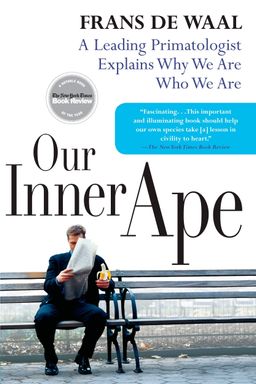
Why do humans comfort the grieving, forgive foes, and punish cheaters? Frans de Waal argues that these behaviors don’t rest on a thin cultural veneer but stem from ancient primate instincts. Across species—chimpanzees, bonobos, gorillas, and even capuchin monkeys—you find empathy, reciprocity, reconciliation, and fairness, all of which form the evolutionary foundation of what we call morality.
Two Faces of Human Nature
De Waal begins with the paradox he calls the Janus Ape: humans and apes are simultaneously capable of deep empathy and deliberate cruelty. You can observe this polarity in primates themselves. Bonobo Kuni once rescued a stunned starling, gently unfolding its wings; conversely, juvenile chimps at Arnhem invented a game of tormenting chickens. Both extremes emerge from the same cognitive capacity—to imagine another's perspective. The mind that enables compassion also allows intentional harm.
Empathy as a Biological Heritage
Empathy is not limited to humans. Kanzi the bonobo shows theory of mind when teaching his sister Tamuli how to act out language tasks. Infant chimps and human babies alike cry when others cry, signaling emotional contagion—a primitive form of empathy. Consolation acts, like Binti Jua cradling a fallen child or Kuif adopting an orphan, reveal that caring behaviors arise naturally when individuals value social bonds.
Morality Beyond the Veneer
De Waal challenges the “veneer theory,” which depicts morality as a fragile cultural overlay on savage instincts (promoted by postwar writers like Lorenz and Ardrey). He shows that moral traits—sympathy, fairness, consolation—develop gradually from social instincts evolved to maintain group unity. Darwin himself saw this when noting that “social instincts” form the core of morality. The evolutionary process may be harsh, but like his “Beethoven error,” De Waal reminds you that a cruel process can yield compassionate results.
A Broadened View of Human Behavior
Through this lens, human morality, empathy, and cooperation cease to be moral miracles. They are elaborations of capacities long present in our evolutionary cousins. Viewing humans as moral apes does not diminish us—it situates compassion as part of nature rather than a rebellion against it.
Key lesson
When you see morality as an evolved system of empathy, reciprocity, and social regulation, you discover continuity rather than rupture between humans and other primates. Culture refines morality—it doesn’t invent it from nothing.
Throughout the book, De Waal builds this argument across domains—politics, sex, conflict, reconciliation, and intergroup behavior—to show that our moral sense is anchored in millions of years of social evolution, with primates offering living case studies of both our best and worst selves.