
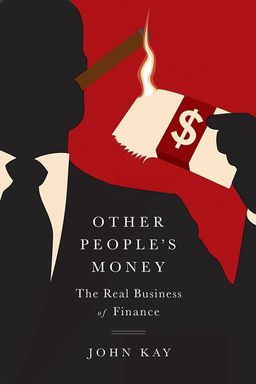
Other People’s Money cover

Other People’s Money

by John Kay

In ''Other People’s Money,'' John Kay delves into the murky operations of the financial sector, exposing its deviation from serving the economy to exploiting it. Through historical context and analysis, Kay reveals how financial excesses led to crises, highlighting the urgent need for ethical reform to safeguard society''s future.

The Architecture of Financialisation

How did finance evolve from community banking into a sprawling global market where trillions trade daily? John Kay’s argument begins with that transformation — the shift from finance as a service industry to finance as an industry that trades with itself. He calls this process financialisation, and he traces how deregulation, technological innovation, mathematical models, and new corporate incentives reshaped the purpose and culture of money. You move from George Bailey’s local trust to Goldman Sachs’ screens and quants, from relationships and stewardship to transactions and speculation.

The end of relationship banking

Kay illustrates the shift with vivid contrasts: branch bankers once knew clients personally; after the 1980s Big Bang, finance became global, anonymous, and hyper‑competitive. Eurodollar markets, deregulated foreign exchange desks, and demutualisation turned cautious partnerships into trading conglomerates. Institutions like Halifax and Lehman converted into public companies where risk was transferred from owners to shareholders and eventually to taxpayers. The trader displaced the fiduciary, and profit came from volatility rather than sustained service.

Models and mathematics

Mathematical finance amplified this cultural revolution. From Black–Scholes option pricing and the Gaussian copula to high‑frequency algorithms, equations became market weapons. Models promised precision but often created illusion — regulators and executives (Greenspan, Summers) believed risk could be quantified and dispersed. Yet the book’s cautionary motif — Galton’s ox and the misplaced faith in aggregate guesses — reminds you that markets can detach from the real value of the assets they claim to price.

The incentives that shaped fragility

Partnerships once constrained recklessness because partners’ own money was at stake. Public flotation removed that brake. Bonuses, mark‑to‑market accounting, and the motto “I’ll be gone, you’ll be gone” rewarded short‑term profits and ignored long‑term losses. Kay uses cases like RBS’s overbid for ABN AMRO and Lehman’s balance‑sheet manipulation to illustrate how financialisation created a system that celebrated temporary gains while socialising losses. Economic success was measured by the volume of trades and asset prices, not by productive investment or community wealth.

From utility to casino — and back?

Kay’s broad claim is that finance forgot its real purpose: connecting household savings to productive enterprise and enabling safe payments. Instead, it built complex internal markets — derivatives, securitisation, arbitrage networks — that generate profit mostly for insiders. Liquidity, leverage and regulatory arbitrage magnified fragility. His prescription is structural, not merely technical: shorten intermediation chains, restore fiduciary duties, ring‑fence payments and deposits from speculative activity, and make individuals personally responsible for misconduct.

Core insight

Financialisation replaced trust with modeling, partnership with limited liability, and stewardship with trading. Kay urges you to see finance again as a social infrastructure — a set of utilities that enable prosperity — not as an autonomous casino powered by leverage and bonuses.

Across the book’s arc — from payments systems and derivatives towers to global capital flows and regulation — the message stays consistent: modern finance thrived on illusion, complexity, and misplaced incentives. To rebuild it, you must disentangle essential functions from speculative ones and realign culture around service, accountability, and long‑term value.


Risk and Radical Uncertainty

You rely on finance to manage risk, yet Kay shows that the sector continually mistakes risk for uncertainty. Models like Black–Scholes and CAPM assume stable probabilities and correlations, but real life brings radical uncertainty — black swans that defy prediction. The lure of risk trading, from Lloyd’s LMX spiral to AIG’s credit default swaps, made institutions believe they could offload danger as if selling milk futures.

Insurance versus wager

Kay recounts the legal distinction articulated by Robin Potts QC: an insurance contract protects against an insurable interest, while a wager is a bet on an event. Many derivatives blurred that line. The Abacus deal at Goldman Sachs—where one party knowingly structured losses for others—exposed how wagers masqueraded as risk management. When losses came, sellers lacked capital because regulatory rules let them treat bets as hedges.

Model hubris and black swans

Goldman’s David Viniar joked of “25‑standard deviation” events. Such statements reveal not extraordinary volatility but model failure. Catastrophes like Lehman’s bankruptcy and AIG’s collapse were not improbable—they were inevitable under assumptions that ignored feedback and correlation. You learn that diversification and securitisation distribute exposure only in theory; in crisis, everyone holds the same correlated risks.

The practical test

Ask of any financial innovation: Does it spread random hazards or concentrate speculative exposure? Kay’s answer is that many modern products do the latter—they turn uncertainty into tradable volatility, enriching intermediaries while endangering stability.

If you treat models as reality, you build systems fragile to surprise. Kay teaches that the goal should be resilience, not prediction—maintain slack, capital buffers, and humility. Real economies prosper not by eliminating uncertainty but by adapting creatively to it.


Intermediation and the Erosion of Trust

Finance once depended on personal trust; today it relies on contractual transparency. Kay explains how agency relationships—where bankers and brokers acted as fiduciaries—deteriorated into trading relationships, where intermediaries advise and profit simultaneously. The result is what he calls the loss of stewardship and the rise of self‑referential markets.

From agent to principal

Old stockbrokers owed duties of loyalty; modern broker‑dealers are counterparties. Conflicts became structural: a firm could sell you products it designed to profit from your losses. Regulations tried to fix this through disclosure, but Kay argues that transparency is not trust—it is the sign that trust is gone. Disclosure cannot replace reputation.

Mortgage chains and hidden fragility

In housing, this breakdown turned stewardship into mass production. Building societies once relied on local knowledge; securitisation enabled remote lending and instant sale of mortgages. Countrywide, Northern Rock, Fannie Mae and Freddie Mac became emblematic of how long intermediation chains destroyed information and incentive alignment. The lenders no longer cared about borrowers—only about selling loans onward.

Kay concludes that finance’s problem is not too little data but too few trustworthy relationships. To rebuild trust, you must shorten chains, clarify duties, and ensure intermediaries serve end‑users rather than markets themselves.


Liquidity, Leverage and Moral Hazard

Liquidity looks abundant until you need it. Kay’s milk analogy—milk scarce at Christmas—captures the essence: liquidity is a supply‑chain property that fails when everyone demands it simultaneously. You saw this in Northern Rock’s run and Lehman’s collapse. High leverage and reliance on short‑term funding make such liquidity illusions deadly.

Liquidity as process, not stock

Bank deposits work because most people leave money untouched; once confidence fails, withdrawal cascades kill banks dependent on wholesale funding. Repo markets, designed for flexibility, turned into regulatory arbitrage (Lehman’s Repo 105). High‑frequency trading offers surface liquidity but vanishes under stress, since algorithmic market‑makers withdraw when volatility spikes.

The public backstop and moral hazard

Governments rescued AIG, Citigroup, and major European banks with trillions, confirming that liquidity is a political phenomenon. Central banks—ECB’s “whatever it takes”—became lenders of political resort. Kay diagnoses a moral‑hazard cycle: thin capital, giant leverage, implicit guarantees. Each rescue entrenches the expectation of another.

Lesson

Liquidity and leverage cannot be cured by liquidity provision alone; only robust structure, prudent leverage limits, and absence of public subsidy create lasting safety.

Kay insists that unless you redesign the financial supply chain—separate utility banking from speculative funding—crises will recur, regardless of clever regulations or central‑bank heroics.


Profit Illusions and Perverse Incentives

High profits once signaled productivity; now they often represent redistributions within finance. Kay borrows Galbraith’s bezzle and Munger’s febezzle to describe transient wealth—paper gains that vanish when reality catches up. Mark‑to‑market accounting and bonus culture transformed temporary victories into permanent pay‑outs.

Short‑termism and asymmetric reward

Executives like Fred Goodwin, Dick Fuld and Chuck Prince epitomized the asymmetry: harvest bonuses during booms, leave losses to shareholders and taxpayers. Trading profits became zero‑sum transfers inside the sector. When assets collapsed, society absorbed the cost. Kay notes these patterns are cultural as well as structural—performance metrics favor speed and aggression over prudence.

Winner’s curse and martingale dynamics

RBS’s purchase of ABN AMRO showed the winner’s curse—paying too much because others bid too high; traders doubling losses echo martingale gamblers (Leeson, Kerviel, Hubler). These dynamics drive illusionary profit spikes that vanish later. The collective outcome: febezzle, not durable growth.

To repair finance, Kay argues, you must align reward with outcome over long horizons—bonuses deferred, capital at risk, and measured real contribution to households and businesses, not ephemeral mark‑ups.


Complexity and Regulatory Arbitrage

Modern finance thrives on exploiting rule differences. Kay shows how regulatory arbitrage—from Eurodollars escaping US rules to Lehman’s English‑law repos—created a lucrative profession of complexity. Each loophole spawns a new instrument; each rule invites a workaround. The result is opacity and systemic fragility.

Historical chain of arbitrage

Regulation Q begot Eurodollars; capital weights begot securitisation; tax rules begot swaps and offshore SPVs. Advisors and lawyers earned fees, while public safeguards eroded. When AIG and SIVs imploded, taxpayers unwound the consequences. Complexity rewarded insiders and misled policymakers.

The complexity trap

Regulators add detail to control loopholes, producing thicker manuals and thinner safety. Basel’s thousand‑page rulebooks prove that precision does not equal control. Kay’s remedy is clarity: separate functions, cap leverage directly, and abandon risk weights that conceal exposure. Fewer loopholes mean fewer games.

Insight

Complexity is not sophistication—it is camouflage. Simplicity and structure achieve what rules cannot.

Kay concludes that enduring reform requires political courage to prefer structural separation over technical micromanagement.


Capital Allocation and Stewardship

Finance’s ultimate purpose is to connect savings to productive investment. Kay distinguishes two duties: search—finding new opportunities—and stewardship—safeguarding long‑term assets. Financialisation weakened both. Housing and business examples show you how.

Misallocation in housing

Local thrifts once knew borrowers; securitisation transformed mortgages into tradable commodities. Countrywide and Northern Rock expanded lending volume by loosening standards. The result: inflated prices, poor underwriting, systemic loss.

Investment and business funding

Stock markets mainly recycle ownership; real investment often comes from retained earnings. SMEs still depend on patient, relationship capital. Kay contrasts the German Mittelstand—families financed by relationship banks—and Silicon Valley’s ecosystem of angels, venture funds and public R&D. Both prove that committed capital and local knowledge beat speculative churn.

Principle

Finance that promotes real prosperity rewards search and stewardship, not short‑term pricing games.

To achieve this, you should favor institutions designed for patience: long‑term funds, relationship banks, and governance that value continuity and expertise.


Global Capital and Systemic Interdependence

Kay turns outward to show how financialisation globalized balance sheets. A country’s wealth now lies in vast interlocking assets and liabilities: Britain’s £10.5 trillion overseas assets offset by nearly equal liabilities. Capital flows circulate among banks, funds, and subsidiaries, blurring national boundaries.

National wealth in a financialised world

Measured wealth mixes physical infrastructure, financial claims and public assets. Cross‑border positions magnify risk: shocks to leveraged financial institutions transmit across borders faster than trade flows. TARGET2 imbalances in Europe—Germany’s €500 billion claims against southern deficits—illustrate structural fragility inside monetary systems.

Kay warns you that looking only at public debt hides private exposures. Systemic vulnerability arises from massive interbank claims, not from roads or bridges. A nation may appear rich yet be leveraged through its financial institutions. The lesson: resilience depends less on net numbers and more on balance‑sheet composition.

You should interpret national wealth cautiously, seeing it as the mirror of household savings filtered through complex intermediation networks. True security comes from diversified real assets and prudent banking structure, not from nominal cross‑border surpluses.


Central Banks and Policy Distortions

Central banks reshaped finance through intervention. Greenspan’s “put” epitomized monetary rescue culture—supporting asset prices whenever panic loomed. Quantitative easing magnified this pattern; balance sheets ballooned as banks were subsidized to keep markets calm. Kay applauds stability but critiques the distortion of incentives.

Functions and drift

Originally lenders of last resort, central banks became asset buyers of first resort. The Fed’s balance sheet jumped from $900 billion to $4.5 trillion; the Bank of England’s to £399 billion. Such expansion inflated asset values rather than real investment. Policymakers asked what “markets” wanted, solidifying finance’s power over politics (James Carville’s ‘bond market’ quip).

Distribution and generation

Loose monetary policy interacts with pensions and demographics. The collapse of defined‑benefit systems shifted risk onto individuals; low rates penalized savers and favored asset owners. Kay calls for recalibrating policy toward long‑term infrastructure and intergenerational fairness—borrowing cheaply for real projects rather than juicing securities.

He concludes that monetary activism must not substitute for structural reform; markets should not dictate public purpose.


Principles for Reform and Responsibility

Kay ends with constructive proposals. To repair finance, focus on structure and accountability, not endless regulation. He advocates ring‑fencing utilities—payments, deposits—from trading; simplifying balance sheets; enforcing personal responsibility; and restoring reputational discipline.

Short, simple chains

Retail banks should handle safe deposits and payments. Investment managers should practice stewardship. Speculators should risk their own capital. This clear separation of functions removes contagion and cultural corrosion. The Vickers and Liikanen reforms follow this logic of ring‑fencing as structural safety.

Accountability and culture

Regulatory micromanagement cannot foresee every loophole. Personal liability can deter misconduct more effectively. Kay urges strict responsibility for senior officers—“shocked and appalled” no longer suffices. Criminal prosecution must re‑establish ethical discipline absent since the 2008 crisis.

Reform manifesto

Short chains, clear purposes, strong duties of care, and withdrawal of public subsidies—turn finance back into a normal industry that serves society instead of governing it.

The book’s final message is moral as well as structural: responsibility must live with power. Finance should recover its civic role—secure savings, channel investment, and uphold trust—before it earns the right to speculate.

Dig Deeper

Get personalized prompts to apply these lessons to your life and deepen your understanding.

Go Deeper

Get the Full Experience

Download Insight Books for AI-powered reflections, quizzes, and more.