
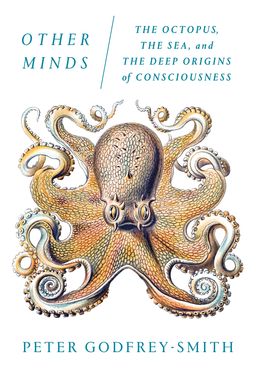
Other Minds cover

Other Minds

by Peter Godfrey-Smith

Embark on an enchanting journey through the evolution of octopuses in ''Other Minds.'' Discover the deep intelligence and unique adaptations of these captivating creatures, challenging our understanding of consciousness and the animal kingdom. Peter Godfrey-Smith unfolds billions of years of evolutionary history, offering fresh insights into the mysteries of intelligent life.

The Minds of the Octopus and the Origins of Consciousness

Have you ever wondered what it feels like to be an octopus—to have eight arms that act semi-independently, skin that sees light, and a nervous system spread across your body? In Other Minds, philosopher Peter Godfrey-Smith dives deep into the evolutionary past to explore how consciousness arose from the sea. His central claim is both radical and elegant: intelligence evolved twice on Earth—once in vertebrates like us, and once in cephalopods, particularly octopuses, cuttlefish, and squid. Through their alien yet parallel forms of awareness, he investigates what it means for any creature to have a mind.

Godfrey-Smith argues that the cephalopods give us a window into the origin of subjective experience itself—a chance to peer across the tree of life and glimpse minds formed in completely different bodies. Far from being mere curiosities, they help answer one of philosophy’s oldest questions: how matter came to know itself. The book unfolds across deep time, from single-celled life through the Cambrian explosion of animal forms, to the vibrant, color-shifting octopus societies he studies off the coast of Australia.

Two Branches of Evolutionary Ingenuity

At the heart of Other Minds lies a provocative evolutionary parallel. Around 600 million years ago, the ancestors of humans and octopuses parted ways in the ocean, splitting into two great branches: vertebrates and invertebrates. Mollusks—normally slow, shelled animals like clams and snails—spawned one rogue lineage that abandoned protection for movement and exploration. These were the cephalopods: tentacled predators who turned vulnerability into mastery. Their brains grew accordingly, wrapped not around bones but within fluid bodies. The result was a second great experiment in mind.

For Godfrey-Smith, this split illuminates the independence of intelligence itself. Cephalopods, despite having no social hierarchies or mammalian empathy, developed learning, problem-solving, and play. They are self-contained minds, shaped by curiosity rather than cooperation. Yet they also reflect the same evolutionary pressures that built our own cognition: mobility, perception, and the need to navigate a world of threats and opportunities.

A Philosophical Diver’s View

Unlike a typical philosophy text, Other Minds is written from underwater. Godfrey-Smith is both philosopher and scuba diver, and his observations give the book a sensory immediacy. He describes encounters with giant cuttlefish—color-shifting creatures that approach humans with what feels like curiosity—and octopuses who reach out a tentacle to touch his hand and then retreat, as if in thought. In these moments, he senses a familiarity that unsettles and expands our notion of the self.

As he notes, meeting a cephalopod is the closest we come to meeting an intelligent alien. They evolved in water, not on land; their lives are short, their bodies soft, their experience unknowable. Yet their eyes look back at us with eerie recognition. Godfrey-Smith uses these encounters to build a bridge between biology and philosophy: the octopus becomes a test case for theories of consciousness, embodiment, and subjective experience.

Consciousness from White Noise

Central to the book is Godfrey-Smith’s exploration of how consciousness itself might have emerged. He rejects the idea that awareness appeared suddenly—a spark in human brains—and instead traces its gradual evolution from simple sensing and reacting. He imagines early nervous systems as loops of feedback between perception and action, producing what he calls “white noise” experience: a primitive buzzing before the clarity of thought. Over time, as organisms became mobile and responsive, those sensations differentiated into feelings, awareness, and eventually minds.

For octopuses, this evolutionary story leads to a form of distributed intelligence. Their arms act semi-autonomously, exploring and manipulating without central oversight. Their skin can perceive light. Their brains “listen” more than command—a kind of jazz improvisation among body parts. Godfrey-Smith sees this as both alien and familiar, a reminder that consciousness may not be a single, unified spotlight but a constantly shifting orchestra.

The Octopus as Mirror

In the final chapters, as he studies the densely populated site known as Octopolis—a rare community of octopuses living together—Godfrey-Smith finds echoes of our own social emergence. These creatures, forced into contact by environmental changes, develop displays, color signals, and even a kind of etiquette. Though short-lived, they offer a glimpse of what social intelligence might look like if evolved anew.

By juxtaposing philosophy, evolutionary science, and firsthand observation, Godfrey-Smith weaves a meditation on the nature of life and mind. He concludes that the story of the octopus is also the story of consciousness itself—born of bodies, sculpted by the sea, and still, at its core, profoundly mysterious. In his words, “When you dive into the sea, you are diving into the origin of us all.” The book invites you not only to think about minds but to feel the ancient continuity between ours and those that first shimmered beneath the waves.


Two Experiments in Evolutionary Intelligence

Peter Godfrey-Smith views the cephalopods as a parallel experiment in intelligence that challenges anthropocentric views of the mind. Where vertebrates built neurons within skulls and spines, cephalopods scattered them across their bodies. This independence from our lineage makes their minds incomparable yet illuminating.

The Fork in the Tree of Life

Roughly 600 million years ago, the ancestors of modern animals diverged into two grand branches. On one branch evolved vertebrates—fish, reptiles, mammals, and humans. On the other, invertebrates proliferated into insects, worms, and mollusks. Among those mollusks, a small group abandoned shells and became active hunters. These were the cephalopods: traveling predators who swapped security for sensory and behavioral complexity.

According to Godfrey-Smith, this path gave rise to a second evolution of large brains, making octopuses and cuttlefish our distant cognitive cousins. The result is strikingly parallel: two unrelated lineages produced perception, curiosity, and flexible action. Like us, cephalopods have camera-style eyes and learning ability, yet their neural architecture is alien—more like a network of cooperating agents than a centralized command center.

The Octopus’s Body as Brain

In his descriptions, Godfrey-Smith often marvels that an octopus’s arms “think for themselves.” Each arm contains tens of thousands of neurons capable of sensing, tasting, and manipulating. Experiments by Binyamin Hochner and Tamar Gutnick showed that octopuses can guide a single tentacle through a transparent maze—not by instinct but by visual planning and tactile feedback. Their physiology suggests that cognition can be a distributed system, not confined to a head.

For humans, thought feels localized; for octopuses, it’s embodied. This difference forces us to ask whether consciousness requires a single self or can reside in parts acting semi-independently. Godfrey-Smith likens octopuses to jazz musicians improvising around a theme—the central brain “conducts,” but the arms play variations of their own.

Convergence and Divergence

Despite their alien anatomy, cephalopods converged with vertebrates in key ways. Both developed complex eyes, memory, and curiosity. Yet divergence runs deep. Octopus blood is blue-green, pumped by three hearts. Their nervous systems loop through their bodies, and their lifespan—a brief couple of years—compresses learning into urgency. They remind us that intelligence is not a linear path to human-like reasoning but a toolkit shaped by environmental demands.

Through this evolutionary mirror, Godfrey-Smith argues that intelligence is not an exception but a natural by-product of life confronting complexity. Cephalopods show that awareness can be reinvented under entirely different conditions, prompting us to see cognition itself as a flexible design of nature, not the monopoly of mammals.


The Evolutionary Roots of Sensation and Mind

How does life begin to feel? Godfrey-Smith traces this question back billions of years to the first stirrings of sensation. In his “history of animals,” he reconstructs how nervous systems evolved not for thought but for coordination—for shaping movement and responding to the environment.

From Single Cells to Collaboration

Early life was dominated by single-celled organisms floating in ancient seas. Even simple bacteria like E. coli could taste and swim—changing direction based on chemical gradients. This primitive sensing built the foundation for later behavioral sophistication. When organisms began to cluster together, their sensory coordination shifted inward. Signals that once guided interactions between individuals became internal messages between cells. This was the birth of multicellular coordination—and eventually, nervous systems.

Two Functions of Nerves

Godfrey-Smith distinguishes two fundamental models of how nervous systems work:

  • Sensory-motor control: linking perception to action—seeing and responding.
  • Action-shaping: coordinating body parts into unified movements, like an orchestra synchronizing its players.

The second, less intuitive function—internal coordination—was likely first. Early organisms needed to organize their own micro-motions before reacting to the outside world. A jellyfish’s pulsating swim or a worm’s crawl exemplifies this: coherence before complexity. Once those rhythmic bodies emerged, sensory feedback loops layered on, gradually weaving perception into action.

From Coordination to Consciousness

By situating the rise of consciousness within these feedback loops, Godfrey-Smith dispels the idea of a sudden “spark.” He pictures subjective experience emerging when actions influence perception and vice versa—each refining the other. The octopus, with its semi-autonomous limbs, exemplifies this loop-based evolution: the arms act, sense, and decide simultaneously. Life learned to feel by learning to move.


Color, Communication, and Expression in Cuttlefish

The book’s most vivid pages describe the giant cuttlefish, shimmering masters of color who blend science and art within their skin. Godfrey-Smith’s underwater encounters reveal a creature whose body is a living canvas controlled directly by its nervous system.

The Machinery of Color

Beneath a cuttlefish’s skin lie millions of chromatophores—tiny sacs of pigment stretched by muscles to reveal red, yellow, or black. Layers of reflective cells below them (iridophores and leucophores) add blues, greens, and metallic whites. All are neural-controlled. Imagine your skin as a ten-megapixel screen directly wired to your thoughts. That’s the cuttlefish’s world.

Godfrey-Smith likens their displays to cinema: moving clouds, flashing veins, and dynamic streaks of silver light. Some patterns signal aggression or courtship, while others seem spontaneous—what he calls “chromatic chatter,” the restless flickering of an expressive brain.

Seeing Without Color

Ironically, cephalopods appear to be color-blind. They perceive brightness, not hue. This paradox—color creation without color perception—puzzled biologists for decades. New research cited by Godfrey-Smith (from Lydia Mäthger and Desmond Ramirez) suggests they may “see with their skin.” Photoreceptors embedded in their bodies respond directly to light, perhaps shaped by chromatophore filters. Thus, each color change could both express and register information, a strange feedback between inside and outside.

From Camouflage to Expression

Originally, color evolved for camouflage. Then signaling emerged—for mating, threat, submission. But Godfrey-Smith goes further: much of their color play seems pure expression, unrelated to utility. He describes an animal named “Matisse,” who erupted in brilliant yellow bursts with no apparent purpose—perhaps the cephalopod equivalent of aesthetic pleasure. The cuttlefish transforms biological function into living art, bridging evolution and emotion.


Octopolis — Social Minds Beneath the Sea

Octopolis, the unique marine site Godfrey-Smith studied, is both laboratory and metaphor: a rare underwater city where octopuses live in close proximity, revealing what social life might look like for creatures usually solitary. This community, discovered near Australia, became the lens through which he explored emergent intelligence and even proto-culture.

A Habitat Engineered by Octopuses

Octopolis formed when a single metallic object fell to the sea floor. Octopuses settled beneath it, eating scallops and leaving shells behind. Over years, these discarded shells accumulated until the area transformed into an artificial reef—a self-made ecosystem. Godfrey-Smith and his colleagues call this “ecosystem engineering,” showing how behavior reshapes environment.

Social Interaction and Communication

Through diver observation and remote cameras, they documented territorial fights, “high-five” arm gestures, and even displays of submission. Color changes acted as a visual language: dark tones for aggression, pale for retreat, blotchy patterns for surrender. The famous “Nosferatu pose,” with mantle raised like a dark cloak, became a clear symbol of dominance. Octopuses here seemed to invent etiquette, cooperation, even personality.

Learning, Recognition, and Novelty

Other studies—including those by Martin Moynihan and David Scheel—indicate octopuses can recognize individuals and reuse gestures as signals. Godfrey-Smith interprets this as a glimpse of social cognition evolving in real time: intelligence adapting to crowding and communication. For an animal with no parental care and a two-year lifespan, this transient society feels miraculous—a recurring flash of mind in the sea’s dark theater.


Parallel Minds: Evolutionary Convergence of Intelligence

In later chapters, Godfrey-Smith examines how evolution repeatedly invents cognitive complexity. Using genetic data and fossil evidence, he shows that cephalopods developed large nervous systems independently—at least twice: once for octopuses, and once for cuttlefish and squid. The ocean’s minds bloomed in parallel lines of thought.

Repeated Evolutionary Sparks

The sequencing of the octopus genome in 2015 revealed expansions of brain-building molecules called protocadherins—also found in vertebrates. Yet similar expansions occurred separately in squid. This means that complex neural architecture evolved three distinct times: in us, in octopods, and in decapods. Intelligence, therefore, is not an accident but an emergent property of active, sensing life.

Birds, Mammals, and Cephalopods

Like mammals and birds—whose cognitive lineages diverged 320 million years ago—octopuses and cuttlefish represent independent branches of mind. Both groups display memory, problem-solving, and social signaling. In Christelle Jozet-Alves’s study, cuttlefish remembered what, where, and when food appeared—an animal analogue of episodic memory observed in humans and jays (Nicola Clayton). Such parallels underscore consciousness as a biological convergence, not a human exclusivity.

For readers, this idea redefines intelligence as a landscape, not a ladder. Minds sprout where perception meets choice, across vertebrate and invertebrate worlds alike.


The Sea and the Fragility of Life

In his epilogue, Godfrey-Smith broadens from philosophy to ecology. The ocean that birthed consciousness now faces collapse. He warns that overfishing, pollution, and acidification threaten the very substrate of mind’s origin. The sea, though vast, absorbs human stress invisibly until systems fail—like the sudden “colony collapse” of bees that Andrew Barron described to him.

The Ocean as Memory

For the author, the ocean is not just habitat but heritage. Every cell retains seawater chemistry; every nerve’s electric pulse echoes ancient marine communication. “When you dive into the sea,” he writes, “you are diving into the origin of us all.” This poetic line ties human reflection back to planetary history.

Human Responsibility

Citing biologists and naturalists, he compares modern exploitation to Thomas Huxley’s mistaken optimism about “inexhaustible” fisheries. Technology overrode nature’s feedback loops, and now dead zones spread where life once thrived. Godfrey-Smith ends not with despair but continuity—urging sanctuaries and respect for the sea as a living origin of sentience. Protecting it, he implies, is protecting consciousness itself.

Dig Deeper

Get personalized prompts to apply these lessons to your life and deepen your understanding.

Go Deeper

Get the Full Experience

Download Insight Books for AI-powered reflections, quizzes, and more.