
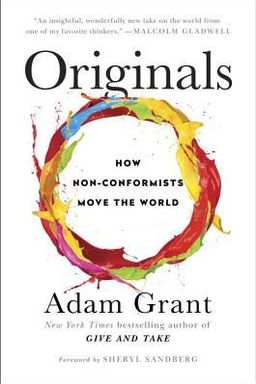
Originals cover

Originals

by Adam Grant

In ''Originals,'' Adam Grant explores the dynamics of original thinking and creativity. Learn unconventional rules to foster originality in all areas of life. Discover methods to enhance creativity and successfully pitch your ideas, turning them into impactful realities.

How Originals Challenge the Defaults

How do you create ideas that truly stand out—and get others to follow you? In Originals, organizational psychologist Adam Grant argues that originality isn’t the product of reckless genius or sudden inspiration. It’s the result of deliberate questioning, disciplined timing, and careful coalition building. The book reveals that originals succeed not by being different for its own sake, but by rejecting defaults, managing risk wisely, and working through social systems that usually discourage dissent.

The book’s core message is that anyone can be more original if they understand the hidden forces that drive conformity—and then systematically counteract them. Originals notice assumptions that others overlook, delay execution to refine their ideas, balance creative risk across domains, and cultivate environments where dissent improves rather than threatens cohesion.

Seeing the world with “vuja de”

Originality starts when you see everyday norms with fresh eyes. Grant calls this stance “vuja de”—the reversal of déjà vu. Rather than treating familiar systems as inevitable, originals ask, “Why are things this way?” Warby Parker’s founders started with such a question: why do glasses cost more than an iPhone? Their answer—market dominance and unnecessary markup—led to a new model that disrupted eyewear. Vuja de breaks system justification, the psychological impulse to rationalize the status quo for emotional comfort. If you convert dissatisfaction into curiosity, you find opportunities that others miss.

Risk like an investor, not a gambler

Contrary to the myth, originals rarely quit their jobs blindly or bet everything on a single idea. They build what Grant calls a risk portfolio: bold moves in one domain offset by stability in another. Steve Wozniak stayed at Hewlett-Packard while working on Apple; Sara Blakely sold fax machines while prototyping Spanx. Keeping a safety net enables experimentation without ruin—originals reduce the risk of risk-taking. You can apply this by launching projects in spare time or maintaining backup plans until traction appears. The goal isn’t fearlessness; it’s sustainable boldness.

Judging ideas: who to trust and when

Generating ideas is one skill; picking winners is another. Grant cites Justin Berg’s forecasting research showing that creators—not managers—are best at predicting which innovations will succeed. Fellow creators understand novelty from the inside without being shackled to precedent. To improve selection accuracy, originals generate multiple variants, separate creation from evaluation, and let peers weigh concepts before managerial filters. Warby Parker used internal peer-voting (“Warbles”) to refine features quickly without costly mistakes.

Timing creativity: the power of strategic delay

Grant reframes procrastination as a creative tool. Jihae Shin’s studies show that people who delay execution while mentally holding a problem produce more original ideas. Martin Luther King Jr. perfected his historic speech hours before delivery—the late improvisation allowed his most inspired lines. Similarly, strategic waiting lets ideas incubate and markets mature. Being first isn’t always best; Netflix and Warby Parker thrived as refined settlers after early pioneers failed. Timing matters—sometimes waiting makes you right.

Speaking up and managing fear

Having ideas isn’t enough—you must voice them effectively. Originals such as Carmen Medina (CIA’s Intellipedia) learned to earn status before proposing radical change. Accumulating “idiosyncrasy credits” through reliable contributions buys credibility. When pitching, Grant suggests the Sarick Effect: lead with flaws to disarm skepticism and invite engagement. Choose disagreeable allies who challenge rather than placate you. Emotionally, originals reframe fear through “reappraisal”—turning anxiety into excitement—just as Lewis Pugh transformed dread into drive before his polar swims.

Mobilizing and sustaining movements

To scale originality, you need followers. Srdja Popovic’s activism proves that humor, small visible acts, and loss framing mobilize change. Tiny signals of dissent and playful protest (Otpor’s Ping-Pong balls, Merck’s “kill the company” exercise) reduce fear and increase urgency. In your organization, visible low-risk steps can prime collective courage before high-stakes reforms.

Lessons from organizations and cultures

Early founder choices—hiring, culture, and blueprint—shape long-term adaptability. James Baron’s studies show that “commitment cultures” built on shared values outperform skill-driven ones early but risk rigidity later (Polaroid’s fall is a cautionary tale). Cohesion isn’t dangerous on its own; groupthink arises from overconfidence and reputational fear. Bridgewater’s “idea meritocracy” offers a pragmatic remedy: transparent evaluations, weighted debate, and accountability systems that prize dissent over harmony.

Cultivating originality from childhood

Originality often begins in families. Frank Sulloway’s birth-order research finds laterborns more willing to rebel. Empathetic parenting—explaining consequences, praising character (“you are helpful”)—fosters moral identity and the courage to defy norms constructively. Exposure to mentors amplifies this effect: Jackie Robinson’s early guides shaped his disciplined defiance. You can raise originals by allowing role differentiation, modeling moral reasoning, and welcoming principled dissent.

The book’s throughline

Throughout Originals, Grant argues for a new model of creativity: question assumptions, balance risk, delay wisely, speak strategically, build coalitions, and design cultures that reward dissent. Originality isn’t innate or chaotic—it’s deliberate, learnable, and collective. These practices let you champion ideas ethically and sustainably, turning small acts of questioning into systemic improvement.


Rejecting Defaults with Vuja De

Original thinking begins by noticing what others overlook. Adam Grant urges you to challenge the defaults—the embedded choices society accepts without question. Systems and norms often feel inevitable because system justification makes people rationalize the status quo to avoid discomfort. The antidote is vuja de: the mental reversal of déjà vu, seeing the familiar as strange and asking why it exists.

Breaking psychological inertia

People stay loyal to defaults even when progress is possible—whether that’s using a built-in browser or obeying outdated workplace hierarchies. Studies show that employees who downloaded a non-default browser performed better and stayed longer, implying initiative bleeds across domains. Practicing vuja de means interrogating trivial frustrations (“why is this policy like that?”) and identifying who benefits from it. Warby Parker’s founders did exactly that, discovering Luxottica’s monopolized pricing and creating an online eyewear alternative with home try-ons.

Practical exercises for vuja de

  • Interrupt routines with curiosity—treat irritation as data, not destiny.
  • Trace default origins—remember that every rule was made by someone; alternatives exist.
  • Prototype micro-changes—small experiments reveal inertia’s weak spots.

Key takeaway

Treat every routine as negotiable. The signature of originality is asking whether a default can be improved, not accepting it as fate.

When you practice vuja de daily—examining, experimenting, reframing—you train your perception to uncover originality beneath ordinary experience.


Managing Risk Like a Portfolio

Originals are often mistaken for reckless risk-takers. Grant dismantles that stereotype: they balance risk across life domains. Clyde Coombs’s risk-portfolio theory suggests people offset daring in one area with stability in another. Successful founders don’t leap—they hedge. Maintaining side jobs, multiple cofounders, or backup plans stabilizes risk exposure and encourages persistence.

Empirical evidence

Raffiee and Feng’s data show entrepreneurs who kept day jobs during launch had 33% lower failure rates. Wozniak, Gates, and Warby Parker’s team exemplified gradual transition. Sara Blakely’s careful rollout of Spanx proved that hedging isn’t cowardly—it enables creative freedom. Originals often balance portfolios consciously: adventurous innovations paired with conservative anchors.

How to apply risk portfolios

  • Launch part-time—build traction before abandoning stability.
  • Use redundancy—team co-leadership or side income buffers failure.
  • De-risk customers—offer low-commitment trials, like Warby Parker’s home kits.

Core insight

The boldest creators protect innovation by managing exposure—not avoiding risk, but distributing it intelligently.

When your risk portfolio supports rather than overwhelms you, experimentation becomes sustainable—and failure becomes formative rather than fatal.


Selecting and Selling Great Ideas

Having many ideas doesn’t guarantee picking the right one. Grant highlights predictable errors: false positives (bad hits) and false negatives (missed gems). To reduce both, originals let peers—fellow creators—evaluate novelty. Justin Berg showed peers predict success better than managers, who are biased toward past patterns. The process should separate invention from judgment and invite diversity before decisions.

Techniques that improve evaluation

  • Generate quantity—Simonton’s research proves prolific output increases odds of hits.
  • Sequence tasks—create first, critique later to prevent managerial bias.
  • Use peer review—engage creators who understand novelty and practicality.

Selling originals

Voice matters. Rufus Griscom’s Sarick Effect—leading with flaws—builds credibility. Disagreeable allies help refine pitches better than agreeable ones. Carmen Medina succeeded once she earned expertise before proposing reform. Authentic dissenters, revealed through polling or feedback networks (Bridgewater’s or Google’s canaries), strengthen group insight. True originality spreads when decisions reward honesty over harmony.

Guiding idea

Better evaluation and communication—not louder risk—create originality that survives judgment.


Timing and Emotional Mastery

Timing and emotion are two invisible factors shaping originality. Grant encourages strategic procrastination for innovation, and emotional reframing for performance. Jihae Shin’s experiments show postponement helps ideas incubate, while Alison Brooks’s studies reveal relabeling fear as excitement boosts persuasion.

Strategic delay

Delaying output while thinking maintains creativity. Martin Luther King Jr.’s last-minute improvisation, blending accumulated fragments, generated timeless rhetoric. Likewise, being a settler—not a pioneer—often yields better outcomes as later entrants refine early failures. The lesson: incubation and timing trump premature execution.

Emotional regulation

Lewis Pugh practiced defensive pessimism to anticipate risks but switched to reappraisal when fear undermined motivation—transforming anxiety into purpose. Grant contrasts surface acting (faking calm) with deep acting (training genuine emotion). Reappraisal works when you hesitate; defensive pessimism works when you commit. Together, these methods let originals operate under stress without surrendering creativity.

Lesson

Originals balance timing and emotion: delay to think better, reframe to act braver.


Building Coalitions and Cultures for Change

No idea succeeds alone. Grant shows that strategic coalition-building and thoughtful culture design turn creative sparks into enduring fires. Movements like suffrage or Otpor! reveal how tempering radicalism with relatable frames (“home protection,” humor, Trojan messages) converts skeptics into allies. Bridgewater demonstrates organizational counterparts: radical transparency and debate systems can institutionalize dissent.

Temper and Trojan strategies

Radicals succeed when they balance provocation with familiarity. Frances Willard reframed suffrage for Temperance allies; Meredith Perry hid uBeam’s vision behind smaller technical goals. Justin Berg’s “familiarity infusion” research (like Disney’s Hamlet-inspired The Lion King) illustrates this principle: pair novelty with recognizable anchors.

Culture design: commitment vs. flexibility

Early hiring choices define company evolution. James Baron’s “commitment blueprint” fosters devotion that keeps startups alive but risks rigidity later—seen in Edwin Land’s Polaroid refusing digital imaging. Cohesion itself isn’t groupthink culprit; overconfidence and reputational fear are. Bridgewater’s open issue logs and believability-weighted feedback show how structured debate prevents stagnation. Dissent needs both accountability and humility.

Authentic dissent vs. assigned roles

Charlan Nemeth’s experiments reveal genuine dissent drives innovation far better than role-played advocates. Bridgewater and Google probe authenticity via polls and feedback networks. Reward real critics, not actors—they ensure cognitive diversity and prevent destructive consensus.

Practical insight

Successful originals build cultures that welcome disagreement and expand belonging—tempered radicals inside systems, not martyrs outside them.


Raising and Leading Originals

Grant closes by turning originality into a developmental model—for yourself, your team, and the next generation. Laterborns, parental explanations, and moral language nurture creative rebellion. Leaders and teachers can use similar techniques to cultivate originality rather than demand conformity.

Birth order and differentiation

Frank Sulloway’s research explains younger siblings’ tendency to innovate—they seek unoccupied niches. You can encourage this by letting team members carve unique domains of expertise rather than competing for identical roles.

Parenting and moral framing

The Oliners found parents of Holocaust rescuers disciplined through moral reasoning (“Think how your act affects others”). Praising character instead of isolated behavior internalizes moral identity. In organizations, leaders can echo this by embedding purpose explanations and treating values as identity, not compliance.

Mentorship and teaching applications

Mentors expand originality beyond family. Jackie Robinson’s role models reoriented rebellion into mission. Teachers using Jigsaw Classroom methods—assigning distinct collaborative roles—mirror this principle by giving each contributor a unique original niche.

Key takeaway

Raise and lead for difference: provide moral context, invite distinct contributions, and build secure spaces for dissent.

Dig Deeper

Get personalized prompts to apply these lessons to your life and deepen your understanding.

Go Deeper

Get the Full Experience

Download Insight Books for AI-powered reflections, quizzes, and more.