
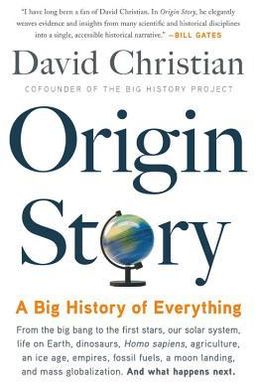
Origin Story cover

Origin Story

by David Christian

Origin Story by David Christian is a captivating exploration of the universe''s history, tracing the evolution from the Big Bang to modern human societies. It reveals how critical events and innovations have shaped life on Earth, offering profound insights into our complex world and our role in its future.

A Scientific Origin Story for Everyone

You live inside stories that help you make sense of your place in the universe. In Origin Story, historian David Christian argues that humanity now has the evidence to tell a single, global origin story grounded in science rather than myth—a narrative that unites cosmology, geology, biology, and human history into what he calls Big History. That unified account offers you a map of reality that’s credible across cultures and disciplines, and it shows how everything—from the Big Bang to modern civilization—fits together as a series of thresholds of increasing complexity.

Why a modern origin story matters

Christian begins by addressing a modern problem: ancient peoples had stories that linked them to their landscapes, but contemporary societies live amid fragmented disciplines and often suffer from anomie—a sense of not knowing where we belong. He offers Big History as a cure, a credible grand narrative anchored in empirical evidence. Drawing on thinkers like William McNeill and H. G. Wells, who sought a universal history, Christian expands the scope to include cosmic origins so that humans can understand not just social evolution but the deepest roots of existence itself.

Thresholds as a framework

The organizing principle of this story is simple but powerful: complexity grows through a series of thresholds when the universe rearranges its existing parts into new systems with emergent properties. Each threshold—from the birth of stars to the rise of Homo sapiens—involves specific Goldilocks conditions that make new forms possible. These transitions aren’t smooth progressions; they’re leaps that mark qualitative changes in what matter and energy can do. You can think of thresholds as stations along a railway map of time: you don’t need every detail to see the system’s overall shape.

The narrative arc of complexity

The book’s narrative unfolds from simplicity to richness. It begins with the Big Bang (Threshold 1), moves through stars and elements (2–3), planets and life (4–5), human language and culture (6), agriculture and civilization (7), industrialization (8), and a possible future sustainable Anthropocene (9). This arc lets you visualize the tempo of history, compressing 13.8 billion years into an understandable pattern. Complexity rises as matter temporarily defies entropy by channeling energy—what Christian calls paying the “complexity tax”—to build structured forms like stars, cells, and societies.

Local stories and global synthesis

Christian respects traditional myths like those of the Lake Mungo people, who retold ancestral and cosmological stories around local evidence. The modern scientific story doesn’t replace but expands such traditions by adding instruments—telescopes, spectroscopes, radiometric dating—that anchor meaning in empirical reality. The goal is not to erase culture but to offer a shared, cross-cultural framework for understanding our common origins.

What you gain from Big History

You gain a sense of scale and connection. Seeing yourself as part of a 13.8-billion-year story fosters perspective on human challenges—ecological, social, and moral. Christian emphasizes that the narrative remains incomplete and evolving; new discoveries continually revise details. Yet the framework—thresholds, complexity, and energy flows—creates a durable backbone for interpreting both cosmic and cultural growth. Big History helps you feel that scientific understanding itself can serve as a kind of global mythos: communal, testable, and oriented toward truth.

In short:

Christian’s modern origin story invites you to see your life as part of an unfolding cosmic experiment in complexity. It’s a call for integration—linking knowledge across scales and reminding you that science, far from cold reductionism, can offer the shared meaning that myths once provided.


From Energy and Entropy to Complexity

At the book’s core lies an explanation for why complexity emerges at all. Christian uses thermodynamics to reveal the tension between energy conservation and entropy: energy is constant, but orderly structures tend toward disorder. Complexity arises when systems can harness flows of free energy—streams of usable energy that temporarily sustain order before decaying into waste heat.

The complexity tax

Every layer of structure—stars, organisms, cities—pays a “complexity tax”: denser flows of energy are required to support increased order. Stars burn billions of tons of hydrogen per second; living cells metabolize sunlight or chemical energy through ATP; human societies channel fossil fuels into global infrastructures. None of this defies entropy—it simply delays disorder through constant energy throughput. You live on borrowed energy.

Goldilocks conditions and emergence

Thresholds form only when conditions are “just right.” The Big Bang’s density fluctuations, Earth’s liquid water, or human brain evolution each required precise balances of temperature, composition, and energy gradients. Chance determines specific outcomes, but necessity—the laws of physics and chemistry—sets the boundary of what’s possible. Complexity thrives where these constraints meet opportunity.

The lesson

You can think of history not as random chaos but as a lawful story of energy arrangements. Each threshold is an act of emergence: when ingredients, energy gradients, and stability align, the universe creates something new that wasn’t implicit before—stars, life, consciousness, civilization.


Cosmic and Chemical Foundations

Christian’s first thresholds stretch from the Big Bang to the formation of Earth—a sequence that provides the physical and chemical groundwork for everything that follows. You start with an unimaginably hot and dense singularity about 13.8 billion years ago. The early universe expands and cools, producing space, time, and fundamental forces. Particles and atoms form, galaxies condense, and gravity shapes the first stars that transform simple matter into chemical diversity.

The universe becomes structured

Tiny density ripples in the cosmic microwave background became seeds for matter collapse. Within millions of years gravity forged stars whose nuclear fusion created the heavy elements necessary for planets and life. Supernovas scattered carbon, oxygen, silicon, and iron—literally forging the ingredients of future biology. Christian calls these stellar furnaces the universe’s workshops, echoing Carl Sagan's claim that 'we are made of star stuff.'

From atoms to planets

Dust and gas formed rotating disks around newborn stars; planets accreted from collisions and mergers. Earth’s early history was violent: Theia’s impact likely formed the Moon, while radioactive decay and compression melted the planet and produced a differentiated core. That metallic core created a magnetic shield; plate tectonics recycled carbon and drove long-term geological cycles. Chemical bonds—especially carbon’s fourfold flexibility—enabled complex molecular structures and organic chemistry. Life’s laboratory was open for business.

Cosmic humility

Christian balances awe with restraint: mysteries remain about what came before the Big Bang or the precise origins of life. But evidence—galactic redshifts, the CMBR glow, and fossilized planetary clues—anchors the modern origin story in repeatable observation rather than metaphysical speculation.


Life as Information and Energy

When life appears, the universe crosses another qualitative threshold—matter begins to process information. Christian treats biology not merely as chemistry but as an information technology. Living cells use genetic codes and membranes to sense, respond, and reproduce. Life distinguishes itself by directing energy flows, maintaining internal order, and transmitting information over generations.

LUCA and bioenergetic origins

The probable last universal common ancestor (LUCA) lived near alkaline deep-sea vents around 4 billion years ago. Proton gradients at those vents acted like natural batteries, powering the earliest metabolic cycles. Biochemist Nick Lane’s work—cited by Christian—shows how these gradients evolved into ATP synthase systems that all known life uses. Every cell today still pays its energy bills through chemiosmosis, an echo of those ancient vents.

Information-driven evolution

DNA’s emergence provided a stable information store, improving on RNA’s dual function as data carrier and catalyst. Enzymes and proteins expanded life’s computational toolkit; mutation and heredity generated diversity. Life continually battles entropy by capturing energy, processing information, and reproducing—an ongoing dialogue between order and decay. You can see genomes as software whose execution runs on biochemical hardware.

Takeaway

Life is special not because it defies physics but because it exploits it—turning free energy into information and structure. Christian’s lens lets you see biology as the universe learning to compute its own continuation.


The Planetary Stage and Human Emergence

Earth’s geological and biological systems matured together to support 'big life.' Christian shows how plate tectonics, photosynthesis, and evolutionary innovations reshaped the planet, producing successive eras of complexity. Oxygenic photosynthesis triggered mass extinctions but enabled multicellular life; tectonics recycled carbon and maintained the planetary thermostat. When mammals and primates appeared, a new form of complexity—cognitive and social—entered the scene.

From microbes to mammals

After billions of years dominated by microbes, multicellular organisms flourished following Snowball Earth episodes. Cambrian diversification exploded under new oxygen levels. Catastrophes, such as the Cretaceous asteroid impact discovered by the Alvarez team, cleared evolutionary space for mammals and ultimately primates.

Human uniqueness

Christian traces the lineage from australopithecines to Homo erectus to Homo sapiens. Humans cross Threshold 6 by developing language and symbolic thought—what he calls collective learning. Unlike genetic evolution, cultural evolution operates at light speed. Your species extended memory beyond the brain through speech, art, and tools, enabling cumulative innovation. This linguistic shift distinguishes human complexity from all previous thresholds.

Human power

Language amplified collective learning into civilization itself—a planetary feedback that now reshapes geology and climate. Humans are not outside nature but a new expression of it: information made self-aware.


From Collective Learning to Civilization

Christian devotes much of the book to showing how cultural information built complex societies. Paleolithic foragers like those at Blombos Cave and Lake Mungo created tools, art, and rituals that transmitted symbolic meaning across generations. Over tens of thousands of years, local cultures fused into global knowledge networks—the earliest noösphere, a sphere of human thought envisioned by Vladimir Vernadsky.

The agricultural revolution

About ten thousand years ago, farming emerged under Goldilocks conditions: ecological knowledge, demographic pressure, and a stable climate. Villages like Abu Hureyra in Syria show this transition from affluent foraging to domestication of wheat and sheep. Farming amplified energy capture, allowing population growth and sedentary living but also increasing vulnerability to disease and hierarchy. Christian notes regional inequalities—Afro-Eurasia’s abundance of domesticable animals gave it an early advantage over the Americas and Australasia.

Surplus and the rise of states

Agrarian surpluses enabled specialization, cities, and bureaucracies. In places like Varna and Uruk, you find early inequality and writing systems to manage grain and labor flows. Elites and priests emerged as governors of surplus, mobilizing populations through law, religion, and coercion—the basic ecology of the state. Writing became society’s new information technology, turning spoken memory into durable data storage.

Civilization’s double edge

Farming and states multiplied energy flows but also inequality and ecological pressure. Every gain in order came with new costs—a pattern that repeats in later thresholds.


Energy Revolutions and the Anthropocene

The fossil-fuel threshold launched humanity into a new planetary era. Coal, oil, and gas unlocked vast stores of ancient sunlight, catalyzing industrial machinery and urban growth. Christian describes this explosion of energy use as a new kind of activation energy: the jump that propelled societies from agrarian constraints into modern dynamism. The consequences are both creative and catastrophic.

Industrial breakthroughs

Britain’s eighteenth-century coal advantage made deep mining profitable. James Watt’s steam engine perfected the conversion of fuel into mechanical work. Later, oil drilling by Edwin Drake and internal combustion expanded mobility globally. Each step multiplied feedback loops—transport expanded markets, which drove further extraction.

The Anthropocene and Great Acceleration

By the twentieth century, human activity itself became a geological force. Fossil fuels powered the Great Acceleration: population soared from under one billion to six billion, energy consumption multiplied tenfold, and cities expanded beyond twenty million inhabitants. The biosphere’s balance shifted—wild mammals dwindled as humans and domesticates took their place, while CO₂ and methane concentrations rose steeply.

Moral contrast

Christian juxtaposes the “Good Anthropocene” (rising life expectancy, global cooperation) and the “Bad Anthropocene” (inequality, environmental collapse). Both emerge from the same threshold of powerful energy control; humanity’s task is to steer evolution toward sustainability rather than unchecked accumulation.


Governing Complexity and Imagining the Future

Modern governance is the social expression of the latest threshold. When energy flows expanded, states evolved from peasant-surplus extractors into managers of wage economies and global networks. Christian argues that your era’s challenge is institutional: how to coordinate billions of interdependent citizens and technologies within biospheric limits.

From national to global governance

Industrialization required monitoring and regulation—currencies, infrastructure, education, and health—all woven into complex bureaucracies. Modern states command fiscal footprints of up to half their GDP. Meanwhile, global institutions like the UN and IMF emerged to manage planetary-scale risks. These embody the first stirrings of world-level governance needed to handle climate and resource challenges.

Toward a mature Anthropocene

The book closes by projecting a possible ninth threshold: a sustainable Anthropocene. Christian references the UN Sustainable Development Goals and the Paris Climate Agreement as early attempts to engineer global cooperation. He imagines the shift from violent energy grabs to gentle management—an “enzyme-like” civilization tuned to equilibrium. Renewable power, education, redistribution, and biodiversity protection become part of this maturity model.

Your role

You stand at the decision point of history: whether collective learning will evolve into planetary wisdom or planetary collapse. Christian’s story ends as all origin stories should—with a choice. The next threshold is yours to cross.

Dig Deeper

Get personalized prompts to apply these lessons to your life and deepen your understanding.

Go Deeper

Get the Full Experience

Download Insight Books for AI-powered reflections, quizzes, and more.