
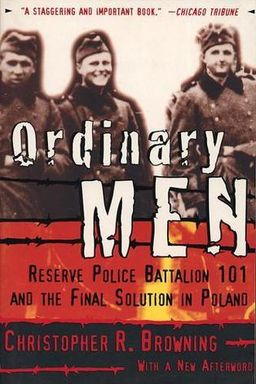
Ordinary Men cover

Ordinary Men

by Christopher R Browning

Ordinary Men presents a riveting and disturbing account of Reserve Police Battalion 101''s transformation from ordinary individuals to participants in the Holocaust. Christopher R. Browning delves into the psychological and societal factors that enabled these men to commit atrocities, offering a crucial lesson on the potential for evil within us all.

Ordinary Men and Extraordinary Crimes

How do ordinary individuals come to commit acts of extraordinary brutality? Christopher Browning’s Ordinary Men: Reserve Police Battalion 101 and the Final Solution in Poland answers this haunting question through meticulous reconstruction of one unit’s experience. He argues that the perpetrators were not driven by ideological fanaticism alone but by a web of authority, conformity, situational pressure, and bureaucratic functionality. To grasp this argument, you must follow the book’s dual structure: a narrative of the battalion’s campaign across occupied Poland and an interpretive study of human behavior within systems of violence.

The men and the mission

Reserve Police Battalion 101 was formed from middle-aged reservists in Hamburg—dockworkers, salesmen, and family men averaging thirty-nine years old. They were not SS professionals but ordinary policemen drafted for rear-area occupation service. When they arrived in the Lublin district in 1942 under Major Wilhelm Trapp, they entered a machinery of mass murder originally designed under SS and Police Leader Odilo Globocnik for Operation Reinhard. Browning begins with the striking ordinariness of these men: few were ideological zealots, many held common moral frameworks, and fewer still anticipated killing women and children. Yet they did—thousands of times.

Structure of power and command

The battalion functioned within the Ordnungspolizei, the Order Police system subordinated to Himmler and Kurt Daluege. It operated through dual chains of command: one civilian-police line and another SS line, creating ambiguity that made orders easy to rationalize. Browning traces how the Orpo’s transformation from domestic policing to paramilitary occupation forces linked ordinary law enforcement to genocide. The police became logistical arms of deportation and execution, supporting SS-led actions under Operation Reinhard. Trapp’s unit thus embodied the integration of state order and racial policy, revealing how bureaucracy converts moral confusion into institutional efficiency.

The turning point: Józefów

The July 13, 1942 massacre at Józefów stands as Browning’s emotional and analytical spine. Trapp’s tearful announcement of orders to shoot Jewish women, children, and the elderly, along with his offer allowing any man to step aside, created an unprecedented moral experiment. Out of nearly five hundred men, only about a dozen refused. The rest killed. The intimacy of execution—walking victims into the woods, using bayonet points for aim—made the horror personal. Afterward, the men drank, wept, and tried to forget. Browning sees Józefów as revealing both an available choice and the overwhelming social forces suppressing it.

Adaptation and routinization

Subsequent operations refined the killing process. At Łomazy, Trawniki-trained auxiliaries performed most of the shooting while policemen guarded and cordoned. This outsourcing reduced psychological strain and habituated policemen to murder behind a screen of bureaucratic distance. Deportations to camps like Treblinka and Sobibór further detached the men from direct violence: escort duty replaced execution, yet complicity deepened as participation became routine. Browning calls this a moral technology—organizational methods that make atrocity sustainable for ordinary performers.

From behavior to interpretation

The book connects history to psychology. Browning juxtaposes situational analysis (Milgram’s obedience studies, Zimbardo’s prison experiment) with personality theories (Adorno’s authoritarian personality). The battalion’s behavior matches these experimental patterns: a minority of cruel enthusiasts, a compliant majority, and a small cadre of refusers. Neither ideology nor innate sadism suffices to explain the killings. Instead, conformity, fear of ostracism, bureaucratic efficiency, and incremental moral disengagement prove decisive.

Moral complexity and the historian’s task

Browning ends by confronting the gray moral zone described by Primo Levi. The killers were not monsters devoid of humanity but men who caved to situational pressures yet still bore responsibility. Postwar trials, such as those in Hamburg, exposed the excuses of duress and obedience to be largely unfounded—no evidence shows that refusal meant execution. Through judicial records and testimonies, Browning reassembles events, insisting that explanation is not exoneration. The book thus becomes more than a wartime case study: it’s a meditation on how institutions mobilize ordinary people for atrocity, how moral boundaries erode through conformity, and how history provides tools of understanding without forgiveness.


Institutional Machinery of Genocide

To comprehend how the Holocaust evolved operationally, you need to study the institutional architecture that transformed policemen into killers. The Order Police system—nominally a state policing apparatus—became militarized under Himmler and fused with SS and Security Police chains of command. This structural hybridity ensured flexibility and deniability: routine orders could be disguised as police work while serving genocidal ends.

Dual command and functional ambiguity

Ordinary men in Reserve Police Battalion 101 reported through two hierarchies: police (BdO via Daluege) and SS (through the Higher SS and Police Leader Odilo Globocnik). That division meant orders could be justified as either policing or security operations. Browning shows how such ambiguity allowed mass executions under bureaucratic cover. Globocnik’s Operation Reinhard—the extermination phase using Bełżec, Sobibór, and Treblinka—relied heavily on the Order Police for manpower: cordons, deportation escorts, and shooting squads.

Historical evolution and precedents

Earlier police killings in Russia in 1941 established crucial precedents. Battalions 309, 322, and 45 participated in mass shootings under the Barbarossa decree; they worked alongside Einsatzgruppen and documented thousands of murders in Białystok, Minsk, and Ukraine. These operations normalized execution as a legitimate police task. By the summer of 1942, such practices were portable—Reserve Police Battalion 101 arrived in Poland ready to apply similar methods even though its men had never faced combat before.

Administrative efficiency and logistical delegation

Operation Reinhard exposed the logistical genius of the Nazi killing system. Camps were small, manpower-light facilities; the heavy lifting of rounding up victims, guarding ghettos, and escorting trains fell to the police and their Trawniki auxiliaries. Lieutenant Fischmann’s transport report from Vienna to Sobibór shows the extent to which policemen saw the entire chain—from deportee loading to camp delivery. They were not ignorant cogs but integrated couriers of death.

Key understanding

The genocide was not spontaneous. It was an organized enterprise in which ordinary police units became the connective tissue—the logisticians and executioners of mass murder.

This institutional analysis helps you see the killing not as personal madness but systemic design. Bureaucracy, rotation, and delegation were crucial technologies that turned administrative obedience into the infrastructure of genocide.


Józefów and the Choice to Kill

The massacre at Józefów gives you the clearest view of moral conflict at ground level. Major Wilhelm Trapp’s tearful briefing and his offer that men could step aside if unwilling to shoot created a rare moment of choice under totalitarian authority. About twelve men did so; hundreds did not. Browning reconstructs the day through interrogations: paired killings between shooters and victims, the physical recoil of first shots, and the waves of nausea and guilt that followed.

Refusal, compliance, and adaptation

Refusers like Lieutenant Heinz Buchmann illustrate moral autonomy—he denounced the killing as wrong and was reassigned without punishment. Others evaded indirectly by performing guard duty or escorting 'work Jews' rather than shooting. The majority complied. The act of refusal was not impossible; it was socially costly. Browning argues that peer pressure, group identity, and fear of ostracism outweighed ethical revulsion. The killers wanted to avoid the shame of seeming cowardly before comrades.

The psychological impact

Józefów left psychological scars: nightmares, drinking, and emotional breakdowns. Captain Wohlauf’s efforts to keep discipline through alcohol consumption show how leadership managed moral strain as a logistical issue. These reactions forced system adaptations: later killings used non-German auxiliaries or deportations to minimize face-to-face murder. The shift from direct execution to administrative killing reflects organizational learning—atrocity industrialized to protect its perpetrators from conscience.

Moral insight

Few moments in Holocaust history expose individual agency as sharply as Józefów. The killings were not compelled by threat of death; they were chosen in silence and solidarity.

For you as a reader, Józefów stands as a frightening index of how quickly ordinary social norms—obedience, camaraderie, professionalism—can eclipse morality when sanctioned by authority.


Delegation, Routinization, and Division of Labor

After the shock of Józefów, Reserve Police Battalion 101 learned to murder with efficiency. The evolution of killing methods through outsourcing and procedural compartmentalization marks a transformation from reluctant destruction to routine genocide. The massacre at Łomazy exemplifies this managerial recalibration.

Trawniki auxiliaries and operational distance

At Łomazy, 1,700 Jews were gathered, undressed, and shot by intoxicated Ukrainian auxiliaries trained at Trawniki. German policemen mainly guarded and supervised, stepping in only when drunken shooters collapsed. This reduction of direct killing created psychological and practical relief. The battle-hardened foreigners became disposable instruments of terror, insulating German perpetrators from emotional damage. (Note: Browning parallels this to the bureaucratic 'desk distance' analyzed by Hannah Arendt in Eichmann.)

Deportation as logistical normalization

When railways were available, deportation replaced shooting. Policemen escorted trains to death camps, maintaining order but rarely witnessing gassing. This change further diluted moral clarity. Paperwork substituted for gunfire, and responsibility scattered among hundreds of small tasks: guarding, loading, inventorying, drinking. Habituation followed. The battalion’s men became steady functionaries in the extermination process without further breakdowns.

Systemic efficiency

Globocnik’s Lublin command demonstrated administrative genius in turning atrocity into workflow. Division of labor limited the psychological exposure of any one group while ensuring uninterrupted throughput of victims. Browning describes this as a bureaucratic defense against compassion—a distributed moral blindness.

Interpretive lesson

When cruelty is divided into tasks, individuals can perform evil acts while believing themselves only partial participants.

Łomazy and the subsequent deportations confirmed the system’s adaptability: moral anguish converted into administrative order, atrocity refined into procedure.


Social Pressure and Masculine Identity

To understand why the majority killed, Browning asks you to look not at ideology but at social psychology. The battalion was a masculine micro-society where reputation mattered intensely. Refusal to shoot risked being labeled weak or disloyal, more unbearable than guilt itself. In such a world, conformity was survival.

Group norms and fear of exclusion

Policemen rationalized refusal in emotional rather than moral terms—claiming they were 'not up to it' instead of condemning killing as wrong. This linguistic shift reveals that shame, not ethics, governed action. Browning’s testimonies show men hiding behind trucks, taking guard posts, or staging sickness to avoid shootings, yet rarely articulating moral protest. Peer pressure intertwined with masculine ideals of toughness and careerism.

Career incentives and evasive language

Captain Hoffmann’s fear of appearing weak and Lieutenant Buchmann’s freedom as an independent businessman exemplify opposite poles of influence. For Hoffmann, ambition reinforced conformity; for Buchmann, civilian identity enabled refusal. These relationships reveal that authority’s grip tightens where personal autonomy is least developed.

Diffusion of responsibility and banality

As shootings gave way to deportations, many policemen believed they were not killers in the strict sense. Escorted trains, checked papers, and maintained order—tasks dissociated from murder. This moral diffusion resembles Arendt’s 'banality of evil': atrocity enacted through bureaucratic normality rather than ideological fervor.

Psychological takeaway

Social belonging and masculine pride proved stronger motivators than overt ideological conviction. The battalion’s fraternity became the crucible of complicity.

Through this lens, Browning reframes evil not as an individual pathology but as a social performance sustained by group cohesion and peer validation.


Ideology, Indoctrination, and Moral Disengagement

You might assume that deep Nazi indoctrination created killers. Browning’s analysis complicates that view. Ideological training within the Order Police emphasized racial rhetoric and loyalty but failed to reach older reservists formed before 1933. Most men of Battalion 101 received sporadic pamphlets like 'Race as the Basis of Our World View,' yet few showed zealotry. Anti-Semitism provided vocabulary, not compulsion.

Content and limits of instruction

Order Police circulars focused more on family policy and ethos than extermination. Browning notes that indoctrination’s insufficiency forced the system to rely on situational framing—orders presented as legitimate policing duties. Older policemen rationalized killing as wartime necessity rather than ideological fulfillment. Lieutenant Drucker’s confession that he felt 'a certain aversion' toward Jews typifies this passive prejudice—adequate for compliance but not ideological enthusiasm.

Ideology as enabling fiction

Ideological language served as moral anesthesia. By defining Jews as enemies, it allowed perpetrators to suspend empathy and align killing with duty. Indoctrination linked to moral disengagement theory (Ervin Staub): people detach from moral self-concepts by reframing harmful actions as authorized or necessary. Thus ideology did not motivate killing directly—it made justification effortless.

Critical point

In Reserve Police Battalion 101, ideology provided legitimacy after the fact; situation and authority produced action first.

Browning’s evidence positions ideology as one strand in a complex web—important for sustaining atrocity but not for initiating it.


Aftermath, Judgment, and Historical Responsibility

After 1945, the lives of Battalion 101’s men resumed with disturbing normalcy. Many returned to Hamburg’s police or civil occupations. Trials in Poland (1947–48) and Germany (1962–72) produced few severe sentences despite thousands of deaths attributed to their actions. Browning uses these proceedings and interrogations as both historical data and moral mirror.

Legal reckoning

Major Wilhelm Trapp was executed by Polish authorities; several officers received limited sentences. Later West German trials confronted duress claims. Records proved no man faced death for refusal to shoot. Courts hesitated to apply murder statutes, citing evidentiary thinness and postwar politics. Thus legal accountability lagged behind moral severity.

Methodological lessons

Browning’s method depends largely on these interrogations—imperfect but revealing sources shaped by guilt, repression, and self-defense. By cross-checking testimonies, he reconstructs reliable patterns of behavior. His approach models how to navigate moral history: weighing contradictions without collapsing nuance.

The gray zone and the historian’s duty

Using Primo Levi’s 'gray zone', Browning insists that understanding is not forgiveness. Policemen like Trapp, who wept while ordering shootings, remain culpable despite emotional conflict. The historian's task is comprehension without moral dilution—to preserve clarity about agency while tracing the structural conditions of evil.

Final reflection

The legacy of Reserve Police Battalion 101 lies not only in its crimes but in its testimony—a portrait of how ordinary men, once mobilized by authority, leave behind extraordinary questions for history and ethics.

Through this final analysis, you see Browning’s broader lesson: evil is not alien but organized, explainable, and preventable only through vigilance against conformity and bureaucratic dehumanization.

Dig Deeper

Get personalized prompts to apply these lessons to your life and deepen your understanding.

Go Deeper

Get the Full Experience

Download Insight Books for AI-powered reflections, quizzes, and more.