
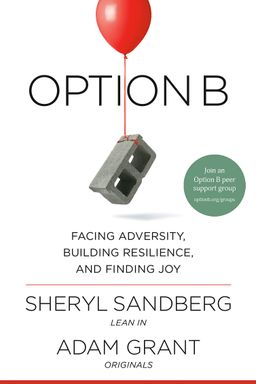
Option B cover

Option B

by Sheryl Sandberg and Adam Grant

In ''Option B'', Sheryl Sandberg shares her journey from profound grief to resilience, offering insights and strategies to overcome adversity. Through personal stories and research-backed advice, discover how to rebuild your life, find joy, and support others through challenging times.

Facing Adversity, Building Resilience, and Finding Joy

How do you take a life that has shattered and rebuild it into something meaningful? That’s the question Sheryl Sandberg faced when her husband, Dave Goldberg, suddenly died, leaving her in what she called “the void”—a place so empty that breathing felt hard. In Option B: Facing Adversity, Building Resilience, and Finding Joy, Sandberg, co-authoring with psychologist Adam Grant, argues that while we don’t choose the tragedies that befall us, we can choose how to respond. Together, they explore how people rise from loss, trauma, and disappointment not just to recover but to grow.

Sandberg’s story begins with personal devastation, but Option B transforms that story into a guide for anyone learning to live through their own “Option B”—the life you didn’t plan for but must now embrace. Grant pairs Sandberg’s experiences with psychological research to show that resilience is not a fixed trait but a skill that can be built. The book blends deeply personal memoir with accessible science—anchored around practical concepts like the “three P’s” of recovery, the Platinum Rule of friendship, the practice of gratitude, and the possibility of post‑traumatic growth.

The Core of Option B

After Dave’s death, a friend told Sandberg, “Option A is not available. We’ll just kick the hell out of Option B.” The phrase captures the book’s spirit. Life will, at some point, deny each of us our perfect plan—whether through death, illness, loss, or heartbreak—and we are left to live Option B. Rather than turning inward or succumbing to “the void,” Sandberg and Grant urge readers to shift from endurance to growth: to move from merely bouncing back to actively bouncing forward. As psychologist Martin Seligman’s research shows, how we explain our hardship—to ourselves—determines how well we recover.

Why Resilience Matters

Resilience, Sandberg and Grant emphasize, emerges both from within us and from the networks around us. It’s strengthened through self‑compassion, meaningful work, and the support of others. Grant’s research into bereavement and trauma dovetails with Sandberg’s lived experience to reveal an encouraging truth: even after terrible loss, most people eventually find equilibrium—and many go on to experience greater empathy, focus, and gratitude than before. This growth is not automatic but dependent on perspective, support, and deliberate practice. The authors show that communities, families, and workplaces can foster resilience just as individuals can cultivate it.

A Roadmap of Recovery

The book unfolds as a sequence of insights—each chapter addressing a dimension of resilience through story and science. The early chapters introduce the Three P’s—personalization (believing adversity is your fault), pervasiveness (believing it will affect every area of life), and permanence (believing it will last forever). Overcoming these mental traps becomes the foundation of breathing again after loss. Later chapters explore how to handle the “elephant in the room” (the silence that follows tragedy), how to comfort others effectively using the Platinum Rule—treat others as they need to be treated—and how self‑compassion and journaling rebuild broken self‑confidence.

From Suffering to Growth

In mid‑book, Sandberg moves beyond survival. Drawing on the work of psychologists Richard Tedeschi and Lawrence Calhoun, she introduces the idea of post‑traumatic growth: the potential to become stronger, more grateful, and more purposeful after tragedy. Real stories—a bereaved father, a cancer survivor, refugees, and even Sandberg’s children—show how people create meaning from pain. The authors remind us that growth doesn’t cancel grief but coexists with it. Grief, they write, “is a demanding companion,” but it can become a teacher when we learn to “lean into the suck” rather than run from it.

Building Collective Strength

Beyond individuals, Sandberg and Grant demonstrate how resilience can be built collectively—within families, classrooms, companies, and even societies. Shared hope, shared narratives, and shared power can turn despair into collective action. From the survivors of a 1972 Andes plane crash to congregants of Charleston’s Mother Emanuel church choosing forgiveness over hate, the book reveals that the human capacity for recovery expands exponentially in community.

A Why and a How

In the end, Option B is not just about how to cope—it’s about why joy matters. Reclaiming joy, Sandberg explains, is a moral responsibility: “To take back joy is to take back what was stolen.” Happiness, she highlights, is not a destination marked by grand events or closure but a series of small, deliberate choices: a gratitude list at night, a shared laugh, or returning to activities once loved. With honesty and hope, Option B invites you to find light even in life’s darkest rooms—to live fully in the wake of loss, to build resilience today so you can face whatever comes tomorrow, and, above all, to keep choosing joy.


The Three P’s of Resilience

When tragedy strikes, our minds instinctively look for causes—and often, we turn against ourselves. Sheryl Sandberg discovered this firsthand after Dave’s death, and with Adam Grant’s guidance, she learned to dismantle the three destructive mental habits identified by psychologist Martin Seligman: personalization, pervasiveness, and permanence. Recognizing and reframing these patterns is crucial to rebuilding strength after loss.

Personalization: It’s Not All Your Fault

Personalization occurs when you internalize blame for events beyond your control. After the medical examiner suggested that Dave’s fall caused his death, Sandberg tortured herself with thoughts like “If only I’d found him sooner.” Only later did she learn that a heart arrhythmia had killed him instantly—nothing she could have done would matter. Grant reminded her that personalizing tragedy delays healing and corrodes self‑worth. As she stopped apologizing for everything—her tears at work, her inability to focus—she began to recover. (In Learned Optimism, Seligman found that people who reject personalization rebound faster from hardship.)

Pervasiveness: Not Everything Is Awful

Grief feels total, smothering; it convinces you that your whole world is ruined. Returning to work at Facebook broke Sandberg’s fog. For a fleeting second in a meeting, she forgot her pain—and that realization cracked open the idea that not every corner of life was dark. Focusing attention on moments and environments untouched by tragedy helps reclaim perspective. Teachers, athletes, and salespeople all perform better when they remember that setbacks happen in one domain, not all (Grant summarizes Seligman’s studies showing how reframing “one bad race” prevents global discouragement). The point is to pinpoint pain without letting it swallow everything else.

Permanence: It Won’t Always Hurt Like This

The hardest of the P’s, permanence whispers that pain will never end. Sandberg imagined her children’s future without Dave—decades of milestones empty of him—and believed she’d always feel this awful. But data and lived experience contradicted her despair: most people move beyond “acute grief” within six months. Simple linguistic reframing helped her; she banned words like “never” and replaced them with “sometimes.” Small breaks in suffering—one easier morning, one unexpected laugh—became proofs that permanence was an illusion. In cognitive behavioral therapy, writing counter‑statements such as “I’ll never feel okay again” alongside evidence—“I laughed at a joke today”—teaches the brain to challenge fatalistic thinking.

Taken together, dismantling the three P’s restores agency. You stop seeing adversity as something done to you and start seeing resilience as something built by you. The three P’s don’t just explain grief—they frame setbacks of all kinds: divorce, career failure, illness. Shifting away from fault, totality, and foreverness cracks open the path to breathe again.


The Elephant in the Room

After loss, conversation itself becomes awkward. Friends don’t know what to say, so they say nothing. Sandberg remembers standing in front of people who asked about the weather but not about her husband. That painful silence—the social avoidance of grief—is what she calls the elephant in the room. In Chapter Two, she and Adam Grant show how speaking honestly about pain can transform alienation into connection.

Breaking Silence

The power of acknowledgment is simple: “Until we acknowledge it, the elephant is always there.” When Sandberg posted publicly on Facebook about her loss—describing how “How are you?” felt like an assault but “How are you today?” felt supportive—the response was immense. People began sharing their own stories of bereavement, miscarriage, and depression. By voicing the unspoken, she gave others permission to talk. Psychologists call this “disclosure benefit”—expressing trauma reduces stress and improves health.

Empathy Over Platitude

Sandberg distinguishes between sympathy and empathy. Platitudes like “Everything happens for a reason” or “He’s in a better place” can sting because they gloss over the sufferer’s reality. Genuine empathy, by contrast, begins with words of acknowledgment: “I see your pain; I’m here with you.” She highlights examples like writer Tim Lawrence’s advice—“The most powerful thing you can do is say, I acknowledge your pain.” The goal is not to fix suffering but to witness it.

Learning to Ask (and Listen)

Grant notes that some people are “openers”—those who ask questions and listen without judgment. After Dave’s death, Sandberg found solace with these openers, such as colleagues who gently asked, “Can I ask how you’re doing with the mornings?” She contrasts this with “non‑question‑asking friends,” people too afraid of discomfort to show concern. Her breakfast conversation with Dave’s friend Jeff, who was suffering from multiple sclerosis, revealed that asking “How are you really?” opens doors to profound connection. Even when pain feels incommunicable, talking about it—naming the elephant—breaks isolation’s hold.


The Platinum Rule of Friendship

When someone is grieving, what’s the right way to help? The old Golden Rule—do unto others as you’d have them do unto you—fails here because a sufferer may need something very different from what you would want. Sandberg and Grant propose what they call the Platinum Rule of Friendship: treat others as they want to be treated. It’s a deceptively simple idea that changes how you offer—and receive—support.

Show Up and Stay There

In Sandberg’s darkest nights, her mother lay beside her until she cried herself to sleep. Her sister took over when her mother left, showing consistency rather than grand gestures. Such presence—the steady, non‑heroic staying—is the friend’s “button” to press, echoing psychological studies where people endured stress better simply knowing they could stop the noise even if they didn’t. When someone is in pain, being there and giving them agency (“I’ll be downstairs if you need me”) can matter more than offering solutions.

Do Something, Don’t Just Offer Anything

“Let me know if there’s anything I can do” puts the burden on the grieving person. Instead, the authors urge specific acts: send dinner, drive kids to school, show up unasked. Author Bruce Feiler calls this the difference between offering anything and doing something. These concrete gestures show empathy in action. One friend texted Sandberg’s colleague Dan Levy, whose son was ill, to ask only, “What do you NOT want on a burger?” Small actions signal reliability without demanding decision‑making from the overwhelmed.

The Ring Theory and the Art of Comfort

Psychologist Susan Silk’s “ring theory” provides a visual model: draw concentric circles with the person most affected in the center. Comfort flows inward; complaints and venting go outward. For Sandberg, this meant friends comforted her and sought their own support elsewhere. The rule keeps empathy focused where it’s needed most—on those at the center of pain.

The Platinum Rule extends beyond grief: it applies whenever someone faces adversity—divorce, illness, burnout. Friendships that follow it deepen over time; they balance giving and receiving. As Sandberg realized, friendship isn’t measured only by what you can offer but by what you’re able to accept. Letting people carry you, she writes, is one of the hardest and bravest acts of love.


Self‑Compassion and Self‑Confidence

After a fall—from failure, shame, or loss—your toughest critic is often yourself. In Chapter Four, Sandberg and Grant explore how self‑compassion, not self‑criticism, fuels recovery. They weave psychology with the story of Catherine Hoke, a social entrepreneur who rebuilt her life after public disgrace, to show that kindness toward yourself can rebuild confidence faster than punishment ever will.

From Shame to Renewal

Catherine Hoke lost her career after inappropriate relationships with former inmates in her Texas rehabilitation program. Ostracized and suicidal, she later founded Defy Ventures, helping ex‑offenders become entrepreneurs. Her turning point came when she sought forgiveness—from others and herself. “I was loved back to life,” she said. Her story illustrates what psychologist Kristin Neff defines as self‑compassion: treating yourself with the same understanding you’d offer a friend. This practice, unlike self‑pity, invites accountability without destruction.

Guilt vs. Shame

Sandberg distinguishes between guilt (“I did something bad”) and shame (“I am bad”). The former promotes growth; the latter blocks it. Studies of prisoners and children alike show that guilt encourages reparative action, whereas shame breeds aggression and withdrawal. This distinction helped Sandberg forgive her own perceived parenting mistakes and professional lapses after Dave’s death. As lawyer Bryan Stevenson says, “Each of us is more than the worst thing we’ve ever done.”

Writing to Heal

Both Sandberg and Hoke discovered the power of journaling. Psychologist James Pennebaker’s decades of research confirm that expressive writing—turning emotion into language—reduces anxiety, strengthens immunity, and increases insight. Sandberg filled over 100,000 words in five months, pouring out guilt, anger, and gratitude. Later, Grant asked her to note three things she did well each day—not accomplishments, but contributions. This shift from counting blessings (passive) to counting contributions (active) rebuilds self‑efficacy.

Reclaiming Confidence

Trauma often erodes confidence across all areas of life—a spillover Sandberg calls “secondary loss.” To reverse it, she recommends small wins: manageable goals like making tea, attending one meeting, or reading to her children. This echoes research from Karl Weick and Teresa Amabile showing that progress, not perfection, predicts satisfaction. Encouragement from compassionate peers—Mark Zuckerberg reminding her she didn’t have to be perfect—helped restore belief in her competence.

Self‑compassion is not indulgence. It’s resilience’s foundation: the ability to recover, learn, and strive again. By forgiving ourselves, we create the strength to forgive circumstance.


Bouncing Forward

“What doesn’t kill me makes me stronger,” Nietzsche wrote—but psychologists Richard Tedeschi and Lawrence Calhoun discovered something deeper: it can also make you wiser, more compassionate, and more grateful. In Option B, this is called post‑traumatic growth. Sandberg and Grant show that growth doesn’t replace grief—it grows alongside it, transforming the pain into meaning.

The Five Forms of Growth

Tedeschi and Calhoun’s research identifies five areas where survivors bounce forward: (1) discovering personal strength, (2) gaining appreciation, (3) forming deeper relationships, (4) finding meaning, and (5) seeing new possibilities. Sandberg illustrates each through stories of resilience—a father who lost his son to illness, survivors of cancer, and even refugees rebuilding communities. Each example proves humans are not just resilient; they’re capable of reconstruction.

Appreciation and Perspective

After talking with Kevin Krim, whose children were murdered by their nanny, Sandberg began marking birthdays and holidays differently: as opportunities to be still alive. Her friend Brooke’s battle with cancer reinforced this. Gratitude coexisted with pain—it did not erase it. (Positive psychology echoes this: gratitude interventions increase happiness by orienting the mind toward what remains rather than what’s gone.)

Meaning, Work, and Legacy

Purpose becomes a lifeline. Jeff Huber, who quit his tech job to lead a company developing cancer detection, found meaning through loss. For Sandberg, her advocacy for bereaved families makes Dave’s influence live on—a concept Joe Kasper calls “co‑destiny.” When helping others emerges from our pain, suffering gains purpose, turning adversity into legacy.

Post‑traumatic growth doesn’t deny suffering—it reframes it. As Sandberg writes, “Dave changed me in profound ways by his presence, and he changed me in profound ways by his absence.” Growth, then, is not moving on from grief but moving forward with it.


Taking Back Joy

For many grieving people, happiness feels like betrayal. Sandberg’s breakthrough came while dancing at a friend’s daughter’s bat mitzvah—she felt fleetingly happy, then crushed by guilt. In reclaiming joy, she and Grant redefine happiness not as feeling good all the time but as noticing, savoring, and creating small moments of delight even amid pain.

Joy as Defiance

“Joy is the ultimate act of defiance,” U2’s Bono told her. Taking back joy, Sandberg writes, is taking back what grief stole. With her brother‑in‑law Rob’s encouragement—“Dave would want you to be happy”—she began intentionally reclaiming shared pleasures: playing Settlers of Catan, cheering for their favorite teams, watching Game of Thrones again. These acts of remembrance turned sorrow into connection.

The Science of Everyday Happiness

Grant presents evidence that happiness comes from frequency, not intensity, of positive experiences. Writing three “moments of joy” each night rewired Sandberg’s attention toward the good. Psychologist Barbara Fredrickson’s research supports this: micro‑moments of positivity boost resilience by broadening perception and building resources. Happiness, says Sandberg, lives on “hundreds of forgettable Wednesdays.”

Flow and Gratitude

Rediscovering flow—being absorbed in meaningful activity—became another source of joy. For Syrian refugee Wafaa, cooking provided solace; for Sandberg, journaling did. Gratitude grounded both. As Larry Brilliant told her, the job of life is “to turn fifteen minutes of joy into fifteen years.” Joy, practiced deliberately, is a discipline—a habit of noticing light even in darkness.


Raising Resilient Kids

After Dave’s death, Sandberg’s deepest fear was that her children’s happiness had died with him. Chapter Seven explores how resilience can be taught—especially to kids. Drawing from child psychology and social science, Sandberg and Grant identify four key beliefs resilient children share: control, growth, mattering, and strengths.

1. Control: I Can Change Things

Children who believe their actions make a difference handle hardship better. Programs like Kathy Andersen’s “Change Your Shoes” show abused girls how to take small steps—finish school, set goals—to reclaim agency. Sandberg applied this at home, giving her kids stability and routines that affirmed control after chaos.

2. Growth: I Can Learn from Failure

Parents and teachers cultivate resilience when they praise effort, not talent. Psychologist Carol Dweck’s work on the growth mindset proves that treating challenges as opportunities rather than verdicts predicts long‑term success. Losing a soccer game or struggling with homework becomes training in emotional recovery.

3. Mattering: I Am Loved and Needed

Knowing that others care provides a buffer against despair. For LGBTQ youth, projects like The Trevor Project hotline affirm this by simply answering the phone. Sandberg kept mattering visible through daily family rituals and open conversations about Dave—ensuring her children felt seen and valued.

4. Strengths: I Have Gifts to Share

Programs like India’s Girls First teach adolescents to name and use their strengths—from courage to kindness—making them less defined by hardship. For Sandberg’s family, creating “family rules”—respect feelings, ask for help, forgive quickly—became a living map of strengths. Above them all, her son later reminded her, “Everyone knows what happened to us. You should just be yourself.” Even at ten, he was practicing resilience.

Children, Sandberg concludes, don’t need perfect parents—they need honest models of vulnerability and recovery. Watching a parent cry and continue living teaches the most durable lesson: pain is survivable.


Finding Strength Together

Resilience multiplies in community. This chapter expands the lens from individuals to groups—showing how shared hope, shared experience, and shared power transform tragedy into collective strength. From the Andes survivors to church congregations and student networks, Sandberg and Grant reveal the anatomy of collective recovery.

Shared Hope

When a Uruguayan rugby team’s plane crashed in 1972, the survivors endured seventy‑two days in the Andes by nurturing hope together—dreaming of futures, writing letters, and praying as one. “If there’s hope, there’s life,” one said. These stories show how grounded hope, not blind optimism, sustains endurance: faith paired with practical action.

Shared Experience and Community

At grief centers like Kara or Experience Camps, families find relief in meeting others who “actually understand.” Connection dismantles isolation. Former prisoners at Berkeley’s Underground Scholars Initiative and underprivileged students in the Posse Foundation demonstrate how peer support transforms identity—from outsider to member, from victim to agent.

Shared Narratives and Justice

Stories unite communities against stigma. In Charleston, South Carolina, churchgoers who lost loved ones to racial violence chose forgiveness over hate, sparking social activism and reform. In China, unmarried women formed Lean In chapters to challenge the “leftover women” stereotype. Communities rewrite limiting narratives—just as individuals rewrite their own after trauma.

Collective resilience, Sandberg notes, depends on empathy that scales. “We find our humanity in our connections to one another.” When society treats adversity not as an individual flaw but a shared challenge, healing becomes a public project, not a private burden.


Failing and Learning at Work

Failure, Sandberg insists, is not the opposite of success—it’s the crucible of growth. Drawing lessons from SpaceX’s fiery rockets, Marine Corps training, and Facebook’s internal culture, she and Grant explore how resilient organizations mirror resilient people: by learning out loud, normalizing mistakes, and turning regret into forward motion.

From Explosion to Innovation

After witnessing SpaceX’s first successful rocket landing following four failures, Sandberg saw collective perseverance embodied. Analyses of 4,000 launches show that organizations learn more after big failures than small ones. At Facebook, engineers institutionalize this insight—transforming accidents into “Ben Testing,” after an intern crashed the site while troubleshooting. Celebrating smart risk‑taking turns fear of failure into curiosity.

Learning Cultures: Debriefs and Transparency

The U.S. Marines conduct formal debriefs even after total defeat. Hospitals hold “morbidity and mortality” conferences to diagnose errors without blame. Transparency makes learning safer. Similarly, a Princeton professor published a “CV of failures” to normalize rejection. These rituals create what organizational scholar Amy Edmondson calls “psychological safety”—the belief that honesty won’t be punished.

Feedback and Courage

Grant’s teaching at Wharton improved after he invited brutal student feedback mid‑semester and shared it publicly. Sandberg adopted the same at Facebook, encouraging “hard conversations” backed by trust. Feedback, she writes, should communicate belief in potential: “I’m giving you this because I know you can reach it.” This framing transforms critique into encouragement.

Resilient workplaces, like resilient hearts, thrive on truth. They convert errors into energy and vulnerability into collaboration. Compassion and candor, Grant adds, aren’t opposites—they’re partners in progress.


To Love and Laugh Again

The book closes with a tender question: Can you love again without betraying what you lost? In tracing her journey from widowhood to the possibility of new love, Sandberg confronts the cultural “third rail” of grief—and expands resilience to include laughter, humor, and renewed connection.

Love After Loss

Encouraged by her family, Sandberg gingerly began dating. She exposes the double standards widows face—while most men remarry, women are judged for moving on. Yet love after loss isn’t betrayal but continuation: as writer Robert Anderson said, “Death ends a life, but it does not end a relationship.” You can miss your spouse and still open your heart again.

Healing Through Humor

Humor became Sandberg’s oxygen. Awkward jokes during grief moments—about Dave’s terrible movie taste or his absence at school events—released tension and restored connection. Studies confirm laughter reduces stress, strengthens immunity, and fosters intimacy. As she realized, humor doesn’t erase pain; it lets you breathe inside it.

Resilient Love

Drawing on John Gottman’s marital research, Sandberg notes that lasting love depends on small moments—“turning toward” one another’s emotional bids rather than away. Conflict doesn’t doom relationships; indifference does. Resilient love welcomes vulnerability, humor, and disagreement. From widows remarrying to single women adopting children, the chapter ends where the book began: with courage to choose love, in any form.

Sandberg’s final insight is universal: resilience doesn’t just help you survive loss—it helps you love more deeply because you know how fragile love is. Option A may be gone, but life’s beauty—messy, incomplete, joyful—remains.

Dig Deeper

Get personalized prompts to apply these lessons to your life and deepen your understanding.

Go Deeper

Get the Full Experience

Download Insight Books for AI-powered reflections, quizzes, and more.